
Loading the article…
Muse Spark Open: 7 Powerful Features Explained (2026)
Muse Spark Open explained: Meta’s 816B AI model, 1M context, benchmarks, GPU requirements, APIs, and licensing. Discover 7 powerful features.
Muse Spark Open explained: Meta’s 816B AI model, 1M context, benchmarks, GPU requirements, APIs, and licensing. Discover 7 powerful features.
Loading the article…
Bring the problem you want solved. We’ll shape it into a project brief you can keep — or let AI draft a first approach.
Muse Spark Open is Meta's new open-weight AI model, released on October 15, 2026. With 816 billion total parameters, approximately 42 billion active parameters per token, and a context window of up to one million tokens, it targets a demanding category of work: software development, AI agents, and complex multimodal tasks.
The announcement sounds exciting, but the important question is practical: what can developers and businesses actually build with it, and what does running it cost in hardware and effort? This guide separates the headline specifications from real deployment considerations.
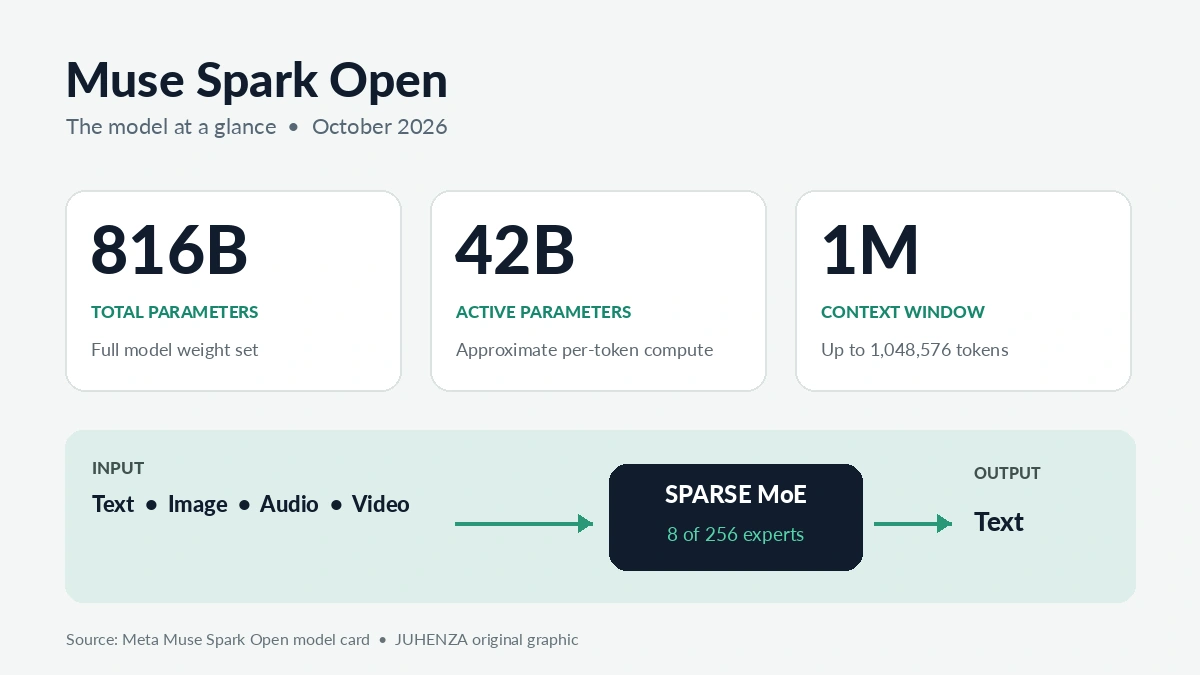
Image: JUHENZA Technologies' overview of Meta's October 2026 release.
| Specification | Detail |
|---|---|
| Developer | Meta Superintelligence Labs |
| Release date | October 15, 2026 |
| Architecture | Sparse mixture-of-experts (MoE) transformer |
| Total parameters | 816 billion |
| Active parameters | Approximately 42 billion per token |
| Context length | Up to 1,048,576 tokens |
| Supported input | Text, images, audio, and video |
| Output | Text |
| Model formats | BF16 and NVFP4 |
| Licensing | Muse Model License, with conditions |
Sources: Meta's release announcement and the official model card.
The defining design choice behind Muse Spark Open is its mixture-of-experts architecture. Instead of activating every parameter for every token, the model routes work through selected experts. Meta reports 256 routed experts, with eight selected per token.
That design helps explain the difference between 816B total parameters and 42B active parameters. Active parameters influence the compute required for a token, but they do not mean the complete model occupies only 42B parameters' worth of memory.
This distinction matters when planning infrastructure. According to Meta's deployment documentation, BF16 weights are approximately 1.65 TB, while the NVFP4 checkpoint is approximately 537 GB before runtime overhead. The model is not something most developers can load onto an ordinary consumer laptop.
Image: A simplified view of the model's parameter counts, context window, and text output.
A headline feature of Muse Spark Open is support for up to 1,048,576 input-context tokens. For software teams, this opens the door to reviewing extensive documentation, large code collections, issue histories, and lengthy technical conversations within a single model context.
However, a large context window is not the same as perfect recall or unlimited practical performance. Serving a very long prompt increases memory use and processing time, while answer quality still needs to be evaluated. Retrieval-augmented generation (RAG), targeted search, and concise context selection can remain more economical than sending everything at once.
For businesses managing knowledge bases, the right architecture may combine a long-context model with search, source references, and access controls. These are the types of problems addressed by JUHENZA's AI and intelligent automation services.
Muse Spark Open is designed for tasks where a model must do more than answer one question. Agentic workflows involve planning, calling tools, checking results, recovering from errors, and continuing toward a defined goal.
Meta demonstrated local agentic workflows using Muse Code, including development work on the open-source Ice Cubes iOS app. It also described a DaVinci Resolve workflow in which the model inspected footage and helped identify suitable moments for vertical edits.
Potential developer applications include maintaining a codebase, investigating failed builds, preparing test cases, reviewing pull requests, and organizing multi-stage document processes. None of these should be treated as guaranteed unattended automation. Real deployments need permissions, test suites, logging, and approval gates for consequential changes.
Unlike a text-only language model, Muse Spark Open accepts images, audio, video, and text as inputs. This is relevant when work depends on screenshots, charts, recorded meetings, scanned documents, or video frames.
Imagine a support agent that reads a screenshot of an error alongside logs, or a document assistant that compares diagrams with written procedures. A video workflow could inspect frames and produce a text-based analysis of what changed.
One limitation is easy to miss: the released model produces text output, not native generated images, audio, or video. Its multimodal strength is understanding incoming material. Teams needing media generation would require separate tools or models.
The most unusual part of the announcement may be the local deployment story. Meta and Apple describe running Muse Spark Open with MLX across two Mac Studio systems equipped with M5 Ultra chips, using up to 512 GB of unified memory per machine.
The model's weights are divided across the machines, which communicate over a high-speed connection. Apple also tested four-machine configurations. In its published measurements, a four-Mac tensor-parallel setup reached about 36.7 output tokens per second on an 8,192-token-context test; those results should not be generalized to every prompt or hardware arrangement.
Running locally may provide greater infrastructure control, particularly when teams do not want prompts routed to an external inference provider. But this is a high-end deployment, not a free replacement for cloud inference. Hardware expense, maintenance, concurrency, throughput, and energy requirements still matter.
Read Apple's MLX distributed inference research for the tested configurations and methodology.
Not every team needs to own a large compute cluster. Muse Spark Open is also offered through hosted inference partners, including Together AI, Fireworks AI, Baseten, Modal, Groq, Nebius, and OpenRouter.
For self-hosting, Meta lists compatible runtimes and ecosystems such as SGLang, vLLM, TensorRT-LLM, Hugging Face Transformers, llama.cpp, and MLX. Support for a runtime does not mean all hardware platforms offer the same performance or feature coverage.
A sensible evaluation process is to start with a hosted API, measure quality and latency on representative tasks, estimate token and infrastructure costs, and then decide whether self-hosting makes operational sense. Teams building production pipelines should also plan observability, fallback behavior, and data retention before rollout.
These considerations connect closely to JUHENZA's cloud and infrastructure solutions and machine-learning development services.
Muse Spark Open is open-weight, which is not automatically the same thing as an unrestricted, permissively licensed open-source project. Meta distributes it under the Muse Model License and an accompanying usage policy.
The license permits many kinds of development and commercial use, but it includes attribution requirements. It also states that certain model-as-a-service providers whose aggregate gross revenue exceeds US$20 million over a consecutive 12-month period must notify Meta and enter into a separate agreement before offering the model in that business. That provision has specified exceptions and should be reviewed against the actual product being built.
Meta reports additional safety training and evaluations for the release. Still, production applications need their own safeguards: scoped tool permissions, audit logs, human review for irreversible actions, privacy controls, and adversarial testing. An AI system is only as reliable as the complete workflow around the model.
Consult the official license and model card before deciding on deployment or redistribution.
Meta's published scorecard reports 61.8 on JobBench, 80.4 on OSWorld Verified, and 76.4 on Terminal-Bench 2.1 for its stated evaluation setups. These are useful signals for agentic and tool-oriented tasks, but the tests use particular prompting settings, agent scaffolds, and environments.
The scores do not establish that one model is universally best. For any business use case, repeatable tests on your own documents, coding tasks, or support workflows are more valuable than relying on a single leaderboard. Review the evaluation details in Meta's model card before comparing results.
This release is most relevant to teams evaluating complex development agents, multimodal analysis, large document workflows, or self-hosted AI infrastructure. A startup prototyping its first support chatbot may find a smaller model cheaper and easier to operate. A software engineering group managing long-running tool workflows may have stronger reasons to test a larger model.
At JUHENZA Technologies, our approach is to begin with the task, data boundaries, evaluation criteria, and operating budget—not with the biggest model available. The same approach applies across software, manufacturing, retail, healthcare, pharmaceuticals, and other industries.
For a practical starting point, explore AI and workflow automation or use our AI project brief generator to outline your requirements.
Meta provides downloadable weights, and its license allows many uses without a license fee. However, hosting hardware, cloud inference, engineering work, and applicable license conditions are separate considerations. Commercial users should review the full terms.
Not at its full released size on a typical laptop. Even the compressed NVFP4 checkpoint is hundreds of gigabytes. Meta's local desktop demonstration uses multiple high-memory Mac Studios; data-center GPU deployments are another route.
Yes. It can take images, audio, video, and text as input, but the release described in Meta's model card generates text as its output.
No universal conclusion follows from the launch announcement. Meta presents strong results on selected tests, while other models lead on some evaluations. Compare cost, task accuracy, latency, hardware needs, and licensing for your particular project.
Muse Spark Open is a significant October 2026 development for developers who want advanced agentic capabilities with access to model weights. Its enormous parameter count, sparse active compute, long context window, and multimodal inputs broaden what teams can experiment with. Its hardware footprint and licensing requirements also make careful planning essential.
The real opportunity is not simply running a larger AI model. It is building systems that turn its capabilities into useful, secure, measurable outcomes. If you are exploring that path, connect with JUHENZA Technologies to discuss the software, automation, and infrastructure your project actually needs.