
Share explicit contracts
Document the boundary between the interface and the server so records, validation and errors can be understood by both sides.
Check external payloads at runtime; shared types are not input validation.
Node.js and TypeScript backend work for APIs, integrations and background processes, with validation, permissions and operating behavior defined before implementation.
Plan your Node.js projectDocument the boundary between the interface and the server so records, validation and errors can be understood by both sides.
Separate work that needs an immediate response from jobs that can complete asynchronously. Choose background processing where the workflow needs it.
A useful service can identify the request, dependency and record involved in a failure. Logging and operational ownership belong in the scope.
Validate an authorized request, apply business rules and return an outcome the interface can handle.
Test denied access, missing fields and repeated submissions.
Track the work separately from the initial request, with explicit states and failure recovery.
Check duplicate jobs, worker interruption and retry limits.
Translate records between supported interfaces and retain references for reconciliation.
Inspect partial writes, rate limits and conflicting updates.
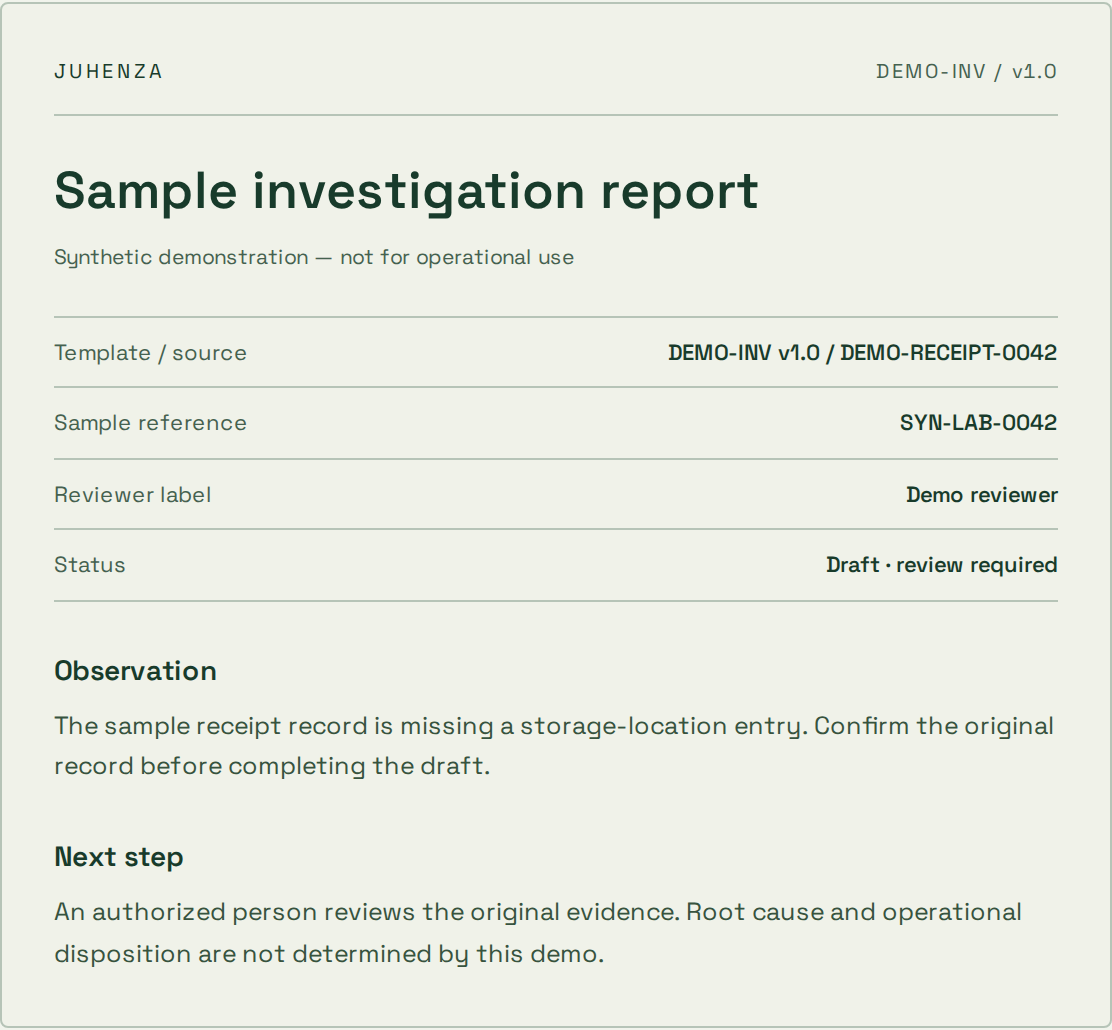
Edit an observation. Inspect the generated draft. Confirm your sample review before exporting a PDF.
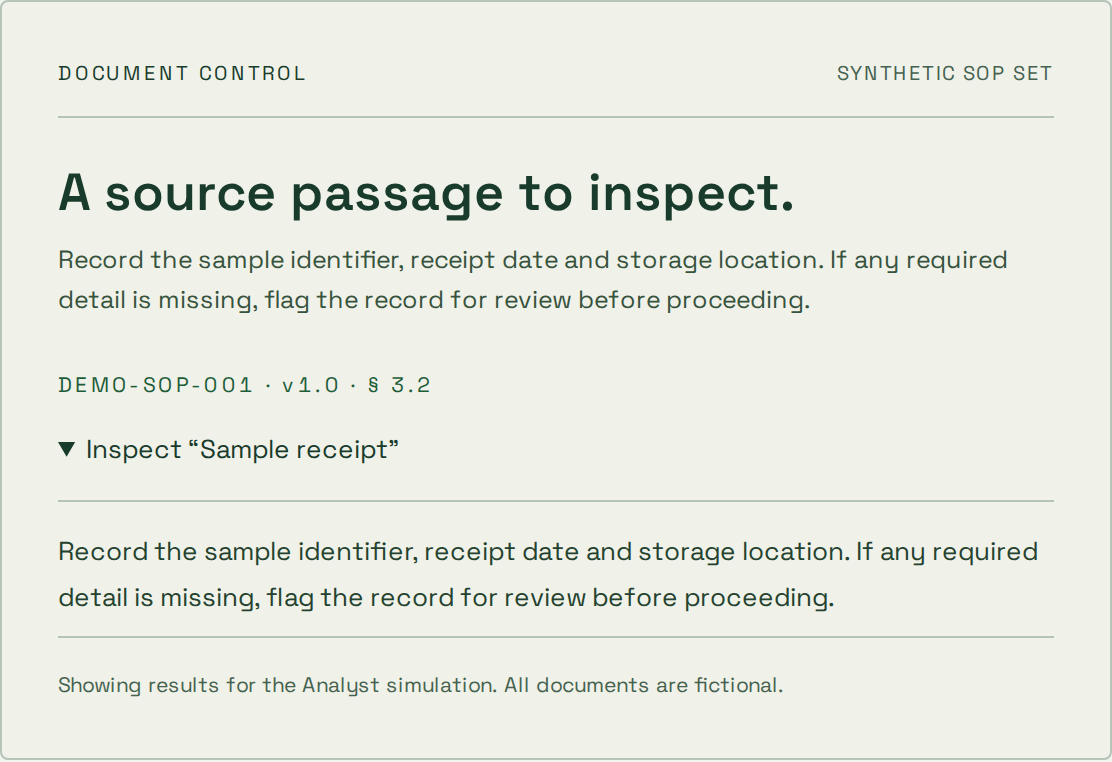
Explore a synthetic SOP library and inspect the source passage. Try a restricted role or an unsupported question.
The problem is clear, but the approach is not.
A bounded experiment, findings and a recommendation on what to validate next.
A prototype is not a production-ready service.
You know the workflow and can agree acceptance checks.
Agreed deliverables, verification evidence and operating instructions for the scoped release.
Changes to scope need an explicit decision on cost and timing.
A live system needs focused changes or ongoing care.
A prioritized backlog, reviewed changes and an agreed maintenance or support boundary.
Coverage, response targets and access are agreed per engagement.
Implement business rules and API contracts around explicit validation, permissions and failure behavior.
Scope jobs, retry boundaries and duplicate handling where work continues beyond a single request. Keep failures traceable to their inputs.
Plan configuration, secrets, logs and graceful recovery. Define how releases and dependency updates are tested and deployed.
Practical answers before the build. Bring the details of your project to the conversation.
Yes, where an agreed API contract connects the interface to the service. The frontend framework does not determine the entire backend architecture.
Agree task states, useful failure signals and an accountable owner. Choose tooling around the operating environment and the consequences of delayed work.
No. Review the workload, dependencies and team skills. CPU-intensive or specialized processing may need separate services or a different runtime.
Bring the problem you want solved. We’ll shape it into a project brief you can keep — or let AI draft a first approach.