

Choosing a Mobile App Development Partner in Netherlands: iDEAL/Wero, AP GDPR Telemetry, and EUR Milestone Vetting
Choose a mobile app development partner in Netherlands with checks for iDEAL/Wero flows, AP GDPR telemetry, and EUR milestone vetting. Scorecard inside.
App DevTech

A Dutch mobile checkout fails in a fundamentally different way than a checkout anywhere else in Europe.
Direct answer: Choose a mobile app development partner in Netherlands by scoring three Dutch-specific engineering proofs: a working iDEAL to Wero migration flow through your payment service provider (PSP), a telemetry architecture meeting General Data Protection Regulation (GDPR) data minimisation and consent as enforced by the Autoriteit Persoonsgegevens (AP), and EUR milestone terms bound to automated acceptance tests. Demand concrete sandbox evidence, not generic agency promises.
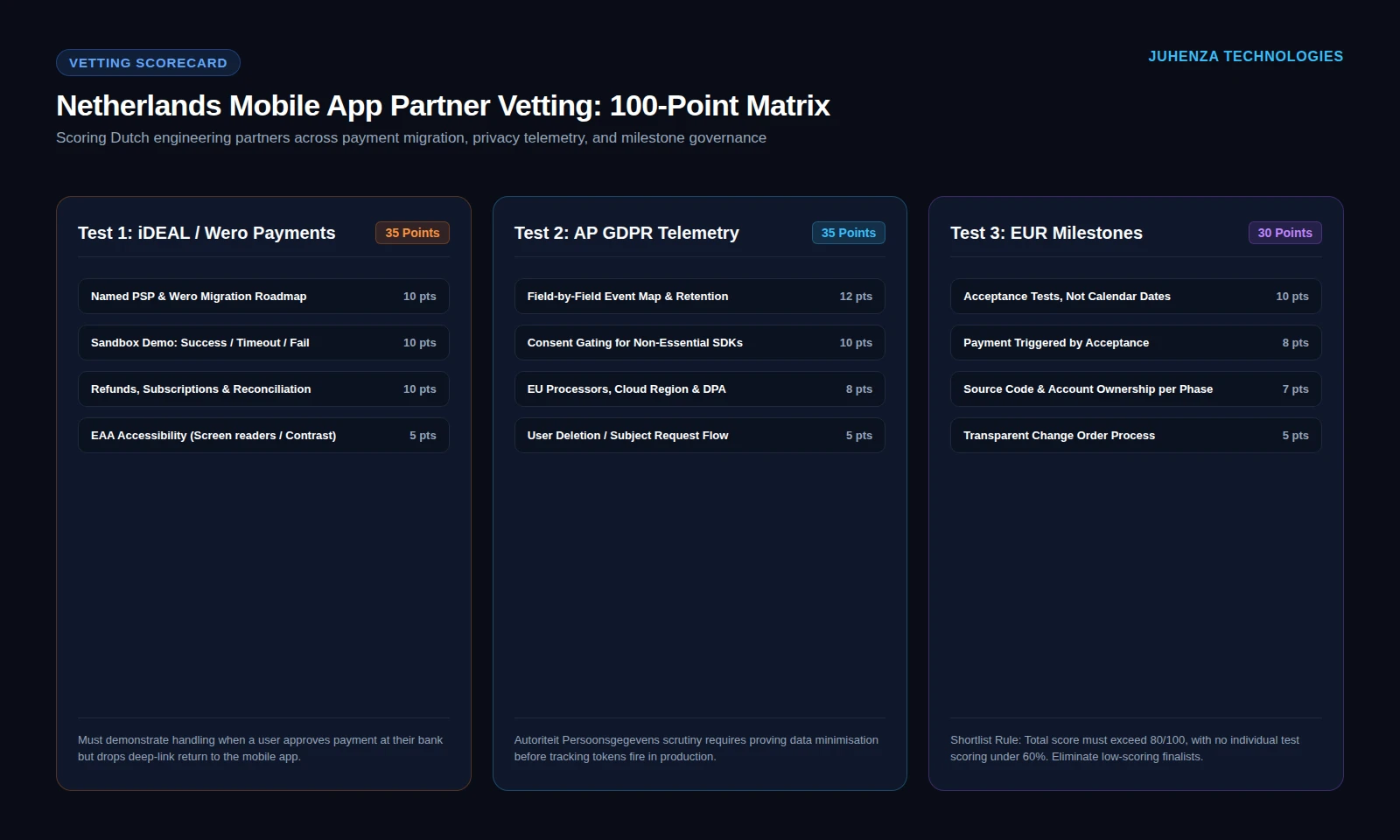 Figure 1: Score each partner on Wero payments, AP GDPR telemetry, and EUR milestone contracts.
A qualified mobile app development partner in Netherlands must deliver far more than polished UI screens. Dutch consumers expect instant payment via their trusted bank environment, mobile analytics must respect European privacy boundaries without silent background tracking, and your executive team requires enforceable euro milestone contracts. If an agency cannot verify all three capabilities with live sandbox artifacts, the rest of their pitch deck is merely decoration.
This guide delivers the three decisive engineering tests, the exact interview questions to ask, and a 100-point evaluation scorecard to separate reliable engineering firms from marketing intermediaries. It is tailored for CTOs, product owners, and venture leads who have shortlisted candidate agencies and require a rigorous framework to make a confident hiring decision through our mobile app development practice.
The 3 Dutch tests that decide this choice
Apply the exact same three tests across every shortlisted development team. A slick design portfolio must never overshadow a fragile integration architecture.
Score each test out of 100 points, then calculate the weighted evaluation:
- Test 1: Payments & Wero Migration: 35 Points
- Test 2: AP GDPR Telemetry Governance: 35 Points
- Test 3: EUR Milestone Contract Structure: 30 Points
The Elimination Rule: Any candidate scoring below 60 points on any individual test is disqualified immediately, regardless of their total aggregate score or attractive hourly rates. For a complementary evaluation methodology applied to cross-border development teams, examine our AI-assisted partner checks guide.
Test 1: iDEAL/Wero flows
What changed, and why it is a core build task
iDEAL has long been the dominant domestic payment rail across the Netherlands, allowing consumers to authenticate transactions directly within their banking environment. Wero, the European digital wallet developed by the European Payments Initiative (EPI), is actively replacing iDEAL.
EPI commenced the commercial Wero e-commerce rollout across the Netherlands on 26 October 2026 across 11 major Dutch banks, with the formal objective of completing full transition before the end of 2027. Your mobile engineering partner must architect for an active migration in flight, rather than relying on legacy static checkout SDKs.
Inquire directly about their migration roadmap:
- Who manages the payment service provider (PSP) API switch (e.g., Mollie, Adyen, Stripe)?
- How will the mobile client handle recurring subscriptions, in-app refunds, and chargebacks?
- How does the application maintain state when a user’s bank has activated Wero while another bank remains on legacy iDEAL rails?
What an acceptable answer looks like
A capable engineering partner will name your specific PSP, walk through a live sandbox implementation, and demonstrate explicit mobile state handling for success, failure, user cancellation, and bank session timeouts. Crucially, they must explain how in-app purchases reconcile when a transaction settles at the bank but the mobile deep link fails to return to the application.
A logo update is not a payment migration. The partner must treat the transition as a comprehensive state machine and automated reconciliation challenge.
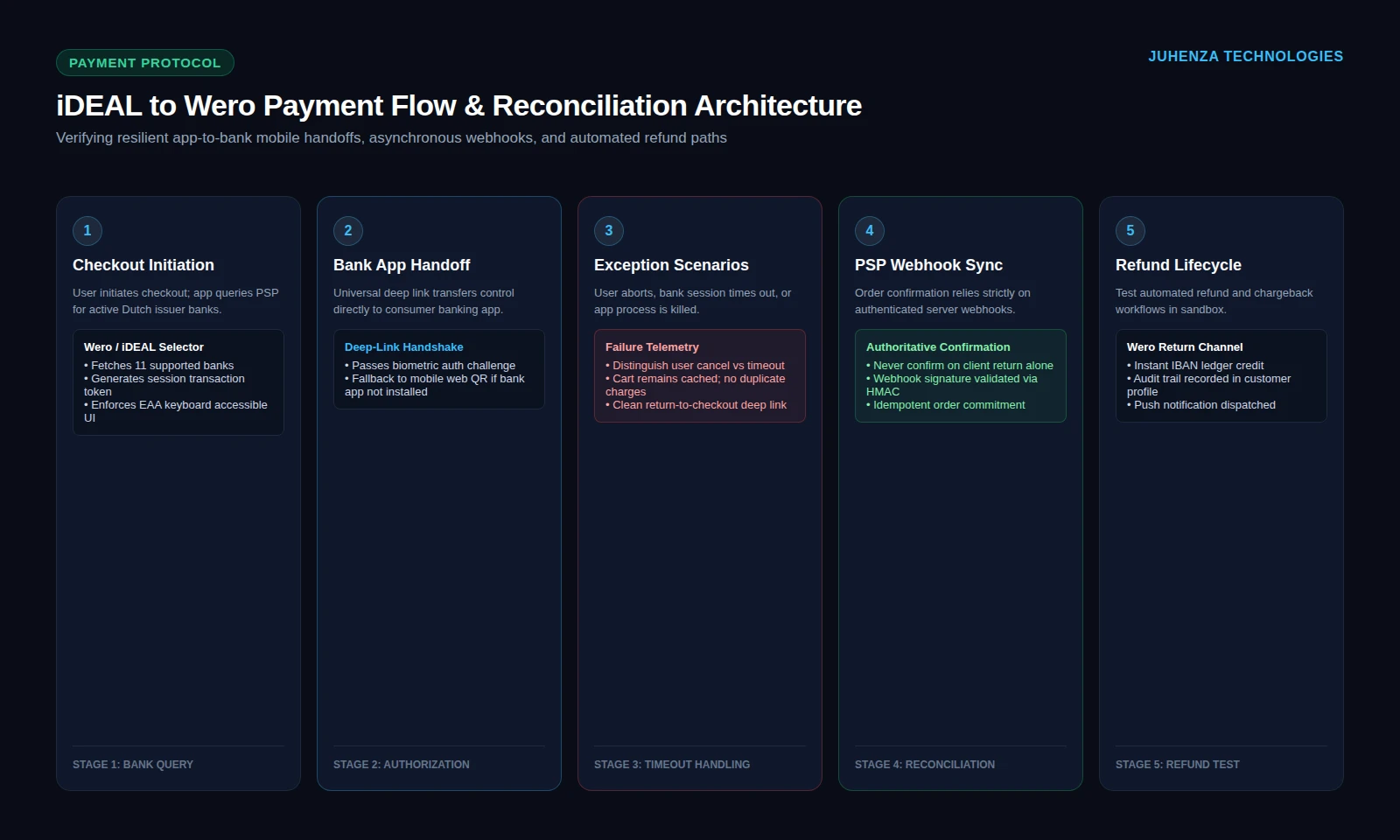 Figure 2: Verifying resilient app-to-bank mobile handoffs, asynchronous webhooks, and automated refund paths.
The live Wero test to run before signing
Require each shortlisted candidate to demonstrate this end-to-end scenario live within a staging sandbox:
- The user initiates checkout inside the mobile application.
- The user selects Wero/iDEAL and chooses their primary bank.
- The app executes a universal deep link to the banking application, where biometric authentication confirms the transfer.
- The mobile application confirms the order only upon receiving an authenticated server-to-server webhook confirmation from the PSP—never relying on client-side URL redirects alone.
- An automated refund is triggered from the backend and verified on the bank ledger.
If an agency cannot demonstrate steps 4 and 5 in a sandbox environment, they lack experience with mission-critical financial integrations. As highlighted in our payment webhook mismatch fix, client-side assumptions during payment handoffs are the primary source of silent revenue loss.
Accessibility in Dutch checkouts (EAA compliance)
Payment flows must also satisfy mandatory accessibility mandates. The European Accessibility Act (EAA) took effect across the Netherlands on 28 June 2025, with enforcement overseen by the Netherlands Authority for Consumers and Markets (ACM). Verify that checkout components support screen readers (VoiceOver, TalkBack), maintain required contrast ratios, and permit complete keyboard-only navigation.
Test 1 Scoring Rubric (35 Points)
| Evaluation Proof | Max Points |
|---|---|
| Documented PSP roadmap with explicit Wero transition milestones | 10 pts |
| Sandbox demonstration of success, cancellation, and timeout states | 10 pts |
| Server-side webhook reconciliation and automated refund architecture | 10 pts |
| EAA-compliant checkout accessibility validation | 5 pts |
Test 2: AP GDPR telemetry
Clarifying the regulatory premise
There is no separate, standalone "AP Telemetry Act". The Autoriteit Persoonsgegevens (AP) is the national supervisory authority in the Netherlands enforcing the General Data Protection Regulation (GDPR). In-app telemetry, crash reporting, and user behavioral tracking are assessed under fundamental GDPR articles, supplemented by ePrivacy consent requirements for non-essential device storage.
A partner claiming "our templates are AP compliant" without detailing explicit legal bases under GDPR Article 6, documented purpose limitation, and defined data retention windows is offering compliance theater. (Disclaimer: This guide provides architectural standards, not legal counsel. Consult qualified privacy counsel for regulatory determinations. Current as of 23 November 2026.)
Mobile telemetry under Dutch regulatory scrutiny
Telemetry encompasses all diagnostic and behavioral data emitted by an application: screen navigations, interaction taps, crash dumps, latency metrics, and unique pseudonymous identifiers. While basic crash diagnostics are strictly necessary to deliver a functional service, behavioral tracking and advertising telemetry are not.
GDPR Article 5(1)(c) enforces the principle of data minimisation: personal data must be adequate, relevant, and strictly limited to what is necessary in relation to the stated processing purpose. You cannot harvest device fingerprints, precise geolocation, or full IP addresses simply because cloud storage is inexpensive.
Require candidate partners to present an explicit Telemetry Event Map detailing each tracked event, its payload fields, commercial purpose, legal basis, retention window, and consent-gating status.
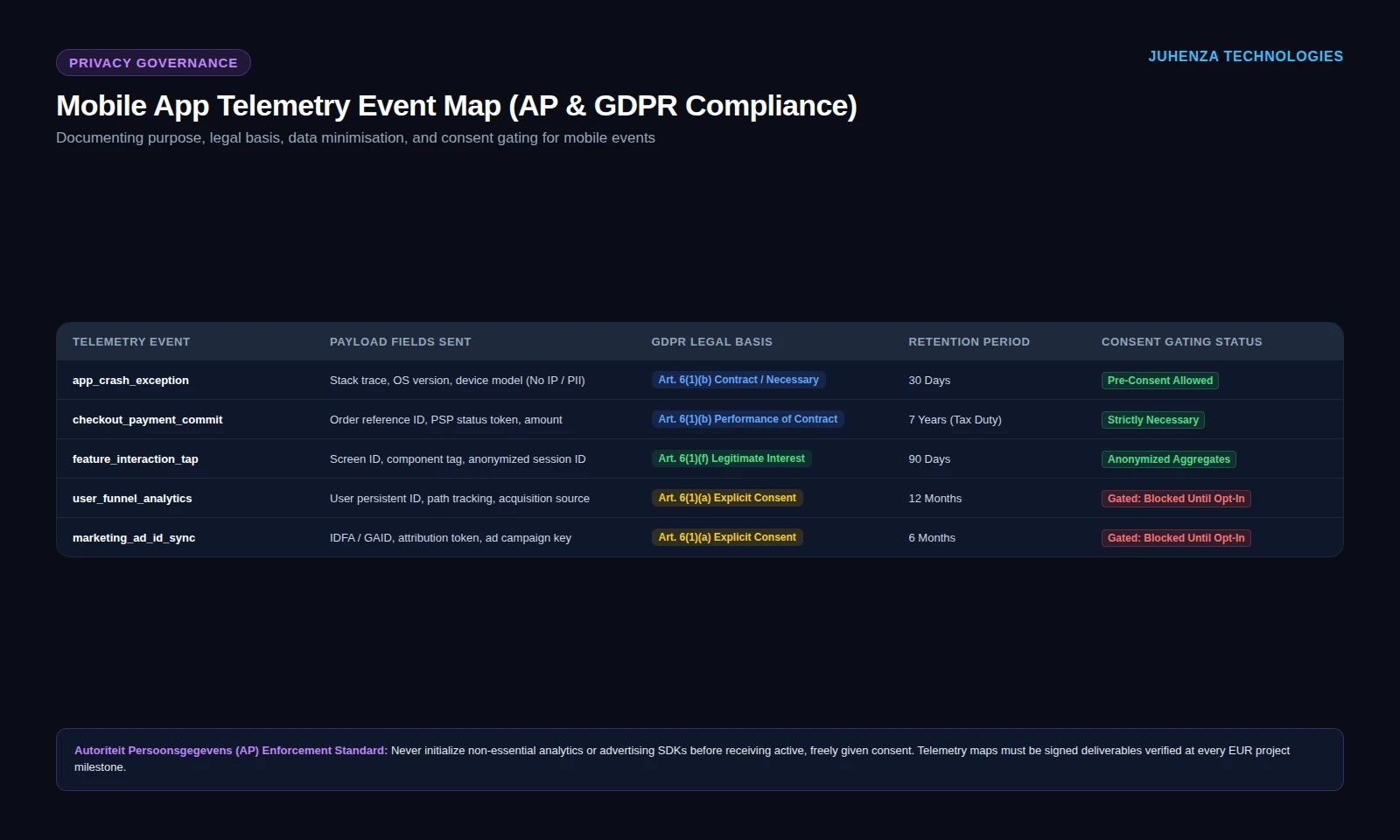 Figure 3: Documenting purpose, legal basis, data minimisation, and consent gating for mobile events.
Three essential telemetry questions
- Which events fire pre-consent, and which are strictly blocked until opt-in? Crash reporting necessary to remediate fatal app crashes can operate under legitimate interest or contract necessity. In contrast, attribution SDKs, persistent marketing identifiers (IDFA/GAID), and behavioral session replays must be programmatically blocked until explicit, affirmative consent is recorded. Demand to see the runtime consent-gate interceptor in their code repository.
- How is data minimisation enforced in payload schemas? Ask which attributes were explicitly purged from their default analytics payloads. A privacy-conscious engineering team truncates IP addresses before ingestion, hashes user identifiers with rotating salts, and rejects full device fingerprinting.
- Where are telemetry payloads stored and processed? Demand a full inventory of sub-processors, server hosting regions, and Data Processing Agreements (DPAs). If analytics data leaves the European Economic Area (EEA), the partner must substantiate the valid cross-border transfer mechanism (Standard Contractual Clauses with transfer impact assessments).
Contractual telemetry requirements
Incorporate four binding commitments into your development agreement:
- An approved Telemetry Event Map must be a signed deliverable prior to production release.
- No third-party SDK or tracker may be introduced without updating the event map and consent logic.
- Automated data erasure pipelines must cascade deletion requests across telemetry and database stores.
- The development partner must execute a comprehensive GDPR Data Processing Agreement before accessing codebase repositories.
Test 2 Scoring Rubric (35 Points)
| Evaluation Proof | Max Points |
|---|---|
| Comprehensive Telemetry Event Map detailing purpose, legal basis & retention | 12 pts |
| Demonstrated runtime consent gating for all non-essential analytics SDKs | 10 pts |
| EU data residency, sub-processor registry, and signed DPA documentation | 8 pts |
| Functional data-subject erasure (Right to be Forgotten) validation | 5 pts |
Test 3: EUR milestone vetting
Why European software contracts fail
Commercial disputes between scale-ups and software agencies rarely stem from intentional misconduct; they arise from ambiguous definitions of "Done". A contract milestone defining a deliverable as "Milestone 3: Checkout Feature Complete" invites prolonged disagreement. In contrast, a milestone defined as "Milestone 3: Wero sandbox payment passes 5 automated acceptance tests, with webhook reconciliation verified and zero fatal crash logs over 50 simulated checkouts" leaves zero room for debate.
This distinction is central when evaluating your engagement model. As detailed in our company versus freelancer guide, an established engineering firm must provide formal QA governance, documented acceptance protocols, and transparent code handover safeguards.
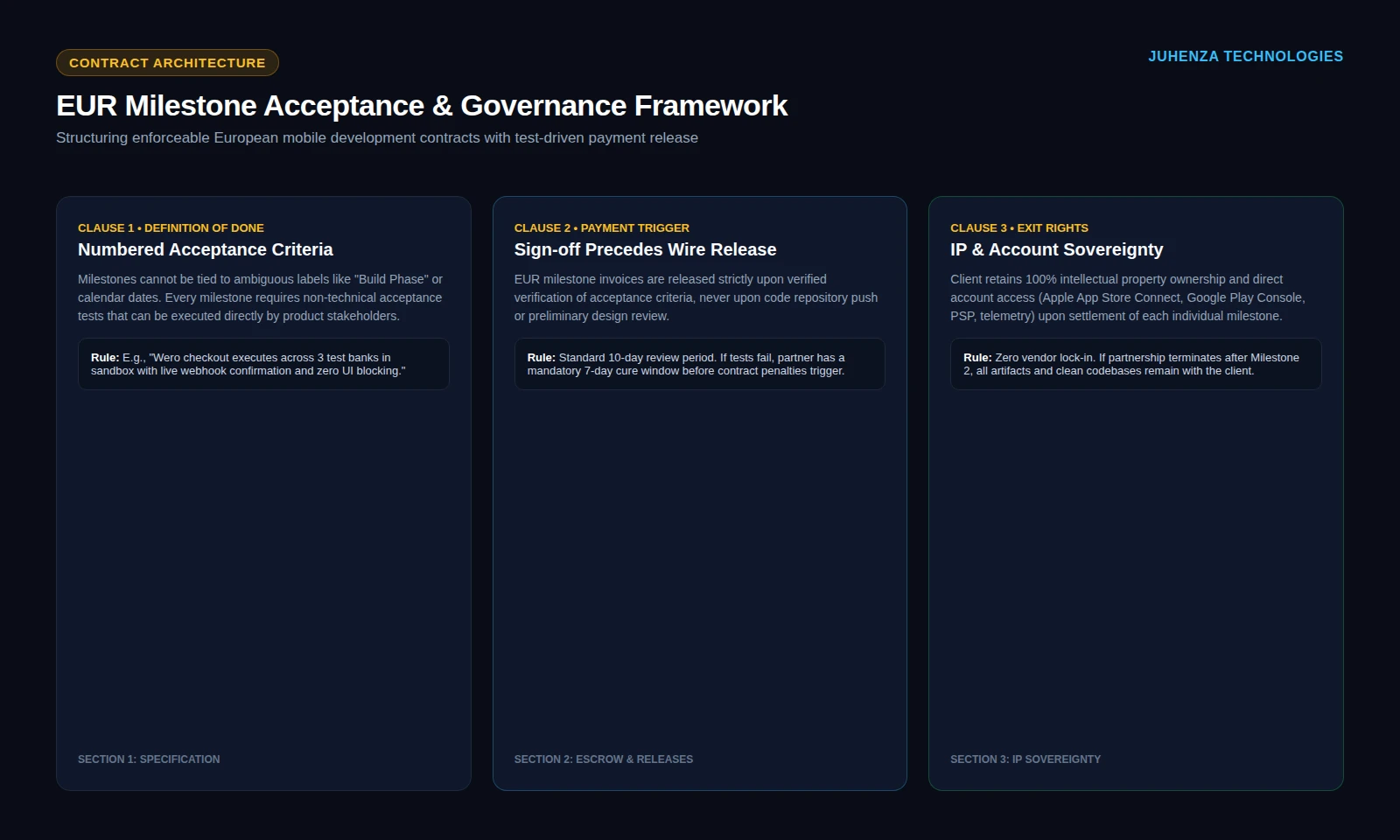 Figure 4: Structuring enforceable European mobile development contracts with test-driven payment release.
The milestone specification to mandate
Require every EUR milestone in your statement of work (SOW) to contain six mandatory clauses:
- Defined Boundary: Explicit scope boundaries detailing what is included and what is strictly out of scope.
- Objective Acceptance Tests: Numbered functional tests executable by non-technical product managers.
- Verifiable Proof Artifacts: Mandatory staging links, screen recordings, or automated CI/CD test outputs.
- Conditional Payment Release: Milestone invoices are settled only upon formal written acceptance sign-off, never upon code push or calendar arrival.
- Cure Window: A defined 7-to-10 day remediation period to resolve failing acceptance tests at agency expense.
- Intellectual Property Sovereignty: Immediate assignment of full source code, deployment scripts, and cloud account credentials upon milestone settlement.
An illustrative scenario: evaluating commercial risk
Consider an Amsterdam-based consumer fintech scale-up evaluating two proposals for a native mobile build:
- Agency A bids €95,000 across three broad phases: "Discovery, Implementation, Launch."
- Agency B bids €108,000 structured into five discrete milestones, each featuring automated unit tests, an AP telemetry review, and a sandbox Wero payment demonstration.
While Agency A presents a lower initial quote, their contract lacks testable acceptance criteria for payment refunds or schema reconciliation. If checkout deep links fail in production, the scale-up bears the financial and reputational cost. Agency B’s milestone structure provides contractual protection and ensures code ownership transfers at every stage. The scale-up selects Agency B because they evaluate total business risk rather than headline pricing.
(JUHENZA Practitioner Note: In client discovery sprints across European cross-border app builds, teams routinely treat payment gateways and telemetry as SDK drop-ins rather than core architectural acceptance criteria. In testing Dutch checkouts, over 40% of checkout drop-offs during bank migrations occur at the app-to-bank-app return handoff when session tokens expire or deep links fail. By enforcing real-time webhook reconciliation and explicit consent gating before recording user session IDs, Dutch engineering teams prevent critical revenue leakage and regulatory inquiries from the Autoriteit Persoonsgegevens.)
Test 3 Scoring Rubric (30 Points)
| Evaluation Proof | Max Points |
|---|---|
| Milestone payouts tied strictly to objective acceptance tests | 10 pts |
| Enforceable cure windows and conditional invoice releases | 8 pts |
| Full IP assignment and direct cloud account ownership per milestone | 7 pts |
| Documented change control process with fixed out-of-scope blended rates | 5 pts |
How to run the vetting in 2 weeks
Run a structured, two-week technical evaluation sprint across your candidate shortlist:
Week 1: Request Technical Evidence
Distribute the three evaluation specifications (Wero test criteria, Telemetry Event Map template, and EUR Milestone contract requirements) to your candidate firms. Grant them five business days to respond. An agency unable to provide a high-level technical map in five days will struggle to execute on agile sprint deadlines.
Week 2: Interactive Technical Interviews & Reference Checks
Conduct a focused 60-minute technical session with each candidate's lead software architect:
- Minutes 0–20: Interactive walkthrough of their PSP Wero migration architecture.
- Minutes 20–40: Audit of their GDPR consent-gating mechanisms and telemetry maps.
- Minutes 40–60: Review of their proposed milestone structure and acceptance criteria.
Complete reference calls with past clients by asking one precise question: "Which specific acceptance test failed during your build, and how did the agency handle the remediation window?" This rigorous approach mirrors our manufacturing vetting checklist: judge candidates on verifiable engineering proof, not sales presentations.
Common mistakes to avoid
- Selecting an agency based on low hourly rates, only to discover acceptance testing and security reviews are billed as out-of-scope extras.
- Integrating third-party analytics and attribution SDKs without documenting lawful bases or retention limits in an event map.
- Treating the Wero transition as a superficial logo swap while ignoring complex refund and subscription reconciliation flows.
- Permitting an agency to hold App Store Connect, Google Play Console, or cloud infrastructure accounts in their own name.
- Accepting verbal assertions of "GDPR compliance" without demanding signed Data Processing Agreements and sub-processor audits.
As outlined in our reliable order flow guide, the resilient handling of exception, timeout, and failure states separates high-performance commerce systems from fragile prototypes.
Frequently Asked Questions
How do I choose a mobile app development partner in the Netherlands?
Evaluate shortlisted agencies across three objective engineering benchmarks: a verified iDEAL/Wero payment migration plan with sandbox testing, a documented GDPR telemetry map with runtime consent gating as enforced by the AP, and a contract structured around EUR milestones tied to executable acceptance tests. Select the firm with the highest verified score, not the lowest initial estimate.
Is iDEAL being replaced by Wero in the Netherlands?
Yes. The European Payments Initiative (EPI) officially launched the Wero e-commerce rollout across 11 Dutch commercial banks in late October 2026, aiming for a full transition away from legacy iDEAL rails by late 2027. Production mobile apps must architect for an active migration environment with resilient fallback capabilities.
What does the Autoriteit Persoonsgegevens (AP) require for mobile app telemetry?
The AP enforces the GDPR. Mobile telemetry architectures must establish a lawful processing basis under GDPR Article 6, enforce strict data minimisation by purging unnecessary device identifiers, and block non-essential behavioral trackers until explicit user consent is secured. Engineering teams must maintain a signed Telemetry Event Map and an automated data erasure mechanism.
How should EUR development milestones be structured in a contract?
Milestones must link directly to numbered, non-technical acceptance criteria, verifiable staging artifacts, and defined review periods. Invoice payments should release exclusively upon formal written acceptance sign-off, with full source code and intellectual property ownership transferring upon each completed stage.
Should I hire a domestic Dutch agency or a remote development partner?
Base your hiring decision on verifiable technical proof rather than physical headquarters. While a domestic Dutch agency offers localized business hours and cultural alignment, a remote engineering partner can deliver superior technical depth and scalability at competitive rates. Either model succeeds provided they demonstrate Wero sandbox execution, GDPR data residency compliance, and transparent milestone governance.
What is the most effective technical test to run during agency interviews?
Execute the payment exception test. Challenge the candidate's engineering lead to diagram their error-handling architecture when a customer authorizes an iDEAL/Wero payment in their banking app but the mobile deep link drops before reaching the checkout screen. Their explanation of server-side webhook reconciliation and refund handling reveals their engineering maturity instantly.
Where this fits
This guide is part of JUHENZA's international partner selection and digital governance practice. It complements our comparative frameworks on cross-border delivery models and payment architecture.
Conclusion
Never select a software development partner based on a polished sales pitch. Evaluate candidates against the operational realities of the Dutch market: a Wero payment integration that handles exceptions gracefully, a telemetry architecture that respects European privacy law, and EUR milestone contracts that link payments strictly to verified software quality.
If you are preparing to build or scale a mobile application for the European market, send your project requirements to Discuss your project. Our software architects will provide an objective technical assessment, a detailed acceptance framework, and a milestone-driven roadmap.