

Monolith to Modular Cloud Migration: A Scorecard for Mohali B2B Software Firms Before You Split Your App
Score your monolith to modular cloud migration before you split it. A practical scorecard for Mohali B2B SaaS teams on modular monolith vs microservices.
App DevTech

Your monolith is not a failure because it grew. It is a sign that customers used it.
Direct answer: Score your application before you split it. If deploy coupling, team blocking, and one hot workload all score high, extract that single service using the strangler fig pattern. If they score low, keep a modular monolith and enforce internal domain boundaries. A monolith to modular cloud migration should follow empirical operational evidence, not industry fashion. The 12-point scorecard below gives your engineering leadership team that objective evidence in one pass.
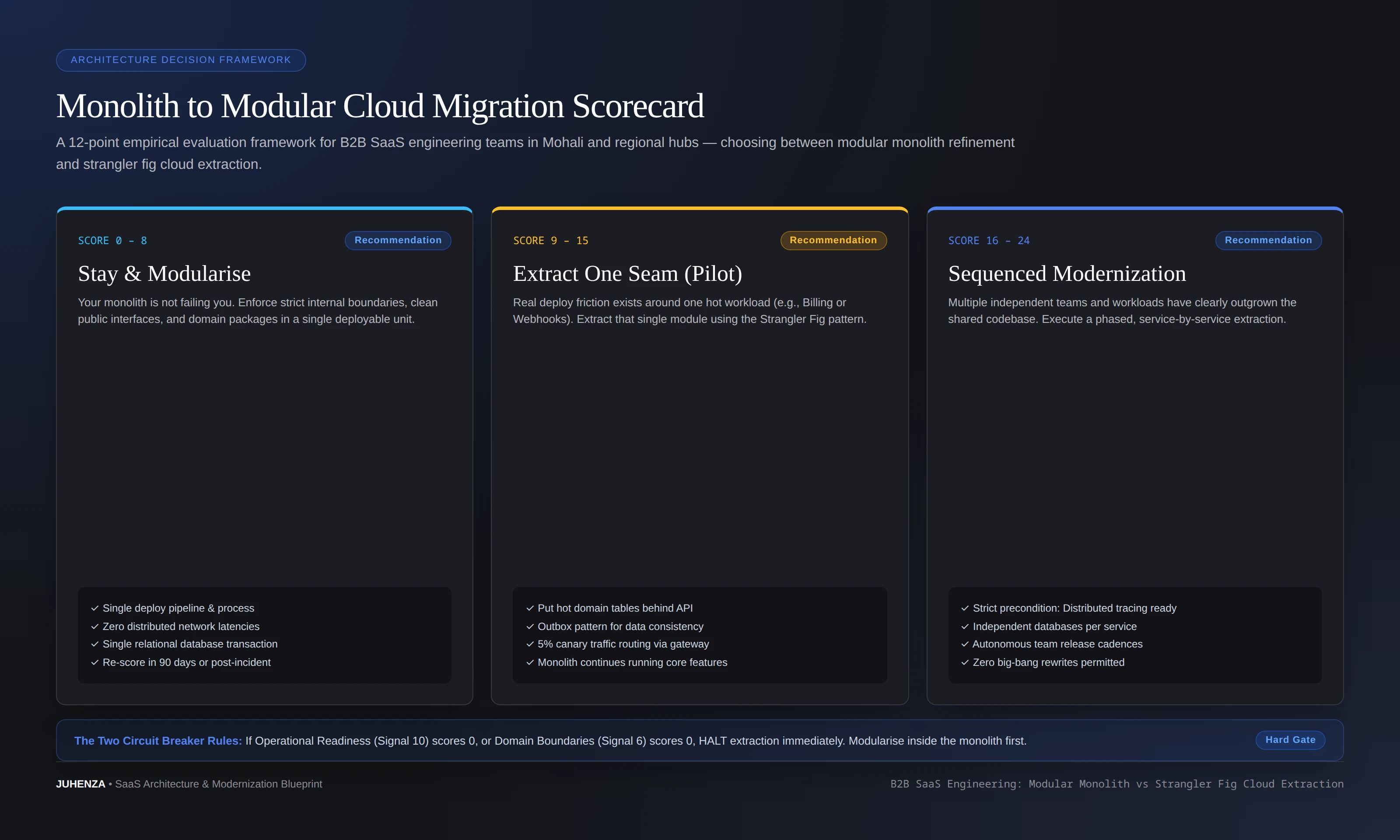 Figure 1: The 12-point migration scorecard and decision thresholds for B2B SaaS engineering teams.
A monolith to modular cloud migration is tempting when deployment pipelines feel sluggish and every small release carries regression risk. Splitting code into microservices feels like technical progress. Sometimes it is.
More often, an unguided split exchanges in-process simplicity for network timeouts, distributed data consistency headaches, and substantial DevOps overhead before delivering a single rupee of customer value.
This architectural guide is tailored for SaaS founders, CTOs, and engineering leaders in regional technology clusters like Mohali and Punjab who operate mature B2B applications. It replaces subjective architecture debates with an empirical, evidence-backed evaluation scorecard supported by our custom software development practice.
What the three options actually mean
Before choosing an architectural direction, engineering teams must establish shared definitions across three operational models:
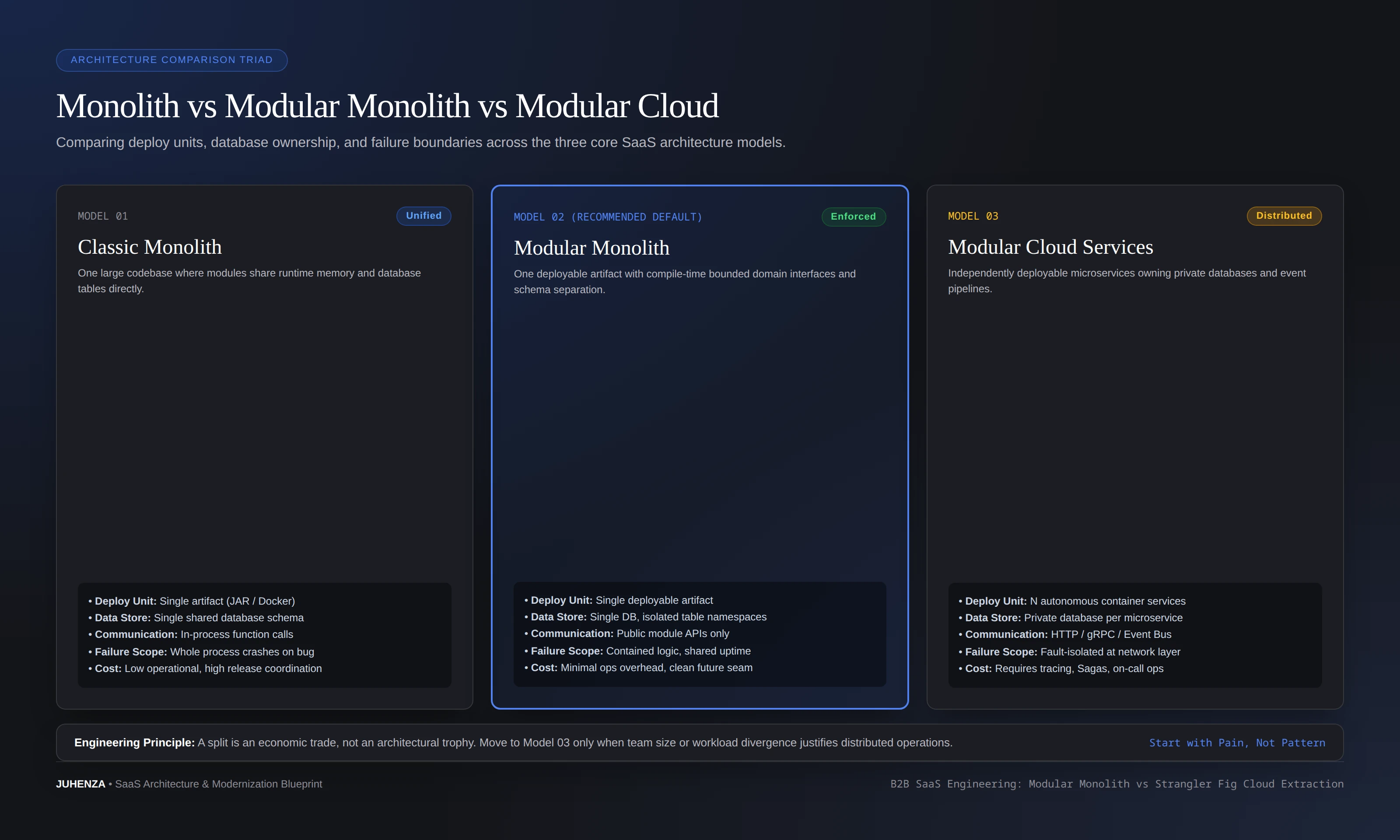 Figure 2: Architectural triad comparison: Classic Monolith vs Modular Monolith vs Modular Cloud Services.
Monolith
A classic monolith is a single deployable artifact (e.g., a single container, WAR, or binary). All modules share execution memory, a unified release cycle, and a single relational database schema.
This model is extraordinarily efficient to build, test, and debug locally. It becomes problematic only when an isolated change forces a full regression cycle, or when a single CPU-intensive background job degrades the primary web application.
Modular monolith
A modular monolith remains a single deployable unit, but enforces compile-time and runtime boundaries between internal domains. Modules communicate exclusively through public interfaces or local domain events; direct cross-module imports into private repository layers are strictly blocked by linter rules and package architecture.
Each module owns its tables through dedicated schema namespaces, even if stored within the same physical PostgreSQL instance. You secure clean domain ownership, rapid onboarding, and clear future extraction seams without paying distributed systems taxes today. For the vast majority of growing B2B products, this is the optimal destination.
Microservices and modular cloud
Microservices decompose the application into independently deployable containerized services running on managed cloud infrastructure (e.g., AWS ECS, EKS, or Lambda). Each microservice strictly owns its dedicated datastore; shared database access is prohibited.
This model buys independent horizontal scaling, autonomous team release cadences, and localized failure domains. However, it requires distributed tracing (OpenTelemetry), asynchronous event buses (Kafka/RabbitMQ), transactional outbox patterns, circuit breakers, and on-call rotation capacity.
A split is an economic trade-off, not a technical promotion. If your team cannot identify the specific workload, team bottleneck, or compliance requirement that microservices resolve, do not split yet. If you are evaluating delivery partner capacity, our comparison of a software development company vs freelancer clarifies organizational scaling constraints.
The migration scorecard
Evaluate each of the 12 modernization signals below on a 0 to 2 scale:
- 0 Points: Absent, negligible, or unsupported by data.
- 1 Point: Anecdotal or observed occasionally, but lacking production metrics.
- 2 Points: Backed by concrete evidence in deployment logs, issue trackers, APM metrics, or post-incident reviews.
Score as a cross-functional council: invite a senior backend engineer, the product lead, and the person who handles after-hours production incidents.
| # | Architecture Modernization Signal | Concrete Evidence Required (Score = 2) | Score (0–2) |
|---|---|---|---|
| 1 | Deploy Coupling | A minor bug fix in one domain forces a full application test cycle and coordinated release. | |
| 2 | Team Blocking | Multiple engineering pods are blocked on a weekly release train; merge conflicts recur weekly. | |
| 3 | Hot Workload Divergence | One module consumes >5x CPU, memory, or I/O compared to the rest (verified in Datadog/CloudWatch). | |
| 4 | Independent Deploy Cadence | One module (e.g., Billing/Tax rules) must ship daily while the core platform releases on a weekly cadence. | |
| 5 | Failure Isolation Need | An unhandled exception or memory leak in a secondary feature has crashed the core customer workflow. | |
| 6 | Domain Boundary Maturity | The candidate domain (e.g., Billing or Webhooks) has a stable bounded context with clear ownership. | |
| 7 | Data Ownership Isolation | All tables belonging to the candidate domain can be identified and decoupled without complex raw SQL joins. | |
| 8 | Change Churn Rate | One specific module experiences 80% of commit churn, repeatedly introducing regressions into stable features. | |
| 9 | Compliance & Security Boundary | Regulated data (e.g., PCI-DSS cardholder data or DPDP-governed PII) requires isolated network access. | |
| 10 | Operational Readiness | Centralized logging, distributed tracing, automated CI/CD, and alert rotations are established and proven. | |
| 11 | Engineering Team Capacity | Sufficient dedicated senior engineers are available to maintain autonomous service lifecycles and DevOps. | |
| 12 | Quantified Cost of Delay | Delaying architectural separation has a measurable business cost (e.g., enterprise SLAs or lost deals). | |
| Total | Maximum Possible Score: 24 Points | / 24 |
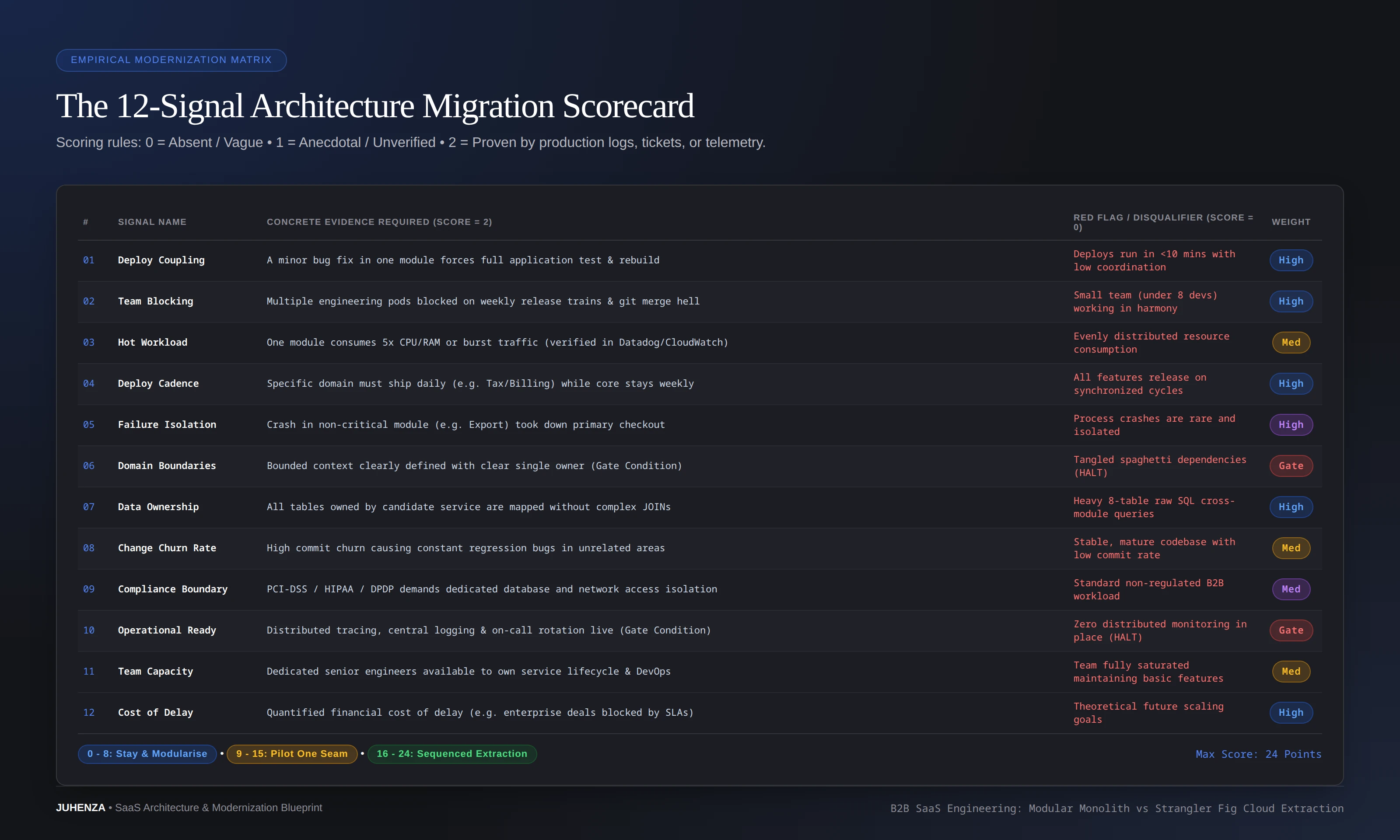 Figure 3: Evaluating the 12 architecture modernization signals against verified production evidence.
How to run the scorecard in one week
- Days 1–2 (Data Mapping): Catalog existing modules, domain owners, and shared database foreign keys.
- Days 3–4 (Telemetry Audit): Review git commit histories, deployment rollback frequencies, APM CPU/memory spikes, and customer incident tickets over the past six months.
- Day 5 (Scoring Workshop): Convene the scoring council. Document the exact ticket or metric supporting every 2-point score.
- Days 6–7 (Decision Sign-Off): Commit to a single candidate pilot or formalize a modular monolith refactoring roadmap.
What your monolith to modular cloud migration score means
Interpret your aggregate score through these empirical decision thresholds:
0 to 8 Points: Stay and modularise
Your monolith is functioning effectively. The friction you feel is natural software growth, not an architectural failure. Enforce internal package boundaries, isolate database queries into repository interfaces, and improve automated test coverage. Re-evaluate in six months.
9 to 15 Points: Pilot one extraction
You have genuine operational pain, but not a justification for a sitewide distributed rewrite. Identify the single module scoring highest on boundary stability and deploy frequency. Extract that single service using the strangler fig pattern, keeping the remaining 90% of the application inside the monolith. Measure operational overhead for 60 days before considering any second extraction.
16 to 24 Points: Sequenced cloud extraction
Multiple independent workloads and engineering teams have outgrown the monolithic container. Execute a sequenced, phased extraction roadmap. Never attempt a big-bang rewrite; decompose one business capability at a time, allowing each new service to stabilize in production.
The Two Mandatory Circuit Breakers
Two conditions override any high numeric total:
- If Operational Readiness (Signal 10) scores 0: HALT. Do not extract microservices without distributed tracing and automated observability. You will convert simple monolithic bugs into untraceable distributed network outages.
- If Domain Boundaries (Signal 6) scores 0: HALT. If you cannot cleanly draw bounded contexts on a whiteboard, microservices will produce a distributed monolith—the worst possible architectural outcome.
Illustrative example: A Mohali B2B SaaS team scores its billing module
(The following scenario illustrates typical scaling dynamics in regional B2B software firms, rather than a specific client engagement.)
Consider a B2B SaaS company headquartered in Mohali providing an enterprise supply-chain management platform across North India. The application was built as a single Ruby on Rails / PostgreSQL monolith managing customer onboarding, catalog orders, vendor invoicing, and logistics tracking.
Over two years, recurring tax rate updates, e-invoicing compliance changes, and custom client payment terms required the Billing module to be modified daily. Meanwhile, the core Catalog and Order workflows remained rock-solid.
Every minor billing patch required a 45-minute continuous integration suite run, delaying customer support fixes and risking regression in order placement.
The engineering leadership council scored the Billing module across the 12 signals:
- Deploy Coupling: 2 (Minor tax tweaks forced full production releases).
- Team Blocking: 1 (Billing releases occasionally queued behind larger feature branches).
- Hot Workload: 1 (End-of-month PDF generation caused memory spikes).
- Deploy Cadence: 2 (Billing needed daily releases; core platform required bi-weekly releases).
- Failure Isolation: 1 (PDF worker memory exhaustion had previously throttled API workers).
- Domain Boundaries: 2 (Billing inputs and outputs were strictly defined).
- Data Ownership: 1 (Invoices were cleanly separated, but customer payment terms shared
orderstables). - Change Churn: 2 (65% of monthly commits touched billing classes).
- Compliance: 1 (Payment gateway API keys required stricter vault access).
- Operational Readiness: 1 (ELK logging was active, but distributed tracing was not yet configured).
- Team Capacity: 1 (One dedicated squad available, but no dedicated platform DevOps).
- Cost of Delay: 1 (Client onboarding delayed by billing patch schedules).
- Total Score: 16 Points
The Decision: Rather than embarking on a disruptive 9-month platform rewrite, the CTO authorized a focused pilot: extracting Billing as a standalone service using the strangler fig pattern.
The team first placed billing tables behind a clean internal REST API within the monolith, implemented OpenTelemetry tracing, and established an asynchronous outbox queue for invoice events. Only then was the Billing container moved to AWS ECS behind an API gateway. The remaining 85% of the platform remained comfortably inside the modular monolith.
If you stay: make the modular monolith boringly reliable
Deciding to stay with a monolith is not a compromise; it is an active engineering strategy. A modular monolith requires strict discipline to prevent architectural rot:
- Organize by business capability, not technical tier: Structure folders by domain (
/billing,/orders,/inventory), rather than generic layers (/controllers,/models,/views). - Enforce boundaries via static analysis: Use architectural linters (such as ArchUnit in Java, Packwerk in Ruby, or Dependency Cruiser in TypeScript) to fail pull requests that bypass public module interfaces.
- Isolate database namespaces: Assign domain-specific table prefixes (e.g.,
bill_*,ord_*,inv_*) and forbid direct cross-domain SQL joins in code. Cross-domain queries must route through internal domain service classes. - Resilient failure testing: Introduce circuit breakers and fallback defaults even within in-process calls for external payment gateways or third-party email providers. For architectural design patterns, review our guide on AI workflow automation and APIs.
- Re-score quarterly: The moment a specific module repeatedly scores 2s across deploy coupling and change churn, its pre-built internal boundaries allow it to be extracted with minimal refactoring.
If you split: use the strangler fig pattern, one service at a time
As formalized in AWS Prescriptive Guidance on the Strangler Fig Pattern, incremental modernization is the industry gold standard for legacy decomposition. Big-bang rewrites freeze ongoing product feature development, introduce catastrophic cutover risks, and regularly exceed budgets.
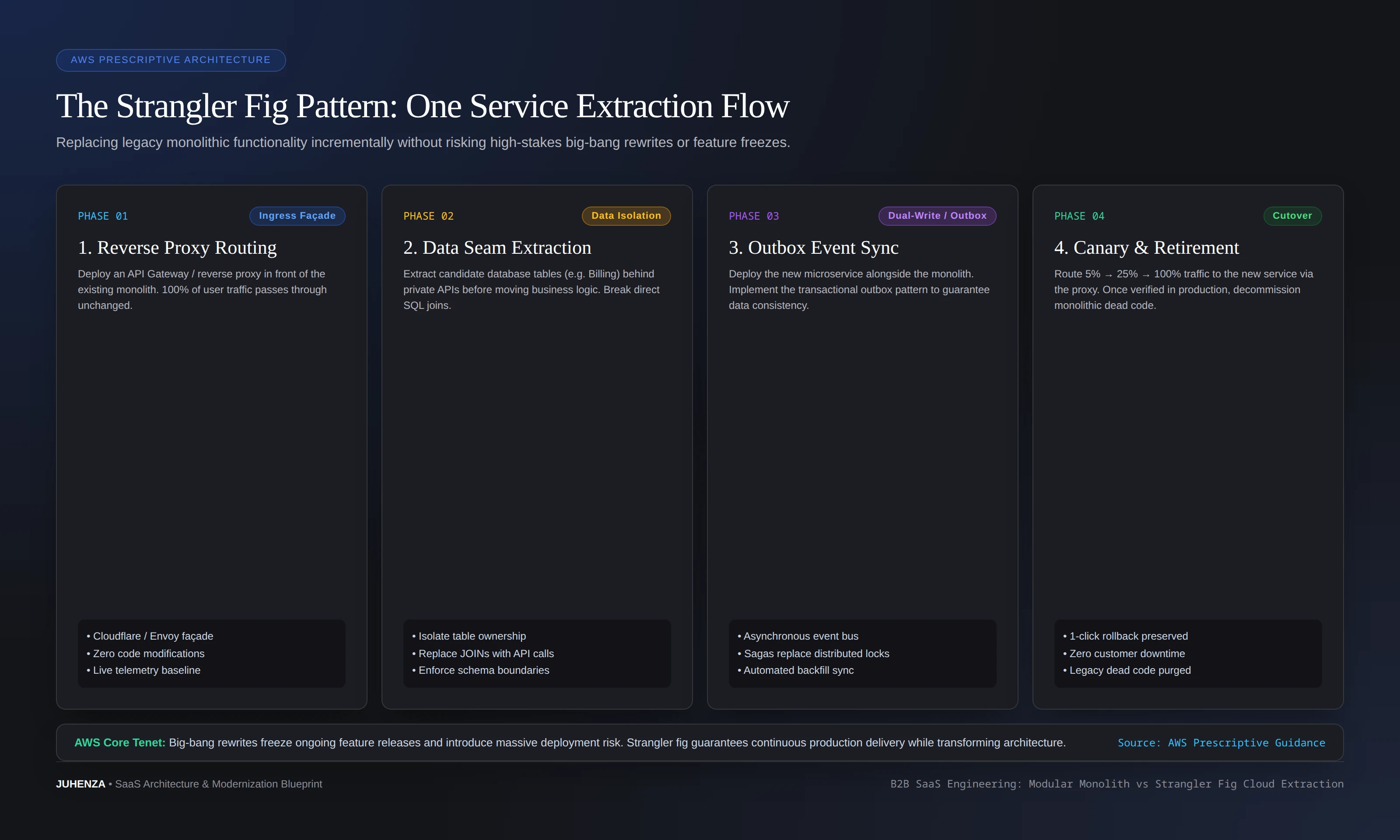 Figure 4: Strangler fig extraction sequence: routing proxy, data seam isolation, outbox event sync, and canary cutover.
Follow this disciplined 6-step extraction sequence for your pilot candidate:
- Deploy the Ingress Façade: Position a reverse proxy (e.g., Cloudflare, AWS API Gateway, or NGINX) in front of your legacy application. Route all incoming user traffic to the monolith initially.
- Isolate the Data Seam First: Decouple candidate database tables before moving application code. If other modules query those tables, refactor them to consume an internal API.
- Build the Autonomous Microservice: Construct the new cloud microservice with its own dedicated datastore. Expose modern, contract-tested API endpoints.
- Implement Transactional Outbox Synchronization: Avoid distributed two-phase commit transactions. Use the transactional outbox pattern with an event broker to publish domain events reliably between the monolith and the new microservice.
- Canary Traffic Migration: Program the API gateway to route a controlled fraction of traffic (e.g., 5% of internal beta tenants) to the new service. Monitor error rates, response latencies, and data consistency before scaling to 100%.
- Decommission Monolithic Dead Code: Once the microservice has run stably in production for 30 days, delete the legacy code paths and drop the deprecated database tables.
For architectural blueprints on service decomposition, consult AWS Prescriptive Guidance on Decomposing Monoliths.
What this guide is based on, and what it cannot prove
This evaluation framework synthesizes AWS cloud architecture principles, Martin Fowler's evolutionary architecture patterns, and empirical decision heuristics derived from B2B SaaS modernization workflows.
It is designed to eliminate subjective opinion from architecture reviews. It does not replace a bespoke technical audit of your team's specific source code, database index locks, or cloud infrastructure configurations.
(JUHENZA Practitioner Note: In B2B SaaS modernization projects across regional technology corridors, engineering teams frequently attempt a whole-application microservices rewrite to escape deploy friction, only to freeze feature delivery for months and exchange manageable monolith bugs for distributed tracing nightmares. In every successful modernization engagement, we enforce a modular monolith first by isolating database schemas and establishing strict domain interfaces. When an extraction is genuinely warranted—such as high-frequency billing or event webhooks—we deploy the strangler fig pattern to extract that single service with an outbox pattern, keeping the rest of the core monolith boringly reliable and customer-ready.)
Common mistakes, limitations, and when to bring in a specialist
Critical Modernization Mistakes
- Decomposing by technical layer: Creating a "database service" and an "API service" instead of functional business domains. This maximizes network overhead while solving zero deployment coupling problems.
- The shared database antipattern: Deploying five microservices that all point to the same central SQL database. This creates distributed deployment locking with none of the benefits of microservices.
- Microservices as a hiring strategy: Adopting distributed architectures merely to attract engineers, rather than solving genuine customer scaling constraints.
- Skipping distributed tracing: Launching independent microservices without correlation IDs (
TraceID), leading to catastrophic blind spots when user requests fail across boundaries.
When to Involve an Architecture Specialist
Engage specialized enterprise software architects when your application handles high-concurrency transactional volume, processes sensitive financial or healthcare compliance data, requires multi-region data residency, or when your in-house team is fully committed to immediate commercial product roadmap delivery.
For rigorous partner evaluation guidelines, reference our practical checklist for vetting a software company.
Frequently asked questions
Should an early-stage B2B SaaS startup start with microservices?
Almost never. Early-stage startups must optimize for rapid product-market fit and domain discovery. Starting with microservices locks in domain boundaries prematurely; changing those boundaries across distributed network APIs is exponentially more expensive than refactoring in-memory code. Build a disciplined modular monolith first.
What is the core difference between a monolith and a modular monolith?
A classic monolith allows unstructured cross-module dependencies and shared database access. A modular monolith enforces strict compile-time boundaries, private database schema namespaces, and public interfaces between business domains while retaining the deployment simplicity of a single artifact.
How do you handle database transactions across extracted microservices?
Avoid distributed two-phase commit (2PC) locks, which degrade system availability. Instead, employ the Transactional Outbox pattern paired with asynchronous event-driven messaging and Saga orchestration to achieve eventual consistency across independent service datastores.
What is the strangler fig pattern in application modernization?
The strangler fig pattern incrementally replaces specific legacy application capabilities with autonomous cloud services by intercepting incoming traffic at an API gateway façade. The legacy monolith continues running while new services are deployed in parallel, minimizing cutover risk.
How long does a typical monolith to modular cloud migration take?
Scoping and extracting a single pilot service (such as Billing or Notifications) typically requires 6 to 10 weeks of focused engineering. Decomposing an entire enterprise monolith is a multi-quarter, sequenced program that should be funded and executed in distinct milestones rather than a single massive rewrite.
What should a team do if their scorecard total is high but their DevOps capacity is low?
Do not split yet. High architectural friction combined with low operational readiness is a recipe for production downtime. Prioritize establishing distributed tracing, automated CI/CD pipelines, and centralized logging inside the modular monolith before attempting service extraction.
Can a modular monolith scale to millions of users?
Yes. Prominent enterprise software platforms (including Shopify and Basecamp) process massive global scale on modular monolithic architectures. True horizontal scaling is achieved by running multiple identical stateless instances behind a load balancer with read-replica database clusters.
Where this fits
This decision framework sits within JUHENZA's SaaS Architecture and Systems Engineering Practice. It connects directly with our enterprise consulting frameworks on custom software modernization, scalable API design, and cloud infrastructure optimization.
One clear next step
Run the 12-point migration scorecard with your core engineering leadership this week. Document the concrete metrics, log entries, and incident tickets that justify every 2-point score.
If your evaluation reveals a candidate module ready for extraction or if your team requires an objective architectural audit before committing capital, Discuss your project with our software engineering team at JUHENZA. Share your current system architecture and operational bottlenecks for an actionable modernization roadmap.
External references
- AWS Prescriptive Guidance: Strangler Fig Pattern — Incremental decomposition patterns and gateway façade architectures for legacy cloud modernization.
- AWS Prescriptive Guidance: Decomposing Monoliths into Microservices — Architectural principles for identifying domain seams, database extraction strategies, and event-driven data consistency.
