

Saudi Enterprise MVP Roadmap: What to Validate in 90 Days Before Funding the Full Platform
A Saudi enterprise MVP roadmap for innovation directors: validate demand, governance, security and economics in 90 days before funding the full platform.
App DevTech

Direct answer: A Saudi enterprise MVP roadmap should validate five things in 90 days: real demand from a named user group, a complete core workflow, governance and security clearance, integration feasibility with existing systems, and the economics of the full platform. If those five pass with pre-agreed thresholds, fund the next stage. If they fail, fix, narrow, or stop before the larger build.
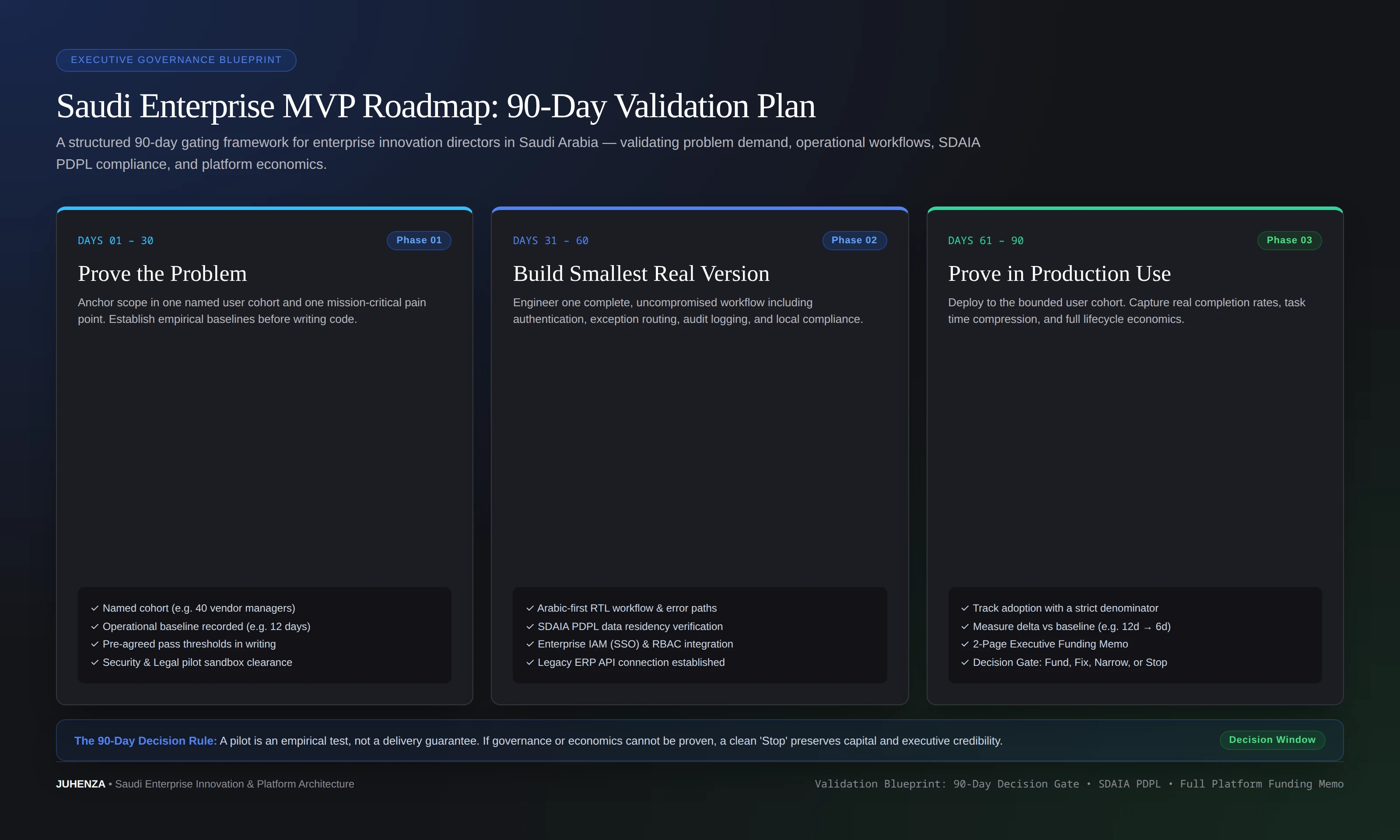 Figure 1: The 90-day gate: prove demand, workflow, governance, integration, and economics before funding.
A Saudi enterprise MVP roadmap is not a plan to build faster. It is a structured framework to earn a multi-million-riyal funding decision with empirical evidence. Innovation directors do not lose organizational credibility because a pilot is tightly scoped. They lose credibility when an ambitious platform is funded on slide decks, executive enthusiasm, and an interactive prototype that never touched real enterprise work.
This guide provides a structured 90-day roadmap, five rigorous validation gates, and an executive funding memo format designed for corporate venture builders and innovation committees across the Kingdom of Saudi Arabia. It treats governance, Personal Data Protection Law (PDPL) compliance, Arabic-first workflows, and legacy system integration as foundational validation criteria, supported by our custom software development practice.
What counts as validated in an enterprise MVP
A Minimum Viable Product (MVP) is the smallest working piece of software that allows a specific user cohort to complete one valuable workflow and produces verifiable telemetry regarding business value, operational feasibility, and long-term cost.
In a corporate enterprise, that definition must be considerably stricter than in a consumer startup:
- A demo impresses an executive steering committee.
- A prototype validates screen layouts and user experience flows.
- A proof of concept (POC) tests technical feasibility in a sandbox.
- An enterprise pilot validates that real employees or partners can complete regulated operational tasks using production systems.
None of the first three proves that an enterprise should commit multi-year capital expenditure. True validation requires that five gates pass simultaneously:
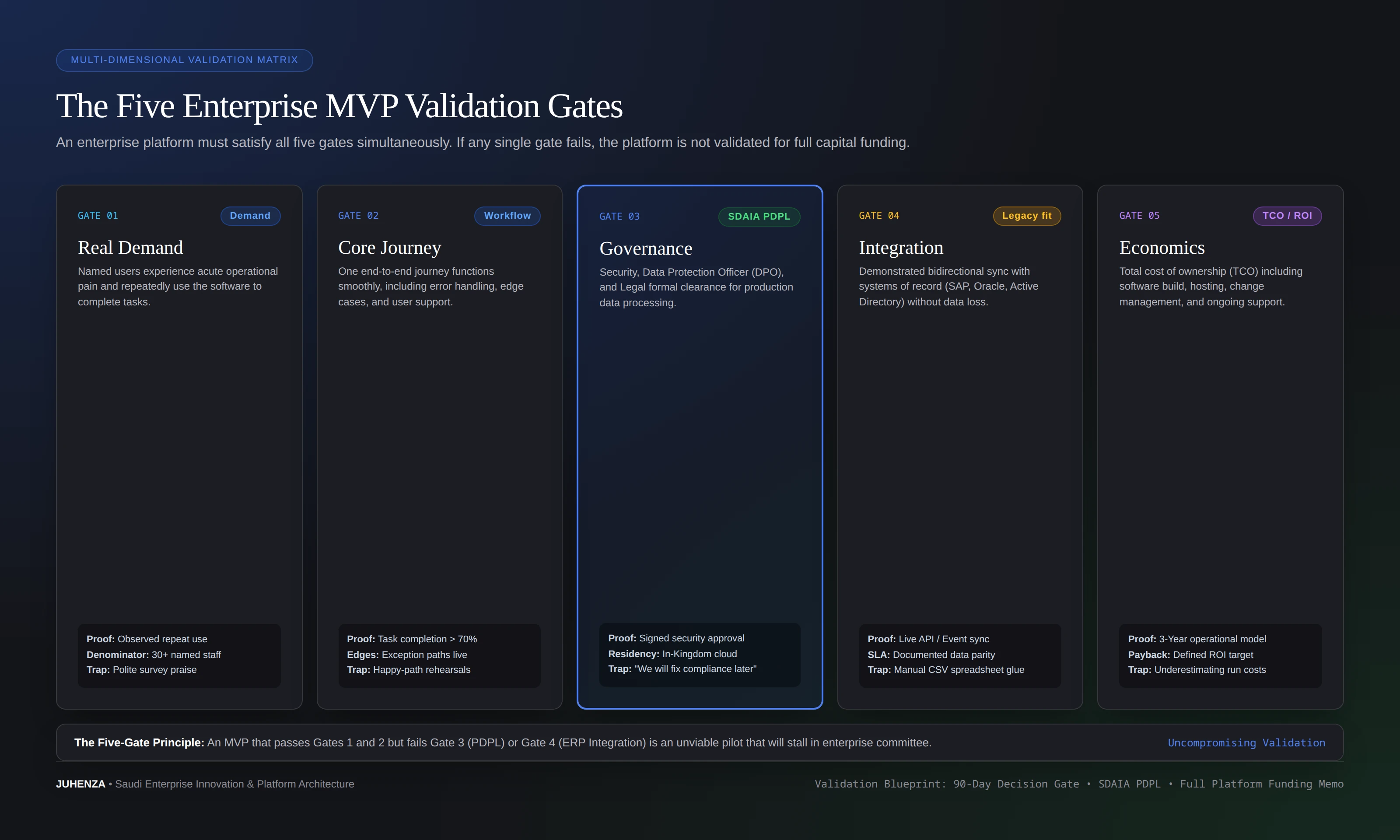 Figure 2: The five enterprise MVP validation gates: Demand, Workflow, Governance, Integration, and Economics.
| Validation Gate | What It Proves to the Committee | Concrete Evidence Required |
|---|---|---|
| 1. Real Demand | A named user group experiences acute friction and voluntarily uses the solution | Observed repeat task completion and retention—never polite survey feedback |
| 2. Core Workflow | One complete operational journey functions reliably end-to-end | Task completion >70%, exception handling, role permissions, and active support paths |
| 3. Governance & PDPL | The software is legally and technically authorized to process enterprise data | Formal sign-off from IT Security, Legal, and the Data Protection Officer (DPO) |
| 4. Integration Feasibility | The application exchanges data seamlessly with core systems of record | Working bidirectional connectors to ERP (SAP/Oracle), CRM, or identity directories |
| 5. Platform Economics | The full platform delivers an attractive Total Cost of Ownership (TCO) | Realistic 3-year financial model covering infrastructure, licenses, support, and change |
If any single gate fails, the platform is not validated—regardless of how polished the visual presentation appears. Establishing this rule before development commences protects the innovation team from organizational pressure to "just add two more features" and declare premature success.
The 90-day Saudi enterprise MVP roadmap at a glance
Structure the 90-day window into three disciplined, 30-day stages:
[Days 1 – 30: Problem & Baseline] ──> [Days 31 – 60: Build Core Seam] ──> [Days 61 – 90: Live Pilot & Memo]
                │                                     │                                    │
                ▼                                     ▼                                    ▼
Named Cohort & Gate Arabic RTL, PDPL & IAM Telemetry & Committee Gate| 30-Day Stage | Timeline | Primary Operational Question | Mandatory Deliverables & Exit Proof |
|---|---|---|---|
| Phase 01: Prove the Problem | Days 01 – 30 | Is this problem sufficiently painful to justify investment? | Named user cohort, empirical baseline metrics, agreed pass thresholds, and pilot sandbox approvals |
| Phase 02: Build Core Version | Days 31 – 60 | Can one complete workflow run safely under enterprise governance? | Functional pilot software, Arabic-first interface, role-based access, and legacy API connectors |
| Phase 03: Live Pilot & Measure | Days 61 – 90 | Does the software produce measurable operational improvement? | Monitored usage telemetry, delta against baseline, 3-year TCO model, and 2-page funding memo |
Treat 90 days as an unyielding decision window, not an elastic delivery schedule. If security clearances or stakeholder approvals consume three weeks, that delay is critical validation data: it reveals exactly how the full platform will navigate corporate governance at scale.
Days 1 to 30: Prove the problem before you build
Begin with the business problem, not an expansive requirements backlog. Select one specific user cohort, one complete workflow, and one quantifiable outcome. In a Saudi enterprise context, ideal pilot candidates include:
- Vendor document validation for a single subsidiary or operating company.
- Customer onboarding and National ID intake for a single retail banking or telecom branch.
- Capital expenditure approval routing for one procurement category.
A narrow pilot scope is not a lack of ambition; it is the discipline that allows an innovation team to prove value without forcing an entire conglomerate to overhaul its operating procedures overnight.
Document the operational baseline
Interview the operational staff who execute the manual workflow today. Ask them to demonstrate the exact process on their screens. Measure the baseline empirically:
- If vendor contract approvals require an average of 12 business days today, document that figure.
- If procurement coordinators manually re-key data across three disconnected software systems, count the daily transaction volume.
- If 18% of customer submissions are returned due to missing compliance documents, record the exact error rate.
Without documented pre-build baselines, every post-pilot metric becomes an endless committee debate.
Agree on quantitative thresholds in writing
Define clear, measurable pass/fail thresholds with executive sponsors before a single line of software is written:
- Completion Threshold: At least 70% of invited pilot users complete the core operational journey without administrator intervention.
- Velocity Threshold: Median task completion duration compresses by at least 40% compared to the recorded baseline.
- Throughput Threshold: A minimum of 50 real transactions process through the pilot software during the test window.
Clarify terminology across stakeholders
Prevent organizational confusion by formalizing these four product stages across your steering committee:
- Prototype: Validates user interface screens, navigation ergonomics, and design layout, often leveraging mock data.
- Proof of Concept (POC): Validates raw technical feasibility (e.g., verifying an algorithmic extraction model or an API response speed) in an isolated sandbox.
- Minimum Viable Product (MVP): Validates a complete operational workflow with real users, actual business rules, and production-grade data boundaries.
- Enterprise Pilot: Deploys the MVP within a bounded organizational scope, complete with dedicated operational owners, technical support channels, and automated telemetry.
If your committee's question is merely "do employees find this interface intuitive," build a clickable Figma prototype. If the question is "should the enterprise fund a 5,000,000 SAR platform build," you require an enterprise MVP and a live operational pilot.
Days 31 to 60: Build the smallest real version
Construct one complete, uncompromised workflow. Do not take shortcuts on the components engineering teams prefer to postpone: identity authentication, role-based access control (RBAC), error handling, notifications, audit logs, and an administrative support console. A digital workflow that functions only when every input is flawless is an interactive rehearsal, not a validated product.
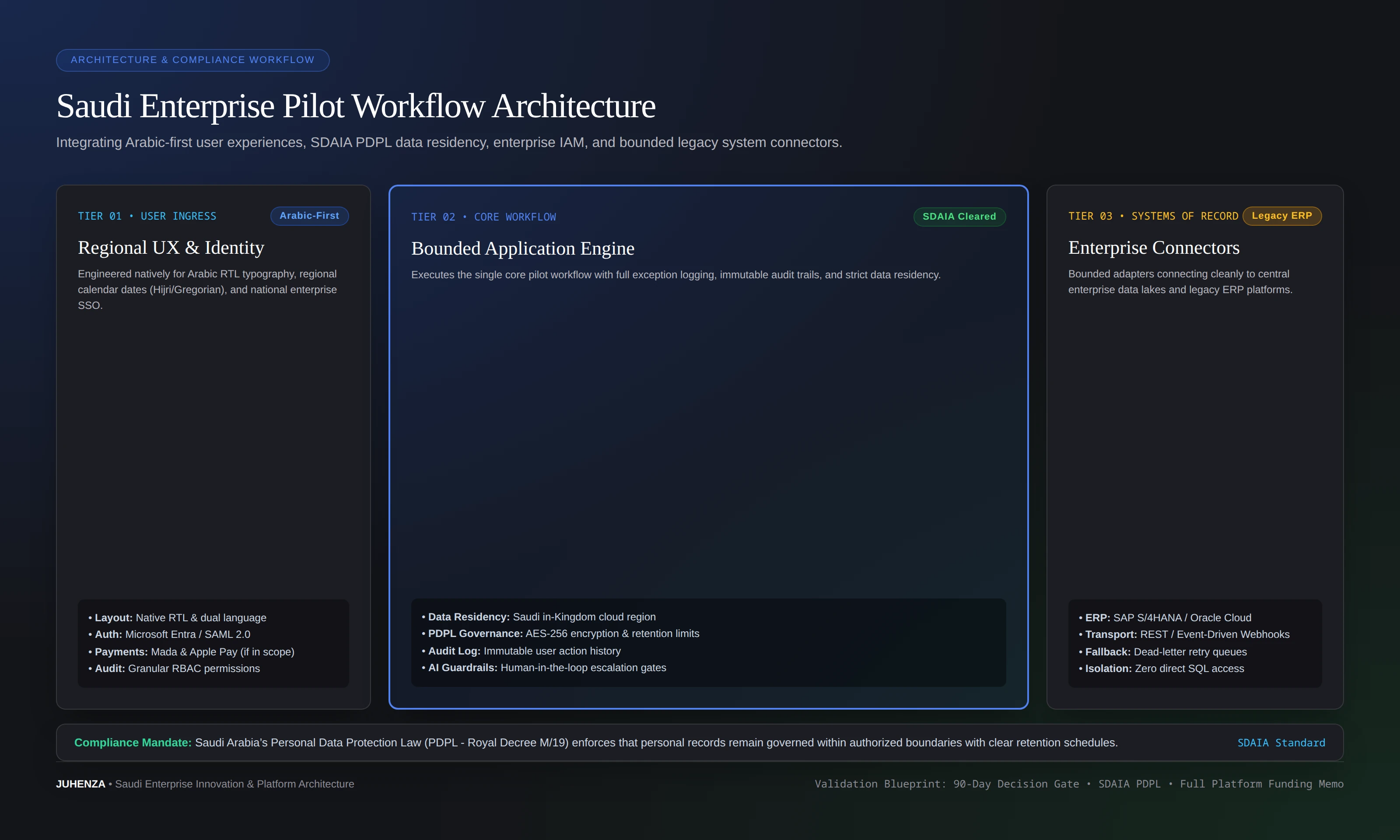 Figure 3: Pilot workflow architecture: Arabic-first UI, SDAIA PDPL data residency, IAM SSO, and bounded legacy ERP connectors.
Essential regional and enterprise criteria
1. Native Arabic-first user experience
If operational staff, suppliers, or end-users interact in Arabic, design the interface Arabic-first from Day 31. Relegating Arabic to a superficial translation pass at the conclusion of development creates severe layout breakage:
- Ensure right-to-left (RTL) layout geometry handles multi-line Arabic typography naturally.
- Accommodate long compound Arabic names without truncating database fields or interface cards.
- Format Gregorian and Hijri calendar dates, currency symbols (SAR), and Arabic-Indic numerals correctly.
2. Saudi Personal Data Protection Law (PDPL) compliance
Saudi Arabia's Personal Data Protection Law (PDPL), enacted under Royal Decree No. M/19 and amended by Royal Decree No. M/148, sets strict governance over personal data processing under the oversight of the Saudi Data and Artificial Intelligence Authority (SDAIA).
Prior to deploying software that touches employee, customer, or vendor PII:
- Identify the lawful basis for processing and maintain an internal Record of Processing Activities (ROPA).
- Enforce strict data minimisation: capture only the specific attributes necessary to complete the pilot task.
- Guarantee in-Kingdom data residency by hosting databases on certified local cloud infrastructure (e.g., AWS Region Saudi Arabia, Google Cloud Dammam, or local hyperscalers).
- Secure written concurrence from your Data Protection Officer (DPO) and Legal Counsel. (Disclaimer: This guide provides technical architecture analysis and does not constitute formal legal counsel.)
3. Vision 2030 strategic alignment
The Kingdom's Vision 2030 outlines national economic diversification, digital government excellence, and private sector operational modernization. When presenting to executive boards, link the pilot to concrete strategic outcomes—such as local vendor enablement, administrative efficiency, or paperless transactions—rather than generic buzzwords.
4. Payments integration (if within scope)
If the workflow involves financial transactions, connect directly with Saudi payment infrastructure (Mada debit rails, credit cards, or corporate virtual accounts). Verify edge cases early: network timeout handling, payment reversals, partial refunds, and settlement reconciliation.
Select implementation partners based on verifiable delivery discipline rather than marketing claims. When hiring an AI development company or evaluating a software development company vs freelancer, insist on clear code ownership, intellectual property transfer, and transparent architectural handovers.
Days 61 to 90: Prove it in real use
Deploy the software to a strictly bounded, named cohort of pilot users. Never release an enterprise pilot to "anyone interested." A named cohort provides an indisputable mathematical denominator:
- If 50 regional procurement coordinators are enrolled, 42 activate their accounts, and 34 complete vendor evaluations without technical assistance, you have a defensible 68% independent completion rate.
- If an open link is circulated and "dozens of people tried it," you possess only unscientific anecdotal feedback.
Capture three distinct categories of evidence
- Adoption & Usage Telemetry: User activation rate, core workflow completion percentage, repeat utilization across weeks, step-by-step drop-off funnels, and customer support ticket volume.
- Operational Outcome Delta: Measurable compression against Day 1–30 baselines: reduction in processing cycle time, elimination of data re-entry errors, or decrease in turnaround days.
- True Operational Cost: Accurate accounting of engineering build effort, cloud hosting overhead, third-party API consumption, and internal training hours.
Conduct qualitative interviews focused strictly on the operational reality: What workarounds did staff invent? Which tasks are still being tracked outside the software in WhatsApp groups or private spreadsheets?
A pilot that users praise verbally but circumvent operationally has failed. A pilot that users critique for minor UX bugs but utilize daily to complete their jobs points to a viable core workflow.
Governing Artificial Intelligence in the pilot
When validating AI-driven workflows (such as automated document parsing or decision support), enforce strict boundaries. As outlined in our guide on AI agents for business operations, define the exact permissions, reference data sources, and human escalation protocols.
Track supported completions, automated escalations, extraction accuracy, and inference costs separately. Never deploy unmonitored AI agents that take autonomous actions on enterprise ledgers without human review.
The funding gate: pass, fix, or stop
Conclude the 90-day pilot with a formal governance decision meeting, not a technical software demonstration. The innovation lead presents the agreed Day 30 thresholds, the empirical Day 90 telemetry, and a definitive funding recommendation:
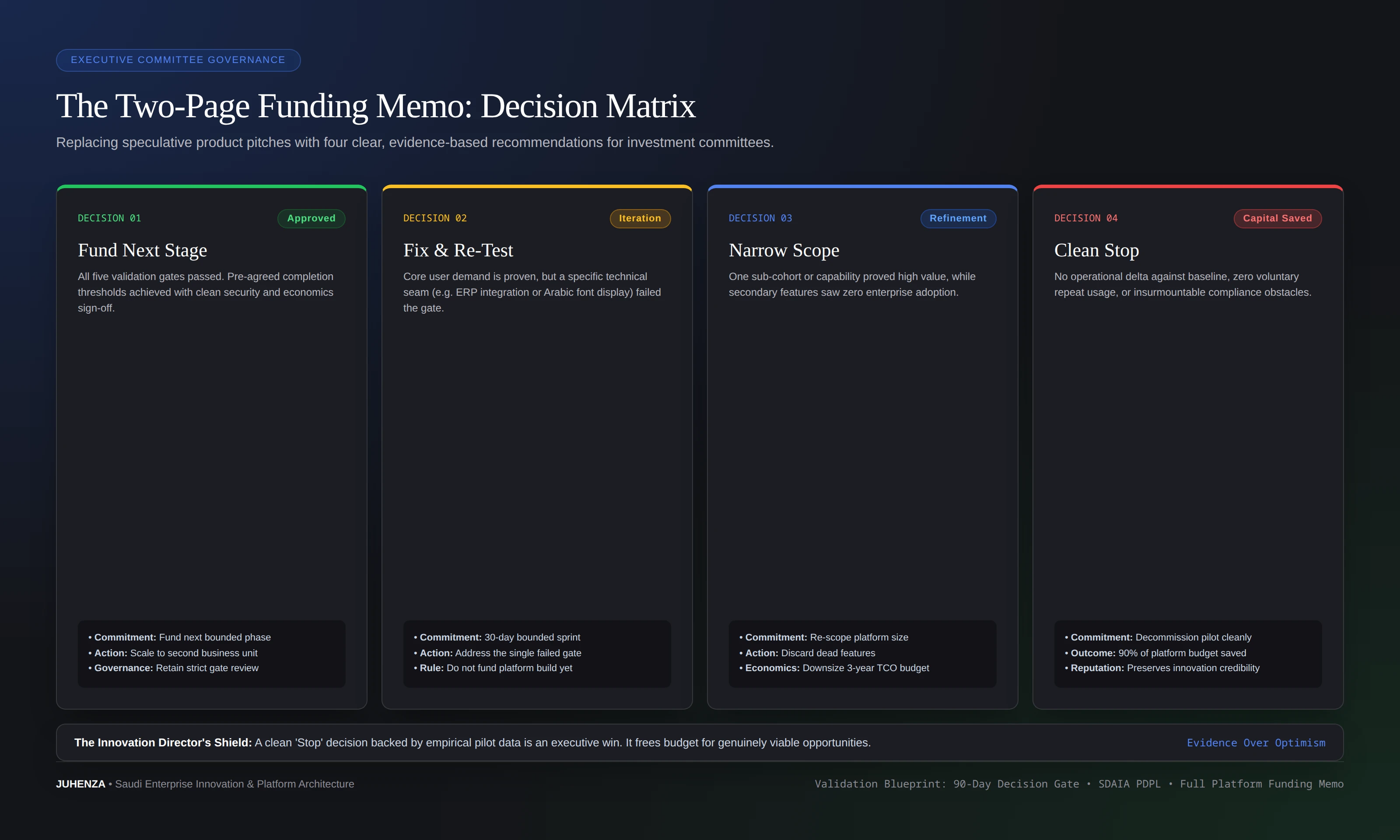 Figure 4: Executive committee funding memo decision matrix: Fund Next Stage, Fix & Re-test, Narrow Scope, or Clean Stop.
| Governance Decision | Empirical Selection Criteria | Actionable Next Step |
|---|---|---|
| Fund the Next Stage | All five validation gates passed; agreed thresholds met; positive ROI model | Fund a bounded Phase 2 rollout across 2–3 additional business units; do not fund the entire 5-year vision at once |
| Fix and Re-Test | Strong user demand demonstrated, but a single technical seam (e.g., ERP sync) failed | Authorize a focused 30-day engineering sprint to resolve the specific bottleneck and re-evaluate |
| Narrow Scope | One specific sub-workflow succeeded while secondary modules saw zero engagement | Decommission unused features, scale down the 3-year TCO budget, and fund only the proven core capability |
| Clean Stop | Zero organic adoption, negligible improvement over baseline, or compliance blocked | Decommission the pilot cleanly, archive architectural learnings, and preserve 80%+ of the platform budget |
The Two-Page Executive Funding Memo
Structure the investment proposal into an executive memo:
- Problem Statement & Baselines: The operational bottleneck, target user cohort, and pre-build baseline metrics.
- MVP Scope & Exclusions: What the pilot validated and the explicit architectural features left out of scope.
- Agreed Thresholds: The quantitative pass/fail benchmarks established on Day 30.
- Empirical Gate Evidence: Telemetry across Demand, Workflow, Governance (PDPL), Integration, and Economics.
- Full Platform Architecture & TCO: Detailed 3-year financial model covering infrastructure, licenses, support, and change management.
- Definitive Recommendation: Executive recommendation (Fund, Fix, Narrow, or Stop) with next milestone deliverables.
Illustrative Enterprise Scenario
Consider a Saudi commercial conglomerate validating a centralized vendor document intake portal for one regional operating subsidiary.
- The Baseline: 12 business days from initial supplier packet submission to vendor master registration, with an average of four manual email follow-up cycles.
- The Pilot Scope: 90 days, restricted to 40 primary suppliers in the Western Province, featuring automated commercial registration (CR) verification and tax certificate parsing.
- The 90-Day Result: 32 of 40 suppliers completed self-service onboarding without assistance; median registration duration compressed from 12 days to 5.5 days; however, automated synchronization with legacy SAP accounts payable stalled due to API rate limits.
- The Recommendation: Fix and Re-Test. Authorize a 30-day technical sprint to implement an asynchronous queue for SAP synchronization, withholding full enterprise platform funding until the integration gate is proven.
First-hand experience
(JUHENZA Practitioner Note: In enterprise digital transformation and pilot builds across the Middle East, innovation committees frequently conflate an interactive prototype demo with operational validation. A pilot that bypasses enterprise identity management, ignores bilingual Arabic-English error handling, or sidesteps Saudi Data and Artificial Intelligence Authority (SDAIA) data residency rules will face immediate regulatory paralysis at the deployment gate. In our client architecture engagements, we enforce that governance and legacy system integration are validated during the initial 90-day window, ensuring that any recommendation to fund the full platform is backed by immutable audit trails and real-world employee adoption metrics.)
Common mistakes
- Beginning with an expansive feature wish-list: Features are speculative assumptions. Begin with the operational bottleneck and the empirical decision the pilot must prove.
- Validating exclusively with enthusiastic users: Enthusiastic early adopters overlook friction. Include conservative operators and operational skeptics in the pilot cohort.
- Treating compliance as a post-launch phase: If security, data residency, and legal reviews stall during a narrow pilot, that friction proves that the full platform will face severe organizational resistance.
- Mistaking activity metrics for business value: High login counts, page hits, and executive demo applause do not indicate that an operational process has improved.
- Bolting AI onto an unstructured workflow: Applying machine learning models to broken manual processes merely accelerates errors and increases audit liability.
- Funding the entire multi-year platform following a single pilot: Fund the immediate next bounded stage, requiring each subsequent phase to earn its capital through telemetry.
Limitations and when to involve a specialist
A 90-day roadmap provides architectural clarity, but it does not eliminate the necessity of specialist domain reviews:
- Regulated Data Processing: When handling sensitive personal data, health records, or cross-border data transfers, secure formal counsel from licensed Saudi data privacy practitioners to ensure SDAIA PDPL alignment.
- Financial & Payment Compliance: When integrating Mada payment gateways, credit processing, or automated invoicing, verify regulatory mandates with your finance and banking partners.
- Legacy ERP Integration: When extracting data from legacy ERPs (SAP R/3, on-premise Oracle, or AS/400 mainframes) lacking documented REST APIs, execute an isolated technical spike before committing to platform integration dates. Explore our ERP and system integration consulting for technical guidance.
- Algorithmic Decisioning: When deploying AI systems that influence automated credit scoring, vendor disqualification, or employment decisions, engineer explainable audit logs and human intervention controls.
Frequently asked questions
What is a Saudi enterprise MVP roadmap?
It is an empirical 90-day framework designed for corporate innovation directors and enterprise leaders in Saudi Arabia to validate user demand, workflow feasibility, SDAIA PDPL compliance, legacy systems integration, and full lifecycle economics before committing capital to a multi-year software build.
How does an enterprise MVP differ from a startup MVP?
A startup MVP primarily evaluates whether a novel product concept attracts early market interest. An enterprise MVP must function within complex regulatory frameworks, respect strict role-based permissions, integrate with legacy systems of record, and prove quantifiable operational cost savings to an internal investment committee.
What should an innovation team validate first during the 90 days?
Validate the operational bottleneck and target user cohort during Days 1 to 30. If a dedicated, named employee or partner cohort does not experience measurable pain, no amount of software engineering will produce a viable platform. Establish baselines and quantitative pass thresholds before writing code.
Is formal PDPL approval mandatory before launching an enterprise pilot?
Yes. Any enterprise pilot processing actual personal data must comply with Saudi Arabia's Personal Data Protection Law (PDPL). Innovation teams must document lawful processing bases, enforce data minimisation, ensure in-Kingdom cloud data residency, and secure clearance from the internal Data Protection Officer (DPO).
Can a successful 90-day MVP evolve into the full production platform?
Yes, provided the software is architected with modular, domain-driven boundaries and production-grade security standards. Avoid disposable "throwaway" code. However, scaling across the enterprise should be phased by business unit and operational division, rather than executing a reckless sitewide rollout.
When should an innovation committee choose a clean "Stop" decision?
Halt the project when the pilot reveals negligible voluntary adoption, fails to compress cycle times against established baselines, or encounters insurmountable regulatory or legacy integration obstacles. A clean stop preserves capital, maintains executive credibility, and redirects funding toward genuinely viable enterprise initiatives.
Where this fits
This validation framework sits within JUHENZA's Enterprise Software Engineering and Digital Governance Practice. It connects directly with our advisory resources on vetting a software company, scalable systems architecture, and AI-enabled operational automation.
Conclusion
Do not fund an enterprise platform on an interactive demonstration. Execute a disciplined 90-day validation roadmap, capture telemetry across all five validation gates, and demand an empirical funding memo.
If the pilot achieves its pre-agreed thresholds, fund the next bounded phase. If it reveals operational deficiencies, fix the specific seam, narrow the scope, or execute a clean stop with your budget and credibility intact.
To scope a structured 90-day validation pilot with defined workflows, governance pathways, and quantitative success thresholds, Discuss your project with our engineering leadership at JUHENZA.
External references
- Saudi Vision 2030 Official Overview — The Kingdom's strategic framework for economic diversification, digital transformation, and sustainable enterprise development.
- SDAIA Guide to the Saudi Personal Data Protection Law (PDPL) — Official statutory guidelines for personal data processing, controller responsibilities, and data residency in Saudi Arabia.
