

Coaching Institute Software Hyderabad: 8 Vendor Questions Before You Sign
Ask 8 vendor questions before signing for biometric attendance, mock-test analytics and parent-fee apps for Hyderabad coaching chains. Checklist inside.
App DevTech

A demo can look perfect while the contract leaves the hard parts undefined.
Direct answer: Evaluate coaching institute software Hyderabad vendors by demanding live proof across three interconnected operations on your actual timetable: biometric attendance with an offline fallback for 7:55 AM peak arrivals, diagnostic JEE/NEET mock-test analytics that pinpoint what to re-teach next week, and automated parent-fee reconciliation across branches. Insist on contractually guaranteed data ownership, unencrypted SQL/JSON exit exports, written Total Cost of Ownership (TCO) including gateway MDR and WhatsApp API charges, and verifiable parental consent logging compliant with Section 9 of India's Digital Personal Data Protection (DPDP) Act, 2023.
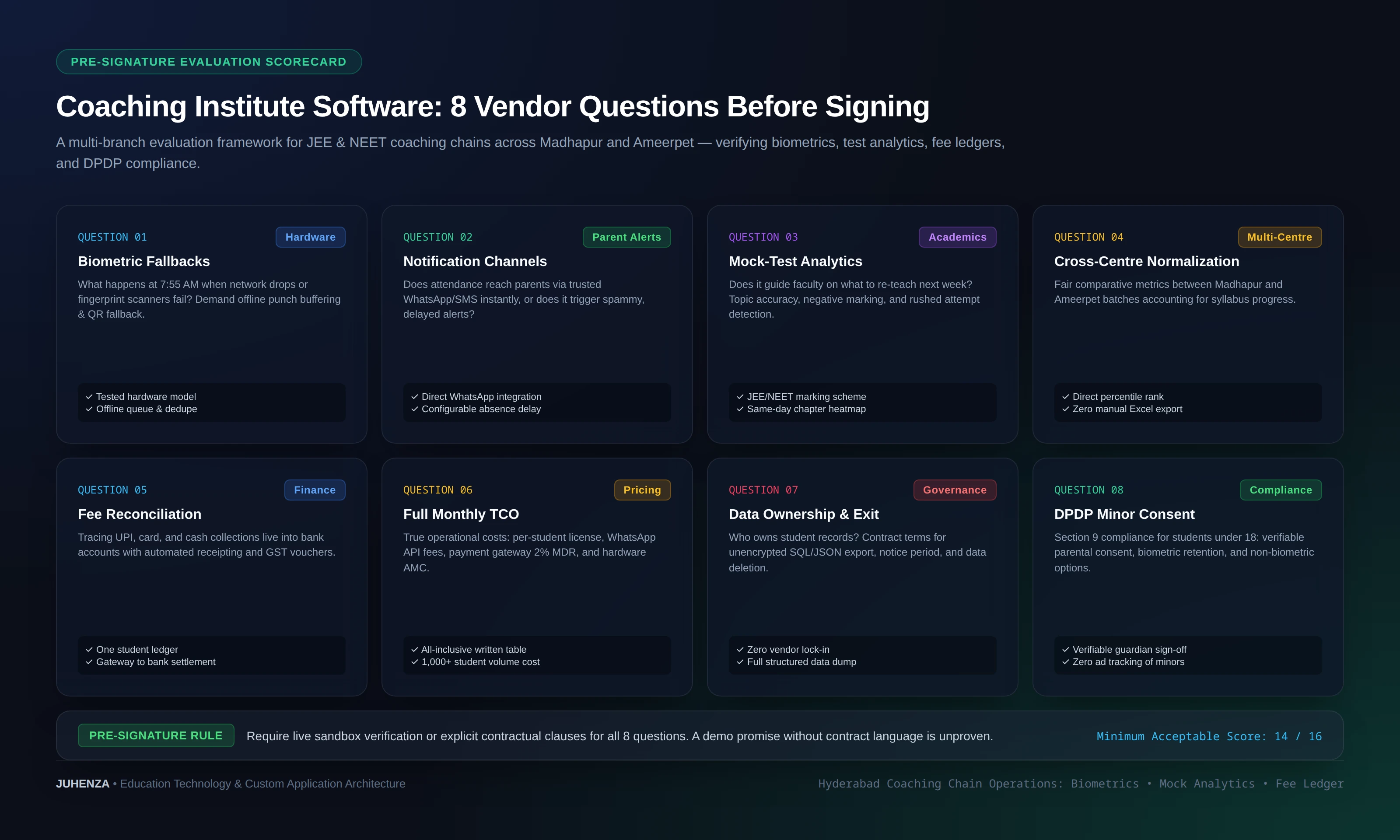 Figure 1: The 8-question vendor vetting scorecard for Hyderabad multi-centre coaching institutes.
Choosing coaching institute software that Hyderabad directors can confidently defend to parents, faculty, and auditors is less about feature quantity and entirely about operational resilience. Most vendors can demo attendance, online tests, and fees in isolation. Far fewer can prove all three working harmoniously across distributed centres during a chaotic morning arrival, with accurate data synchronization, clear parental consent, and an exit clause if service degrades.
This checklist is engineered for multi-centre academy chains, not a single classroom. Use it directly during vendor demonstrations. Ask each question, demand a live system demonstration on your timetable or an explicit contract clause, and score the answer. In enterprise procurement, a vague verbal assertion is an answer in itself.
Why three systems become one buying decision
Attendance, mock tests, and fees appear to be three separate purchases. For a competitive coaching chain operating across high-density hubs like Madhapur and Ameerpet, they represent a single continuous record of one student.
A student who is repeatedly marked absent, scores poorly in Rotational Motion on Saturday, and holds an overdue fee instalment requires one coherent institutional response—not three disconnected departmental software tools that disagree.
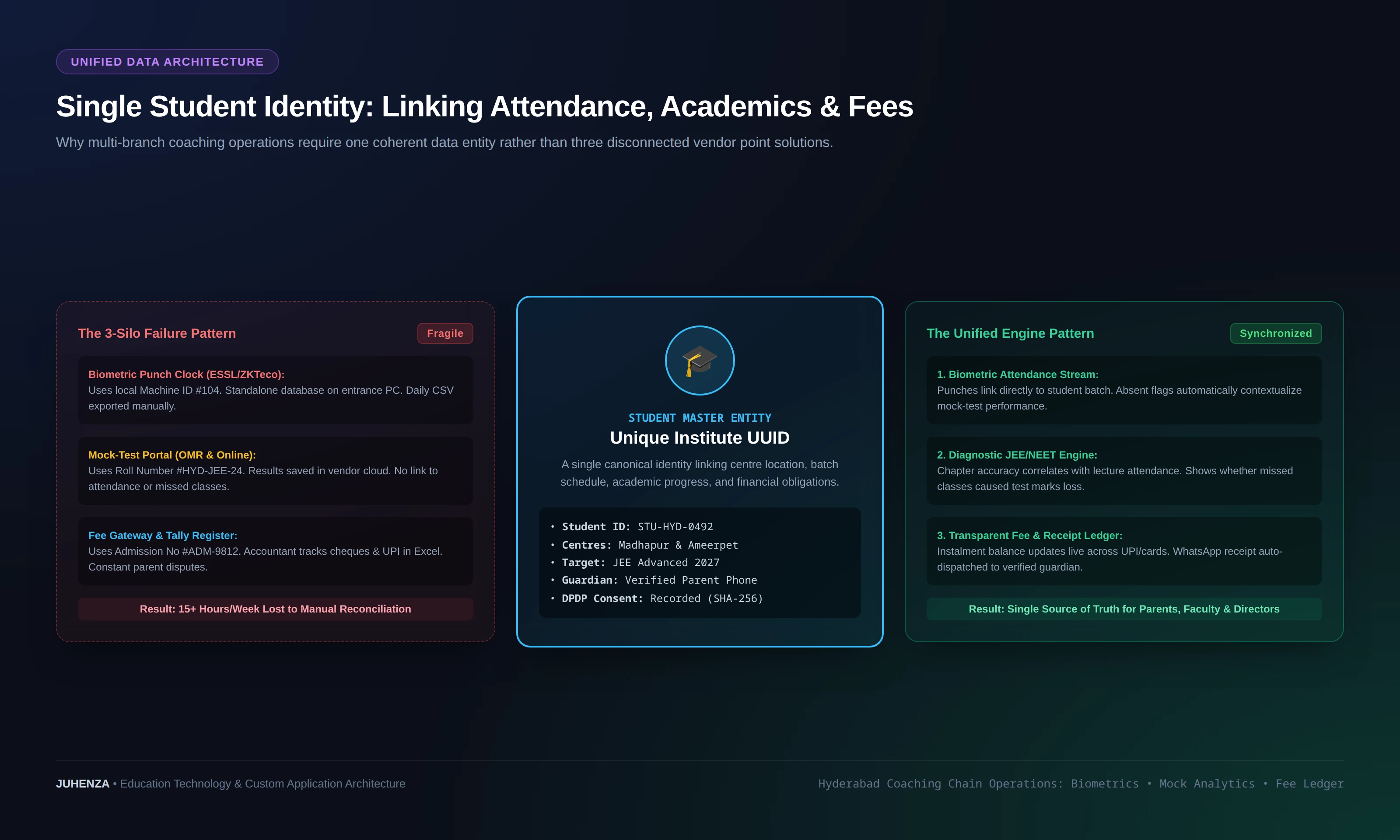 Figure 2: A single student identity links attendance, test analytics, and the fee ledger across branches without manual Excel reconciliation.
This is where generic SaaS demos collapse in practice. A vendor often showcases a biometric attendance module built by one team, a mock-test portal acquired from another, and a fee collection tool bolted on through a payment link API.
Inquire specifically how these modules share student identity, batch codes, centre location, and academic years. If a student carries a fingerprint terminal ID in Madhapur, a separate test roll number in Ameerpet, and an admission reference in the accounts department, your administrative staff will spend dozens of hours every week reconciling data in spreadsheets.
Furthermore, examine role-based access controls (RBAC):
- Executive Directors: Require an aggregated cross-branch view across all centres.
- Centre Heads: Must access operational records strictly within their own facility.
- Faculty: Require academic and attendance analytics restricted to their active teaching batches.
- Parents: Must access only their child's authenticated records.
If permissions are coarse or shared, faculty and branch coordinators will bypass the software with private WhatsApp groups and manual Excel trackers, destroying your data as a single source of truth. Teams evaluating custom enterprise operational platforms can examine our custom software development practice for architectural patterns that enforce unified data schemas.
Question 1: What happens when biometric attendance fails
Ask the vendor to demonstrate the operational fallback live, rather than describing it verbally. Optical fingerprint scanners fail when students arrive with wet or dusty hands, during Hyderabad power fluctuations, during broadband drops, or simply when 200 students converge on two turnstiles at 7:55 AM for an 8:00 AM JEE batch. Facial recognition systems struggle with backlighting, masks, or crowded vestibules.
The question is never whether hardware functions in an air-conditioned demo room; the question is how the centre handles arrival flow at 7:55 AM without creating a street queue.
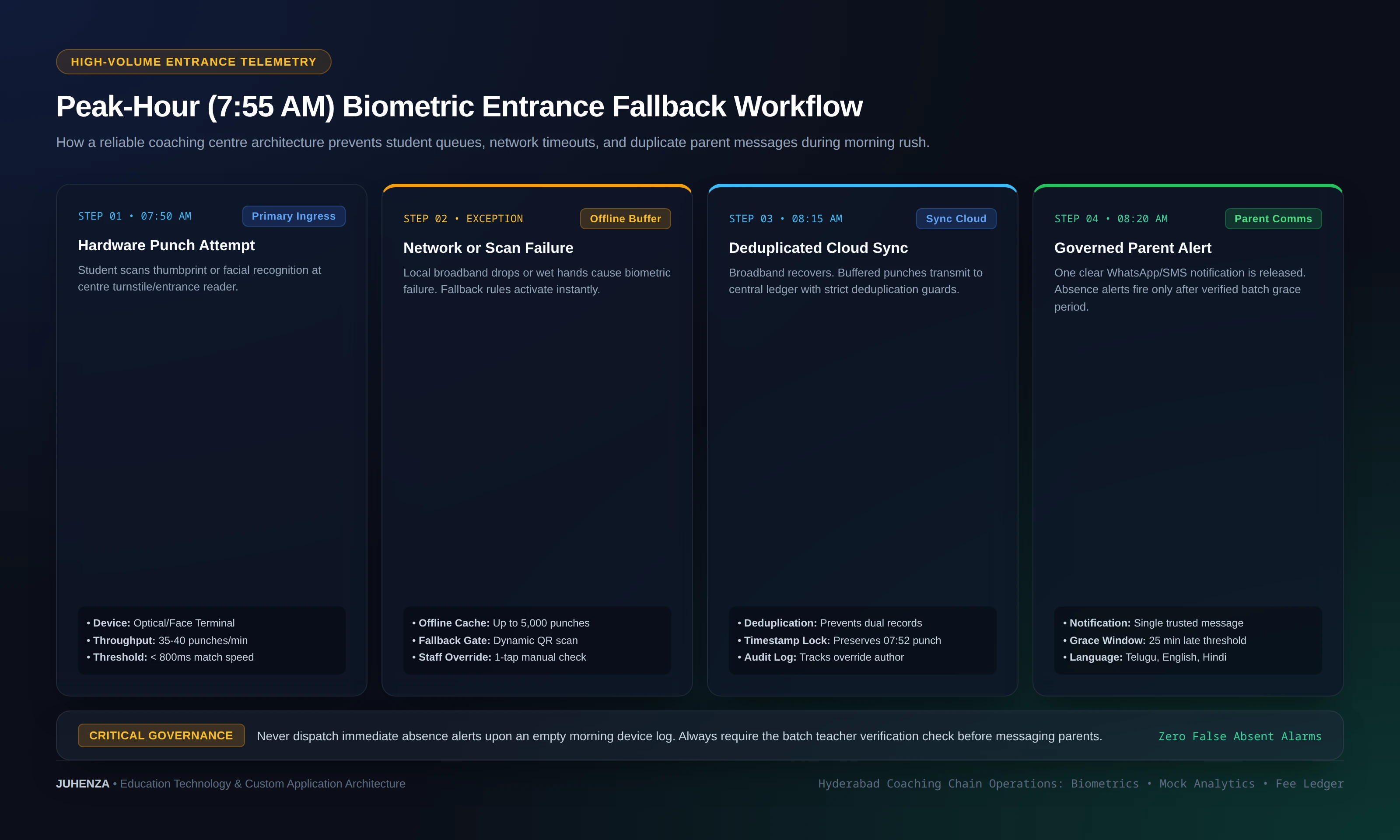 Figure 3: Peak-hour biometric fallback sequence: offline buffering, supervisor QR overrides, deduplicated cloud sync, and governed parent alerts.
Require written answers and contractual commitments for five specific criteria:
- Local offline buffering: The physical device or local gateway must store at least 5,000 punch records in local flash memory during internet outages, syncing automatically once connectivity restores without dropping a single timestamp.
- Throughput capacity: The system must specify verified throughput (e.g., 35–40 successful punches per minute per lane) so you can accurately budget hardware density per centre.
- Structured fallback gates: If biometric verification fails, the system must support dynamic student QR scans on staff tablets or a supervisor override with role-based sign-off.
- Deduplication guards: Software logic must prevent rapid double-taps from generating multiple attendance events, while ensuring an evening punch never overwrites a morning arrival.
- Tamper-evident audit trails: Every manual override or attendance adjustment must log the supervisor's user ID, exact timestamp, and administrative reason.
Demand a concrete list of supported hardware models. Vendors often claim generic compatibility with "all ESSL, ZKTeco, or Realtime biometric devices." Reject vague assertions without a confirmed hardware compatibility list, verified local distributors, and guaranteed on-site maintenance SLAs across Hyderabad.
Question 2: How does attendance reach the parent
Parents do not need repetitive notification spam; they require timely, authoritative information. Request an exact preview of the parent notification interface across present, late, absent, and early departure events. Clarify whether messages dispatch via SMS, official WhatsApp Business API, in-app push notifications, or multi-channel failover, and determine who pays for message delivery.
Scrutinize these operational rules:
- Dispatch timing: Does the notification trigger immediately upon physical punch, after a configurable batch grace window (e.g., 20 minutes post-class start), or in an end-of-day digest?
- Absence threshold: When a student misses morning roll call, does the system automatically cross-reference teacher attendance in the classroom before alerting the parent, preventing false alarms caused by unread biometric scans?
- Contact escalation: If the primary guardian number is unreachable or throttled, does the notification route automatically to the secondary guardian?
- Multilingual support: Can templates render dynamically in Telugu, English, or Hindi depending on family preference?
- Regulatory proof: If a parent blocks WhatsApp marketing or silences app notifications, how does the platform maintain a legally defensible delivery receipt proving the academy fulfilled its notification duty?
Competitors frequently promote "instant notifications." In high-stakes test preparation, an erroneous absence notification sent to a working parent because a broadband router dropped for three minutes creates severe friction. Demand configurable grace intervals and human verification checks before automated parent dispatch.
Question 3: What does mock-test analytics change next week
A numerical test score is merely a record; it is not academic analytics. True diagnostic analytics informs faculty exactly which chapter requires re-teaching, identifies students slipping in specific cognitive competencies, and evaluates whether corrective sessions succeeded.
Provide the vendor with a raw scoring sheet from your most recent mock test—not their pre-formatted sample—and evaluate their analytical engine across these capabilities:
- Granular topic accuracy: Reporting must break down performance by chapter, sub-topic, and question type (e.g., Organic Chemistry: Electrophilic Substitution vs. Reaction Mechanisms), rather than showing gross percentages.
- Time expenditure telemetry: Track seconds spent per question, highlighting students who rush through complex problems or get stranded on single high-difficulty items.
- Examination marking patterns: Strict mathematical handling of negative marking across JEE Main (+4/-1), JEE Advanced (partial marking schemes), and NEET (+4/-1) formats.
- Marks-lost prioritization: Ranking syllabus deficiencies by gross marks surrendered across the batch, directing faculty to the highest-leverage curriculum topics.
- Batch-level heatmaps: Distinguishing whether a poor score reflects an isolated student struggle or an institutional comprehension failure across an entire lecture batch.
- Pre- and post-intervention tracking: Measuring performance shifts on the same topic in subsequent weekly reviews to prove pedagogical intervention efficacy.
Additionally, verify question bank governance: who retains copyright over uploaded questions, how questions are tagged by difficulty and taxonomy, and how the platform processes physical Optical Mark Recognition (OMR) sheets. Given that many Hyderabad institutes maintain hybrid testing models combining physical OMR testing with computer-based tests (CBT), software that supports only digital screens will disrupt your testing calendar.
Question 4: How are results compared across centres
Multi-centre academy chains require standardized comparative metrics. However, student cohorts across Madhapur, Ameerpet, Dilsukhnagar, or Kukatpally often differ in faculty allocation, daily lecture timing, syllabus completion rate, and baseline entrance scores. Unadjusted arithmetic averages misrepresent actual teaching quality.
Evaluate how the platform normalizes cross-centre academic comparisons:
- Identical test conditions: Restricting institutional comparisons to batches that sat the exact same question paper within synchronized testing windows under identical proctoring rules.
- Multi-dimensional slicing: Allowing management to toggle views across centre, batch, faculty member, and subject without requiring CSV data manipulation.
- Transparent ranking models: Plain-language percentile and normalized z-score calculations, avoiding opaque proprietary scoring algorithms.
- Syllabus progress controls: Preventing comparative penalties against a centre that has not yet covered a topic on the centralized test syllabus.
- Executive summary reporting: Generating automated board-level performance decks directly from production databases, eliminating manual data re-entry.
When a vendor responds with "you can easily export everything to Excel for custom analysis," they are conceding that their platform lacks native enterprise reporting. Excel exports should serve as an optional audit backup, not your primary analytical engine.
Question 5: How are fees reconciled across branches
Fee collection is where operational trust is most fragile. A parent insists an instalment was transferred via UPI on Sunday; the centre front desk shows an overdue account; the central finance team sees an unidentified credit in their bank statement.
Require the vendor to trace a single live transaction from parent authorization through payment gateway settlement to student sub-ledger posting:
- Single student ledger: One continuous financial ledger that travels with the student if they transfer between Madhapur and Ameerpet campuses.
- Installment and scholarship rules: Built-in tracking for structured payment schedules, early-bird discounts, sibling concessions, merit scholarships, and late fines, complete with an immutable approval log.
- Omni-channel payment capture: Native handling for UPI payment links, debit/credit cards, net banking, demand drafts, and front-desk cash collections with automated receipt generation.
- Compliant documentation: Immediate generation of branded digital receipts carrying the academy's corporate identity, student enrolment ID, and appropriate GST tax breakdowns where applicable.
- Automated settlement reconciliation: Daily three-way matching between payment gateway settlement files, merchant bank statements, and outstanding student receivables.
- Refund and balance transfer governance: Enforceable multi-level approval workflows for processing fee refunds or inter-centre fee transfers.
While fintech portals simplify parent checkout via WhatsApp, you must confirm gateway account ownership, dispute handling mechanisms, and settlement cycles. A sleek payment link is useless if your accounting team spends month-end manually reconciling unallocated bank credits.
Question 6: What is the full monthly cost
Demand a comprehensive Total Cost of Ownership (TCO) breakdown calculated at your actual student volume, rather than accepting entry-level subscription quotes. Vendor marketing often advertises base plans starting at ₹499 per month or per-student figures like ₹200 per year. These figures represent starting software fees that exclude critical operational infrastructure.
Require a written, binding commercial schedule covering all cost dimensions:
| Cost Component | Pricing Structure & Unit Metrics | Notes & Budgetary Traps |
|---|---|---|
| Platform Licensing | Tiered per-student/year (e.g., 500, 1,000, 2,500 active enrolments) | Confirm whether dormant or alumni accounts incur active seat charges. |
| Biometric Hardware & AMC | One-time device hardware cost + Annual Maintenance Contract (AMC) | Inquire about local on-site replacement guarantees in Hyderabad. |
| Parent WhatsApp Messaging | Per-conversation charges based on Meta Business API rates | Distinguish utility notifications from promotional campaigns. |
| Payment Gateway MDR | Transaction percentage + applicable GST | Standard domestic gateway rates average 2% + GST per Razorpay published pricing. |
| Implementation & Training | One-time onboarding, data migration, and faculty training fees | Ensure scope includes historical fee and student record import. |
| Custom Engineering & SLAs | Hourly development rates for custom reports and guaranteed ticket SLAs | Clarify response time guarantees for morning entrance outages. |
On payment gateway integration, verify whether your institute contracts directly with the RBI-regulated payment aggregator (such as Razorpay, Cashfree, or PayU) or operates under a vendor sub-merchant account. Retaining your own merchant gateway account ensures direct settlement into your bank account and avoids third-party escrow delays.
Question 7: Who owns the data and how do we exit
This is the most critical question in enterprise procurement, and the one vendor sales decks deliberately obscure. If your academy cannot transition away from a software vendor cleanly with complete historical data, you do not own your operational infrastructure.
Require explicit contractual commitments for data sovereignty and exit procedures:
- Unconditional data ownership: The contract must state in unequivocal terms that all student profiles, attendance timestamps, mock-test results, fee transaction histories, and parent contact databases remain the exclusive property of the coaching institute.
- Standardized data export: Full data extraction must be guaranteed in unencrypted, industry-standard formats (such as relational SQL dumps or structured JSON/CSV files)—never restricted to locked PDF reports.
- Contractual exit window: A defined 30- to 60-day exit transition period during which the vendor must provide API access or database exports at no additional punitive fee.
- Verified data purging: Written certification that all institutional records, student biometrics, and parent phone numbers are purged permanently from vendor backup servers following successful migration.
- Sub-processor disclosures: Full written disclosure of all third-party sub-processors, including cloud hosting providers, SMS gateways, WhatsApp business partners, and analytics tools.
- Disaster recovery SLAs: Documented Recovery Point Objectives (RPO) and Recovery Time Objectives (RTO) for recovering from hardware or data centre outages.
When engaging custom development partners, demand full code and repository ownership. As reflected in JUHENZA's architectural principles, custom enterprise software builds remain strictly private to the client, with full source code, deployment scripts, and database credentials handed over upon project completion.
Question 8: How is consent handled for students under 18
Deploying biometric attendance systems for minor students carries severe regulatory responsibilities. Under India's Digital Personal Data Protection Act, 2023, a child is defined as an individual under the age of eighteen. Section 9 of the DPDP Act mandates that a Data Fiduciary must obtain verifiable consent from the parent or lawful guardian prior to processing any personal data belonging to a child.
(Disclaimer: This section provides technical and operational architecture analysis and does not constitute formal legal counsel. Enterprise academies must consult qualified legal practitioners regarding their specific statutory compliance obligations.)
Require the vendor to demonstrate their compliance mechanics in live software:
- Verifiable guardian consent logging: How the platform captures, timestamps, and cryptographically stores verifiable parental consent during student admission, linking the consent token directly to the guardian's verified mobile number or Aadhaar-based OTP.
- Biometric template governance: Where facial embeddings or fingerprint minutiae templates are stored (on local device hardware versus centralized cloud servers), how they are encrypted at rest (AES-256), and the exact data retention schedule.
- Non-biometric operational fallback: The platform must provide an equally functional, non-biometric alternative (such as RFID smartcards or secure mobile QR badges) for parents who decline biometric processing for their child.
- Prohibition on minor tracking: Verifying that student profiles and behavioural usage logs are never processed for targeted advertising, commercial behavioral profiling, or sold to third-party academic aggregators.
- Right to correction and erasure: Providing a streamlined administrative mechanism for parents to review, correct, or request deletion of their child's stored personal data.
If a vendor cannot show a dedicated consent management interface that maps each enrolled minor to an authenticated parental sign-off record, do not deploy biometric terminals based on casual sales assurances.
Score it in one sitting
Evaluate vendor candidates using this disciplined scoring rubric during formal product demonstrations. Assign points based on verifiable proof:
- 0 Points: Verbal assurance or sales assertion without demonstration.
- 1 Point: Demonstrated in a generic staging sandbox.
- 2 Points: Verifiable live test on your centre data or confirmed by an explicit contract clause.
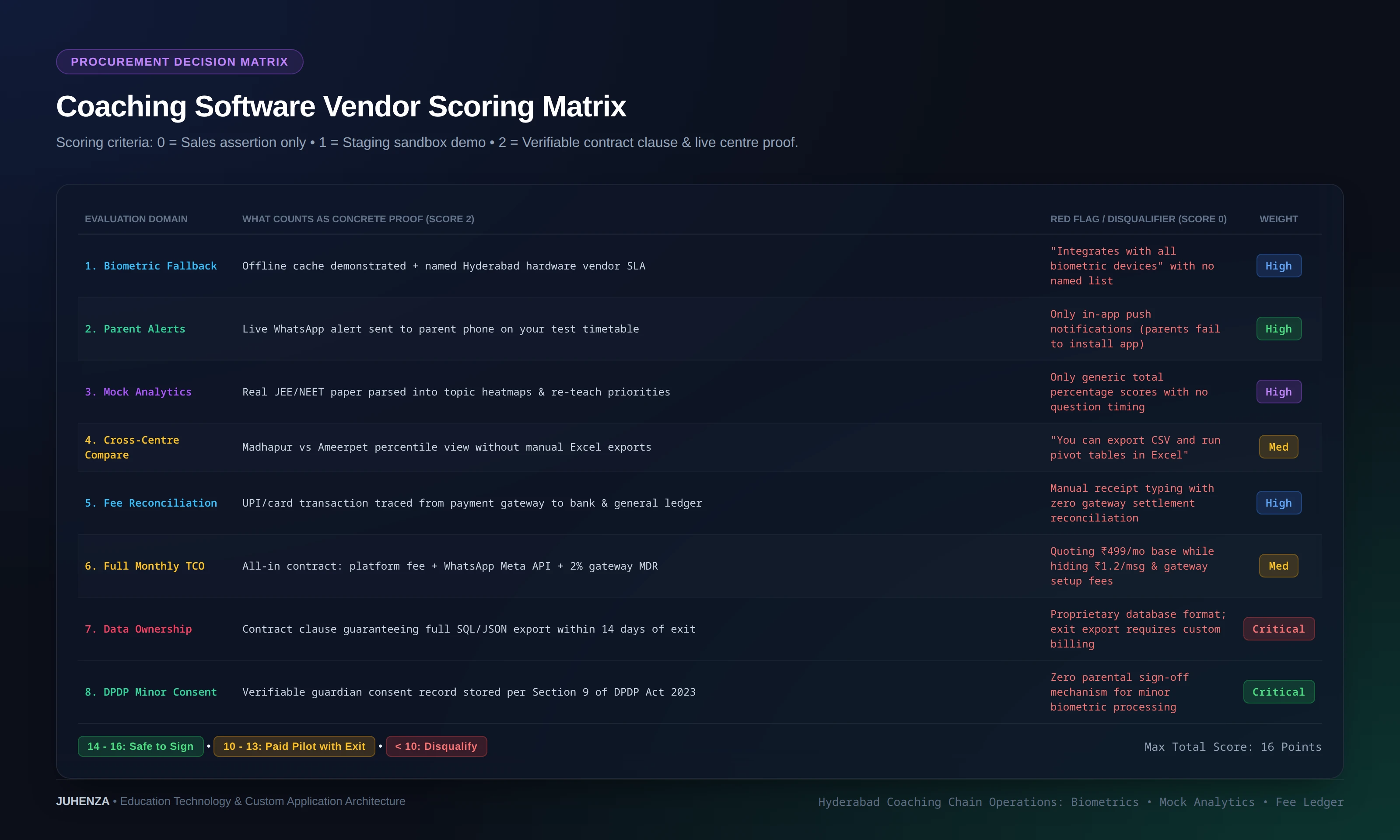 Figure 4: Scoring framework: 0 = Sales assertion only, 1 = Staging sandbox demo, 2 = Contract clause & live centre proof.
| Evaluation Domain | Verification Criteria (2-Point Benchmark) | Score (0–2) |
|---|---|---|
| 1. Biometric Fallback | Demonstrated offline punch cache + named local hardware SLA | |
| 2. Parent Notifications | Verified WhatsApp/SMS alert dispatched on your timetable | |
| 3. Mock-Test Analytics | Diagnostic chapter heatmap and marks-lost ranking on real exam paper | |
| 4. Cross-Centre Compare | Multi-branch percentile view without manual Excel data export | |
| 5. Fee Reconciliation | Three-way transaction match: parent payment to bank to ledger | |
| 6. Total Monthly TCO | All-inclusive written cost schedule including gateway MDR and WhatsApp fees | |
| 7. Data Ownership & Exit | Contract clause guaranteeing unencrypted SQL/JSON dump within 14 days | |
| 8. DPDP Minor Consent | Verifiable guardian consent mechanism stored per Section 9 compliance | |
| Total Score | Maximum Possible Score: 16 Points | / 16 |
Decision Thresholds
- 14 – 16 Points (Procure): Exceptional engineering and legal maturity. Safe to proceed to commercial contracting.
- 10 – 13 Points (Conditional Pilot): Acceptable core functionality but deficiencies in contract terms or hardware SLAs. Require a 30-day paid pilot with written exit clauses before multi-year commitment.
- Below 10 Points (Disqualify): Fragile integration architecture, hidden operational fees, or unaddressed regulatory risks. Disqualify immediately.
An illustrative centre scenario
(The following scenario illustrates typical multi-branch operational dynamics across Hyderabad coaching academies rather than a specific client engagement.)
Consider an established entrance coaching academy operating two campuses: a primary facility in Madhapur and an intensive secondary branch in Ameerpet, collectively managing 600 students across Class 11, Class 12, and repeaters targeting JEE and NEET.
On a rainy Monday morning, the broadband line at the Ameerpet facility suffers a junction box failure at 7:48 AM. Over 180 students arrive simultaneously for 8:00 AM lectures.
Under a fragile architecture, turnstiles freeze, students crowd the hallway, front-desk staff attempt to record names on paper pads, and panicked parents receive automated "student absent" warnings at 8:30 AM because the cloud database registered no punches.
Under a resilient, unified architecture:
- The biometric terminals detect network failure and transition seamlessly to offline mode, capturing and buffering thumbprint minutiae in local memory with millisecond response times.
- At 8:14 AM, the local internet connection restores. The terminals execute an idempotent synchronization protocol with the cloud server, transferring 184 buffered records while deduplicating timestamps.
- The parent notification engine verifies attendance against the active classroom roster, identifying two legitimate late arrivals and dispatching accurate WhatsApp arrival confirmations to parents.
- On Saturday, both campuses sit a synchronized NEET diagnostic exam. By 6:00 PM, the academic platform generates cross-campus heatmaps revealing that while Madhapur students mastered Optics, Ameerpet students lost significant marks due to pacing errors in Organic Chemistry.
- On Monday morning, the central finance controller views a unified reconciliation dashboard showing 48 fee instalments settled through the parent portal over the weekend, three failed UPI attempts queued for administrative follow-up, and an inter-branch transfer balance automatically updated without touching a spreadsheet.
Common mistakes, limitations and when to involve a specialist
Enterprise coaching operations frequently encounter common strategic errors during software procurement:
- Procuring based on feature quantity: Selecting software boasting 150 administrative features while failing to verify whether attendance and fee reconciliation work reliably under peak load.
- Accepting generic hardware claims: Purchasing biometric devices from third-party retailers without verifying firmware integration with your software platform.
- Ignoring recurring communication charges: Budgeting for base software licenses while overlooking substantial monthly WhatsApp Business API consumption fees during peak testing cycles.
- Permitting shadow spreadsheet systems: Allowing faculty to maintain disconnected spreadsheets because software permissions are too rigid or reporting is inadequate.
- Overlooking DPDP compliance: Capturing minor biometric data without verifiable parental consent records, exposing the academy to substantial regulatory liability under Indian data privacy law.
Implementation Limitations
This checklist evaluates administrative and technical software architecture. It does not replace formal legal review of commercial vendor contracts, cyber security penetration testing, or academic evaluation of question bank pedagogical quality. If a prospective vendor refuses to permit a live test on your timetable, treat that refusal as a definitive signal to pause procurement.
When to Involve a Software Engineering Specialist
Engage specialized software architects when your academy manages over 1,500 students across three or more physical campuses, operates bespoke entrance testing workflows, requires bi-directional synchronization with custom financial ledgers, or demands complete intellectual property ownership over its digital infrastructure. Explore our ERP and system integration consulting services for tailored architectural guidance.
(JUHENZA Practitioner Note: In custom administrative and ERP builds for multi-centre education networks across India, the most frequent failure point is assuming that off-the-shelf biometric punch clocks and third-party fee links share a reliable student ID. When network cuts hit during morning batch arrivals or parents pay through unlinked UPI handles, disconnected systems create dozens of hours of manual reconciliation. By enforcing a single unified student data model, offline punch buffering, and automated fee gateway reconciliation with strict DPDP-compliant parent consent records, coaching chains reduce administrative overhead by over 75% while protecting student data privacy.)
Frequently asked questions
Can a single software system reliably manage biometrics, test analytics, and fees across multiple branches?
Yes, provided the software is architected around a single canonical student master entity rather than cobbled together from disconnected third-party tools. Require the vendor to demonstrate live synchronization of a single student profile across attendance logs, academic scorecards, and the fee ledger without manual CSV exports.
Which biometric verification method is best suited for Hyderabad coaching centres?
High-throughput optical fingerprint terminals combined with facial recognition readers provide the best balance of speed and cost. For peak morning arrivals, ensure terminals achieve throughput of at least 35 punches per minute. Dynamic QR code scanning on supervisor tablets must always be configured as a zero-downtime fallback.
How quickly should mock-test analytics be available to faculty?
Diagnostic analytics for objective, auto-evaluated exams (such as JEE Main and NEET) should be available within hours of test completion. Immediate same-day analytics allows faculty to adjust their lesson plans for the upcoming week based on demonstrated topic deficiencies.
Do parents need to install a mobile app to pay institute fees?
No. Modern educational payment workflows allow parents to receive secure, branded payment links directly via official WhatsApp Business channels or SMS, enabling instant settlement via UPI, credit cards, or net banking without mandatory app downloads.
What data ownership clauses must be included in the vendor contract?
The contract must explicitly state that all institutional data belongs exclusively to the academy, mandate full data export capabilities in unencrypted SQL/JSON formats within 14 to 30 days of notice, prohibit vendor data retention following termination, and disallow any third-party commercial profiling of students.
How does the DPDP Act 2023 impact coaching institutes processing minor data?
Section 9 of the DPDP Act requires verifiable parental consent prior to processing the personal or biometric data of minors under eighteen. Institutes must store verifiable guardian sign-offs, maintain non-biometric attendance alternatives, and ensure student records are never leveraged for targeted advertising or commercial tracking.
Where this fits
This decision framework sits within JUHENZA's Education Technology and Custom Software Practice. It complements our engineering blueprints on enterprise application development, secure API architectures, and automated operational reconciliation across multi-branch organizations.
Next step
Take this 8-question evaluation scorecard into your next software procurement meeting. If your academy requires an engineered, custom coaching management system or an enterprise integration layer that unifies your existing biometric hardware, academic testing engines, and payment gateways under total institutional ownership, Discuss your project with our engineering team at JUHENZA. Share your centre count, student volume, and current toolchain for an objective technical roadmap.
External references
- Digital Personal Data Protection Act, 2023 (Section 9 - Processing of Personal Data of Children) — Ministry of Electronics and Information Technology, Government of India.
- Razorpay Standard Domestic Payment Gateway Pricing — Standard domestic payment gateway transaction fees and merchant settlement specifications.
