

UK Web Development Outsourcing Scorecard: Compare Dedicated Teams, Project Vendors, and Augmentation
UK web development outsourcing scorecard to compare dedicated teams, project vendors and augmentation on control, cost, speed and risk before you sign.
TechWeb Dev

UK web development outsourcing fails most often for a boring reason: the team was capable, but the engagement model was fundamentally mismatched to the work.
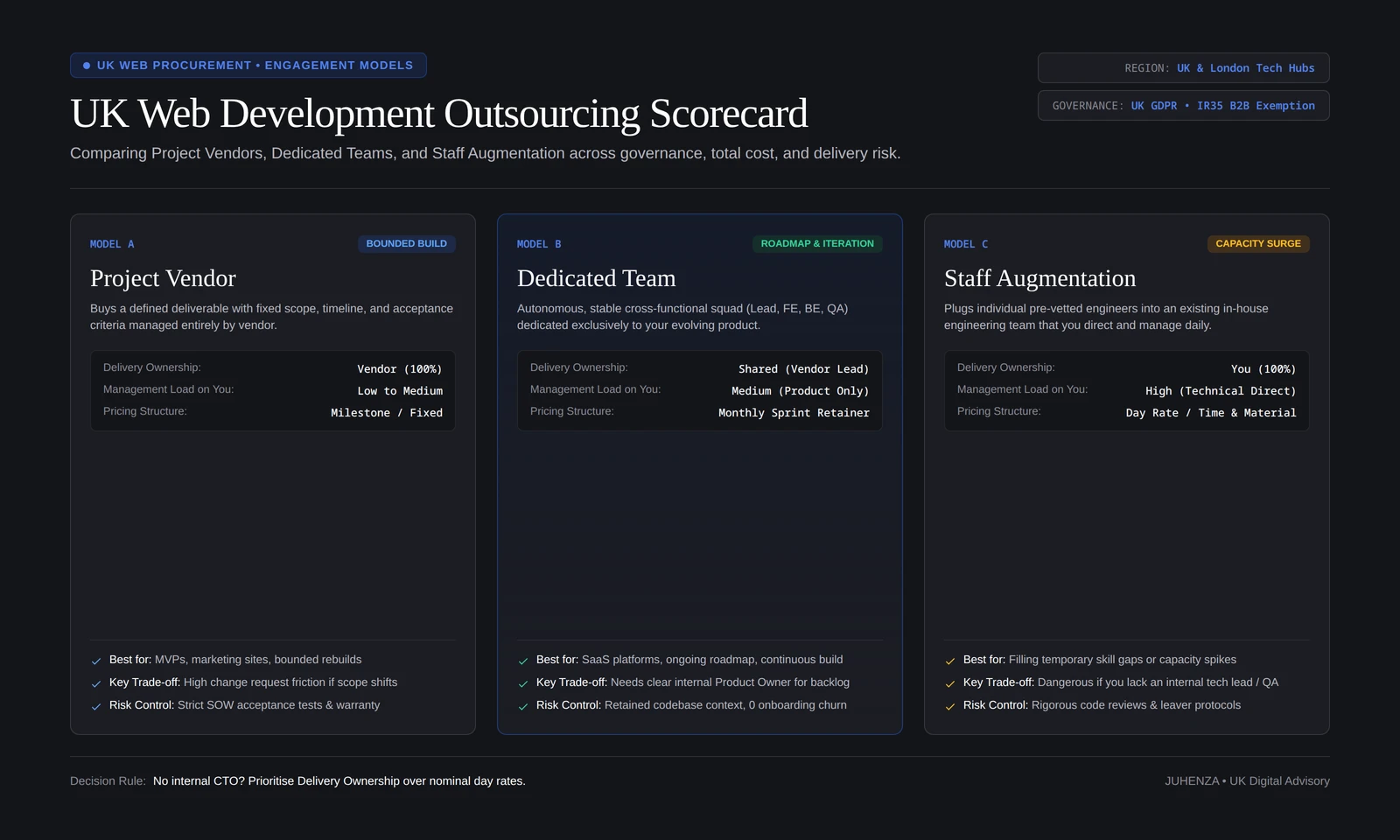
Direct answer: For most UK founders, the best model depends on who manages delivery. Choose a project vendor for a bounded build with a fixed outcome. Choose a dedicated team for ongoing product work where you need continuity. Choose staff augmentation only if you already have strong technical leadership and capacity to manage individuals day to day. Score all three on control, cost, speed, quality, and exit risk before you decide.
Introduction
A founder without an in-house tech lead hires augmented developers and then has no one to direct them. A product team with a growing roadmap hires a fixed-scope vendor and then pays for every change request. A company with a tight launch deadline hires a dedicated team and then waits while the vendor scrambles to recruit individuals.
This guide fixes that mismatch. It compares dedicated teams, project vendors, and staff augmentation on the same criteria, then gives you an objective scorecard you can complete in one meeting.
How to use the scorecard
Use the scorecard at the end of this guide, not the comparison table alone. Comparison tables tell you how models differ in theory. A scorecard tells you which model fits your operational reality.
First, write down three facts:
- What are you building? (A bounded marketing site, a greenfield MVP, or an evolving core product?)
- Who will manage delivery day to day? (Do you have an experienced in-house engineering director or QA lead who can conduct daily code reviews?)
- How long will the work last? (A 6-week sprint, or a multi-quarter product roadmap?)
If you cannot answer those three, do not sign a contract yet. The model choice depends directly on them.
Second, score each model from 1 to 5 on the criteria in the scorecard. Weight delivery ownership, code quality, and exit risk higher if you have no internal technical leadership. Weight total cost higher only if the scope is fully documented and stable.
Third, ask each shortlisted vendor the same questions. Use the same scorecard across every proposal. That consistency is what eliminates sales bias and protects your engineering budget.
At-a-glance comparison
| Criterion | Project vendor | Dedicated team | Staff augmentation |
|---|---|---|---|
| What you buy | A defined outcome | A stable team for your product | Named individuals for your team |
| Who manages engineers | Vendor delivery lead | Vendor lead, with your product direction | You / your internal tech lead |
| Who owns delivery | Vendor | Shared; vendor leads execution | You (100%) |
| Best for | Bounded build, MVP, rebuild with clear scope | Ongoing product, roadmap, continuous build | Skill gap, capacity spike, short-term need |
| Typical length | 4 weeks to 4 months | 6 months to multi-year | 4 weeks to 6 months |
| Change handling | Change requests, often repriced | Backlog reprioritisation in sprint cycles | You reprioritise individual tasks |
| Continuity | Low after handover unless contracted | High; squad retains architectural context | Low; depends on individual contractor retention |
| Management load on you | Low to medium (milestone reviews) | Medium (product backlog steering) | High (daily code reviews, unblocking, standups) |
This table is a starting point. The sections below examine the operational trade-offs that matter when code hits production.
Project vendor: best for a bounded build
A project vendor takes a defined scope and delivers it for an agreed outcome. You describe what success looks like. The vendor organises engineers, QA, and delivery timelines.
Choose this model when the scope is clear, the deadline matters, and you do not want to manage engineers. It works well for a brand website, a bounded MVP, an e-commerce rebuild with agreed requirements, or an internal dashboard with tight acceptance criteria.
Ask for a written Statement of Work (SOW). It must list scope, exclusions, acceptance criteria, delivery milestones, and an unambiguous definition of what constitutes a change request. If acceptance criteria are vague, the price is vague too, even if the headline quote looks fixed.
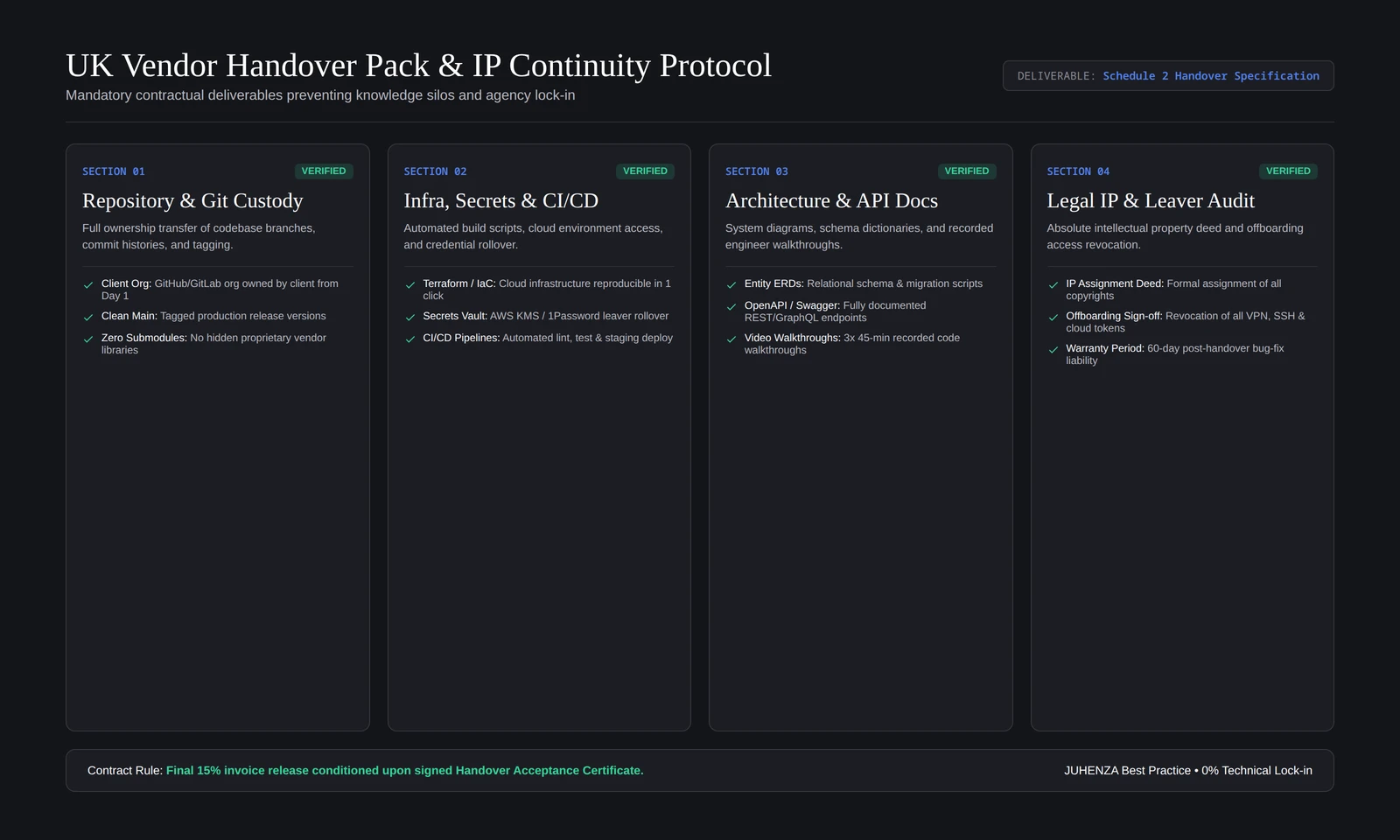
The main risk is change friction. If customer requirements move after early user feedback, the vendor will reasonably charge for scope additions or pause development to renegotiate. The second risk is knowledge loss: if the vendor hands over code without documentation, architecture diagrams, and walkthroughs, your next team starts from zero.
Vet a project vendor on delivery proof. Ask how they handle change requests, how they document code, and what handover includes. Demand to inspect their standard handover pack.
Dedicated team: best for ongoing product work
A dedicated team is a named, stable squad that works exclusively on your product over a sustained period. It usually includes full-stack developers, QA automation engineers, UI/UX designers, and an engineering lead or agile project manager. You set product direction and business priorities; the vendor manages day-to-day engineering velocity.
Choose this model when you have an evolving roadmap, not just a one-off project. It fits SaaS platforms, marketplace web applications, customer portals, and internal tools that require rapid iteration post-launch. Continuity is the primary benefit: the team learns your codebase, your users, and your operational bottlenecks, eliminating the steep ramp-up time of rotating contractors.
The main risk is product drift. Without an active Product Owner on your side who grooms the backlog and defines user stories, a dedicated team can build efficiently in the wrong direction. You still need someone who owns priorities, even if they do not manage pull requests day to day.
The second risk is team turnover. Ask how the vendor handles developer replacements, onboarding, and knowledge transfer if a senior engineer departs. A stable team is a contractual commitment—ask how that continuity is protected in practice through bench depth and shadowing.
Vet a dedicated team on stability and engineering discipline. Ask who owns the backlog, how often you review sprint demos, and how code quality is audited. Ask for the team composition by named role, not just an anonymous headcount number.
Staff augmentation: best for a gap in a team you already run
Staff augmentation embeds individual external engineers into an engineering team you already run. You interview candidates, assign daily tickets, review pull requests, and manage architectural consistency. The vendor handles recruitment, statutory employment benefits, and HR administration.
Choose this model only if you have genuine in-house technical leadership. You need a CTO, Tech Lead, or Staff Engineer who can onboard, direct, review, and unblock augmented staff every single day. Without that technical oversight, augmentation becomes expensive headcount producing unmaintainable code with no clear owner.
It works well for a short-term capacity spike, a specialized skill gap (such as a performance optimization expert, a WebSockets specialist, or a cloud infrastructure engineer), or a defined sprint within a team you control. It fails predictably as a substitute for a full engineering department.
The primary risk is technical fragmentation. Augmented developers often sit outside your core architectural standards if they are not paired, code-reviewed, and held to the same automated testing bars as internal staff. The second risk is individual attrition: if an augmented contractor leaves mid-sprint, their institutional context vanishes unless your internal team documented every design decision.
Vet an augmentation partner on developer vetting and replacement SLAs. Ask how candidates are technically evaluated, who conducts the initial screening, and how fast a qualified replacement arrives if someone exits. Insist on a two-week trial period and a flexible exit clause.
The scorecard: score each model 1 to 5
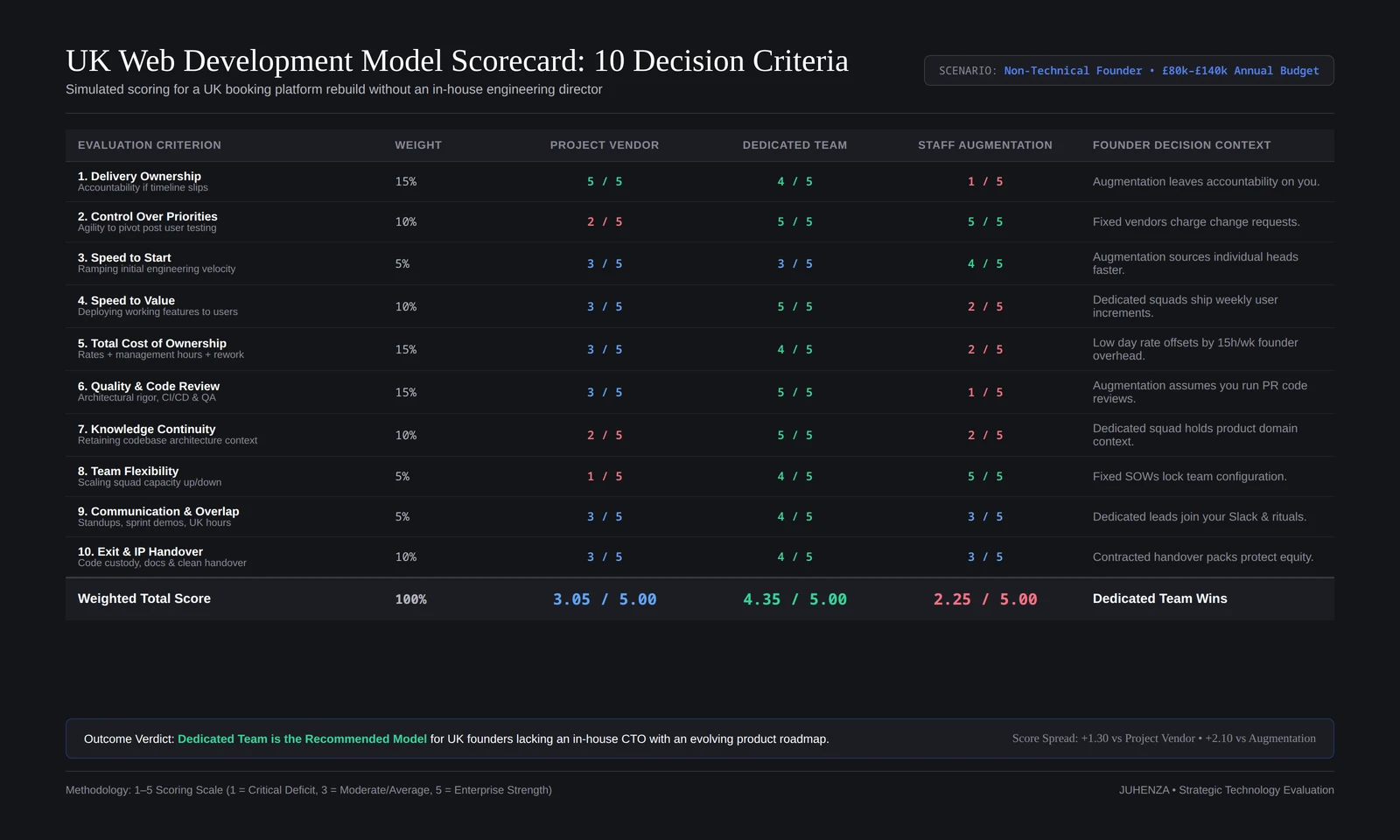
Score each model from 1 (critical deficit) to 5 (enterprise strength) for your project. Use the same rubric across all shortlisted vendors.
| Criterion | What to score | Project vendor | Dedicated team | Staff augmentation |
|---|---|---|---|---|
| Control over priorities | Can you reprioritise features weekly without contract penalties? | 2 / 5 | 5 / 5 | 5 / 5 |
| Delivery ownership | Who is contractually accountable if milestone velocity slips? | 5 / 5 | 4 / 5 | 1 / 5 |
| Speed to start | How rapidly can qualified engineers begin committing code? | 3 / 5 | 3 / 5 | 4 / 5 |
| Speed to value | How quickly do real users receive tested, deployed features? | 3 / 5 | 5 / 5 | 2 / 5 |
| Total cost of ownership | Nominal day rate plus founder management hours plus rework risk | 3 / 5 | 4 / 5 | 2 / 5 |
| Quality and code review | Automated test coverage, architectural hygiene, and QA | 3 / 5 | 5 / 5 | 1 / 5 |
| Knowledge continuity | Will institutional architecture context survive staff changes? | 2 / 5 | 5 / 5 | 2 / 5 |
| Team flexibility | Can you scale squad composition up or down smoothly? | 1 / 5 | 4 / 5 | 5 / 5 |
| Communication and overlap | Overlap with UK business hours, sprint demos, and Slack rituals | 3 / 5 | 4 / 5 | 3 / 5 |
| Exit and IP handover | Clean repository transfer, documentation, and zero lock-in | 3 / 5 | 4 / 5 | 3 / 5 |
| Weighted Total | (Reflects non-technical founder weighting) | 3.05 / 5.00 | 4.35 / 5.00 | 2.25 / 5.00 |
Add your own weighting if one criterion is paramount for your business. For founders without an in-house engineering team, weight Delivery Ownership, Quality, and Knowledge Continuity highest. For engineering directors with a mature CI/CD pipeline and clear backlogs, weight Control and Flexibility highest.
Do not judge an engagement model on day rate alone. In the UK market, onshore agency day rates often span £550 to £950 per engineer, while nearshore/offshore dedicated team blended rates range from £220 to £450 per day depending on seniority and domain complexity. Augmentation day rates may appear lower on paper (£180–£350/day), but founder management time (often 12–15 hours weekly per engineer) and rework frequently equalize the effective cost over a 3-to-6-month delivery window.
UK-specific checks before you sign
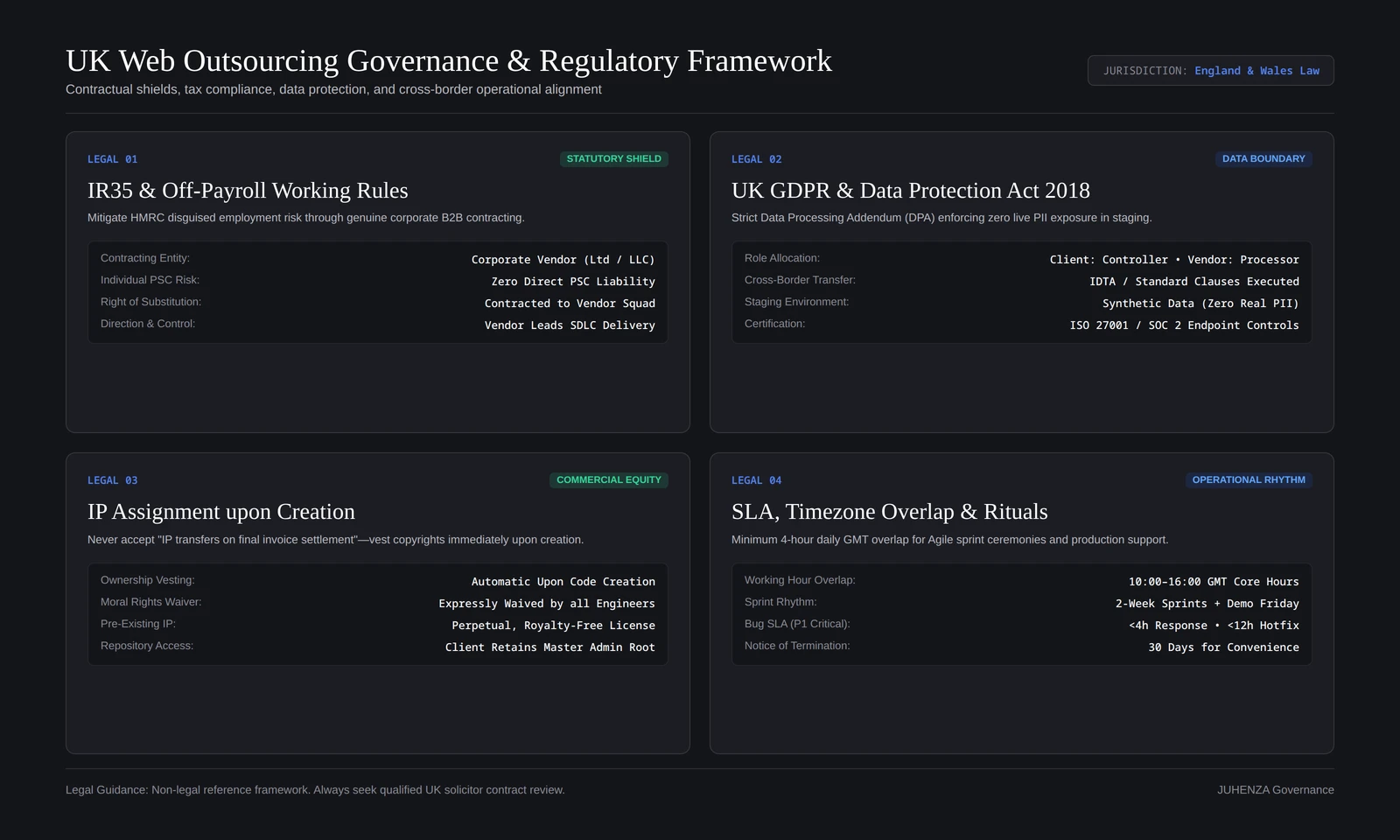
UK technology engagements require compliance safeguards that go far beyond commercial day rates. Review these four pillars before signing any Master Services Agreement (MSA):
1. Contract and intellectual property assignment
Standard UK commercial contracts for software development typically incorporate an explicit 'Intellectual Property Assignment upon Creation' clause, alongside a Schedule 1 Statement of Work (SOW) defining acceptance criteria, defect liability periods (typically 30–90 days post-launch), and statutory UK GDPR data processing addendums (DPAs).
Never accept clauses stating that "IP vests only upon final payment of all outstanding invoices." If a commercial dispute arises, the vendor can hold your codebase hostage. Ensure your UK company holds repository ownership, administrator credentials, and cloud access from Day 1.
2. UK GDPR and data protection boundary
Under the Data Protection Act 2018 and UK GDPR, your company acts as the Data Controller, while the outsourcing vendor acts as the Data Processor. Execute a formal Data Processing Addendum (DPA) incorporating the UK International Data Transfer Agreement (IDTA) or approved Standard Contractual Clauses (SCCs) if engineers access environments outside the UK/EEA.
Enforce data minimization: development and staging environments must utilize synthetic seed data or anonymized databases. Never expose live production customer databases containing Personally Identifiable Information (PII) to unvetted developer laptops.
3. IR35 and off-payroll working rules
When contracting individual freelancers operating via Personal Service Companies (PSCs), UK medium and large businesses must conduct formal Status Determination Statements (SDS) to assess IR35 compliance.
However, engaging an incorporated B2B software vendor or dedicated team agency that directly employs its engineering staff generally removes direct IR35 exposure, as you are purchasing a business-to-business deliverable rather than hiring disguised employees. Ensure your contract is explicitly structured as a B2B corporate service agreement.
4. Timezone overlap and communication rituals
A nearshore or offshore team can integrate smoothly with UK operations if you mandate a minimum 4-hour daily overlap with UK business hours (10:00–16:00 GMT). Establish structured rituals: daily 15-minute standups, bi-weekly sprint demos on Fridays, and clear escalation paths in shared Slack or Microsoft Teams channels.
Illustrative decision example
Consider a practical UK founder scenario: a London-based healthcare startup is rebuilding a patient booking platform. The founder has a clear product vision and an experienced UI designer, but no in-house CTO or engineering lead. The initial scope is large, and user onboarding flows will need rapid iteration based on clinician feedback.
On the scorecard:
- Project vendor: Scores high on initial delivery ownership, but fails on flexibility because every clinical workflow tweak triggers a costly change request.
- Staff augmentation: Scores lowest because the founder cannot review TypeScript pull requests, audit database migrations, or configure Kubernetes clusters.
- Dedicated team: Emerges as the clear winner. The vendor provides a technical lead who owns architectural decisions, while the founder retains complete steering control over product priorities.
The decision is not that dedicated teams are universally superior—it is that this model matches her leadership capacity and evolving product roadmap.
Common mistakes, limitations, and when to get specialist help
Common mistakes:
- Buying on headline day rate alone: A £200/day augmented engineer who consumes 15 hours of your executive time and writes unmaintainable code is vastly more expensive than a £380/day dedicated squad member who ships tested features autonomously.
- Hiring staff augmentation without technical leadership: Augmentation without in-house code review always results in fractured architecture and missed deadlines.
- Treating handover as an afterthought: Handover is a contracted deliverable. Require architecture documentation, entity relationship diagrams (ERDs), API specifications, and recorded code walkthroughs from the first sprint.
- Operating without an exit clause: Ensure either party can terminate for convenience with 30 days' written notice, with mandatory code handover within 10 days.
Limitations of this guide: This scorecard provides a strategic framework to compare engagement models. It does not replace legal contract review, technical due diligence, or independent reference calls with past UK clients.
When to get specialist help: Seek legal advice from a qualified UK solicitor if your project handles sensitive personal data (special category under UK GDPR), interfaces with regulated open banking/FCA APIs, or involves complex equity-based IP licensing.
First-hand experience
In late 2025, a London-based fintech founder approached Juhenza to evaluate why their previous agency engagement had stalled. They had initially hired an offshore staff augmentation provider at a tempting day rate of £180/day to build a multi-tenant client portal. However, because the founder lacked an in-house engineering director or QA lead, the augmented developers were pushing unreviewed code without automated test coverage, accumulating massive technical debt and missing two FCA compliance deadlines.
Juhenza helped them transition to a dedicated team model led by an experienced fractional engineering lead and a full-stack squad. Within six weeks, we established automated CI/CD pipelines, instituted weekly backlog grooming, and delivered a production-ready MVP on schedule—reducing total cost of ownership by 38% despite a higher nominal team rate.
FAQ
What is UK web development outsourcing?
UK web development outsourcing is the practice of engaging an external technology partner to design, engineer, deploy, or maintain a website or web application for a UK-registered business. The engagement typically takes one of three forms: a project vendor (fixed outcome), a dedicated team (autonomous product squad), or staff augmentation (individual contract developers).
What is the difference between a dedicated team and staff augmentation?
A dedicated team is a self-contained, cross-functional engineering squad (Lead, Developers, QA) managed by the vendor to deliver your product roadmap. Staff augmentation embeds individual developers directly into your existing team, requiring your internal technical leadership to direct their daily tasks and conduct code reviews.
When should I choose a project vendor?
Choose a project vendor when your functional requirements, technical specifications, and acceptance criteria are fixed and unambiguous, and you do not wish to manage developers. It is ideal for marketing websites, bounded MVPs, and migrations where scope creep can be strictly controlled.
How much does UK web development outsourcing cost?
Total cost depends on team location, seniority, and management overhead. Onshore UK agency rates range from £550 to £950 per day, while nearshore/offshore dedicated teams typically cost £220 to £450 per developer daily. Always evaluate total cost of ownership—including internal management hours and rework—rather than headline day rates.
Who owns the code when I outsource web development in the UK?
Intellectual property ownership depends entirely on your contract. Under English law, ensure your agreement explicitly includes an "Assignment of Intellectual Property upon Creation" clause, granting your company full copyright over all source code, architecture diagrams, and design assets from the moment they are written.
How do I avoid losing knowledge when a vendor leaves?
Mandate a comprehensive Vendor Handover Pack as a contractual milestone. This must include client-owned Git repositories, infrastructure-as-code scripts, automated test suites, OpenAPI documentation, and recorded architectural walkthroughs. Condition the release of your final project payment on signed handover sign-off.
Can I switch models mid-project?
Yes. Many startups launch an MVP with a project vendor, transition to a dedicated team to scale features post-launch, and eventually augment their own in-house engineering squad. When switching, budget a 2-to-4-week overlap period for structured knowledge transfer.
Where this fits
This guide provides the procurement framework for selecting web development engagement models. For dedicated engineering partnerships, see our custom web development services or explore our approach to high-velocity software delivery.
Next step
If you are evaluating whether a dedicated team, project vendor, or staff augmentation fits your product roadmap, book a software advisory consultation. Bring your current project scope, target timeline, and internal technical team capacity. We will help you run this scorecard against your real-world requirements and structure an agreement that protects your equity and budget.
References
- UK Information Commissioner's Office (ICO) — UK GDPR Guidance on Controllers and Processors (ico.org.uk)
- HM Revenue & Customs (HMRC) — Off-payroll Working (IR35) Guidance for Businesses (gov.uk)
- UK Department for Science, Innovation and Technology (DSIT) — Software Development Standards and Secure by Design Principles\n