

Wix Polish vs Rebuild: A Five-Test Decision for Consulting Owners
Should you polish your Wix site or rebuild it? Use a five-test framework built for consulting owners, with SEO migration risks and clear next steps.
Web DevTech

Direct answer: Polish your Wix site when the structure, service positioning, and lead path are fundamentally sound, and the friction is cosmetic styling or mobile typography. Rebuild when the platform itself blocks the page hierarchy, CRM integrations, or data ownership your consulting firm requires. Use the five tests below to score the decision objectively before requesting proposals.
If your Wix website looks somewhat dated but steadily generates qualified consulting inquiries, commissioning a full rebuild can be an expensive, high-risk way to solve a surface styling problem. Conversely, if your site looks visually sleek but prospective corporate clients cannot decipher your core methodology or book an introductory discovery call, visual polish cannot repair the underlying commercial disconnect. For boutique consultancies, your website functions as the primary due-diligence checkpoint before an executive agrees to an introductory conversation.
This guide provides a transparent framework to evaluate a Wix polish vs rebuild. It is written specifically for managing partners and consulting practice leads who need an objective, defensible rationale before committing agency budget.
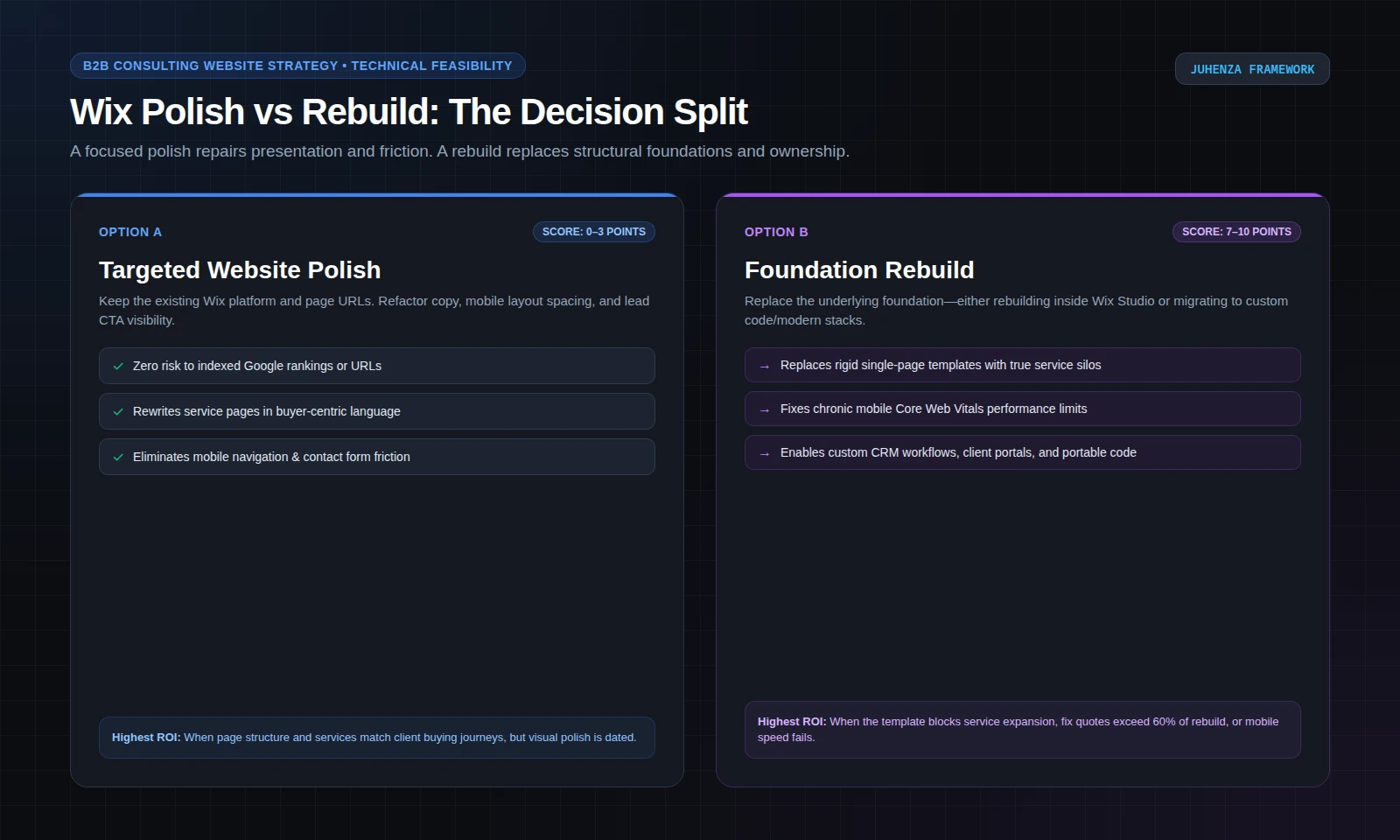 A focused polish improves surface styling and conversion friction; a foundation rebuild replaces structural constraints and data ownership.
What polish and rebuild actually mean
A polish preserves your existing Wix site, URL structure, and database collections. You refine the presentation layer: typography scales, responsive spacing on mobile viewports, service narrative copy, proof assets, and call-to-action buttons. The underlying page hierarchy and hosting platform remain unchanged. A polish is the lower-risk path when your domain already ranks for high-intent keywords and your site architecture makes commercial sense to corporate buyers.
A rebuild replaces the architectural foundation. On Wix, this presents two paths:
- Rebuilding within Wix (Classic Editor to Wix Studio): Wix's documentation explicitly clarifies that sites built on the legacy Classic Wix Editor cannot be automatically migrated or converted into Wix Studio. Because Classic Wix relies on absolute positioning while Studio operates on a fluid CSS grid and flexbox engine, migrating to Studio requires manually rebuilding the layout from scratch.
- Rebuilding off Wix (Custom code or headless CMS): Moving to a standalone architecture (such as TanStack Start, Next.js, or WordPress) where your firm owns the source code, hosting environment, and database schema completely.
The operational distinction is control. A polish enhances your presentation within existing boundaries. A rebuild redefines what your digital platform can accomplish.
The five-test decision for consulting owners
Score each test from 0 to 2 points:
- 0–3 points: Polish territory. The foundation is solid; refine the surface.
- 4–6 points: Borderline area. Remediate the highest-friction bottleneck first, then re-score.
- 7–10 points: Rebuild territory. Platform and structural debt are actively capping firm revenue.
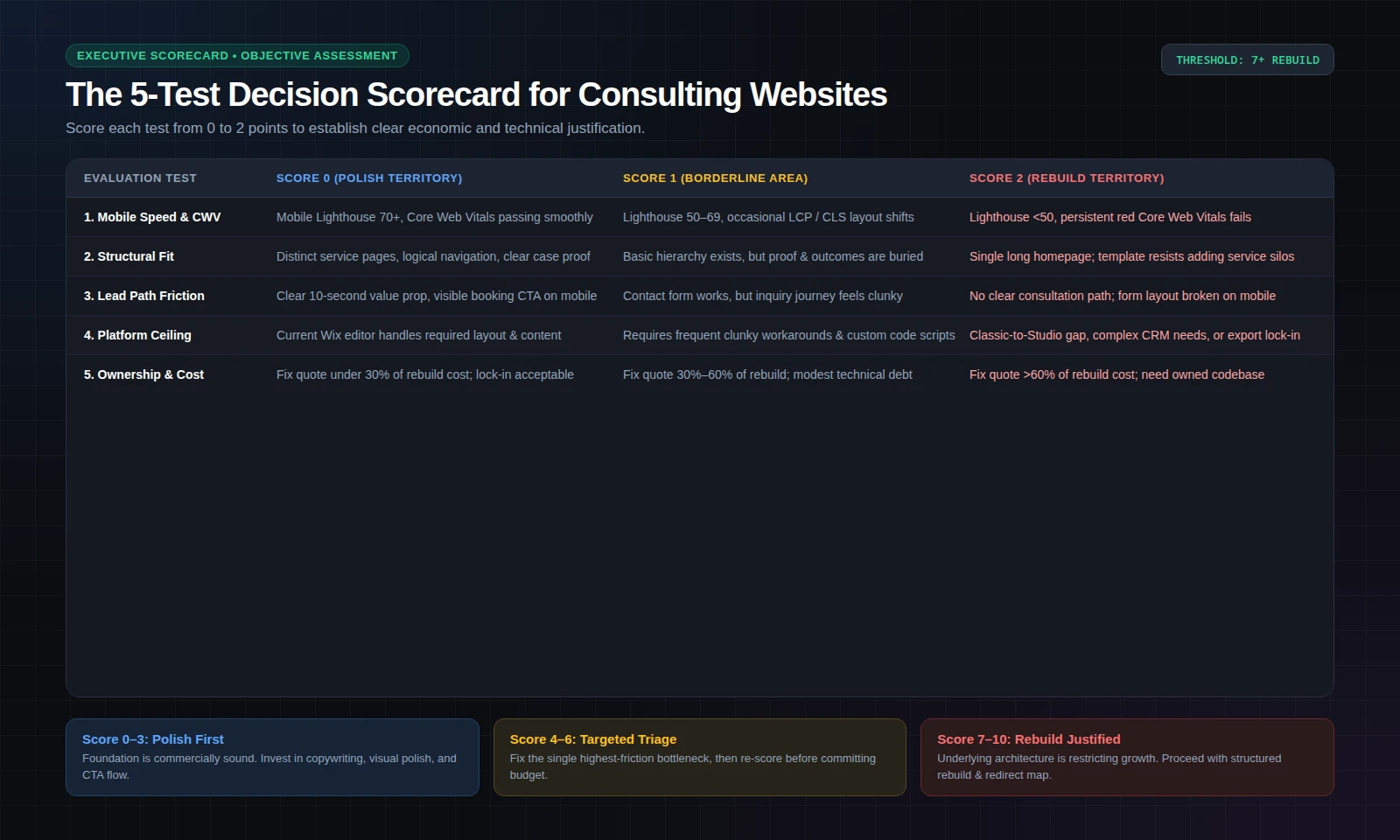 Score each test from 0 to 2 points: a score of 0–3 points indicates a polish is optimal, while 7+ points economically justifies a rebuild.
Test 1 — Mobile speed and Core Web Vitals
Run Google PageSpeed Insights on your mobile homepage and primary service landing page. Reference the official thresholds defined by web.dev:
- Largest Contentful Paint (LCP): 2.5 seconds or less.
- Interaction to Next Paint (INP): 200 milliseconds or less.
- Cumulative Layout Shift (CLS): 0.1 or less.
If your mobile Lighthouse score is below 50 due to bloated platform scripts and third-party widgets that cannot be removed in Wix without breaking functionality (Score 2), attempting endless micro-optimizations inside a constrained template produces diminishing returns. If performance clears 70 on mobile (Score 0), site speed is not a valid justification for a rebuild.
Test 2 — Structural fit for consulting services
Enterprise and mid-market consulting buyers evaluate firms across dedicated pages: distinct capability verticals, demonstrable industry case studies, executive team biographies, and a frictionless consultation booking flow.
If your site is structured as a single long-scrolling homepage where three distinct practice areas are squeezed into horizontal text strips (Score 2), your architecture is undermining your fee positioning. If clear service silos already exist with logical navigation (Score 0), a polish can elevate the narrative without restructuring URLs.
Test 3 — Lead path and conversion friction
Perform a live audit on a mobile device: Can an executive prospect understand your core value proposition within ten seconds? Is the path to request an exploratory conversation prominent without triggering intrusive popups? Does your calendar booking or inquiry form submit cleanly?
If conversion friction stems from rigid template boundaries—such as forms positioned beneath irrelevant stock imagery or mobile tap targets overlapping—a rebuild is often more cost-effective than hacking CSS within an uncooperative theme (Score 2). If the form works reliably but the headline copy is passive, polish your messaging (Score 0).
Test 4 — Platform ceiling and Wix Studio
Audit whether your product roadmap requires custom client portals, bidirectional CRM synchronization (HubSpot, Salesforce), or proprietary diagnostic assessment tools.
If you are on the Classic Wix Editor and require fluid multi-breakpoint responsiveness, you face a rebuild regardless, because Wix does not support automated Classic-to-Studio migration. If your team desires full ownership of the codebase and zero platform subscription overhead, leaving Wix for modern full-stack web engineering is the strategic choice (Score 2). If your firm merely publishes thought-leadership articles and standard service outlines, Wix's native platform ceiling has not been reached (Score 0).
Test 5 — Ownership and cost-to-fix
Obtain a precise, itemized quote for the specific design and functional remediation your site requires, and contrast it directly with a ground-up rebuild quote:
- The 60% rule: If professional remediation of your existing Wix template exceeds 60% of the cost of an engineered rebuild, commissioning the rebuild is the superior capital allocation. The rebuild eliminates legacy design debt rather than subsidizing it.
- Codebase equity: A Wix site cannot be exported; you rent access to the platform. An engineered custom application is an owned intellectual asset that can be transferred, self-hosted, or audited during a firm sale or merger.
| Test | Score 0 (Polish) | Score 1 (Borderline) | Score 2 (Rebuild) |
|---|---|---|---|
| 1. Mobile speed | Mobile Lighthouse 70+, CWV passing | Lighthouse 50–69, occasional LCP/CLS shifts | Lighthouse below 50, persistent CWV fails |
| 2. Structural fit | Distinct service pages & proof hubs | Basic hierarchy, but case studies buried | Single long homepage; cannot add silos |
| 3. Lead path | Obvious value prop & mobile CTA | Form works, but booking journey clunky | Broken mobile inputs or buried booking path |
| 4. Platform ceiling | Native editor easily handles needs | Requires complex third-party app scripts | Blocked by Classic Editor limits or custom CRM |
| 5. Cost-to-fix / Equity | Fix quote <30% of rebuild cost | Fix quote 30%–60% of rebuild cost | Fix quote >60% of rebuild cost |
When polish is the higher-return choice
A focused polish delivers the highest return on investment when your site structure matches how enterprise clients evaluate advisory services. You already possess distinct practice pages, verifiable client testimonials, and pages indexed in Google Search. The shortfall is purely aesthetic: typography lacks gravitas, mobile padding is inconsistent, or service headlines describe internal tasks rather than executive outcomes.
Under these circumstances, a targeted polish enhances client trust without introducing technical risk. Because Wix provides native page-level SEO controls for URL slugs, title tags, canonical links, and Open Graph cards, an experienced web team can overhaul on-page conversion and search discoverability while preserving your established URL footprints.
When a rebuild is the honest answer
A rebuild becomes mandatory when your existing digital presence constrains your firm's commercial evolution. You may have expanded from a boutique advisory into three distinct specialized practice groups, yet your template cannot accommodate nested service architectures without breaking mobile navigation.
The strongest justification for a rebuild is structural and operational, not decorative. When your website foundation prevents you from tracking lead attribution, integrating with your sales pipeline, or meeting enterprise security due-diligence standards, rebuilding on modern infrastructure provides the scalable foundation required for multi-year firm growth.
The rebuild risk nobody budgets for: migration
The primary vulnerability of a website rebuild is not visual design—it is organic search visibility destruction caused by unmapped URL migrations. If your current Wix site earns qualified organic search impressions for specialized advisory queries, launching a new website without a rigorous redirect map will result in severe organic pipeline degradation.
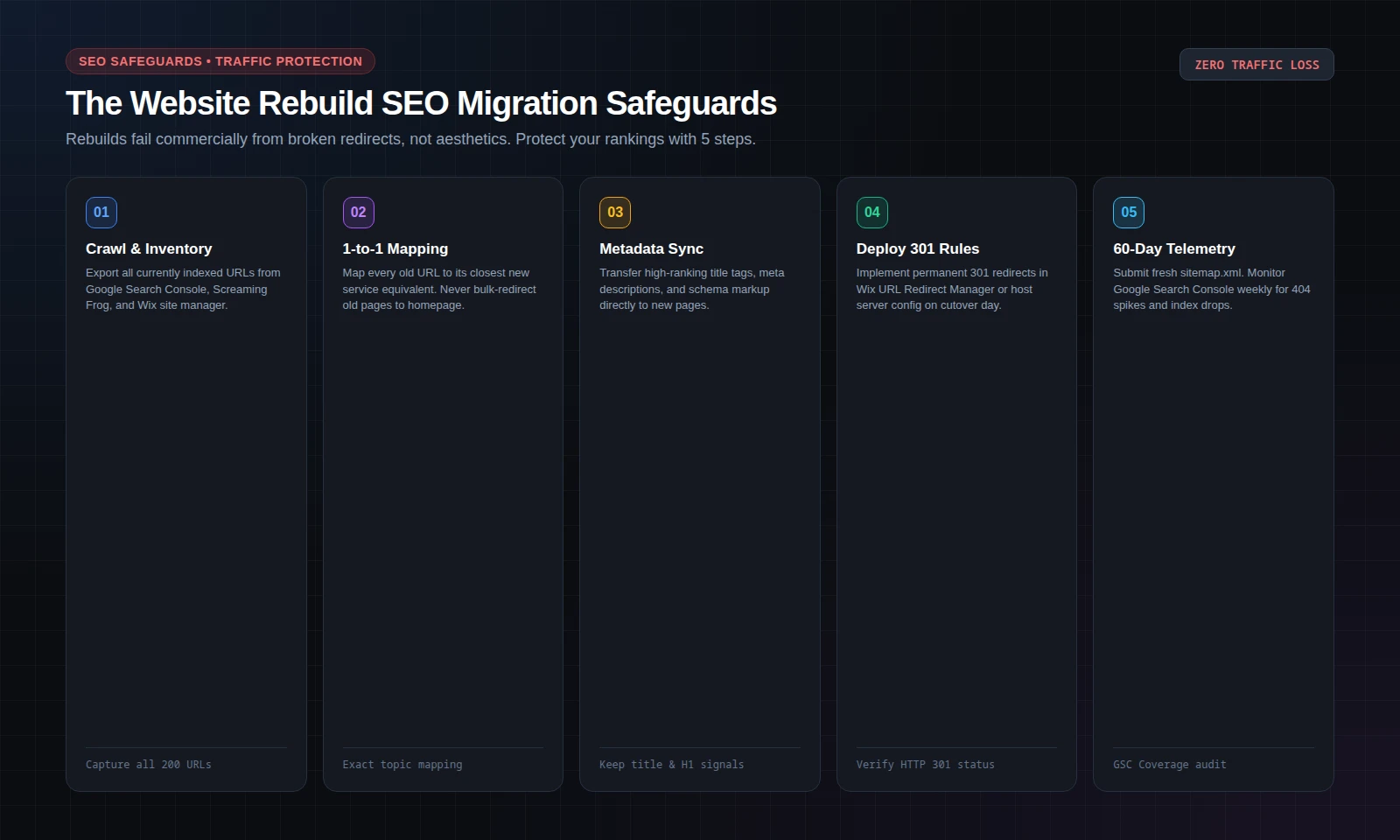 Implement a strict 1-to-1 redirect mapping sheet and monitor Search Console coverage for 60 days to prevent ranking dips during a rebuild.
To safeguard your search visibility during a rebuild:
- Extract all indexed URLs: Export every active URL from Google Search Console and crawling tools before writing a single line of new code.
- Execute 1-to-1 redirect mapping: Map every legacy URL to its direct counterpart on the new architecture. Avoid redirecting discontinued service pages to the homepage; route them to the most relevant category parent.
- Preserve metadata and schema: Maintain established title tag phrasing and JSON-LD structured data on your primary revenue-driving URLs.
- Deploy permanent 301 redirects: Configure HTTP 301 redirects within Wix's URL Redirect Manager (or server configuration files if self-hosting) prior to DNS cutover.
- 60-day telemetry monitoring: Submit updated sitemaps to Google Search Console and inspect crawl reports weekly to rectify 404 crawl anomalies immediately.
What to keep either way
Regardless of whether you polish or rebuild:
- Retain your root domain: Never rebrand your primary domain name without compelling commercial justification. Domain age and backlink history require years to build.
- Preserve high-converting copy: Retain client-tested headlines, testimonials, and case-study metrics that have historically resonated in discovery calls.
- Preserve your Google Business Profile: Maintain your verified Google Business Profile records independently; do not alter localized NAP (Name, Address, Phone) consistency during a site refresh.
FAQ
Is a website polish the same as a redesign?
No. A polish refines visual presentation, typography, and copy within existing page templates and URL structures. A redesign frequently alters page hierarchy and navigation patterns, which functionally constitutes a rebuild from an SEO and technical routing perspective.
Can I preserve my search rankings during a Wix rebuild?
Yes, provided you implement a comprehensive 1-to-1 301 redirect map, preserve your primary page headings and title metadata, and maintain your root domain. Even when rebuilding from the Classic Wix Editor to Wix Studio, structural redesign requires proactive redirect management to avoid temporary indexing drops.
Is Wix inherently bad for B2B SEO?
No. Modern Wix supports comprehensive technical SEO controls, including server-side rendering, customizable canonical tags, structured data injection, and automated XML sitemaps. Platform limitations primarily emerge around complex programmatic URL taxonomies, deep caching customizability, and third-party script execution speed.
Should our consulting firm rebuild inside Wix Studio or migrate to custom code?
Rebuild in Wix Studio if your primary objective is responsive design flexibility while retaining Wix's hosted ecosystem and non-technical dashboard management. Migrate to an engineered custom framework (such as TanStack Start or Next.js) if you require total codebase ownership, zero platform lock-in, advanced CRM integration, or sub-second mobile page loads.
What is the typical timeframe for a consulting site polish vs a rebuild?
A focused polish typically requires 1 to 3 weeks of copywriting, UI styling, and conversion QA. A comprehensive rebuild—encompassing architecture planning, content restructuring, custom development, and redirect validation—typically spans 6 to 10 weeks depending on page volume and third-party integrations.
What should our leadership team do first if we are undecided?
Execute the five-test evaluation and request two distinct proposals: one strictly scoped for functional polish, and one for a foundation rebuild. If the polish proposal approaches 60% of the rebuild investment, proceed with a foundation rebuild to eliminate inherited technical debt.
Where this fits
This guide belongs to JUHENZA's architectural advisory library under Web Development Decision Guides. It provides management teams with unbiased, data-backed frameworks to evaluate software and web investments.
To understand how our engineers scope and structure high-performance web applications, explore our web development services practice. For related insights into architectural decision-making, review our framework analysis on AI workflow automation vs RPA. You can also examine our client work and case studies to see how technical scopes are delivered.
Conclusion
Choose a polish when your existing site architecture successfully guides prospective consulting clients, and the friction is confined to outdated styling or mobile formatting. Choose a rebuild when your platform foundation restricts your service offerings, slows mobile performance below acceptable standards, or blocks proprietary integrations.
Score your site against the five tests before soliciting agency proposals. If you need senior technical guidance to audit your web infrastructure, book a technical scoping consultation with JUHENZA; our initial review focuses on identifying the most commercially efficient path forward.
