

Shopify, WooCommerce or a Custom Store? A Mehsana Retailer’s INR Cost-and-Ownership Scorecard
Compare Shopify, WooCommerce and custom store costs for Mehsana retailers in INR. See 5-year TCO, transaction fees, ownership trade-offs and a decision scorecard.
Web DevTech

Short answer: For most Mehsana retailers selling a standard catalogue to consumers, WooCommerce or Shopify will cost less in the first two years than a custom store. Shopify is faster to launch but carries a compounding third-party transaction fee in India; WooCommerce has lower platform fees but shifts hosting, plugin and maintenance work onto you. A custom store becomes rational when your workflow — dealer pricing, Tally integration, multi-location stock or a non-standard checkout — cannot be served by an off-the-shelf platform without fighting it.
Why this decision is harder in Mehsana than a pricing page suggests
A Mehsana hardware store, apparel shop or specialty food retailer does not face the same platform economics as a metro D2C brand. Order volumes may be lower, but the operational mix is often more complex: local delivery zones, cash-on-delivery confirmation, Gujarati product content, NRI family gift orders, and in some cases a Tally or ERP workflow that already runs the shop.
The result is that the cheapest monthly plan can become the most expensive platform once transaction fees, maintenance time and workflow gaps are counted. This article gives you a scored way to compare Shopify vs WooCommerce vs a custom store in Mehsana, using INR cost assumptions you can replace with your own numbers.
The five criteria that decide total cost and ownership
Score each platform from 1 (poor fit) to 5 (strong fit) on these dimensions. The weighted total matters more than any single line item.
| Criterion | What it measures | Weight |
|---|---|---|
| Upfront cost | Build, theme, catalogue setup, payment gateway integration | 20% |
| Recurring platform cost | Subscription, hosting, plugin licences | 20% |
| Transaction cost at your volume | Platform surcharge + gateway MDR + GST | 25% |
| Operational fit | COD, GST invoicing, local delivery, Tally/ERP, Gujarati content | 20% |
| Ownership and exit | Code/data ownership, migration effort, lock-in | 15% |
A retailer doing ₹2–5 lakh in monthly online sales should weight transaction cost and operational fit highest. A retailer testing online sales for the first time should weight upfront cost and launch speed higher.
Shopify: fastest launch, compounding per-order cost
Shopify Basic is listed at ₹1,499 per month on annual billing (₹1,994 monthly), with Grow at ₹5,599 and Advanced at ₹22,680 per month on annual billing.
The subscription is not the main cost driver in India. Because Shopify Payments is not available in India, every merchant must use a third-party gateway such as Razorpay, and Shopify adds its own surcharge on top: 2% on Basic, 1% on Grow and 0.6% on Advanced. On Basic, the combined platform surcharge plus gateway MDR typically lands at roughly 4–5% per transaction before GST, and 18% GST applies to the gateway fee.
Illustrative Mehsana example: A store doing ₹3,00,000 in monthly prepaid sales on Shopify Basic pays roughly ₹6,000 in Shopify’s 2% surcharge and another ₹6,000–₹9,000 in gateway MDR before GST. That is ₹12,000–₹15,000 per month in payment-related cost alone, on top of the plan fee. This is a planning example, not a quotation; replace the sales figure with your own.
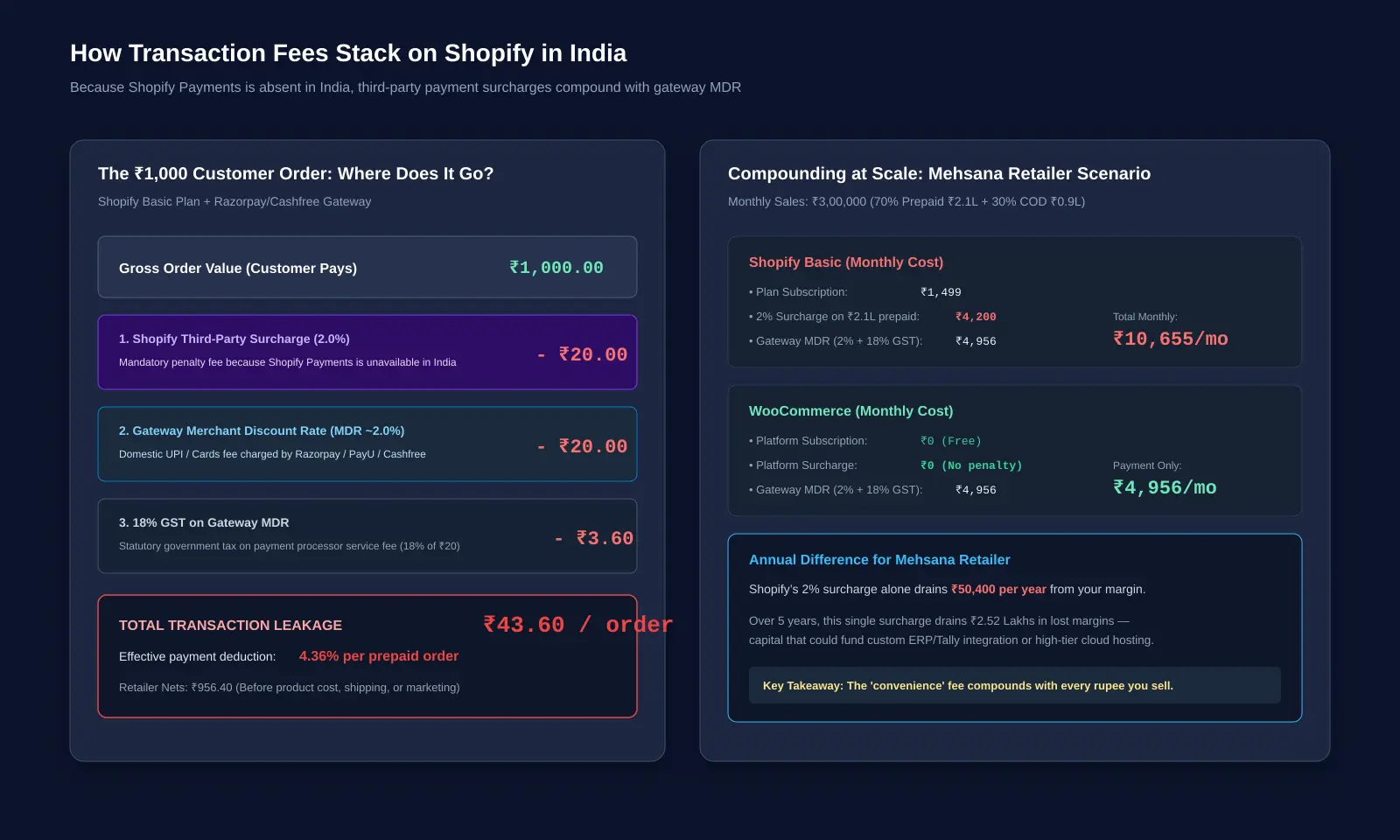 On Basic, the platform surcharge and gateway fee stack before GST.
What Shopify does well: hosting, security, checkout reliability and a large app ecosystem. A non-technical retailer can launch in two to three weeks. Apps fill gaps — loyalty, reviews, local courier rules — but premium apps commonly cost ₹400–₹8,000 per month each, and four or five apps can add ₹10,000–₹20,000 per month.
Where it strains: ownership. Your store lives inside Shopify’s infrastructure. Exporting product and customer data is possible, but checkout logic, app configuration and theme customisations do not migrate cleanly.
WooCommerce: lower platform fees, visible maintenance
WooCommerce software is free, but a working store is not. Realistic Indian hosting ranges from shared hosting at a few hundred rupees per month to managed WordPress hosting at ₹1,500–₹8,000 per month, and premium plugins for payments, shipping and SEO add ₹5,000–₹40,000 per year combined. Plugins themselves may cost ₹0–₹25,000 per year for essentials, while Shopify’s equivalent app stack often runs ₹15,000–₹80,000 per year.
Razorpay’s standard domestic pricing is around 2% per successful transaction plus 18% GST on that fee, with no additional platform surcharge on top of the gateway fee for WooCommerce stores. That is the structural advantage: WooCommerce does not add a second platform-level percentage cut.
What WooCommerce does well: ownership and control. You own the code, database and customer data, and can move hosts or developers. It handles COD, GST invoicing and Indian payment gateways well, and is a natural fit if you already run WordPress.
Where it strains: the work is real even when the software is free. Plugin conflicts after a WordPress core update are a common cause of downtime, and a store running a dozen plugins needs someone actively keeping them compatible. Cheap hosting produces slow stores, and emergency developer hours after a failed update can erase the savings from a lower platform fee. Budget either your own time or a maintenance retainer.
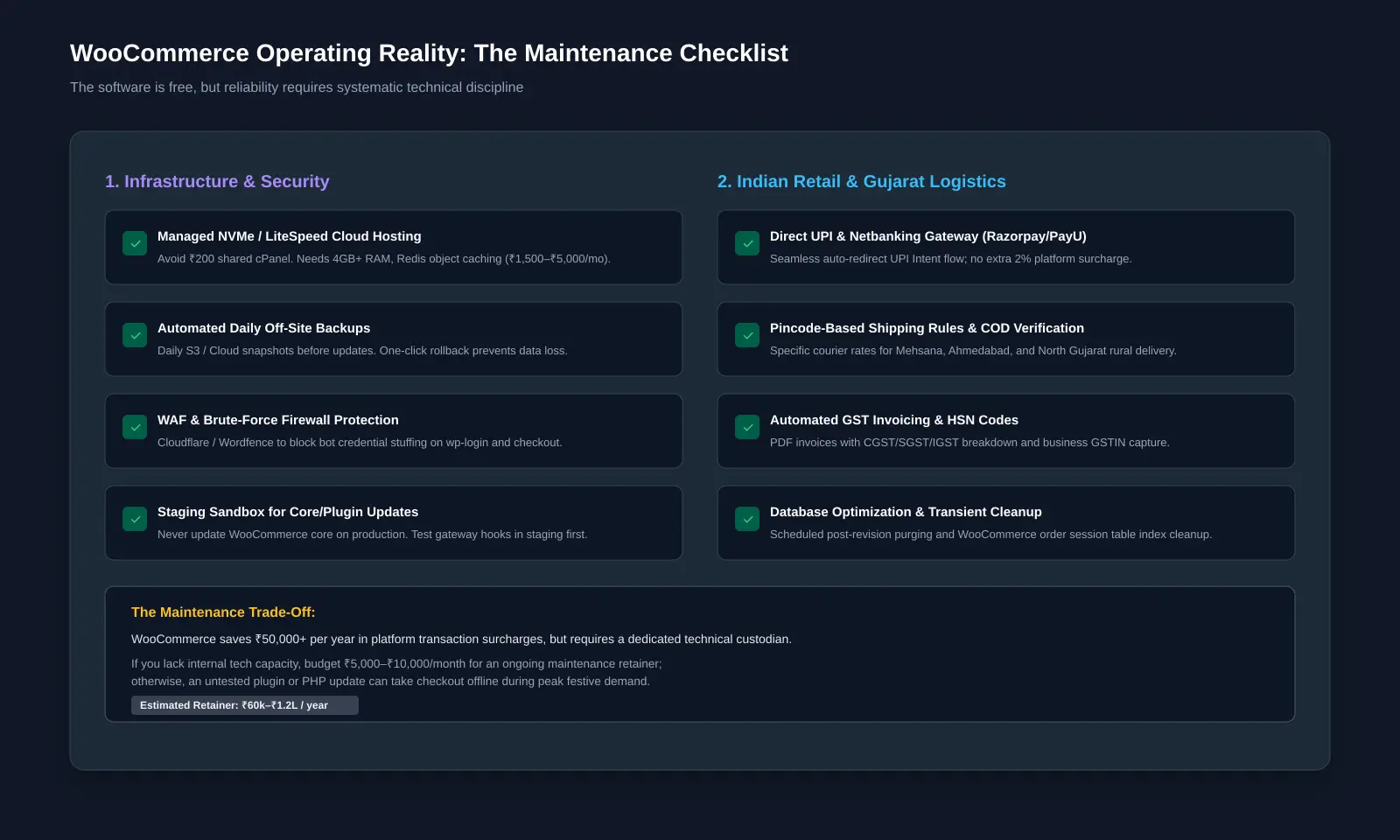 WooCommerce is free software; the operating work is not free.
Custom store: highest control, highest threshold
A custom store starts at roughly ₹3–4 lakh one-time for a focused build, and serious custom platforms with ERP or dealer workflows commonly run ₹2–8 lakh or more. The trade-off is the opposite of Shopify: you pay more upfront and less per order, because there is no platform subscription and no platform transaction surcharge.
Custom becomes rational when at least two of the following are true:
- You sell to dealers or distributors with customer-specific pricing, minimum order quantities or credit terms.
- You need Tally, ERP or inventory synchronisation that off-the-shelf connectors handle poorly.
- Your checkout or order-approval flow is genuinely non-standard.
- Your annual online revenue is high enough that eliminating the platform percentage saves more than the build amortised over three to four years.
- You need multi-location stock visibility or a B2B portal alongside a consumer store.
For a Mehsana retailer with a standard catalogue and consumer checkout, custom is usually premature. For a hardware distributor or a specialty brand with dealer pricing and Tally at the centre of operations, custom can be the only route that avoids fighting the platform. Review our AGNITY B2B platform case study for how custom workflows, product filtering, and specialised supplier portals operate in practice.
Five-year TCO comparison: an illustrative model
The table below uses stated assumptions: ₹3 lakh average monthly online sales, 70% prepaid and 30% COD, 2% gateway MDR plus 18% GST, and no paid marketing. Shopify assumes Basic with three paid apps. WooCommerce assumes managed hosting at ₹4,000 per month and ₹15,000 per year in premium plugins. Custom assumes ₹4 lakh build plus ₹1,500 per month hosting and ₹30,000 per year maintenance. These are planning assumptions, not quotes; replace them with your own figures.
| Cost line | Shopify Basic | WooCommerce | Custom |
|---|---|---|---|
| Year 1 upfront | ₹35,000–₹60,000 (setup/theme) | ₹40,000–₹80,000 (setup/theme) | ₹4,00,000 (build) |
| Platform / hosting per year | ₹17,988 plan + apps | ₹48,000 hosting + ₹15,000 plugins | ₹18,000 hosting |
| Transaction surcharge (annual) | ₹50,400 (2% of ₹25.2L prepaid) | ₹0 platform surcharge | ₹0 platform surcharge |
| Gateway MDR + GST (annual, illustrative) | ₹53,000–₹60,000 | ₹53,000–₹60,000 | ₹53,000–₹60,000 |
| Maintenance / retainer | Included in plan | ₹60,000–₹1,20,000 | ₹30,000 |
| Approx. 5-year cumulative | ₹5.6–₹7.0 lakh | ₹6.0–₹8.5 lakh | ₹8.0–₹9.5 lakh |
Read the table directionally, not as a forecast. The custom build’s higher five-year total is driven by the upfront build. At higher revenue, the absence of a 2% platform surcharge and the operational savings from integrated Tally/dealer workflows can close the gap. The crossover usually appears when the platform surcharge exceeds the annualised build premium — often in the ₹40–60 lakh annual online revenue range, depending on workflow complexity.
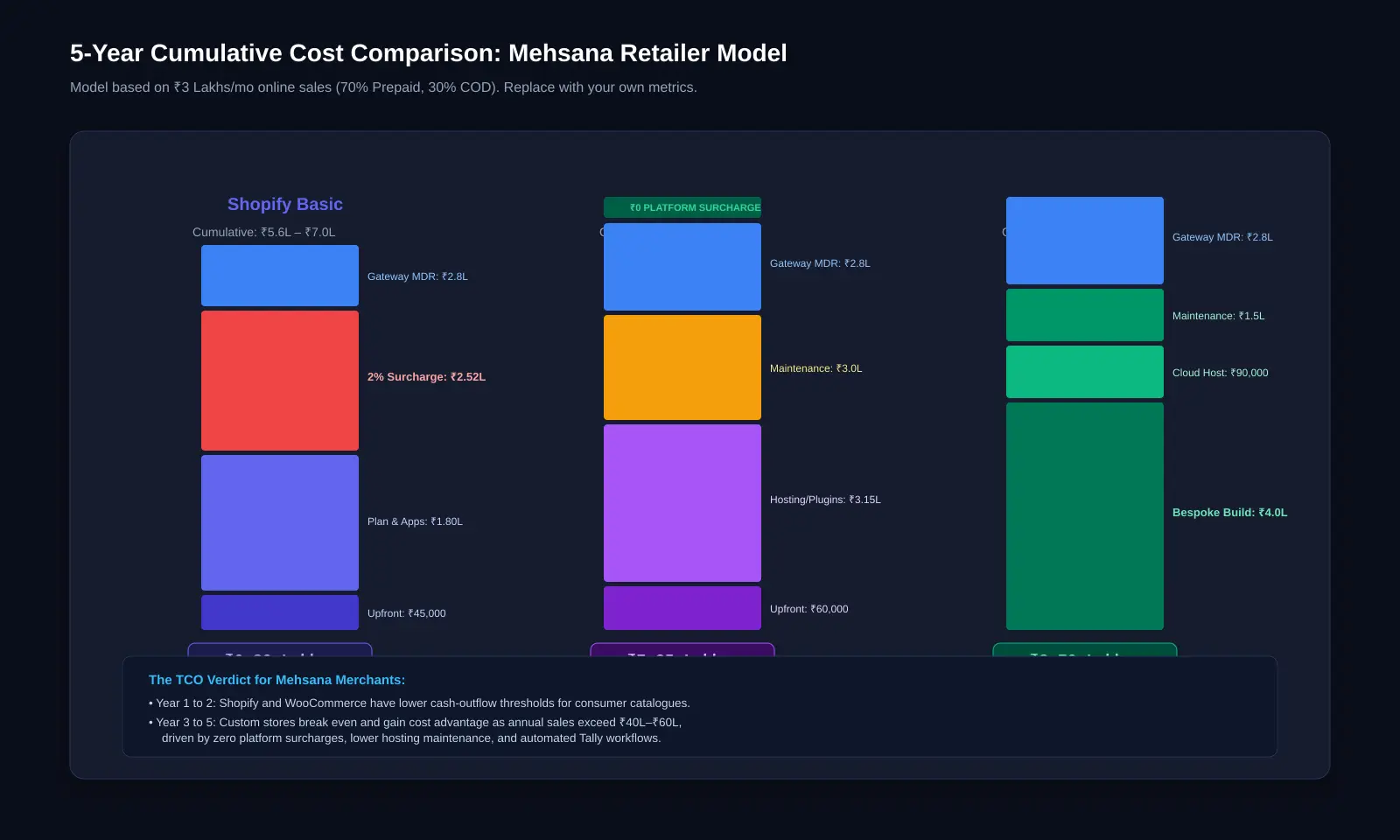 Illustrative model; replace assumptions with your own sales and COD mix.
Retail-type fit: hardware, apparel and specialty stores
| Retail type | Best first platform | Why |
|---|---|---|
| Hardware and building materials | WooCommerce or custom | Heavy SKU counts, variants, local delivery zones and possible dealer pricing. WooCommerce handles the catalogue; custom handles dealer-specific pricing and ERP integration. |
| Apparel | Shopify or WooCommerce | Size/colour variants, returns and visual merchandising. Shopify’s theme and app ecosystem reduces time-to-launch; WooCommerce wins if you already run WordPress and want lower ongoing fees. |
| Specialty food and local brands | WooCommerce or Shopify | Shelf-life and shipping rules matter. Shopify handles fast launches; WooCommerce gives more control over pincode-based shipping rules and GST invoicing. Custom is rarely justified unless NRI gift ordering or subscription logic is central. |
Mehsana’s local WooCommerce footprint is small — a verified count of five live WooCommerce stores in the city at the time of the source’s update — which means local platform-specific support may be limited regardless of platform choice. Plan for remote support and clear documentation either way.
Common mistakes and when to involve a specialist
- Comparing headline plan fees only. Shopify’s 2% India surcharge and WooCommerce’s maintenance burden are the costs that decide the five-year total.
- Choosing custom before validating demand. A ₹4 lakh build is not a demand test. Launch on a standard platform, prove the order book, then migrate if the workflow justifies it.
- Ignoring the checkout reality. COD confirmation, UPI failure handling and GST invoice formatting are not edge cases in Indian retail; they are the checkout.
- Underestimating content and catalogue work. Product photography, descriptions and Gujarati copy often cost more than the platform decision, especially for large catalogues.
Involve a specialist when you are choosing between custom and WooCommerce and cannot confidently model the integration work, or when your existing Tally/ERP workflow must connect to the store. A scoped brief is more useful than a feature list at that stage.
FAQ
Is Shopify or WooCommerce cheaper for a small Mehsana retailer?
WooCommerce usually has the lower total platform cost if you or someone on your team can handle hosting, plugin updates and basic maintenance. Shopify costs more per month but removes infrastructure work. For a first online store with no technical support, Shopify’s higher monthly fee can be cheaper than emergency WooCommerce fixes.
How much does a custom ecommerce store cost in India?
Custom store builds commonly start around ₹3–4 lakh and rise with integrations, dealer pricing and ERP work. A focused custom store for a retailer with a standard catalogue is usually not the lowest-cost first step; it becomes more defensible when workflow complexity or transaction volume makes the platform surcharge more expensive than the build.
Does Shopify charge extra in India?
Yes. Because Shopify Payments is not available in India, Shopify adds a third-party transaction surcharge of 2% on Basic, 1% on Grow and 0.6% on Advanced, on top of the gateway’s own MDR. GST at 18% also applies to the gateway fee.
Can WooCommerce handle COD and UPI in India?
Yes. Razorpay’s WooCommerce plugin supports UPI, cards and netbanking, and COD can be enabled alongside prepaid methods. The gateway charges around 2% plus GST on successful domestic transactions, with no additional WooCommerce platform surcharge.
When should a Mehsana retailer choose a custom store over Shopify?
When the business needs dealer-specific pricing, Tally or ERP integration, multi-location stock, or a checkout flow that cannot be configured on Shopify without several paid apps and workarounds. A standard consumer catalogue alone rarely justifies custom.
How long does each option take to launch?
Shopify stores commonly launch in two to three weeks; WooCommerce in three to four weeks; custom builds in six to ten weeks or longer depending on integrations. Catalogue readiness and payment gateway KYC often determine the real timeline more than the platform.
Where this fits
This guide sits under Ecommerce & Online Stores → Platform Selection & Ownership. If you are still deciding whether an online store is the right next step, start with our broader website and product guidance. If you already know you need a store and want to understand how a build is scoped, compare the agency selection process before requesting quotes.
Conclusion: score your own situation before you commit
The right platform is not the one with the lowest monthly fee. It is the one whose five-year total — build, subscription, transaction surcharge, maintenance and workflow fit — is lowest for your order profile.
Use the five-criterion scorecard in this article with your own sales, COD and integration assumptions. If the result is close, start on WooCommerce or Shopify, prove the order book, and revisit custom only when the workflow or the platform surcharge makes it rational.
Next step: Describe your current retail workflow, catalogue size and any Tally or ERP dependency in a brief, and we will scope the smallest useful starting point. Discuss your project.
References
- Razorpay, “Shopify Payment Gateway Cost 2026: The Complete India Guide,” Razorpay Learn. Official Guide
- eChai Explore, “Ecommerce platforms: what to use, priced, and what founders use,” eChai Ventures. Resource Portal
- Qtcinfotech, “Ecommerce website cost in India (2026): real price ranges, WooCommerce vs Shopify,” Qtcinfotech Insights. Analysis