

Bhavnagar Shops: Own Website, Marketplace or WhatsApp Catalogue? A 2026 Decision Framework
Compare own website, marketplace and WhatsApp catalogue for Bhavnagar boutiques. Use our decision framework to choose your first digital channel.
Web DevTech

Direct answer: For most Bhavnagar boutiques and home businesses, the right first digital channel is a WhatsApp Business catalogue if you have fewer than 100 products and orders arrive through conversation. Choose a marketplace if you need strangers to find you and can absorb commissions. Build your own website when repeat customers and Google searches justify the monthly cost. The decision framework below helps you score your situation in 15 minutes.
If you run a boutique, a home baking business or a neighbourhood store in Bhavnagar, you have probably been told to “just get online.” The advice usually comes with three options: a WhatsApp catalogue, a marketplace listing, or your own website. Each one solves a different problem, and choosing the wrong first channel can cost you months of effort and thousands of rupees. This guide gives you a practical way to choose the first digital channel for a Bhavnagar shop — not by hype, but by matching the channel to your products, your customers and your capacity.
The three channels at a glance
| Factor | WhatsApp Business catalogue | Marketplace (Amazon, Flipkart, JioMart, ONDC apps) | Own website (e.g., WooCommerce, Shopify) |
|---|---|---|---|
| Setup cost | Free (app) | Free to list; commission per sale | ₹10,000–₹50,000+ build; ₹1,000–₹2,000/month hosting and platform |
| Setup time | 1–3 hours | 1–7 days (verification, catalogue upload) | 2–8 weeks |
| Product limit | 500 items in the free app | Category‑dependent; usually thousands | Unlimited |
| Who finds you | People who already have your number | Buyers searching on the marketplace | Google searches, social links, ads, regulars |
| Checkout | Customer sends a message; you confirm and share a UPI link | Marketplace checkout; you ship | Full checkout; UPI, cards, COD |
| Customer relationship | You own the phone number and chat | Marketplace owns the buyer relationship | You own the data and the brand experience |
| Hidden cost | Manual order handling; no Google visibility | Commission (often 15–30%); returns and penalties | Traffic acquisition; maintenance |
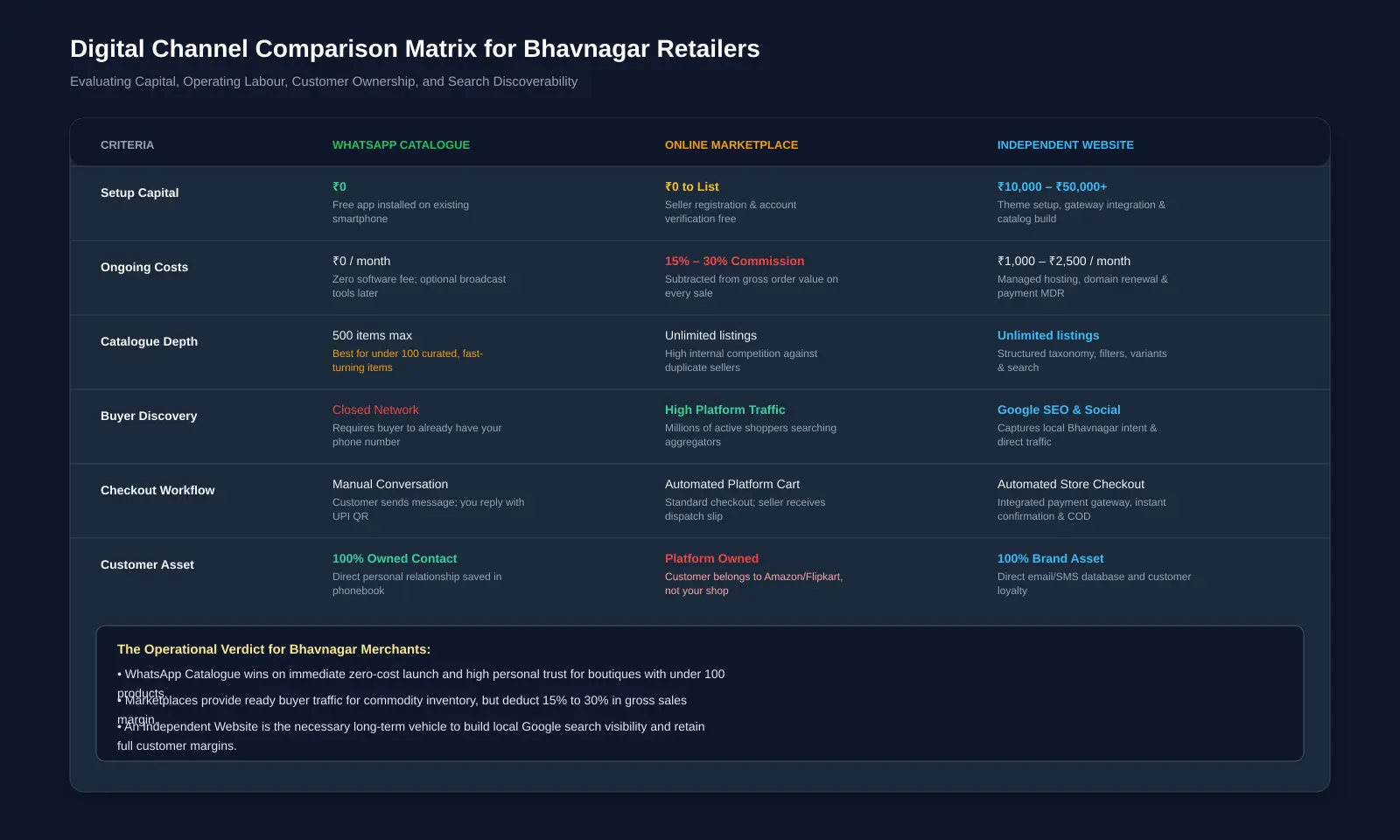 Each channel solves a different operational problem with distinct upfront and hidden costs.
What the table does not show: the cost of your time. A free WhatsApp catalogue still needs someone to reply, confirm stock and chase payments. A marketplace listing still needs someone to pack and ship. A website still needs someone to update products and answer enquiries. The right channel is the one whose hidden costs you can actually absorb.
How to choose: a 3‑step decision framework
Step 1: Map your customer’s buying journey
Ask three questions about your typical customer:
- Do they already know you? If most sales come from walk‑ins, referrals or repeat buyers, WhatsApp is the shortest path. If you need strangers, a marketplace or a website with search visibility is necessary.
- Do they need to browse many options? A boutique with 200 sarees needs a catalogue that can be filtered or scrolled. WhatsApp’s 500‑item limit is fine for a curated range; a marketplace or website handles depth better.
- Do they ask questions before buying? If sizing, fabric or customisation questions are common, WhatsApp’s conversational format is an advantage. If the product is standard and self‑explanatory, a marketplace checkout is faster.
Step 2: Score each channel
Rate each factor from 1 (poor fit) to 5 (excellent fit). A simple weighted score avoids the trap of choosing the channel that sounds most modern.
| Factor | Weight | WhatsApp catalogue | Marketplace | Own website |
|---|---|---|---|---|
| Fits your product range (size, variability) | 25% | |||
| Reaches new customers | 25% | |||
| Cost you can afford now | 20% | |||
| Time you can dedicate weekly | 20% | |||
| Control over brand and customer data | 10% |
Multiply each rating by the weight, then add the columns. The highest total is your starting channel, not your forever channel. Most Bhavnagar shops will find WhatsApp scores highest on cost and time, while marketplace scores highest on reach and website scores highest on control. The framework simply makes the trade‑off visible.
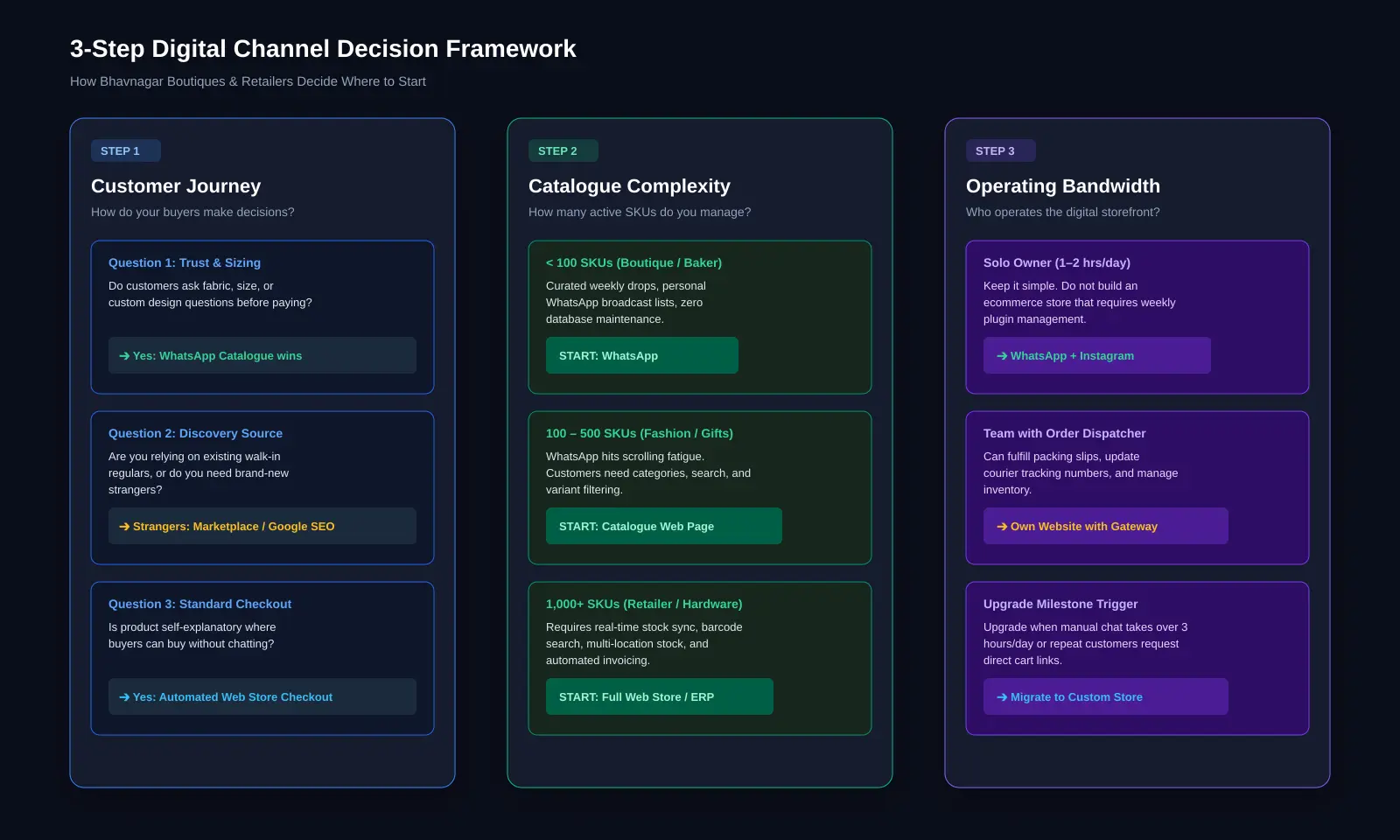 Score your product range, customer journey, and time capacity before committing capital.
Step 3: Match to your resources
Use these three scenarios as a sanity check:
- Boutique with 80–150 curated pieces, 5–10 enquiries per week, owner handles everything. Start with WhatsApp catalogue. Add a simple website later if Google searches for your boutique name grow. Do not pay marketplace commissions until you have excess stock you want to clear.
- Home baker with 20–30 products, strong Instagram following, festival spikes. WhatsApp catalogue plus Instagram link is enough. A marketplace will bury you in competition; a website is premature until you have repeat orders that justify the monthly fee.
- Neighbourhood retailer with 1,000+ SKUs and walk‑in customers asking “do you have this in stock?” A marketplace or a catalogue‑style website with WhatsApp ordering is a better first step because the range is too large for a WhatsApp catalogue and the customer needs search. Consider ONDC‑enabled seller apps if you want local discovery without building a full store.
Channel deep dive
WhatsApp Business catalogue
Best for: conversation‑led selling, small curated ranges, repeat customers, home businesses.
What it does well: zero setup cost, familiar interface, direct chat, easy UPI payment links, and a product catalogue that customers can browse without leaving WhatsApp. For a Bhavnagar boutique where the owner personally knows many customers, this is the lowest‑friction start.
What it cannot do: appear in Google searches, handle complex variants, automate order status, or scale beyond manual replies without paid tools. The free app caps the catalogue at 500 items. If you sell 30 kurtis and 20 dupattas, that is not a problem. If you stock 800 SKUs, it is.
Marketplace
Best for: reaching strangers, clearing excess stock, standard products with clear photos and descriptions.
What it does well: brings demand you do not have to generate. A marketplace shopper is already looking to buy. For a Bhavnagar shop with no website and no Google presence, a marketplace listing can produce the first online order faster than a website.
What it cannot do: give you the customer relationship. You pay commission, follow marketplace rules, and compete on price with sellers who may source cheaper. For a boutique selling curated, higher‑margin pieces, marketplace commission can erase the margin. For a retailer selling commodity items, the volume may still make sense — but only if you calculate the commission against your margin before listing.
Own website
Best for: brands with repeat customers, clear product photography, and a plan to earn search traffic or run ads.
What it does well: builds a durable asset. A website can rank in Google for “boutique in Bhavnagar” and related searches, collect enquiries, and present your brand without a marketplace’s distractions. It also gives you full control over pricing, bundles and customer data.
What it cannot do: bring traffic by itself. A website with no SEO, no Google Business Profile and no social promotion is a digital brochure. The build cost (₹10,000–₹50,000+) is only the beginning; the ongoing cost is content, maintenance and traffic acquisition. If you are not prepared for that, WhatsApp is a better first step. When you do build, treat it as a long‑term asset, not a one‑time project — the same discipline we apply to custom web and product builds.
Common mistakes and hidden costs
- Building a website before proving demand. A website is the most expensive channel to start. If you have not yet sold through WhatsApp or a marketplace, you do not know which products people ask for or what questions they need answered.
- Treating WhatsApp catalogue as a website. It does not rank on Google, does not automate checkout, and does not scale without manual effort. It is a conversation tool, not a storefront.
- Ignoring marketplace commission. A 20% commission on a ₹1,500 kurta leaves ₹1,200 before product cost. If your margin is 30%, the commission eats two‑thirds of it. Calculate before listing.
- Starting three channels at once. A shop owner who tries WhatsApp, a marketplace and a website in the same month usually does none of them well. Pick one, make it work, then add the next.
- Forgetting Google Business Profile. Regardless of channel, a complete Google Business Profile is free and helps local customers find your shop’s address, timings and phone number. It is not a substitute for a channel, but it is a prerequisite for local discovery.
When to upgrade
Move from WhatsApp to a website when at least two of these are true:
- You answer the same stock or sizing question more than five times a day.
- Customers find you on Google but have no page to land on.
- Your product range exceeds 300–400 items and the WhatsApp catalogue becomes hard to browse.
- You want to run ads but have no destination page.
- Repeat customers ask for online ordering outside WhatsApp.
Move from a marketplace to your own website when marketplace commission exceeds the cost of building and running a site, and you have a way to drive traffic (Google, Instagram, WhatsApp broadcasts, local ads).
First‑hand experience
This section will be updated with real build notes after our next local Saurashtra project. In our custom software and web advisory work across Gujarat, we find that retail clients who start with conversation-led ordering on WhatsApp develop a much clearer understanding of their catalogue taxonomy, payment handling, and customer queries before transitioning capital to an independent web store.
FAQ
Is a WhatsApp catalogue free?
Yes, the WhatsApp Business app and its catalogue are free to use. You pay in time: every order is a manual conversation, and there is no automated checkout. Paid tools exist for automation, but they are optional.
Can I use both WhatsApp and a website?
Yes, and most shops eventually do. A common pattern is to use WhatsApp for conversations and a website for browsing and search visibility. The two can connect: product pages can have a “Chat on WhatsApp” button, and WhatsApp messages can link to the website.
How many products can a WhatsApp catalogue hold?
The free WhatsApp Business app supports up to 500 products in a catalogue. Larger catalogues require the WhatsApp Business API or a different channel.
Do I need GST or a business registration to sell on a marketplace?
Marketplace requirements vary. Most marketplaces ask for a GSTIN for taxable goods, but some categories and thresholds differ. Check the marketplace’s seller onboarding page and, for regulatory questions, consult a qualified professional. This article is not legal or tax advice.
How much does an own website cost in Bhavnagar?
A simple catalogue‑style website with WhatsApp ordering can start around ₹10,000–₹15,000. A full e‑commerce store with payment gateway, shipping and product management typically ranges from ₹25,000 to ₹50,000+ to build, plus monthly hosting and maintenance. The build cost is only one part; traffic and content are ongoing costs.
Where this fits
This post is part of our local business digital presence guide. If you have decided that a website is your next step, explore JUHENZA’s web and product development services to see how we scope a build around your actual product range and workflow. You can also read how we approached a business network platform to understand the level of scoping involved, or review our guide on how to choose a web development agency in India. When you are ready to discuss your shop’s first channel, book a call or send a project brief.
Conclusion
The right first digital channel for a Bhavnagar shop is the one you can run consistently with the time and money you actually have. WhatsApp is the lowest‑friction start for conversation‑led boutiques. A marketplace is a reach tool, not a brand home. A website is a long‑term asset that needs traffic and maintenance. Score your situation, pick one channel, and give it 60–90 days before adding the next.
Next step: If your scoring points to a website, start a conversation with JUHENZA and describe your product range, your current order flow and what you want the site to do. We will tell you honestly whether a website is the right next move or whether WhatsApp should come first.
References
- WhatsApp, “About product catalogues in WhatsApp Business,” WhatsApp Help Center. Official Documentation
- Open Network for Digital Commerce (ONDC), “Democratising digital commerce in India,” ONDC Official Portal. Official Portal
- Shopify India, “Ecommerce website pricing and plans in India,” Shopify Documentation. Official Pricing
