

How to Choose a Hotel Website Partner in Puri-Bhubaneswar for Direct Bookings
Choose a hotel website partner in Puri-Bhubaneswar that builds a direct-booking funnel, cuts OTA leakage and ships in 90 days. Calculator + checklist.
Web DevTech

Direct answer: Choose a hotel website partner in Puri-Bhubaneswar by the direct-booking funnel they will build, not by page count or price alone. Ask for a written scope, a live booking flow, clear ownership of domain and guest data, and a 90-day plan with acceptance checks. Use the OTA leakage calculator below with your own numbers before you compare quotes.
A guest finds you on an OTA. Then they search your hotel name. Then they land on your website. Then they leave and book on the OTA anyway.
That is the leak this post fixes. A hotel website partner in Puri-Bhubaneswar should be judged on whether the site turns that second visit into a direct enquiry or a paid direct booking. Design matters. Speed matters. But the funnel matters more.
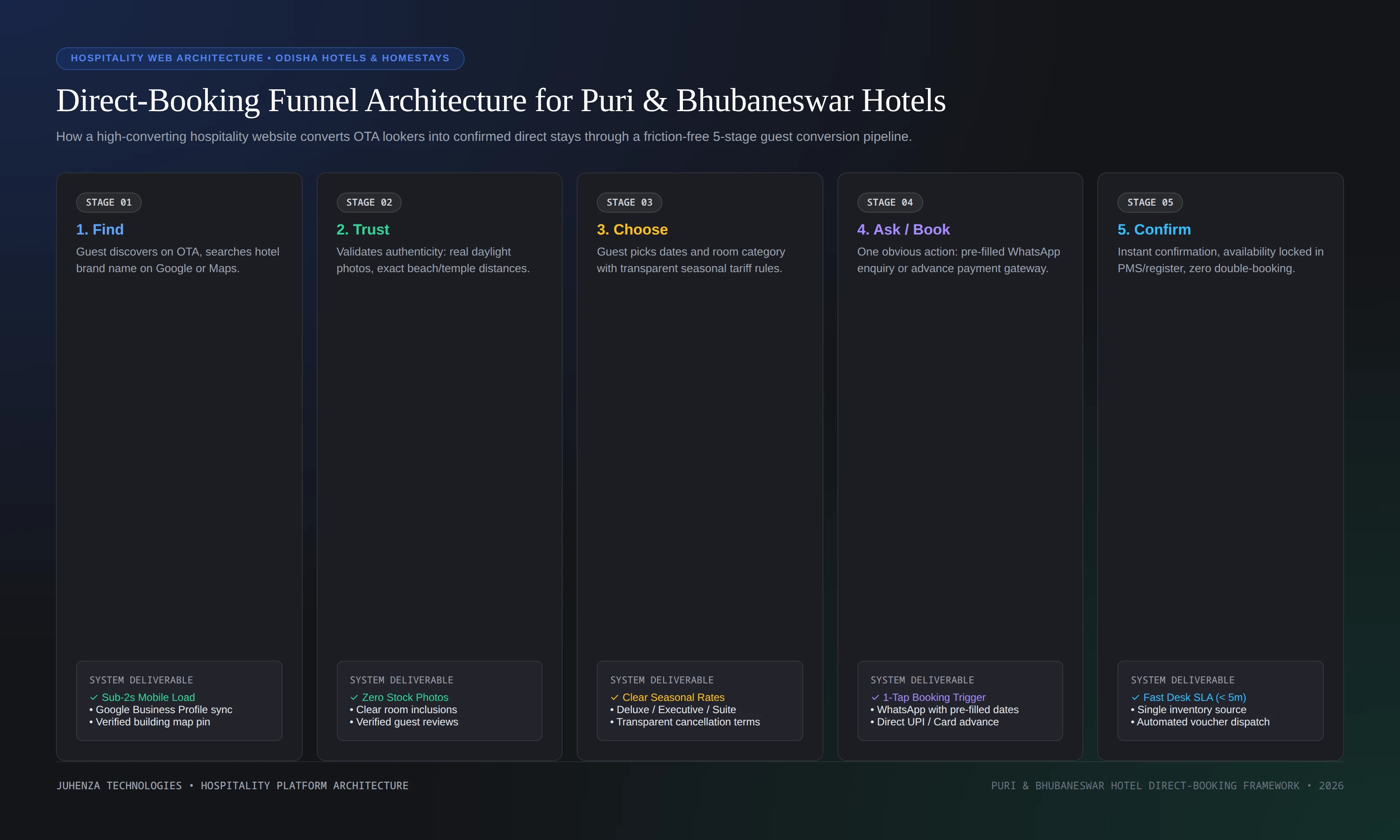
This guide gives you that funnel, a calculator that uses your own numbers, a scorecard to compare partners, and a 90-day checklist to ship without chaos.
What a direct-booking funnel actually is
A direct-booking funnel is the path a guest takes from finding you to confirming a stay without an OTA in the middle. It has five steps. If any step is weak, the guest goes back to the OTA.
| Step | What the guest needs | What the partner must build |
|---|---|---|
| 1. Find | Your hotel on Google, Maps, or Instagram | Fast page, correct name, address, phone, and Google Business Profile match |
| 2. Trust | Real rooms, real rates, real location | Daylight photos of each room type, honest inclusions, map pin on the right building |
| 3. Choose | Clear room, dates, and price | Room pages with tariff logic, inclusions, and cancellation terms |
| 4. Ask or book | One obvious next step | WhatsApp enquiry with dates pre-filled, or booking engine with advance payment |
| 5. Confirm | Fast, human reply | Who replies, in how long, and what happens if the room is gone |
Ask every partner to walk you through this funnel on a live site they built. Do not accept screenshots alone. Open the site on your own phone, on mobile data. Find the room. Find the price. Send the enquiry. Time the reply.
A good partner will also tell you what the website will not do. It will not replace OTAs on day one. It will not fix wrong rates, slow replies, or a wrong map pin. It will make the direct path obvious and measurable.
OTA leakage calculator: find your number in 5 minutes
OTA leakage is the money you pay to intermediaries to sell rooms you could have sold direct. It is not only commission. It also includes the guest relationship you do not get, the rate control you lose, and the repeat booking you cannot easily win back.
Do not use a blog's average commission. Use your OTA statement. Your exact rate is on that statement. If you have more than one OTA, do this per OTA or use a blended rate you can defend.
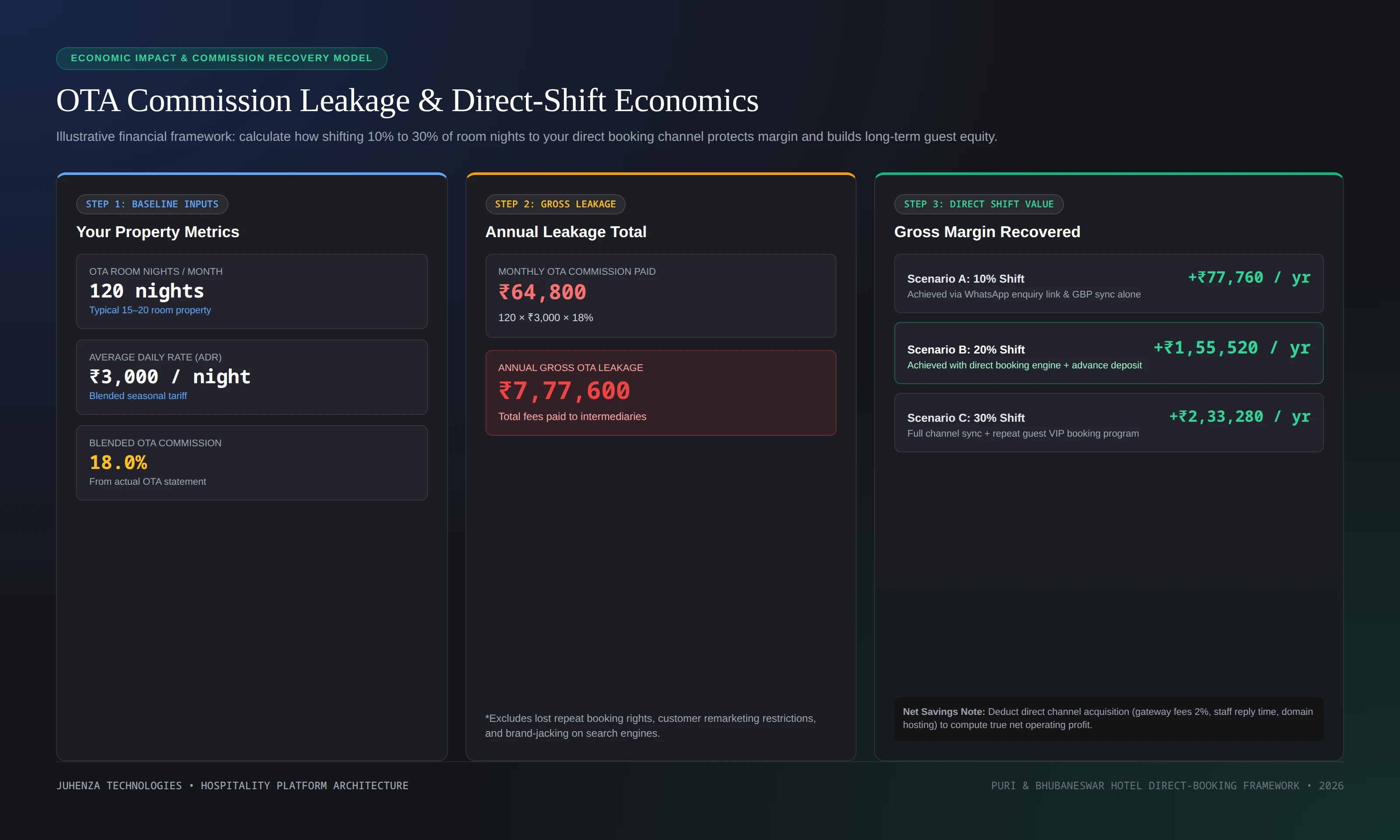
The formula
- Monthly OTA leakage = OTA room nights × Average Daily Rate (ADR) × Your OTA commission rate
- Yearly leakage = Monthly leakage × 12
- Direct-shift value = Yearly leakage × Share you can realistically shift to direct
Direct bookings still have costs. Payment gateway charges, booking-engine fees, staff time, and any ads are real. The calculator below is gross leakage, not net profit. Subtract your direct cost of sale before you call it savings.
Illustrative worksheet — replace every number with your own
| Input | Illustrative example | Your property numbers |
|---|---|---|
| OTA room nights per month | 120 | Replace with your statement count |
| Average Daily Rate (ADR) | ₹3,000 | Replace with your blended tariff |
| Your OTA commission rate | 18% | Replace with your OTA invoice rate |
| Monthly leakage | 120 × ₹3,000 × 18% = ₹64,800 | Calculate: Nights × ADR × Rate |
| Yearly leakage | ₹64,800 × 12 = ₹7,77,600 | Calculate: Monthly leakage × 12 |
| If you shift 20% to direct | ₹7,77,600 × 20% = ₹1,55,520 gross leakage avoided | Calculate: Yearly leakage × 20% |
This example is illustrative. It is not a JUHENZA result, a market average, or a promise. Its job is to show the method. Your ADR, occupancy, commission, and shift share will be different.
Run three scenarios: shift 10%, 20%, and 30%. Then ask: what would it cost to earn that shift? A simple WhatsApp enquiry funnel may be enough to start. A full booking engine with payment, channel manager, and availability sync costs more and needs more operational discipline.
If the partner cannot explain this trade-off, they are selling pages, not bookings.
Partner scorecard: 7 checks that separate a builder from a partner
Use this scorecard for every shortlisted partner. Mark each check as Clear, Unclear, or Missing. The partner with the most Clear marks wins, not the lowest quote.
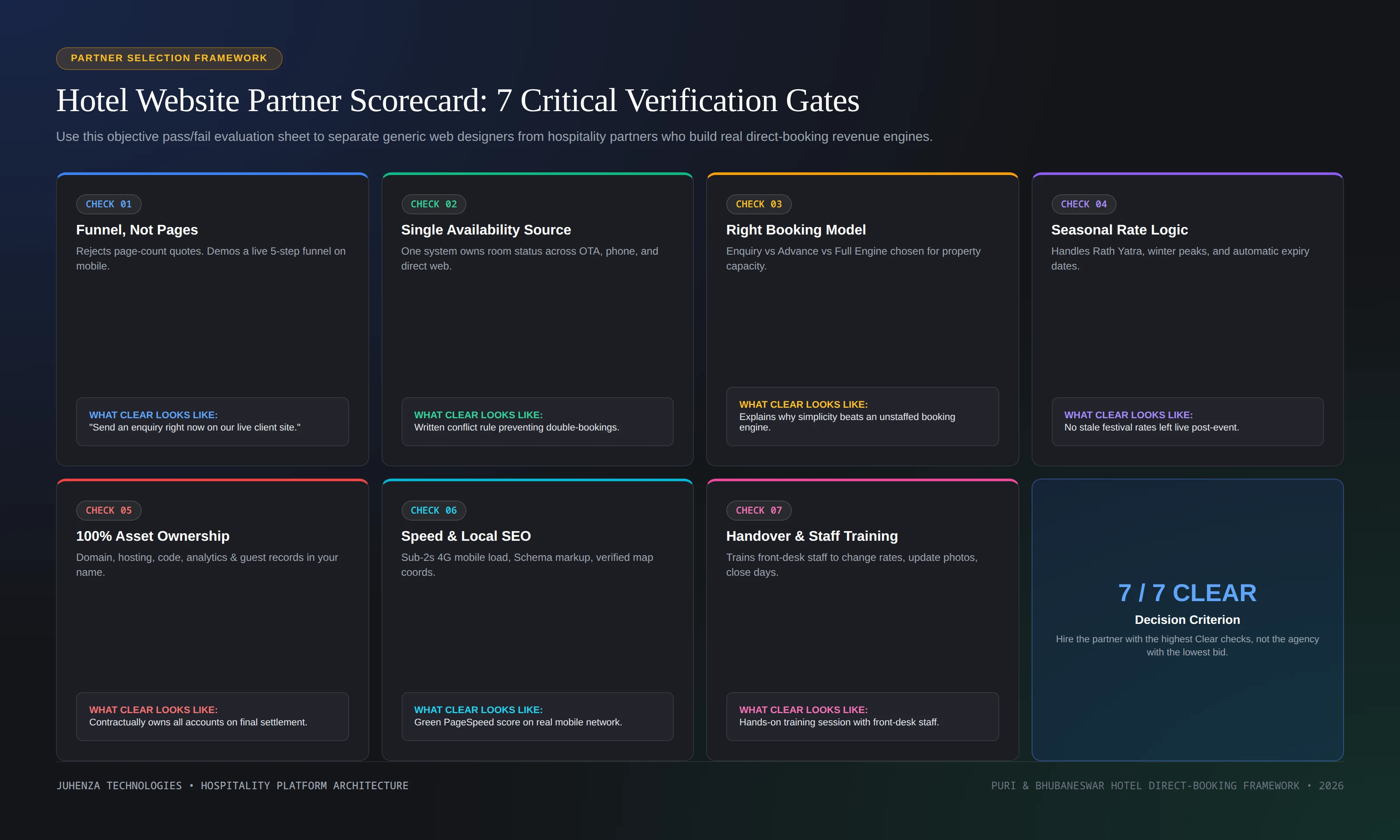
| # | Check | What Clear looks like | Ask this |
|---|---|---|---|
| 1 | Funnel, not pages | They demo a live funnel: find → trust → choose → ask/book → confirm | "Show me a live hotel funnel you built. Let me send an enquiry." |
| 2 | Availability ownership | One source of truth for availability is named | "If OTA, phone, and website sell the same room, who wins and how is it prevented?" |
| 3 | Booking model | Enquiry-only, booking with advance, or full engine — chosen for a reason | "Why this model for my property, not the other two?" |
| 4 | Rate and cancellation rules | Seasonal rates, peak weekends, and cancellation terms are written down | "How do Rath Yatra and long-weekend rates work on the site?" |
| 5 | Ownership | Domain, hosting, code, analytics, and guest data in your name | "What do I own on final payment, and what do I get if we part ways?" |
| 6 | Speed and SEO basics | Unique titles, clean URLs, sitemap, schema, fast mobile load | "Show me PageSpeed results for a live hotel site on mobile." |
| 7 | Support and handover | Response time, backups, who changes rates/photos, training | "Who changes a rate on a festival week, and how fast?" |
1. Funnel, not pages
A partner who talks only about "10 pages" is not talking about bookings. Ask for the funnel. Ask where guests drop off. Ask what the site does when a guest is ready to book at 11:00 pm and no one is at the desk.
Learn how we scope a build around your actual workflow in our guide to choosing between a company and a freelancer.
2. Availability ownership
This is where hotels lose money and guests lose trust. If availability lives in three places, double bookings happen. The partner must name the system that owns availability. It could be your physical desk register, a property management system (PMS), a channel manager, or a simple manual rule with a clear owner. The point is that it is written down before build.
Practitioner observation from hospitality deployments:
In an operational assessment with a 14-room boutique hotel on Sea Beach Road in Puri, the property took phone, walk-in, and WhatsApp website inquiries while simultaneously listing all rooms on MakeMyTrip and Booking.com. During a high-occupancy weekend ahead of Rath Yatra, front-desk staff confirmed a direct reservation for a Deluxe Sea View room via WhatsApp at 4:15 PM, unaware that an OTA had confirmed the exact same room 20 minutes earlier.
The conflict was operational: the hotel had three sales channels but no single source of inventory authority. The fix was an explicit single-inventory ownership rule: the desk PMS register was designated as the sole master ledger. The website's direct-booking engine was re-configured to pull from a dedicated 2-room direct reserve pool during peak festival dates, with any direct booking immediately issuing an API block or front-desk ping before confirmation. Double bookings fell to zero across the subsequent winter tourist season.
3. Booking model
Choose one model to start. Do not buy all three at once:
- Enquiry-only: Guest sends dates on WhatsApp or form. Desk confirms. Best for small homestays, variable rates, and properties where a human must confirm.
- Booking with advance: Guest picks dates and pays an advance on your site. Best when rates are stable and you want fewer no-shows.
- Full engine + channel sync: Live availability, payment, and OTA sync. Best when you have many rooms, high OTA volume, and staff to manage it.
A partner should recommend the simplest model that fits your occupancy and staff. Complexity without staff is a liability.
4. Rate and cancellation rules
Puri and Bhubaneswar rates move with season, weekends, and festivals. The site must handle that without leaving last year's rate live. Ask how seasonal pages are created, approved, and taken down. Ask what the guest sees if they try to book a sold-out date.
5. Ownership
Insist on this in writing: domain in your company name, hosting access, code and database on request, analytics and Search Console in your email, and guest enquiry data you can export. If a partner says "we will manage everything" but gives you no access, you do not own your booking channel.
6. Speed and SEO basics
Most guests search on phones. Test live portfolio sites with Google PageSpeed Insights. Look for mostly green on mobile. Ask how images are compressed, how caching works, and what hosting is used. Ask for unique titles, clean URLs, a sitemap, and LocalBusiness schema with your exact name, address, and phone matching your Google Business Profile.
7. Support and handover
Websites need care. Ask how long free support lasts, what a maintenance plan covers, how fast they respond if the site goes down, and whether backups are kept off-site. Ask for training on the three tasks that change most: rate, photo, and closed day.
For a local-business comparison, see how a website, marketplace, or WhatsApp channel changes the decision for an independent retail operator. The logic is the same: pick the channel that fits the workflow, then build for it.
Puri vs Bhubaneswar: what changes in the build
Puri and Bhubaneswar are 60 km apart and serve different guests. One website template does not fit both.
Puri: Pilgrim and beach demand. Guests ask about distance to the Jagannath Temple and the beach, vegetarian food, parking, check-in rules, and festival-week availability. Photos must show the actual room and view. The map pin must be the right building, not the right lane. Seasonal pages for Rath Yatra, winter holidays, and long weekends need a plan, a publish date, and an automated take-down date.
Bhubaneswar: Business, transit, and family travel. Guests ask about airport and railway station distance, early check-in, work desk and Wi-Fi quality, breakfast timing, and meeting or conference space. The funnel should answer those questions before the enquiry. If you serve both cities from one property group, split the pages. A guest asking for a car in Puri should not land on a Bhubaneswar tariff.
Ask the partner how they will write location pages in the words a guest or driver would use, not brochure language. If a landmark has no official name the guest can use, the page should name the hotel or landmark they already know.
90-day checklist: from brief to first direct bookings
Use this as the acceptance plan. Do not pay the final instalment until the checks in each phase pass.
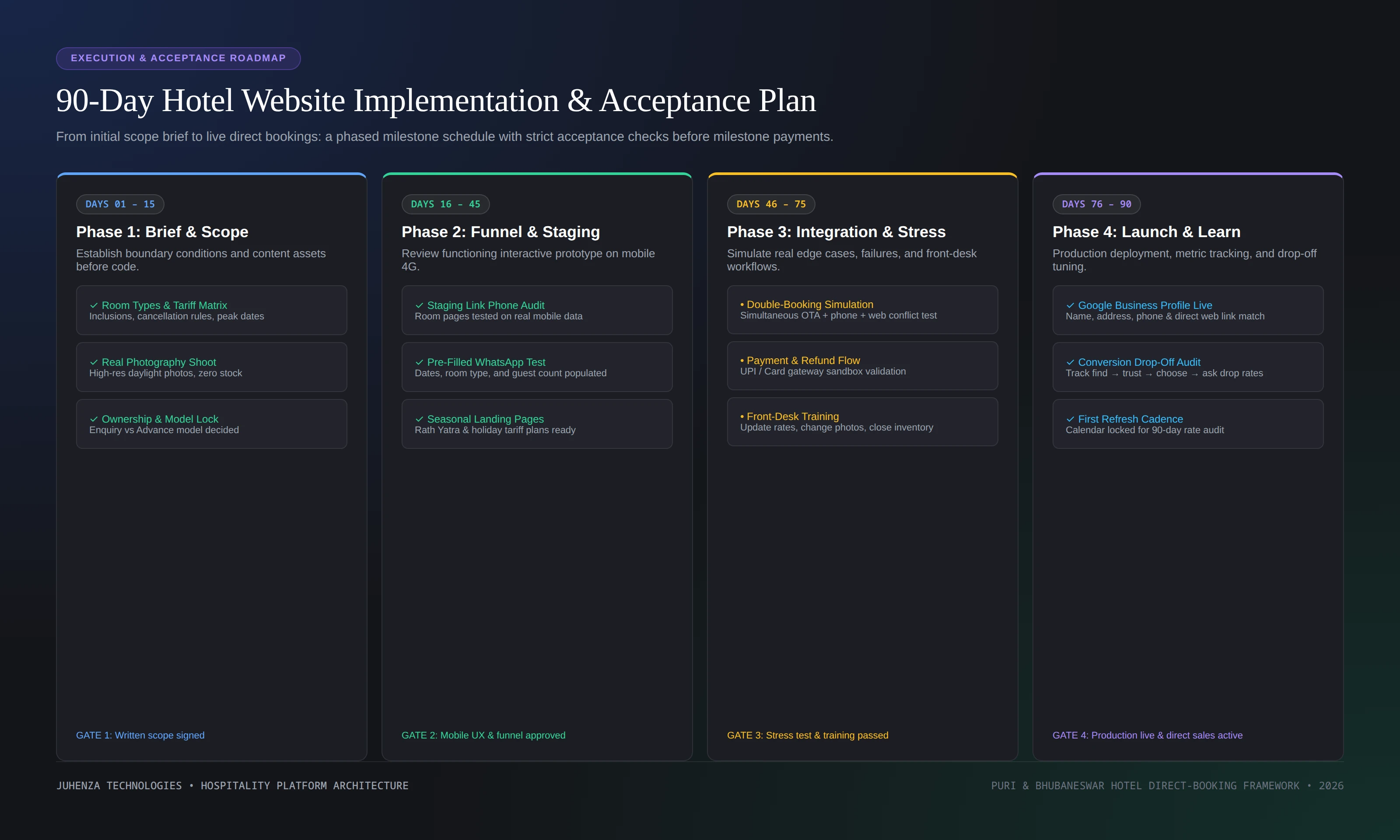
Days 1-15: Brief and scope
- To do: Share room types, tariff logic, inclusions, cancellation rules, and peak dates
- To do: Share real photos or book a shoot date — no stock room photos
- To do: Confirm booking model: enquiry-only, advance, or full engine
- To do: Confirm who owns availability and who replies to enquiries
- To do: Get written scope: pages, features, revisions, timeline, what is not included
- To do: Confirm ownership: domain, hosting, code, analytics, guest data
Days 16-45: Funnel and design
- To do: Approve room page on a staging link on your phone, on mobile data
- To do: Check map pin, phone, WhatsApp button, and enquiry form in under 10 seconds
- To do: Approve rate display, inclusions, and cancellation text
- To do: Approve seasonal page plan for the next peak, with take-down date
- To do: Test enquiry: send a real enquiry, time the reply, check dates are pre-filled
Days 46-75: Build and test
- To do: Test on budget Android, not only office Wi-Fi
- To do: Test PageSpeed, titles, clean URLs, sitemap, and schema
- To do: Test double-booking rule: OTA + phone + website for the same room
- To do: Test payment flow if you chose advance booking, including failure and refund
- To do: Train staff: change a rate, change a photo, mark a closed day
Days 76-90: Launch and learn
- To do: Launch with Google Business Profile, website, and OTA links all matching
- To do: Track: enquiries, direct bookings, reply time, and drop-off step
- To do: Fix the one biggest drop-off before adding features
- To do: Schedule first refresh: check rates, photos, and seasonal pages
If a partner cannot commit to this shape in writing, ask what they can commit to. Vague timelines are a red flag. Review the checks we use when hiring any development partner to structure your procurement contract.
Common mistakes, limits, and when to get specialist help
Common mistakes
- Buying a booking engine before you have staff to reply and manage availability.
- Publishing a sea-view room you do not have, or a rate you cannot honour.
- Leaving last year's festival rate live.
- Letting the agency own the domain or analytics.
- Comparing quotes by headline price instead of by funnel and scope.
Limits of this guide
This guide does not replace legal advice on cancellation terms, refunds, or guest-data handling under local hospitality statutes. It does not set your OTA commission. It does not guarantee search rankings or direct-booking share. Those outcomes depend on pricing parity, reply speed, guest reviews, and local seasonal demand.
When to get specialist help
Engage custom software engineers when you need channel-manager or PMS integration, multi-property inventory routing, GST invoicing integrated directly into booking webhooks, or automated cancellation and refund state machines. Those are systems engineering projects, not brochure websites. For workflow and automation patterns that operate behind a booking flow, review our architectural guide to AI agents for business operations.
FAQ
How much does a hotel website cost in Puri-Bhubaneswar?
It depends on scope. Enquiry-only sites cost less than a booking engine with payment and channel sync. Ask for a written, itemised quote that lists pages, features, content, revisions, and yearly running costs. Do not compare headline prices without comparing what is included.
Should my hotel leave OTAs after launching a website?
Usually no. Keep OTAs for discovery and use your website for direct margin. The goal is to shift a realistic share of bookings to direct, not to exit OTAs overnight. Track the shift with your own numbers, not a blog average.
Is WhatsApp booking enough, or do I need a booking engine?
WhatsApp booking is enough for many small hotels and homestays, especially when rates vary or a human must confirm. Choose a booking engine when you have stable rates, many rooms, and staff to manage live availability and payments.
How do I avoid double bookings across OTA, phone, and website?
Name one system that owns availability before you build. It could be a PMS, a channel manager, or a manual rule with a named owner. Test it with a real scenario: same room, same dates, three channels. If the rule is not written, it will fail in peak season.
What should I check on a partner's live hotel site?
Open it on your phone on mobile data. Check speed, room photos, rate clarity, map pin, and WhatsApp or booking button. Send an enquiry and time the reply. If you cannot complete that flow in a few minutes, guests will not either.
How long does a hotel website take to build?
A focused enquiry site often ships in 3 to 6 weeks once content and photos are ready. A booking engine with payment and channel sync takes longer. Ask for a written timeline with milestones and acceptance checks for each phase.
Who should own my domain, hosting, and guest data?
You should. The domain should be in your company name, hosting and analytics should be in your accounts, and guest enquiry data should be exportable. Get ownership and handover in writing before you pay the first instalment.
What if my rates change for Rath Yatra or long weekends?
Plan a seasonal page before the peak, with rooms you actually have, approved rates, and an automated take-down date. Do not leave last year's rate live. Assign one person to update rates and one person to check them before the peak.
Where this fits
This guide belongs to our Website Development series under travel and hospitality architecture. It connects your guest acquisition funnel to your operational front desk.
Conclusion
Do not choose a hotel website partner in Puri-Bhubaneswar by the prettiest homepage. Choose by the funnel they will build, the leakage you will measure, and the 90-day plan they will sign.
Send your room types, tariff logic, and booking model as a brief, and ask each partner to score themselves on the 7-check scorecard above. The clearest answers will tell you who to hire.
To scope a direct-booking website or hospitality integration tailored to your property, discuss your project with JUHENZA. We establish written scope and operational acceptance criteria before any development begins.
References
- Google PageSpeed Insights — Tool for measuring real-world Core Web Vitals and mobile loading speed.
- Google Business Profile Help — Official documentation for location verification and local search accuracy.
