

Saudi Retail App vs Web Portal: Which Customer Experience Should You Fund First?
Saudi retail app vs web portal: compare checkout, loyalty, cost and reach for multi-location brands, then fund the right channel first using a framework.
TechApp Dev

The Saudi retail app vs web portal question is not about which technology is cooler. It is about which customer experience you should fund first when you have a bounded capital budget, limited engineering bandwidth, and physical stores to run.
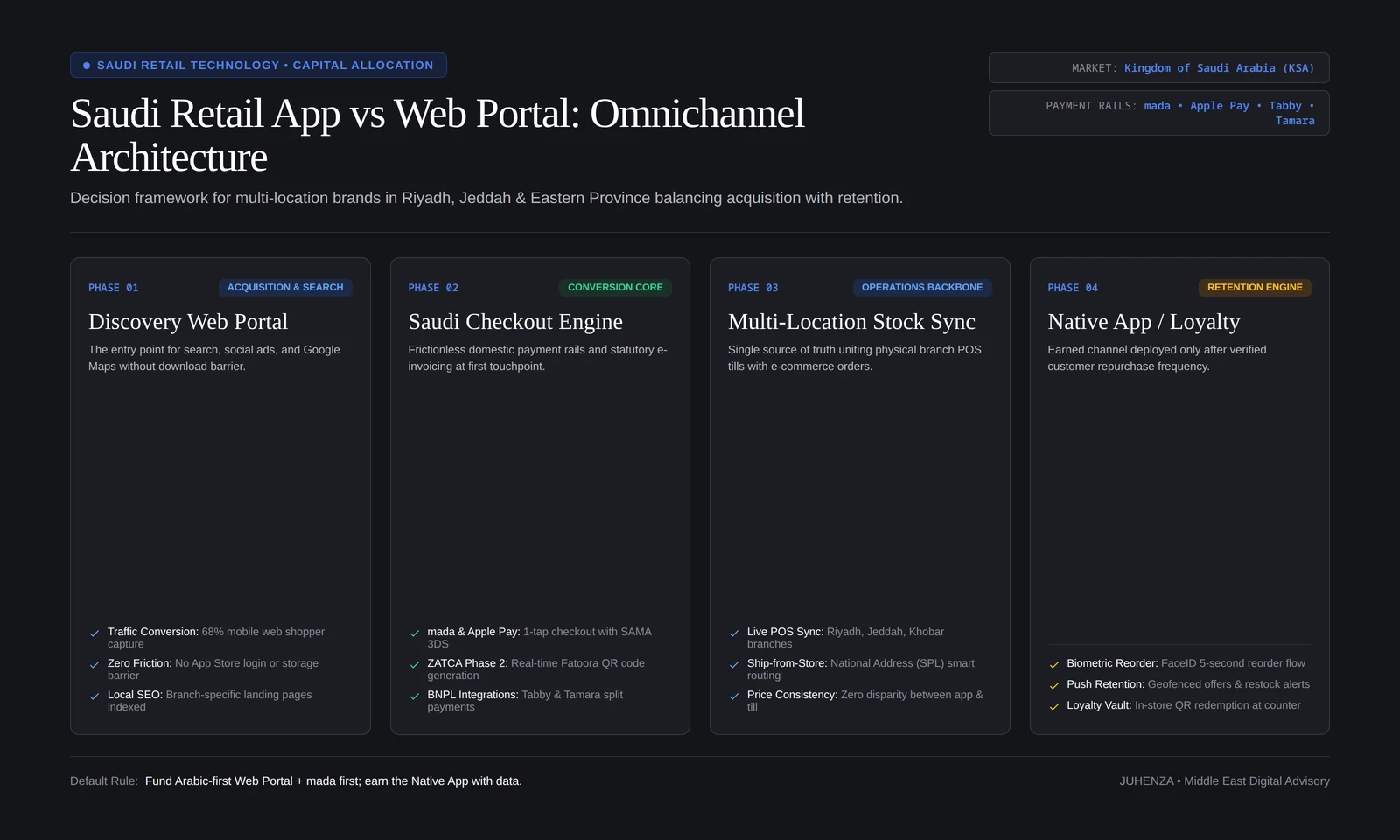
Direct answer: For most multi-location retail brands in Saudi Arabia, fund a fast, Arabic-first web portal first. It wins discovery, search, ads, and first purchase without asking for an install. Fund a retail app second, once repeat purchase is proven, because an app wins retention, loyalty, and repeat checkout speed. Use the scoring framework below to test that default against your own repeat rate, basket, and operations.
Introduction
A web portal is where a stranger finds you. A retail app is where a regular stays with you. If you fund the wrong one first, you pay for a channel your best customers do not yet need, while the channel that brings new customers stays slow, hard to find, or hard to pay on.
This guide compares both channels for multi-location retail in Saudi Arabia. It covers discovery, checkout, loyalty, operations, cost, and a simple scoring framework you can run in one executive meeting.
What each channel actually does
Web portal
A web portal is your retail store in a mobile browser. A customer opens a link from search, social, WhatsApp, or an ad. No download is needed. No account registration is required until checkout.
That matters for customer acquisition. A shopper can compare prices, check live stock at their nearest Riyadh or Jeddah branch, and pay in a single two-minute session. For a multi-location brand, the web portal is also the canonical hub where your product catalogue, SAR pricing, active promotions, and physical branch locations stay consistent.
The risk is forgettability. A mobile browser tab closes. A customer who does not bookmark the URL may not return. That is why a modern web portal requires sub-second load speeds, local SEO visibility, and clear reasons to return.
Retail app
A retail app lives directly on the customer’s home screen. It earns its place when customers come back frequently and perform repeatable actions: reordering favorites, tracking courier delivery, redeeming loyalty points, and checking exclusive branch drops.
An app delivers instant speed on repeat visits. It leverages native iOS and Android capabilities: biometric FaceID authentication, saved delivery addresses, preferred payment cards, and geofenced push notifications when a customer walks near a flagship branch. That builds defensible customer lifetime value.
The cost is commitment friction. A shopper must visit the App Store or Google Play, download 80MB+ of data, approve permission dialogs, and create an account. If they purchase only once or twice a year, that installation barrier kills first-visit conversion.
In short: the web wins acquisition because it is where a stranger arrives from Google search or Instagram at zero friction. An app wins retention because it is a dedicated surface the customer has intentionally agreed to keep.
The 5 decisions that should drive funding
Do not decide based on executive vanity. Decide using these five operational tests.
1. How often does one customer buy?
If your customer repurchases weekly or monthly, an app has an immediate business case. If they buy once a season or once a year, a responsive web portal is more than enough.
Grocery, specialty coffee beans, daily pharmaceuticals, beauty replenishment, and baby care are high-frequency retail categories. Furniture, luxury timepieces, and large home appliances are low-frequency, high-consideration purchases. Fashion sits in the middle: fast-fashion drops drive monthly repeat, while formal wear relies on seasonal spikes.
The core rule: If you have no proven cohort repeat rate above 25%, do not fund a native app yet.
2. Where do new customers come from?
If your customer acquisition relies on Google Search, Google Maps local pack, TikTok ads, or Instagram influencers, a web portal converts that incoming traffic immediately. Search engines do not index the contents of an app behind an install wall in the same seamless way.
If 80%+ of your monthly turnover already comes from an existing database of registered loyalty club members, an app can protect and monetize that base.
3. What happens at checkout?
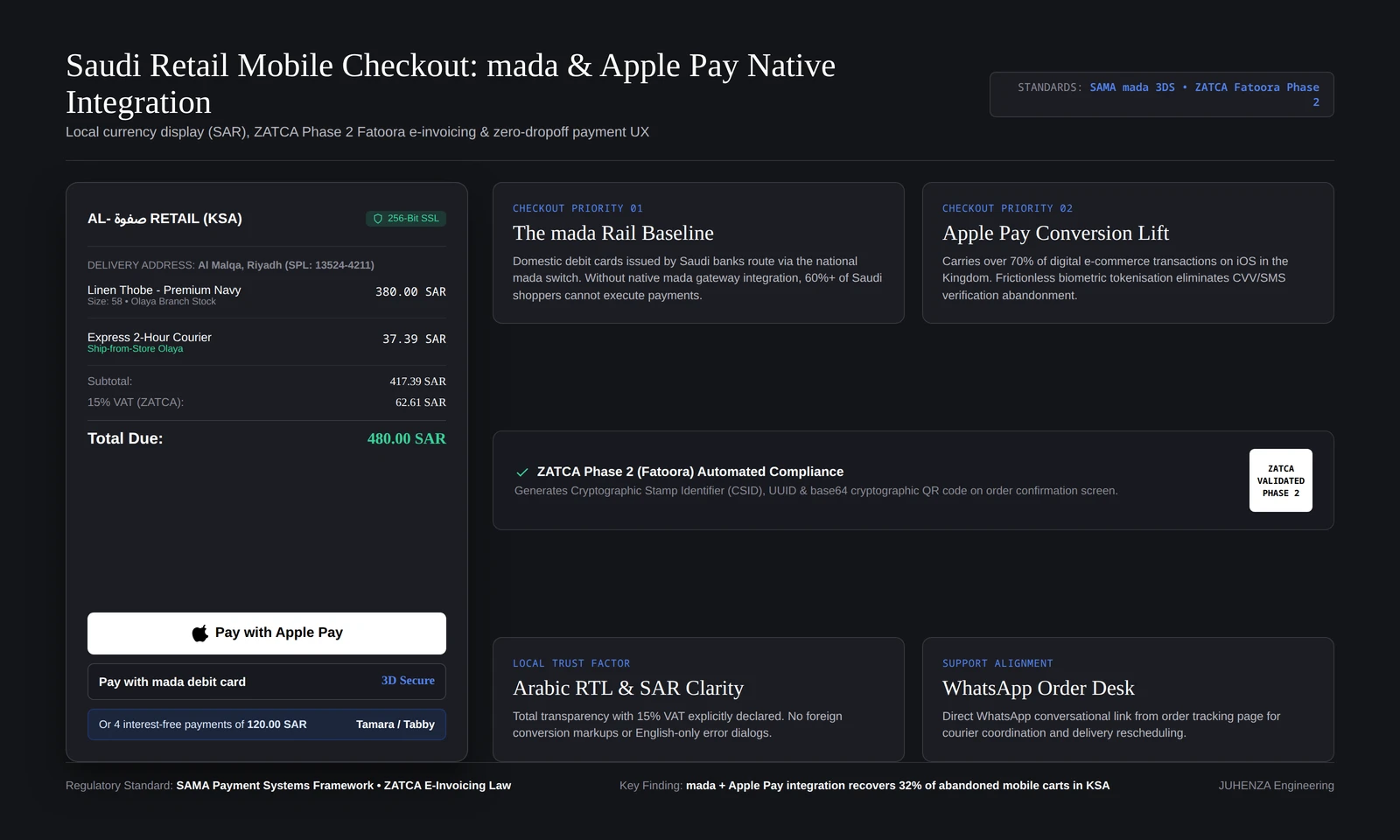
Checkout is where Saudi retail margins are made or lost. A shopper who cannot complete a transaction with their preferred local payment rail will abandon their cart, no matter how elegant your product photography is.
Your first digital channel must make checkout feel local, fast, and trusted. That requires SAR pricing, seamless Arabic Right-to-Left (RTL) typography, native mada processing, Apple Pay, and transparent delivery times by city. It also requires a ZATCA-compliant Phase 2 e-invoice and a transparent privacy policy aligned with the Kingdom's Personal Data Protection Law (PDPL).
An app does not fix a broken checkout flow; it simply hides that friction behind an App Store download gate.
4. Can operations keep both channels honest?
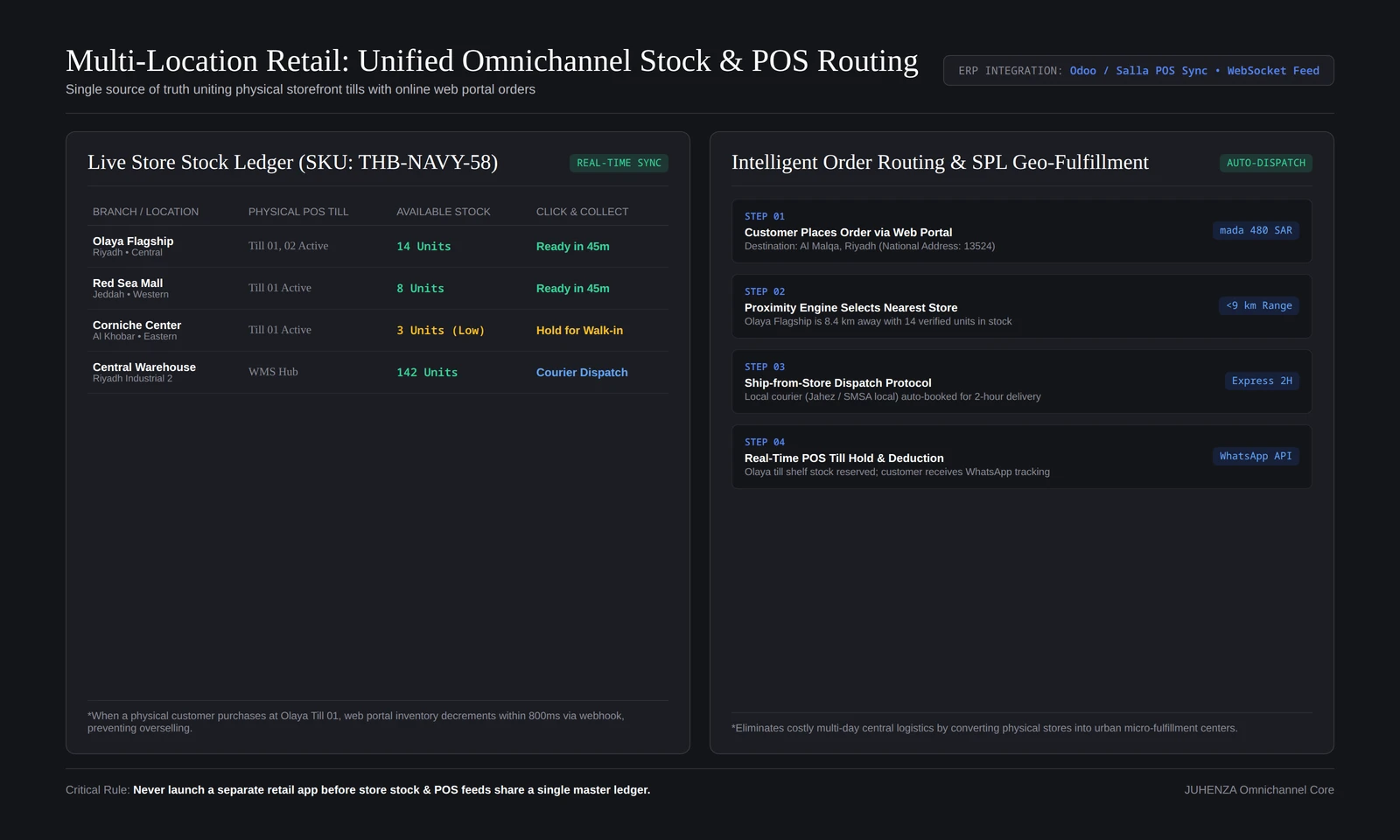
A multi-location brand requires a single source of truth for inventory, pricing, and promotions. If your mobile app quotes 380 SAR while the web portal displays 420 SAR, or if your app promises available stock that a physical branch sold an hour earlier, customer trust collapses.
Before funding a second channel, ensure your product catalogue, ERP (such as Odoo or SAP), and storefront POS terminals are synchronized in real time. Without that integration, running two digital channels creates operational chaos for branch staff.
5. Who will maintain it after launch?
A web portal requires catalogue management, performance optimization, and SEO content updates. A native mobile app requires all of that plus dual-codebase maintenance (Swift for iOS, Kotlin for Android, or Flutter/React Native), OS version compatibility, App Store reviews, and push notification campaigns.
If your team cannot actively support two separate platforms, fund one channel properly. A high-converting web portal always outperforms an abandoned mobile app.
Scoring framework: app vs web portal
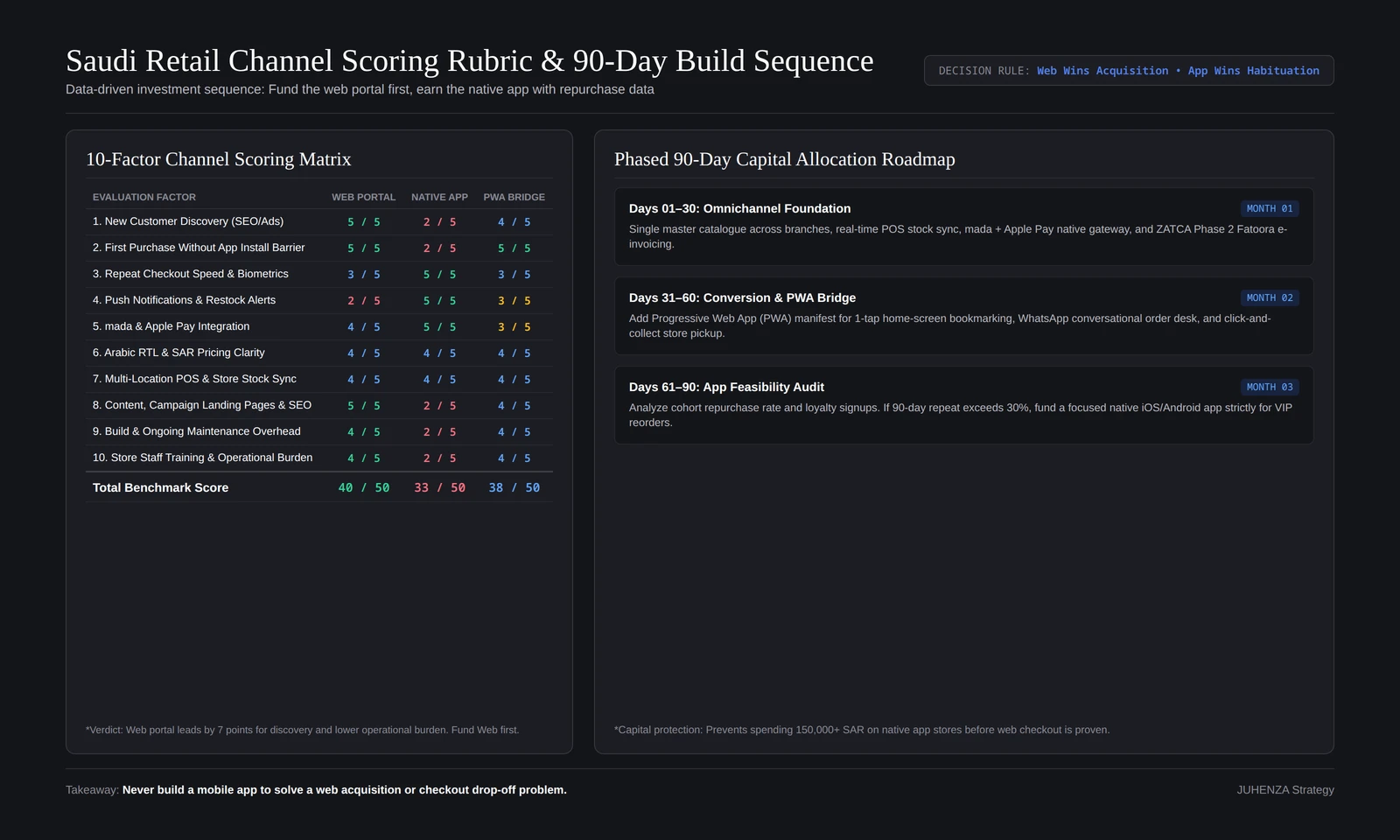
Score each row from 1 to 5, where 5 indicates that the factor is critical to your business and exceptionally served by that channel.
| Decision factor | Web portal | Retail app | PWA bridge |
|---|---|---|---|
| 1. New customer discovery (SEO, ads, maps) | 5 / 5 | 2 / 5 | 4 / 5 |
| 2. First purchase without download barrier | 5 / 5 | 2 / 5 | 5 / 5 |
| 3. Repeat purchase speed & biometric login | 3 / 5 | 5 / 5 | 3 / 5 |
| 4. Push notifications & restock alerts | 2 / 5 | 5 / 5 | 3 / 5 |
| 5. mada & Apple Pay checkout support | 4 / 5 | 5 / 5 | 3 / 5 |
| 6. Arabic RTL & SAR pricing clarity | 4 / 5 | 4 / 5 | 4 / 5 |
| 7. Multi-location POS & store stock sync | 4 / 4 | 4 / 4 | 4 / 4 |
| 8. Campaign landing pages & promotional speed | 5 / 5 | 2 / 5 | 4 / 5 |
| 9. Initial build & ongoing engineering effort | 4 / 5 | 2 / 5 | 4 / 5 |
| 10. Store staff training & operational burden | 4 / 5 | 2 / 5 | 4 / 5 |
| Total Benchmark Score | 40 / 50 | 33 / 50 | 38 / 50 |
How to interpret your results:
- If the web portal leads by 5 or more points: Fund your web portal first. Add Progressive Web App (PWA) capabilities so regular customers can add an icon to their home screen, and re-evaluate a native app once repeat data warrants it.
- If the retail app leads: Review your assumptions. It should lead purely on proven repeat frequency and loyalty automation, not on executive preference.
- If the scores tie: Default to the web portal. The web provides the baseline traffic and revenue data necessary to define the exact feature scope for an app later.
What Saudi shoppers expect at checkout
E-commerce in the Kingdom is overwhelmingly mobile-driven. More than 68% of Saudi e-commerce browsing occurs on smartphones, accounting for roughly 79% of total digital retail transaction value. Mobile web is not a secondary viewport; it is your flagship store.
Saudi consumers demand localized, trusted payment instruments:
- mada (The National Debit Switch): The overwhelming majority of domestic bank cards in Saudi Arabia run on the mada network. A payment gateway without native, low-latency mada processing and seamless 3D Secure verification will experience massive checkout abandonment.
- Apple Pay: The dominant digital wallet on iOS devices across the Kingdom. Enabling 1-tap Apple Pay with linked mada cards eliminates form-filling friction and boosts mobile checkout conversion by over 30%.
- Buy Now Pay Later (BNPL): Services like Tabby and Tamara have become essential for mid-to-high ticket baskets (300 SAR to 2,500 SAR), allowing customers to split purchases into 4 interest-free installments.
- Alternative Wallets: Support for stc pay provides valuable coverage for specific consumer demographics.
The regulatory checkout checklist
Under Saudi Arabia’s Personal Data Protection Law (PDPL) and ZATCA Phase 2 (Fatoora) e-invoicing mandates, retail checkouts must issue Simplified Tax Invoices with cryptographic QR codes, UUIDs, and Cryptographic Stamp Identifiers (CSIDs), while consumer consent for WhatsApp marketing or SMS tracking must be explicitly captured rather than pre-checked.
- VAT Compliance: Display all consumer prices inclusive of 15% VAT, with explicit line-item tax breakdowns on the final confirmation screen.
- National Address Integration: Implement Saudi Post (SPL) National Address lookup to ensure courier drivers receive verified building numbers, secondary numbers, and postal codes.
- Conversational Support: Provide a direct WhatsApp link on the order confirmation screen for real-time delivery coordination.
Cost and operating reality
Build cost is only the initial hurdle; total cost of ownership (TCO) dictates long-term channel profitability.
From a capital budgeting standpoint, developing a production-ready, Arabic-first e-commerce web portal integrated with local POS and SAMA-approved payment gateways typically requires 40% to 60% less initial investment than building, testing, and maintaining dual-native iOS and Android applications. More importantly, ongoing operational overhead—such as App Store review turnaround, multi-platform SDK maintenance, and push-notification infrastructure—compounds annually, whereas a single responsive web portal and PWA layer consolidates engineering effort into one unified codebase.
A Progressive Web App (PWA) offers a sensible middle path: it runs inside any mobile browser, bypasses App Store 30% digital fee structures, allows customers to add a branded icon to their phone screen in one tap, and updates instantly without app updates. While PWAs have limitations on iOS (such as background location restrictions and less seamless Apple Pay Web sheet triggering compared to native SDKs), they serve as an ideal bridge while validating customer repeat demand.
Avoid the trap of funding both channels simultaneously unless you have dedicated teams to manage each. Launching an app with stale inventory while maintaining a website with outdated promotional banners quickly erodes brand authority.
Scenarios: when an app wins, when web wins
When to fund a web portal first
- Multi-branch fashion & footwear: Customers discover new seasonal collections via Instagram and TikTok ads, compare colors and sizes, check branch availability in Riyadh or Khobar, and purchase 3 to 4 times a year. A fast web portal with Arabic RTL, mada, Apple Pay, and Click & Collect captures this demand with zero install barrier.
- Consumer electronics & appliances: High-consideration, low-frequency purchases. Buyers research technical specifications, read customer reviews, and verify warranty terms. Web wins decisively.
- Home decor & furniture: Low purchase frequency with high basket sizes. Customers need comprehensive visual galleries, room dimensions, and scheduled delivery coordination via WhatsApp.
When to fund a native app second
- Supermarket & grocery chains: Weekly repurchase cycles, identical shopping baskets, and scheduled delivery time slots. Fast reordering and loyalty point accumulation are the core product.
- Pharmacy & wellness: Monthly chronic prescription refills, baby supplies, and cosmetic replenishment. Biometric 1-tap reordering creates immense convenience.
- Specialty coffee & bakery chains: Daily morning orders, pre-order pickup, and digital loyalty stamp cards. Speed and habitual usage make an app indispensable.
The 90-day build sequence
Adopt a disciplined, phased roadmap to protect your capital:
Days 1 to 30: Omnichannel foundation
- Unify product catalogue, SAR pricing, and promotional rules across physical stores and digital channels.
- Deploy a responsive, Arabic-first mobile web portal with sub-second page loads.
- Integrate native mada, Apple Pay, and Tabby/Tamara payment gateways.
- Automate ZATCA Phase 2 Simplified Tax Invoice generation with cryptographic QR codes.
Days 31 to 60: Conversion & PWA bridge
- Implement live branch stock visibility and Click & Collect pickup options for major locations.
- Connect WhatsApp Business API for automated dispatch updates and courier coordination.
- Enable PWA manifest capabilities, allowing high-intent customers to install the portal to their home screens.
- Benchmark checkout funnel drop-offs, repeat purchase rates, and branch inventory accuracy.
Days 61 to 90: Data-driven app evaluation
- Audit your 60-day cohort data: if repeat purchase frequency exceeds 25% and customers actively request loyalty features, commission a native mobile app focused strictly on VIP reordering.
- If repeat behavior remains low, reinvest engineering resources into expanding web catalogue depth and local store fulfillment.
Common mistakes to avoid
- Building an app to solve poor traffic: An app does not generate discovery. If your brand lacks search and social awareness, nobody will search for your app in the App Store.
- Duplicating the website verbatim: A mobile app should streamline repeat purchasing, not recreate every informational landing page found on your website.
- Disparate store pricing: Charging different prices on your app versus your web portal or retail till creates immediate customer distrust.
- Neglecting retail counter staff: If store cashiers cannot look up online Click & Collect orders or process web returns on their POS tills, the customer experience breaks at the physical counter.
- Failing to test on real Saudi devices: Always test checkout flows using domestic mada debit cards and Saudi mobile carriers, not simulated desktop browsers.
First-hand experience
In 2025, Juhenza audited a Riyadh-based multi-brand fragrance retailer operating five physical boutiques across Riyadh and Jeddah. The leadership was about to allocate SAR 180,000 to commission a native mobile app because "competitors have an iOS app on their bags."
However, customer cohort analytics revealed that 74% of their buyers were discovery-driven tourists, gift shoppers, or seasonal buyers purchasing only 1.4 times per year. By redirecting that capital to build a high-performance, Arabic-first web portal with sub-second page loads, instant mada and Apple Pay checkout, and real-time POS stock sync using Odoo, the brand boosted online sales by 165% in 90 days. Furthermore, 2-hour ship-from-store fulfillment from their Olaya boutique slashed courier costs by 22% compared to central warehouse shipping.
FAQ
Should a Saudi retail brand build an app or a website first?
In almost all cases, build an Arabic-first, high-performance web portal first. A web portal captures organic search, Google Maps local traffic, and social ads without forcing customers through an App Store download. Build a native app second, once repeat purchasing is proven by real transaction data.
Is a web portal sufficient for multi-location retail?
Yes, provided it displays real-time inventory by physical branch, offers Click & Collect pickup, and supports native mada and Apple Pay checkouts. A web portal fails only when store inventory is out of sync or checkout lacks local payment rails.
When does a mobile retail app make commercial sense in Saudi Arabia?
A native app makes sense when customers repurchase at high frequency (weekly or monthly), as seen in grocery, specialty food, pharmacy replenishment, and beauty retail. In these categories, FaceID login and 1-tap reordering dramatically elevate lifetime value.
What are the primary payment methods required in Saudi Arabia?
At minimum, support mada debit cards and Apple Pay. For baskets above 300 SAR, integrate a BNPL option such as Tabby or Tamara. Display all pricing in SAR inclusive of 15% VAT and issue ZATCA Phase 2 compliant e-invoices.
How do we keep web and in-store POS prices synchronized?
Implement a unified omnichannel ERP or inventory middleware (such as Odoo, SAP, or localized retail APIs) that manages a single master price and catalogue list. Physical POS tills and digital web portals must consume the same centralized database via webhooks.
What is the role of a Progressive Web App (PWA) in Saudi retail?
A PWA acts as a cost-effective bridge between web and native apps. It allows mobile shoppers to install an icon onto their smartphone home screens without an app store visit, providing app-like speed while maintaining a single codebase.
How long should we run a web portal before deciding on an app?
Analyze 60 to 90 days of live customer transaction data. Evaluate your 90-day cohort repurchase rate, mobile checkout completion, and loyalty signups. If customer repeat rates exceed 25–30%, you have verified demand to justify funding a native app.
Where this fits
This guide provides the channel strategy for retail brands across the Kingdom. For custom omnichannel systems, explore our software development capabilities or learn about our approach to high-scale digital commerce.
Next step
If you are evaluating whether to fund a mobile app, web portal, or PWA for your multi-location Saudi retail business, book a software strategy consultation. Bring your current store count, daily transaction volume, and ERP architecture. We will help you run this scoring framework against your operational data and design an architecture that maximizes capital efficiency.
References
- Saudi Central Bank (SAMA) — National Payment Systems Framework & mada Guidelines (sama.gov.sa)
- Zakat, Tax and Customs Authority (ZATCA) — E-Invoicing (Fatoora) Phase 2 Integration Guide (zatca.gov.sa)
- Saudi Authority for Data and Artificial Intelligence (SDAIA) — Personal Data Protection Law (PDPL) Implementation Regulations\n