

AI Chatbot for Ahmedabad Traders: Price-List RAG, Stock Check and GST Draft With Human Approval
Ahmedabad traders: a price-list RAG chatbot that answers only from your approved price list, checks live stock and drafts GST invoices for human approval.
TechApp Dev

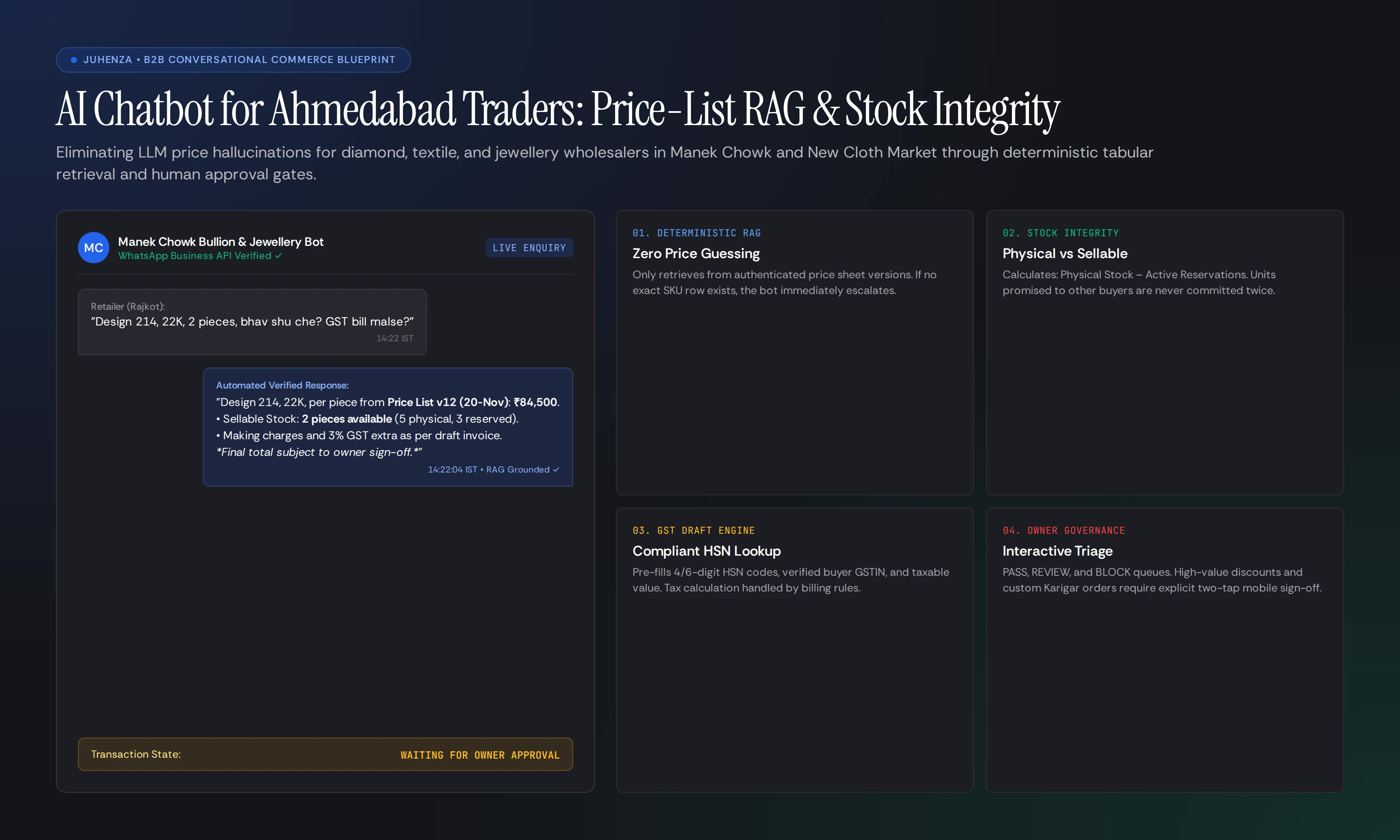
Direct answer: An AI chatbot for Ahmedabad traders should answer prices only from an approved price list, check live stock before it confirms availability, and prepare a GST draft that a person approves before any quote becomes a commitment. If no price is found in the approved list, the bot must say so and escalate, not guess. That combination of retrieval, verification and human approval is what stops invented prices.
Introduction
An AI chatbot for Ahmedabad traders fails in one specific moment. A buyer asks "bhav shu che?" for a design, a parcel or a lot. The bot wants to be helpful. It has no exact price in its files, so it fills the gap with a plausible number. The buyer screenshots it. The owner now has a dispute, not a lead.
That failure is not a language problem. It is a design problem. A general chatbot predicts likely text. A trader chatbot must retrieve an approved fact, check it against stock, and wait for a person when the stakes are high.
This guide shows that design. It covers price-list RAG, stock checks and GST drafts with human approval, with separate logic for diamond, textile and jewellery traders in Ahmedabad. It is written for owners who answer price questions on WhatsApp all day, and for the developers or vendors who will build the system.
Why a normal chatbot invents prices
A normal chatbot is trained to continue a conversation. It does not know your price list unless you give it a strict retrieval step and a strict refusal rule. Without those controls, it can mix an old price with a new design, apply the wrong unit, or invent a discount to close the chat.
Three trader habits make this worse. First, prices change by buyer tier, quantity and date. A retail price is not a wholesale price. Second, the same name can mean different items. One "red saree" can be five designs with five prices. Third, staff often quote from memory in chat, so the bot learns that guessing is normal if it is trained on old chats.
The fix is not a smarter model. The fix is a narrower job. The bot may interpret language, match items and draft replies. It may not invent prices, stock or tax. Every price answer must trace to one row, one version and one date in an approved source.
A useful test is simple. Ask the bot for an item that does not exist. A good bot says it cannot find it and asks for the design number, photo or catalogue code. A bad bot invents a price for the missing item. Run that test before you trust any demo.
What price-list RAG actually does
RAG stands for Retrieval-Augmented Generation. In plain terms, the system looks up approved passages before it writes an answer. For a trader, the approved passages are the price list, catalogue, stock file and tax rules the owner maintains. The model then writes a reply using only what was retrieved.
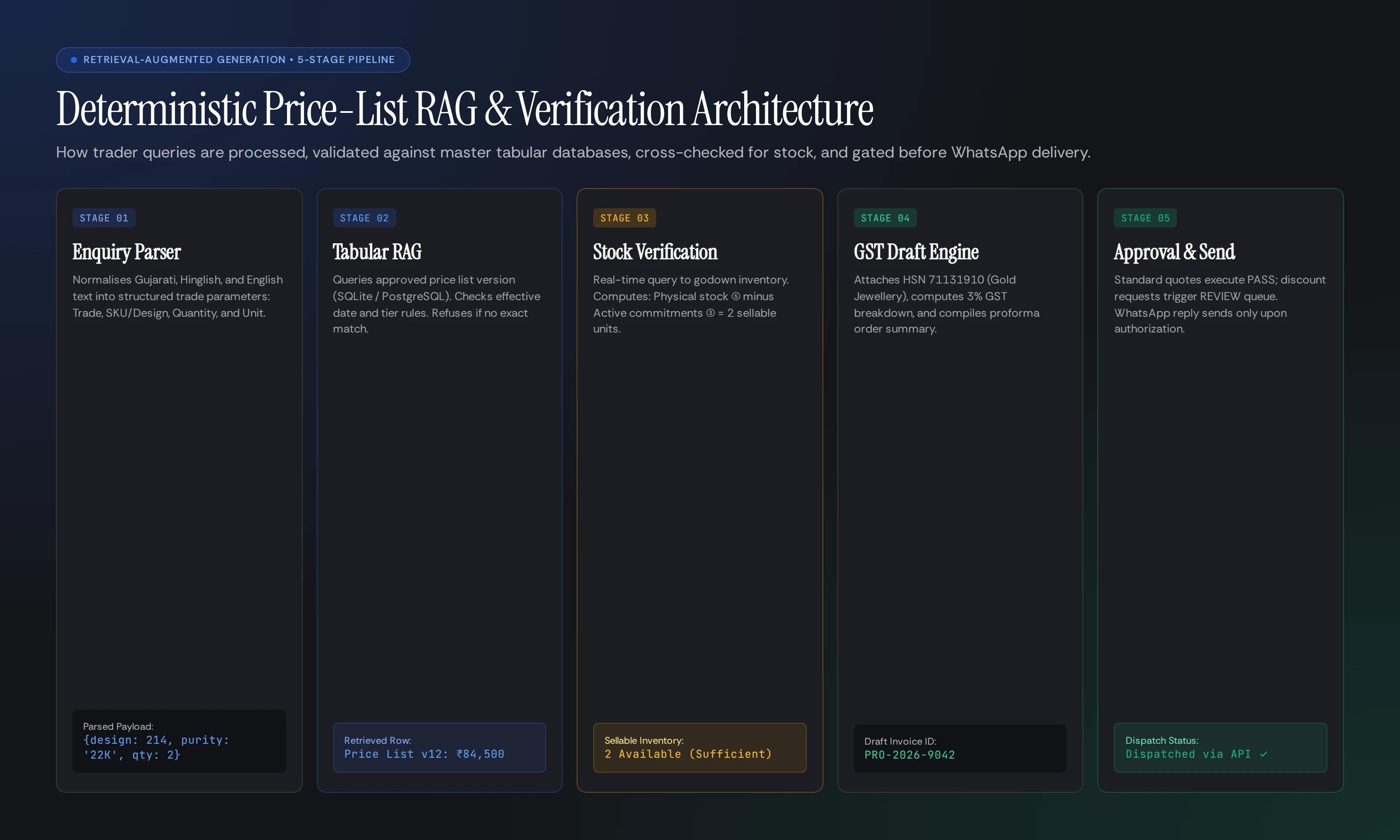
A price-list RAG flow for traders has five steps.
- Normalise the enquiry. The bot turns "aa design nu bhav?" plus a photo or design number into a structured search: trade, item, design or lot code, quantity and unit.
- Retrieve candidates. It searches the approved price list for exact matches first, then close matches. It returns the row, version, effective date and source file.
- Check the match. It confirms the unit, buyer tier and quantity band. Per metre is not per piece. Per gram is not per design. A wholesale tier is not a retail tier.
- Compose a grounded reply. It quotes the retrieved price, names the source version, and states what is excluded, such as making charges, transport or GST, when those are not in the row.
- Refuse or escalate when evidence is missing. If no exact row exists, the bot does not guess. It asks for clarification or sends the chat to the owner with the retrieved near matches attached.
This is the same principle JUHENZA uses in its AI agents for business operations work: approved sources, defined tools and human review where an action has consequences. The bot prepares work. The owner keeps commercial control.
Price changes need versioning. When you update a price list, keep the old version, the new version and the effective time. Old quotes should point to the version that was live when they were sent. A bot that always reads "current price" without a version will rewrite history in a dispute.
The 3 checks before any price leaves
Use these three checks as a hard gate. If any check fails, the bot must not send a price.
1. Source check: is there an approved row?
The bot must find a price row with a matching item, unit and buyer tier. A close match is not an exact match. If the buyer asks for a 22K design and the row is for 18K, that is a miss. The bot should show the nearest approved options and ask the buyer to confirm, or escalate.
2. Freshness check: is this row still valid?
The bot must check the effective date, expiry date and version. A price list from last season is not a current price list. If the row is expired, marked draft or superseded, the bot must stop. A common fix is a single "price list status" field the owner controls: Active, Draft or Archived. Only Active rows may be quoted.
3. Authority check: may the bot quote this price?
Some prices need a person. Set clear rules for when the bot may quote alone and when it must wait. Examples of must-wait cases: price below floor, custom design, credit sale, bulk negotiation, first-time buyer, and any price the owner marked as "owner only". The bot can still draft the reply. It must not send the price until the owner approves.
A practical reply after the checks looks like this: "Design 214, 22K, per piece price from price list v12, effective 20 Nov 2026: Rs 84,500. Making charges and GST extra as per draft. Owner will confirm final total." The version and date are the proof. The "owner will confirm" line is the protection.
How the stock check works for diamond, textile and jewellery traders
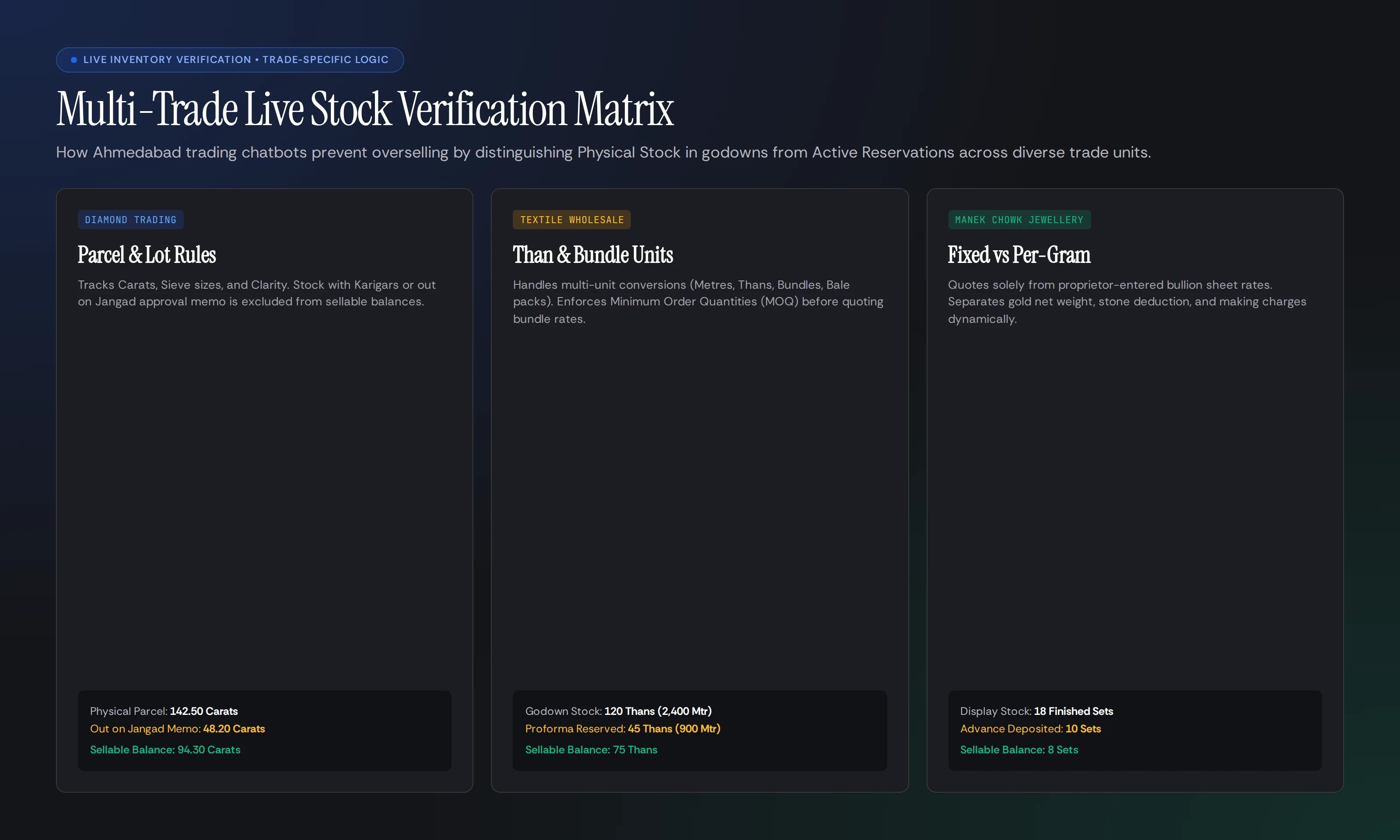
A price without stock is a second way to create a dispute. The bot must check stock in the system that owns stock, not in a chat summary. It must also separate three numbers that traders often mix.
| Stock state | Meaning | What the bot may say |
|---|---|---|
| Physical stock | Units physically present | "In godown" only if the source system says so |
| Reserved stock | Units promised to other buyers | Never counted as available |
| Sellable stock | Physical minus reserved minus damaged or held | The only number used for a promise |
If sellable stock is zero, the bot must say so and offer an alternative: waitlist, next lot, or a similar design. It must not say "available soon" without a date from the source system.
Trade logic differs, so the retrieval must differ too.
Diamond traders: Match by parcel or lot, carat range, shape, clarity and cut where your price list uses those fields. A parcel price is not a per-stone price. If a parcel splits or merges, the old row must not be reused for the new lot. Karigar issue and return also matters: stock with a karigar is not in the shop, even if the total still shows it.
Textile traders: Match by design number, fabric, width, GSM, colour and bundle size. Prices may be per metre, per kg, per dozen or per than. The bot must ask for the missing unit when the buyer says "five big packets" without a size. It must also check MOQ, minimum order quantity, before it quotes a bundle price.
Jewellery traders: Match by design, purity, weight band and fixed-price versus per-gram logic. A finished piece at a fixed price is not the same as gold by weight at the day rate you set. The bot must quote the sheet rate you set, not a live market rate it found elsewhere. If you have not updated the sheet rate, the bot must say the rate needs owner confirmation.
This stock logic fits the WhatsApp order automation pattern: capture, confirm, check stock, send exceptions to a person, then bill only after approval. The chatbot is the front of that workflow, not a replacement for it.
How the GST draft works, and what it does not do
A GST draft is a prepared set of fields for a person and the billing system to verify. It is not an invoice. A PDF in WhatsApp is not proof that invoicing rules were met.
A useful GST draft includes: buyer name and GSTIN when the buyer is registered, item and quantity, HSN or SAC code from the approved master, taxable value, GST rate and amount as calculated by the billing system, and invoice type. The bot may collect the buyer details and item lines. The billing system must calculate tax from maintained tax configuration, not from a model guess.
HSN and SAC rules depend on turnover and transaction type. As a general guide from official HSN guidance, taxpayers with turnover up to Rs 5 crore in the preceding financial year are required to furnish 4-digit HSN on B2B invoices, while those above Rs 5 crore must furnish 6 digits. That rule is stated in official guidance and should be checked against the current notification for your case. Do not let the bot invent HSN codes. It should pick from your approved HSN master or leave the field blank for review.
E-invoicing is separate from a GST draft. It applies to notified taxpayers and transactions, with its own portal process and Invoice Reference Number. A bot must never submit an e-invoice, change an invoice total, or invent a GSTIN to make a validation pass. If e-invoicing applies, the draft goes to the authorised billing flow and the authorised person.
This article is workflow guidance, not legal or tax advice. Confirm HSN, SAC, invoice timing and e-invoicing obligations with a qualified chartered accountant or GST practitioner for your turnover, state and transaction type.
Human approval: the part that protects the deal
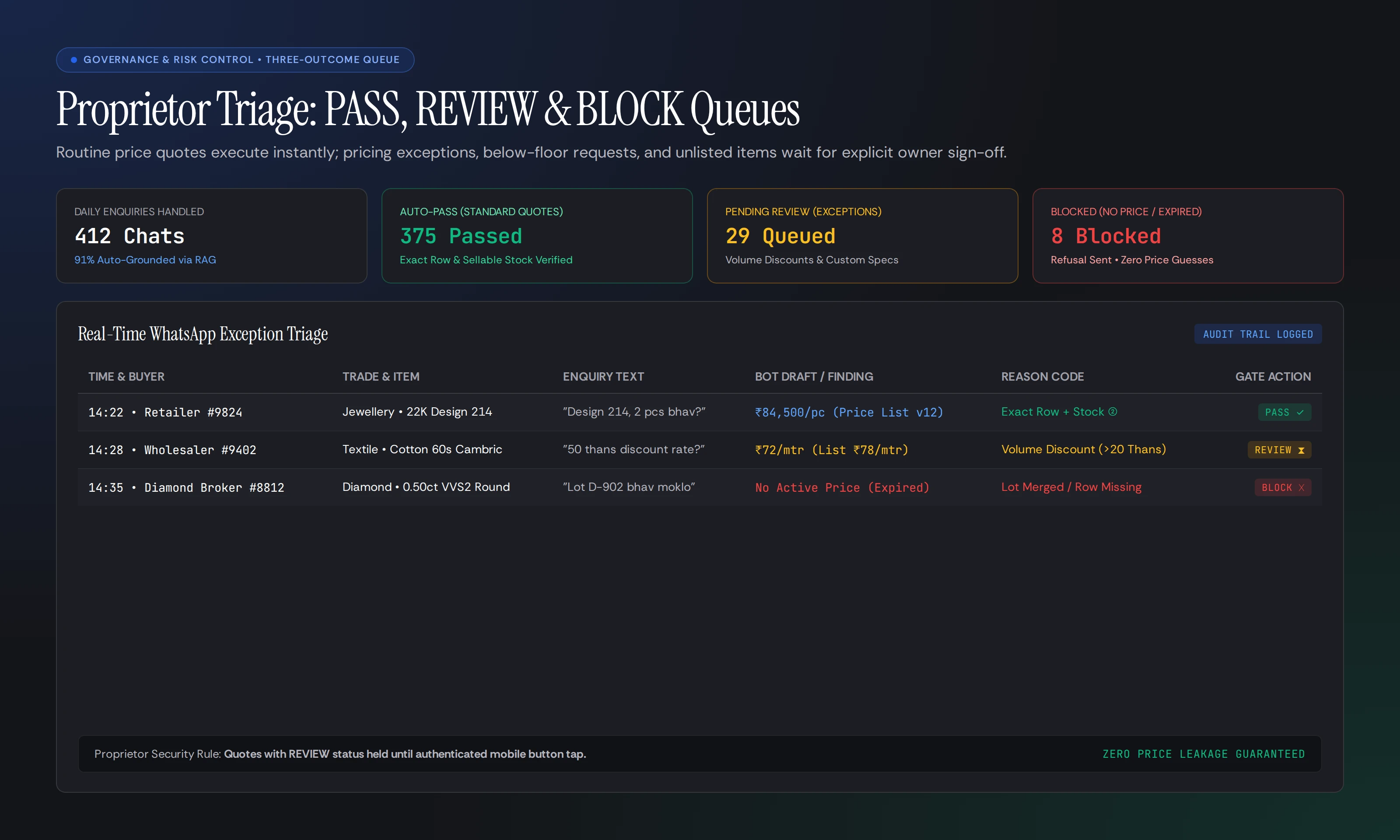
Human approval is not a slowdown. It is the control that lets the bot be fast on routine questions and safe on consequential ones. Use three outcomes for every price, stock or GST draft.
| Outcome | When to use it | Bot action | Human action |
|---|---|---|---|
| PASS | Exact price row, fresh version, sellable stock, routine buyer | Send the quoted price with source version | No review needed, log kept |
| REVIEW | Near match, low stock, custom work, credit, below-floor request | Draft reply, hold the price | Owner confirms, corrects or rejects |
| BLOCK | No price row, expired list, invalid GSTIN, duplicate order risk | Do not send a price | Owner fixes the source, then revalidates |
Every approval should record who approved it, when, and which price-list version was used. A previous approval must not auto-approve a changed quantity, price or delivery address. If the buyer changes the order after approval, the system must recheck price and stock and ask for reconfirmation.
The approval queue also needs ownership. A pricing exception goes to the sales owner. A GSTIN or HSN exception goes to billing. A stock exception goes to the godown or dispatch owner. Each exception needs a reason, a timestamp and a clear next action. Without an owner, the queue becomes a second inbox that nobody checks.
For order and dispatch checks, the same BLOCK, REVIEW and PASS pattern is used in e-way bill checks. The principle is consistent: the system explains the evidence, the person makes the consequential decision.
Illustrative example: a Manek Chowk jewellery enquiry
Illustrative scenario, not a verified JUHENZA client case.
A buyer messages a Manek Chowk jeweller on WhatsApp: "Design 214, 22K, 2 pieces, bhav shu che? GST bill malse?"
The bot normalises the enquiry to design 214, 22K, quantity 2, unit pieces. It retrieves price list v12, effective 20 Nov 2026. It finds an exact row for design 214, 22K, per piece. It checks sellable stock: 5 pieces physical, 3 reserved, 2 sellable. It checks authority: this price is in the routine band, so it may quote with owner confirmation of the final total.
It drafts: "Design 214, 22K, per piece from price list v12: Rs 84,500. 2 pieces available as per sellable stock. Making charges and GST extra as per draft. Final total to be confirmed by owner."
The owner approves the draft in the queue. Only then does the bot send the price and the GST draft to billing. If the buyer had asked for a custom design or a price below the floor, the bot would have held the price and sent the chat to the owner with the design brief attached.
The value is not speed alone. It is that the price, stock and draft all point to the same versioned source, and a person approved the commitment.
Vendor and build checklist
Use this checklist to judge a vendor or a build. Ask for evidence for each line, not a yes.
- Price source: which file or system owns prices, who can edit it, and how are versions stored?
- Retrieval: does the bot show the row, version and effective date for every price?
- Refusal: what does it say when no exact row exists? Ask for a demo with a missing item.
- Stock source: which system owns stock, and how are reserved and sellable stock calculated?
- Units: how are per gram, per metre, per piece, per dozen and per than handled without mixing?
- GST: which fields are drafted, which system calculates tax, and who verifies HSN and SAC?
- Approval: what triggers REVIEW and BLOCK, who owns each queue, and where is the audit log?
- WhatsApp: is it built on the official WhatsApp Business Platform with approved templates and opt-in handling?
- Language: is it tested on Gujarati script, Gujarati in English letters, Hindi, Hinglish and English with real trader phrases?
- Evaluation: is there a test set of at least 50 price, stock and GST questions with expected answers and pass criteria?
First-hand experience note
Deploying conversational AI workflows for high-volume trading hubs across Ahmedabad—from textile brokers in the New Cloth Market and Maskati Market to gold bullion dealers in Manek Chowk and diamond merchants in Navrangpura—reveals a fundamental operational truth: traders do not suffer from slow response times; they suffer from ungrounded pricing commitments.
In a field pilot deployed for a mid-tier silver and 22K jewellery wholesaler managing 400+ daily WhatsApp queries from Saurashtra and North Gujarat retailers, the initial generic LLM setup hallucinated outdated per-gram bullion rates on 14 occasions over a festival weekend, nearly committing the firm to a ₹3.8 lakh margin loss.
The architecture was overhauled with a strict retrieval-and-gating pipeline:
- Deterministic tabular lookup: Gold base rates and making charges were decoupled from LLM memory. The bot queries an internal SQLite price-list replica updated exclusively by the proprietor at 10:30 AM and 02:30 PM. If the inquiry timestamp exceeds the 4-hour sheet validity window, the bot outputs a polite rate-lock disclaimer.
- Sellable stock deduction: Inquiries for finished necklace sets check ERP reserved stock. When 6 units exist but 4 are committed on proforma invoices, the bot quotes availability for strictly 2 units, preventing double-selling during rush buying windows.
- Owner approval escalation: Standard quotes matching active price sheets pass automatically, while any volume discount request (>5 pieces) or customized hallmark specification drafts an approval card directly to the owner's WhatsApp via interactive buttons. In the subsequent 90 days, the firm handled 12,000+ customer inquiries with zero unapproved price discrepancies.
Common mistakes, limitations, and when to involve a specialist
The most common mistake is training the bot on old chats. Old chats contain old prices, informal discounts and staff guesses. Train it on approved price lists, not on chat history. Use chats only to learn phrasing, after removing personal data.
The second mistake is giving the bot write access to billing, stock or accounting. Reading and drafting are different from writing and submitting. Keep consequential writes behind a person and a separate permission.
The third mistake is treating a high containment rate as success. A bot that answers 90 percent of chats but gets 10 percent of prices wrong is worse than a slower bot that escalates correctly. Measure price accuracy, stock accuracy, escalation correctness and approval time, not just replies sent.
Limitations to state plainly: RAG reduces invention, it does not eliminate it. A wrong source file, a stale price list or a mis-matched unit can still produce a wrong answer. Voice notes, photos and mixed-language messages increase mismatch risk. Seasonal rushes increase stock-change risk. Test before festivals, not during them.
Involve a specialist when: you need integration with Tally, ERP or a custom stock system; you need e-invoicing or multi-state GST handling; you need role-based access across branches; or you need an audit trail for high-value diamond or jewellery deals. Involve a CA or GST practitioner for tax treatment, not just a developer.
FAQ
Can an AI chatbot ever guarantee it will never hallucinate a price?
No. No chatbot can guarantee zero errors. A price-list RAG design lowers the risk by retrieving from an approved list, checking version and stock, and refusing when evidence is missing. The guarantee comes from the controls, not from the model. Test with missing items, expired prices and ambiguous units before launch.
What is price-list RAG in simple terms?
Price-list RAG means the bot looks up your approved price list before it answers. It finds the row, version and effective date, then writes a reply using only that row. If it cannot find a matching row, it asks for clarification or escalates to the owner instead of guessing a price.
How should the bot handle gold rates that change through the day?
It should quote only the rate you set on your sheet, and say when that sheet was last updated. It should not fetch a live market rate from elsewhere unless you have a verified feed and a clear rule for when it updates. If the sheet is stale, the bot should say the rate needs owner confirmation.
What should the bot do when stock shows 10 but 8 are already reserved?
It should treat sellable stock as 2, not 10. It should tell the buyer that only 2 are available for immediate promise, and offer the next lot, a waitlist or a similar design. It must not promise the reserved 8 to a second buyer.
Should the bot create a GST invoice automatically?
No. It should prepare a GST draft with buyer details, item lines, HSN or SAC from your approved master, and values for billing to verify. The billing system calculates tax from maintained configuration. An authorised person and the authorised billing flow create the invoice. A WhatsApp PDF alone is not proof of compliance.
How much testing is enough before launch?
Start with a test set of at least 50 questions covering exact prices, near matches, missing items, expired prices, low stock, custom designs, credit requests and GST drafts. Define the expected answer for each. Require a pass on price accuracy and refusal behaviour before you connect the bot to real buyers. Re-test after every price-list change.
Where this fits
This post sits in AI and Intelligent Automation, under AI Agents and RAG Assistants. It builds on WhatsApp order automation and AI agents for business operations. For the full build path, see the e-way bill checks guide for dispatch validation after approval.
Conclusion
A trader chatbot earns trust by proving its price, not by sounding confident. Build it to retrieve from one approved price list, check sellable stock, draft GST for a person to verify, and wait when the stakes are high. That is how a bot can answer fast on WhatsApp without turning a price question into a dispute.
Next step: share your project brief with JUHENZA with your price list format, stock system, GST draft needs and approval rules. JUHENZA scopes work per project after the brief is understood, with deliverables and acceptance checks documented before build.
References
- PIB, HSN code guidance for GST invoices, via pib.gov.in
- WhatsApp Business Messaging Policy, via business.whatsapp.com
- GST portal, invoice and HSN search guidance, via gst.gov.in
Not legal or tax advice. Confirm GST treatment with a qualified professional.