

Audit Trail for Pharma Labs in Hyderabad: How CROs Prove Every Result Sponsors and Auditors Accept
Learn what an audit trail for pharma labs in Hyderabad must prove for sponsors and auditors: ALCOA+, 21 CFR Part 11, review checklist and build checks.
TechApp Dev

A sponsor does not pay for a number. A sponsor pays for a number it can defend.
Direct answer: An audit trail sponsors and auditors accept proves who did what, when, why, and what changed, without obscuring the original record. For a Hyderabad CRO or pharma lab, that means secure, computer-generated, time-stamped entries, unique logins, old and new values, a reason for change, and a reviewed trail retained with the record.
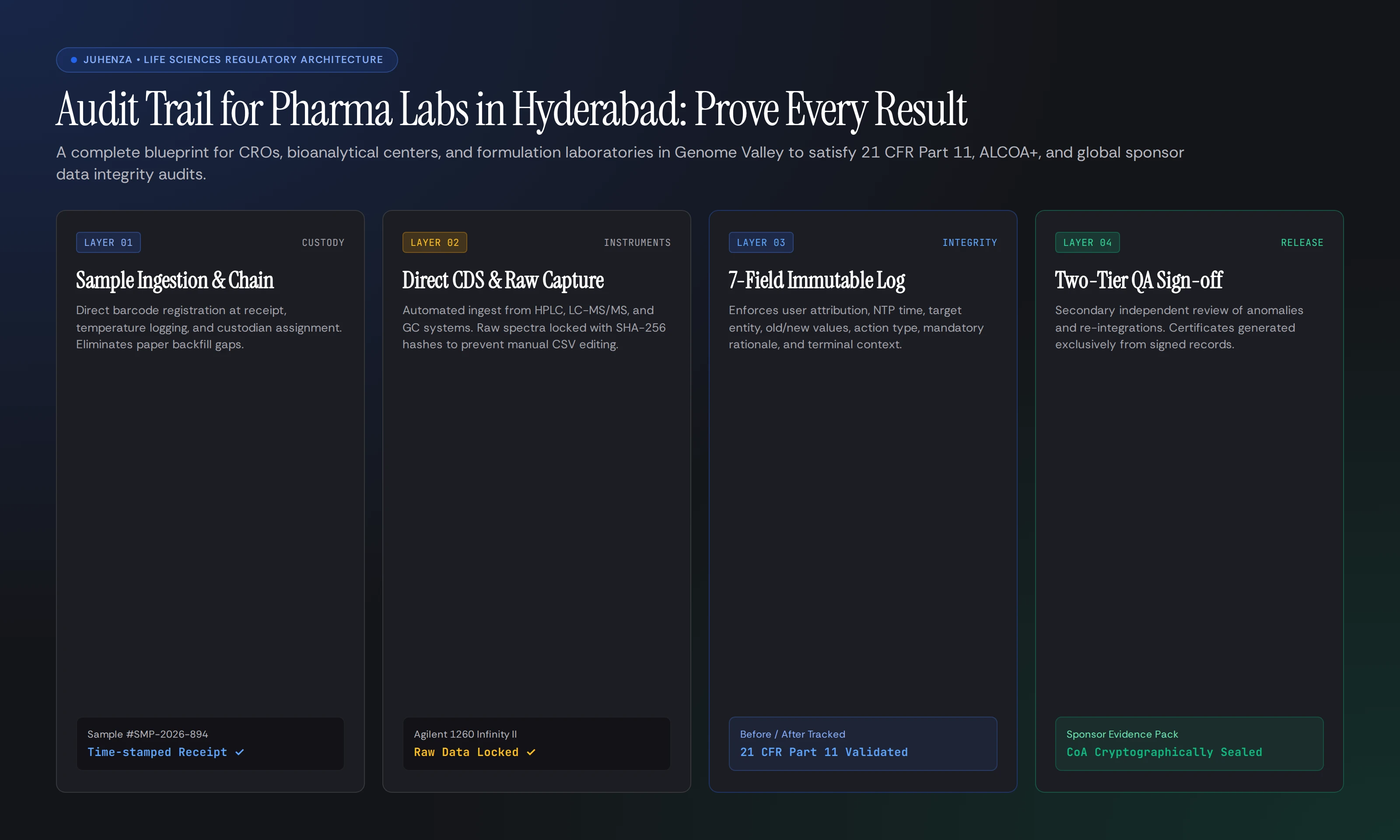
An audit trail for pharma labs in Hyderabad is not a log file you export at the end of a study. It is the proof that sits beside every result, from sample login to certificate. If a sponsor or auditor cannot reconstruct what happened, the result is hard to use, even when the science was sound.
This guide gives you that proof system. You will learn what to capture, how to review it, what to hand over in a sponsor audit, and how to decide whether to build, buy, or fix your current setup. It is written for CRO founders and QA heads who need a defensible answer, not a feature list.
What sponsors and auditors actually check
Sponsors check whether they can trust the result without re-running the work. Auditors check whether the record can be reconstructed.
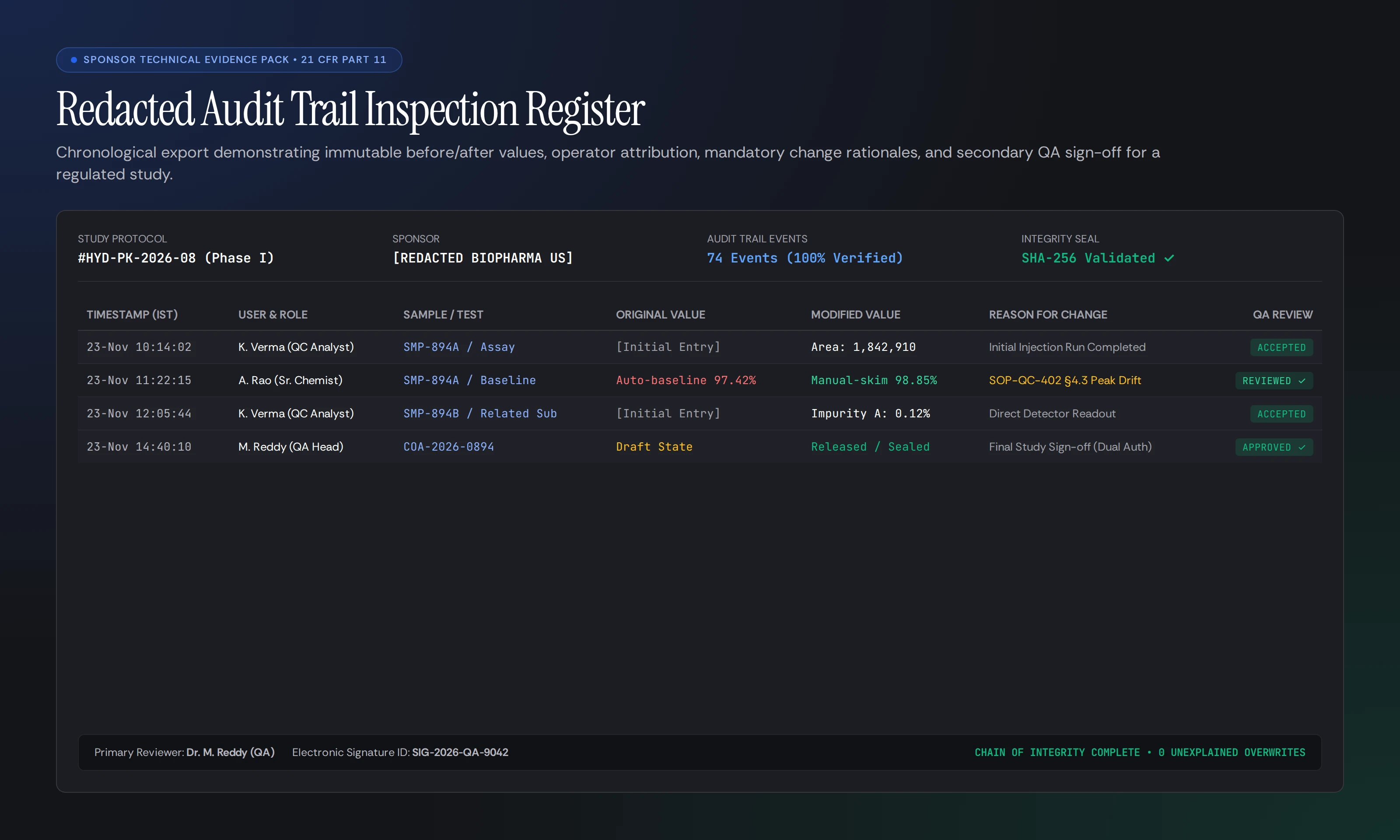
A sponsor usually starts with one question. Can you show me the full history of this result? That means the sample, the method version, the instrument, the analyst, the reviewer, and every change after the first entry. If any link is missing, the sponsor must ask for more evidence or discount the result.
Auditors look for control, not volume. They want to see that only authorised people could create, change, or approve records. They also want to see that changes did not erase earlier entries. A long log with gaps, shared logins, or editable timestamps fails that test faster than a short, complete log.
The strongest proof is boring. It is consistent, complete, and easy to follow. A reviewer should be able to open one result and trace it back to the raw data without asking the lab for a separate explanation.
ALCOA+ in plain language
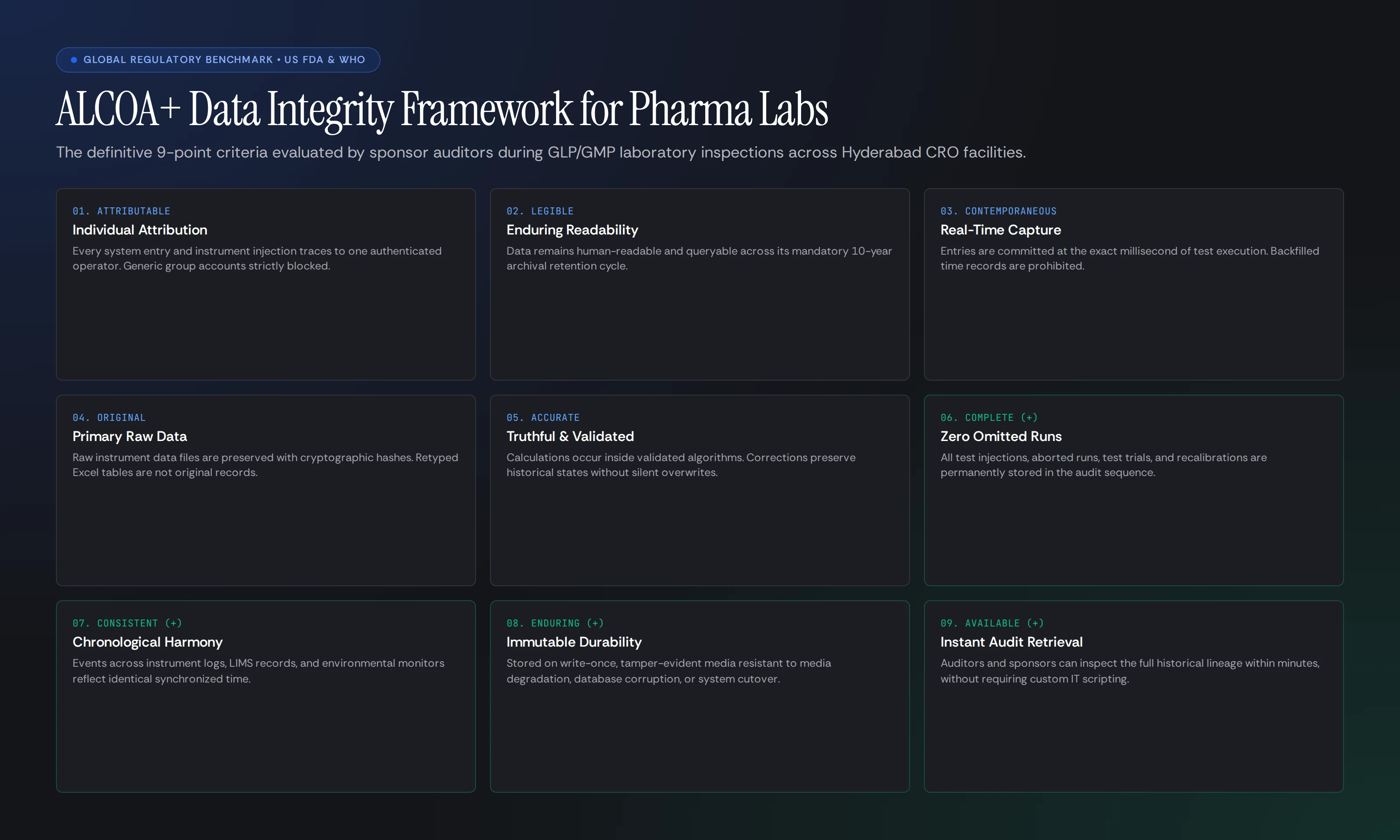
ALCOA+ is the vocabulary regulators use to describe trustworthy data. It is not a software feature. It is a test you apply to every record.
Attributable means every action traces to one identified person. Shared logins break this test. If two analysts use one account, no one can prove who did the work.
Legible means the record stays readable for its full retention period. A scanned image with missing pages, or a file format no one can open later, fails this test.
Contemporaneous means the record was made at the time of the work. Backfilled entries, even when accurate, create doubt. The system should save as work happens, not at the end of the day.
Original means the first capture, or a certified true copy, is kept. A retyped result without the raw instrument file is not original. Keep the raw data and the link to it.
Accurate means the record reflects what actually happened, with errors corrected visibly. A correction is normal. A silent overwrite is not.
The plus adds four more tests. Complete means no missing pages, runs, or deletions without a trace. Consistent means the same event shows the same time, user, and values across systems. Enduring means the record survives storage, migration, and system changes. Available means an auditor can retrieve it when needed, not after a week of IT tickets.
Use ALCOA+ as a review lens. For each result, ask which attribute would fail if a sponsor challenged it.
What 21 CFR Part 11 requires
21 CFR Part 11 sets the conditions under which the FDA treats electronic records and electronic signatures as trustworthy and equivalent to paper records and handwritten signatures. It applies when a record is kept under FDA record requirements.
Section 11.10(e) requires secure, computer-generated, time-stamped audit trails to independently record the date and time of operator entries and actions that create, modify, or delete electronic records. Record changes must not obscure previously recorded information. The audit trail must be retained at least as long as the subject records and must be available for agency review and copying.
In practice, that means three controls. First, the trail is generated by the system, not typed by a user. Second, no user, including an administrator, can edit or switch it off. Third, the trail shows the before and after values, not only the final value.
This section is general information, not legal advice. Consult a qualified professional for how Part 11, EU GMP Annex 11, or revised Schedule M applies to your specific study, product, or site. As of November 2026, the FDA Data Integrity Q&A guidance from December 2018 remains the key explanatory guidance cited by QA teams for these points.
For a deeper check on vendor claims, use the same discipline you would use when vetting a software partner for a regulated build. The questions in the manufacturing vetting checklist help separate a documented control from a sales claim.
The 7 fields every entry needs
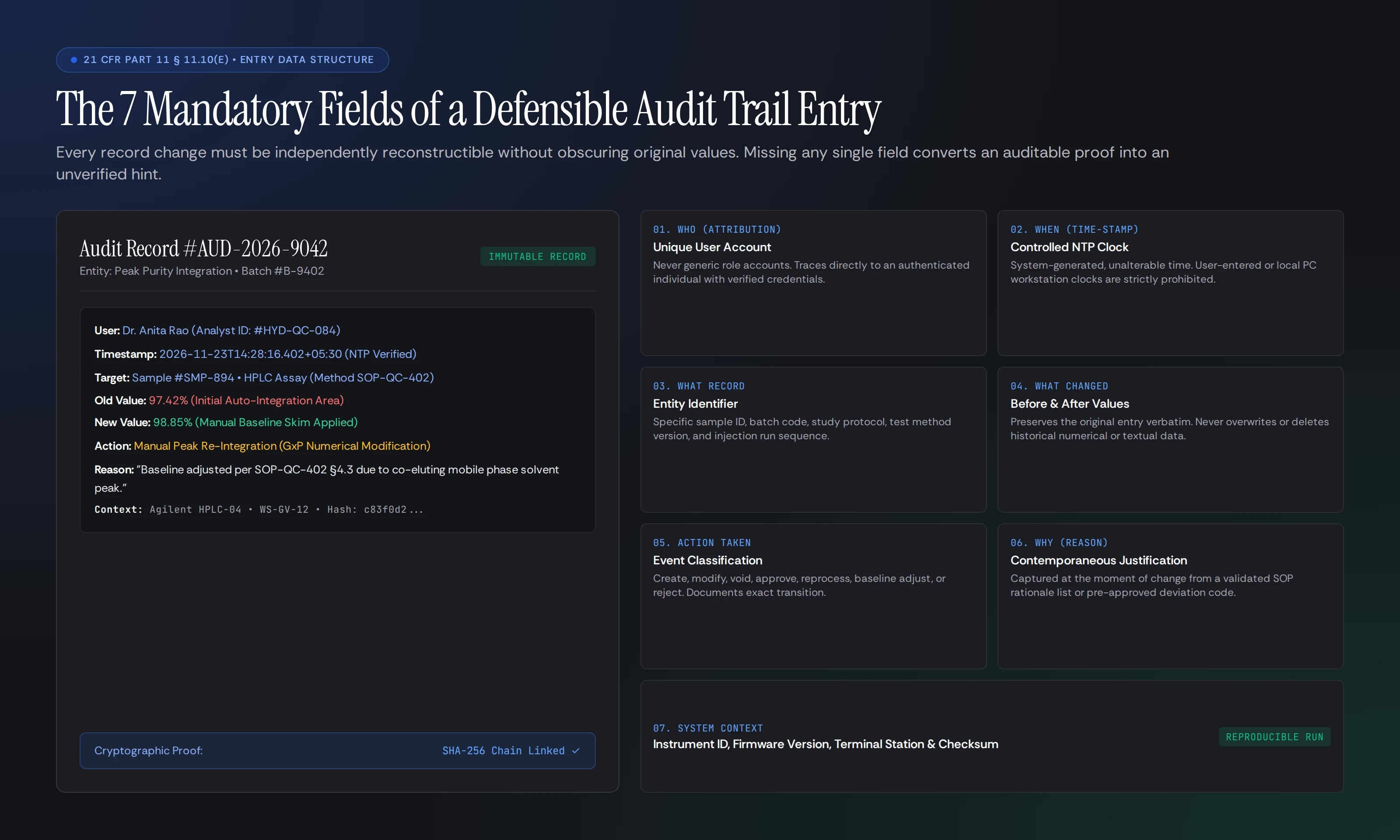
If an entry misses one of these fields, it is not proof. It is a hint.
| Field | What it must show | Why it matters |
|---|---|---|
| Who | Unique user ID for one person | Proves attribution |
| When | System timestamp, not user-typed time | Proves contemporaneous capture |
| What record | Sample ID, batch ID, study ID, and record version | Links the change to the right result |
| What changed | Old value and new value | Proves nothing was obscured |
| Action | Create, modify, delete, approve, reprocess, or reject | Shows the full course of events |
| Why | Reason for change, selected or typed at the time | Explains intent without rewriting history |
| System context | Instrument ID, method version, and software version | Lets a reviewer reproduce the result |
Two rules make this table work. First, timestamps must come from a controlled system clock, not a workstation clock a user can change. Second, the reason for change must be captured at the time of the change, not added later during an audit.
From sample to certificate: where trails break
Most trails do not break in one place. They break at handoffs.
Sample login is the first risk. If a sample is logged on paper and entered into the system later, the gap is already there. The fix is to log the sample at receipt, with a barcode or unique ID, storage location, and custodian. The system should record who received it and when.
Testing is the second risk. If an analyst exports results to a spreadsheet, edits them, and pastes them back, the system trail stops at the export. The fix is to keep the instrument file as the raw record and record any calculation or reprocessing inside the controlled system.
Review is the third risk. If a reviewer approves a result without seeing the audit trail, the approval proves little. The fix is to make the trail part of the review packet, not a separate file the reviewer can skip.
Certificate or report is the final risk. If the certificate is edited in a word processor after approval, the approved record and the issued document can drift apart. The fix is to generate the certificate from approved results and lock it after issue. Any correction needs a new version, a reason, and re-approval.
A useful test is to pick one issued certificate and work backwards. Can you reach the raw instrument data, the analyst, the method, and every change, without asking for a manual explanation? If not, that handoff is your priority.
Audit trail review: who, when, how
An audit trail that no one reviews is not a control. It is storage.
Who reviews: The reviewer should be independent of the person who performed the work. For GxP records, that is usually a second person in QA or QC, not the analyst who generated the result. The reviewer needs access to the trail, not only the final result.
When to review: Review the trail with the record it belongs to, before release. That means before a batch is released, before a study report is issued, and before a certificate goes to a sponsor. A monthly spot check can help find patterns, but it does not replace review before release.
How to review: Start with exceptions. Look for deletions, reprocessing, repeated injections, manual integrations, failed runs that were not reported, and changes made after approval. Then check a sample of normal entries for completeness. Document the review with reviewer name, date, scope, and outcome.
A review record should answer four questions. Which records were reviewed? What trail entries were checked? What was found? What was done about it? If those four answers are missing, the review will not survive a sponsor challenge.
For teams adding AI assistance to review, keep the same rule. AI can flag anomalies, but a human must decide and sign. The pattern for AI agents for business operations works here: defined tools, approved sources, and human review where the action has consequences.
Build, buy, or fix: a decision framework
Do not start with a vendor demo. Start with your gaps.
Score each option on the same five gates. Use 0 for missing, 1 for partial, 2 for proven with evidence.
| Gate | Build custom | Buy commercial LIMS | Fix current system |
|---|---|---|---|
| Audit-trail completeness | Depends on spec | Depends on configuration | Depends on what is broken |
| Validation and SOPs | Must be planned | Vendor package plus site SOPs | Must close gaps |
| Instrument integration | Must be scoped | Check connector list | Check export path |
| Review workflow | Must be designed | Check reviewer role | Check current review habit |
| Total cost of ownership | Build plus maintenance | Licence plus validation | Fix plus retraining |
Build makes sense when your workflow, permission model, or sponsor reporting cannot be served by an existing product. A founder-led custom software approach works when the scope, acceptance checks, and validation plan are agreed before build starts.
Buy makes sense when a commercial LIMS already covers your methods, instruments, and review workflow, and the vendor can show validation documentation you can reuse. Do not buy on a feature list alone. Ask for a redacted audit-trail export and a review workflow demo using your own sample flow.
Fix makes sense when the core system is sound but handoffs, shared logins, or review habits are broken. A fix is often faster than a replacement, but only if the underlying trail cannot be switched off or edited.
Illustrative example
Illustrative example, not a verified case. A 12-person CRO in Genome Valley runs bioanalysis for two sponsors. Its current system captures final results but not reprocessing reasons. Analysts export chromatography data to spreadsheets for review.
The QA head picks one recent certificate and traces it back. The trail shows the final result but not two reprocessed injections. The sponsor asks why the second run was used. The lab cannot prove it from the system alone.
The fix the team scopes is narrow. First, keep reprocessing inside the controlled system. Second, require a reason for every reprocessing event. Third, add the trail to the reviewer packet. Fourth, generate the certificate from approved results only. The team does not replace the whole LIMS. It closes the handoff that created the gap.
Use the same test on your own lab. Pick one certificate. Trace it back. The first gap you find is the project.
When you compare vendors, use hiring checks for AI vendors as a model for evidence. Ask for the same kind of proof: who can change what, what the trail shows, and how review is recorded.
Common mistakes
Shared logins. A shared lab login makes attribution impossible. Give every person a unique login, even for short tasks. Disable accounts when staff leave.
Editable spreadsheets as the system of record. A spreadsheet outside the controlled system has no secure trail. If you must use one, treat it as a calculation aid, not the record. Keep the controlled system as the record.
Audit trail switched off for speed. Some teams disable trails during method development or troubleshooting. Do not do this for GxP work. If the trail can be switched off, a sponsor cannot trust the periods when it was off.
Reviewing only the final result. A clean final result can hide repeated failures. Review the trail, not only the outcome.
No reason for change. A change without a reason forces the reviewer to guess intent. Capture the reason at the time of the change.
Backdating or manual timestamps. Manual time entry breaks contemporaneous capture. Use system timestamps from a controlled clock.
Limitations and when to involve a specialist
This guide does not replace validation, QA, or regulatory advice. It gives you a checklist to scope the work.
Involve a specialist when you need to validate a new system, qualify an instrument, define a data integrity risk assessment, or respond to an FDA Form 483, sponsor audit finding, or inspection observation. Involve your QA head before changing any GxP workflow, even for a small fix. A change that looks like an IT fix can be a GxP change.
If you use AI for chromatogram review, report drafting, or anomaly detection, treat the AI output as a suggestion, not a record, until a qualified person reviews it and the review is itself logged.
First-hand experience note
In our architecture reviews of life-sciences data pipelines and custom laboratory informatics tools in the Hyderabad corridor—spanning bioanalytical units in Genome Valley and analytical development facilities in Cherlapally—the most frequent audit vulnerability is not the absence of an audit log, but the presence of unlinked handoffs.
In a recent architecture engagement for an analytical testing lab handling stability studies for international generic dossiers, the facility used a hybrid setup: raw HPLC area counts were exported as CSVs to network drives, where analysts calculated degradation percentages in local spreadsheets before copying them into a report template. During mock sponsor audits, tracing an anomalous assay result (a 1.8% drop between 3-month and 6-month stability stations) required manually correlating file modification times with analyst shift logs—a process that collapsed under audit scrutiny.
The remediation replaced the unmanaged file export with an integrated, append-only capture service:
- Instrument-direct ingestion: Chromatographic integration results are ingested directly from instrument controllers via authenticated API endpoints with SHA-256 payload checksums.
- In-system calculation with change attribution: Degradation curve calculations occur within the system boundary. When an analyst applies a manual peak baseline reintegration, the platform enforces mandatory selection of an approved SOP rationale code and captures an unalterable before/after chromatographic snapshot.
- Unified sponsor export: Rather than assembling multiple disconnected PDFs, QA generates a single, cryptographically signed sponsor evidence pack with all raw runs, parameter modifications, and two-tier QA sign-offs in one verifiable chain. In subsequent European sponsor technical audits, complete study reconstruction time dropped from 14 hours across filing cabinets to under 12 minutes.
FAQ
What must an audit trail include to satisfy a sponsor?
It must include who acted, when the system recorded the action, which record changed, the old and new values, the action taken, the reason for change, and the system context. The original entry must stay visible. The trail must be secure, computer-generated, and time-stamped.
How is an audit trail different from a system log?
A system log records technical events for IT. An audit trail records GxP record events for QA and auditors. It is part of the record, reviewed with the record, and retained with the record. A server log alone does not prove a result.
Who should review the audit trail?
A second person independent of the work, usually in QA or QC. The reviewer needs access to the full trail, not only the final result. The review must be documented with scope, date, reviewer, findings, and follow-up.
How often should audit trails be reviewed?
Review the trail with each record before release. Use periodic trending to find patterns, such as repeated reprocessing or late entries. A periodic check does not replace review before batch or study release.
What should we do if we find a gap in an old audit trail?
Do not rewrite history. Document what is missing, when it was found, and what you did to prevent recurrence. Preserve the original record. If the gap affects a released result, follow your deviation and CAPA process and inform the sponsor as your agreement requires.
Can we build a compliant audit trail with custom software?
Yes, if the build includes secure, non-editable trails, unique logins, controlled timestamps, validation, SOPs, training, and review workflow. Software alone does not create compliance. The surrounding controls do.
What should a sponsor evidence pack contain?
It should contain the approved result, the raw data link, the audit trail for that result, the method and instrument versions, the reviewer and approver records, and the review record. Keep the pack in one place. A sponsor should not need to chase five systems to reconstruct one result.
Where this fits
This post sits in Industries > Pharma and Life Sciences Software in Hyderabad. It is the parent guide for audit-trail proof. Related reading in the same silo will cover LIMS selection, validation planning, and sponsor reporting. For now, the closest decision guides on this site are the vetting checklist and the hiring checks for AI vendors.
Conclusion
Pick one certificate today. Trace it back to raw data. Fix the first handoff that breaks the proof.
If you need a scoped build or a fix for your current system, Discuss your project on the contact page. Share your current workflow, instruments, and review process, and JUHENZA will scope the audit-trail controls, acceptance checks, and validation support before quoting.
References
- 21 CFR Part 11, Electronic Records and Electronic Signatures. https://www.ecfr.gov/current/title-21/chapter-I/subchapter-A/part-11
- FDA, Data Integrity and Compliance With Drug CGMP: Questions and Answers, December 2018. https://www.fda.gov/regulatory-information/search-fda-guidance-documents/data-integrity-and-compliance-drug-cgmp-questions-and-answers
Not legal advice. Consult a qualified professional for your site and study.