

Cold Chain Excursion Losses in Ahmedabad Pharma: GDP Audit Trail, Shipper Choice and an INR Loss Calculator
Ahmedabad pharma distributors: cut cold-chain excursion losses with a GDP audit-trail checklist, reefer vs passive shipper comparison and an INR loss calculator.
TechApp Dev

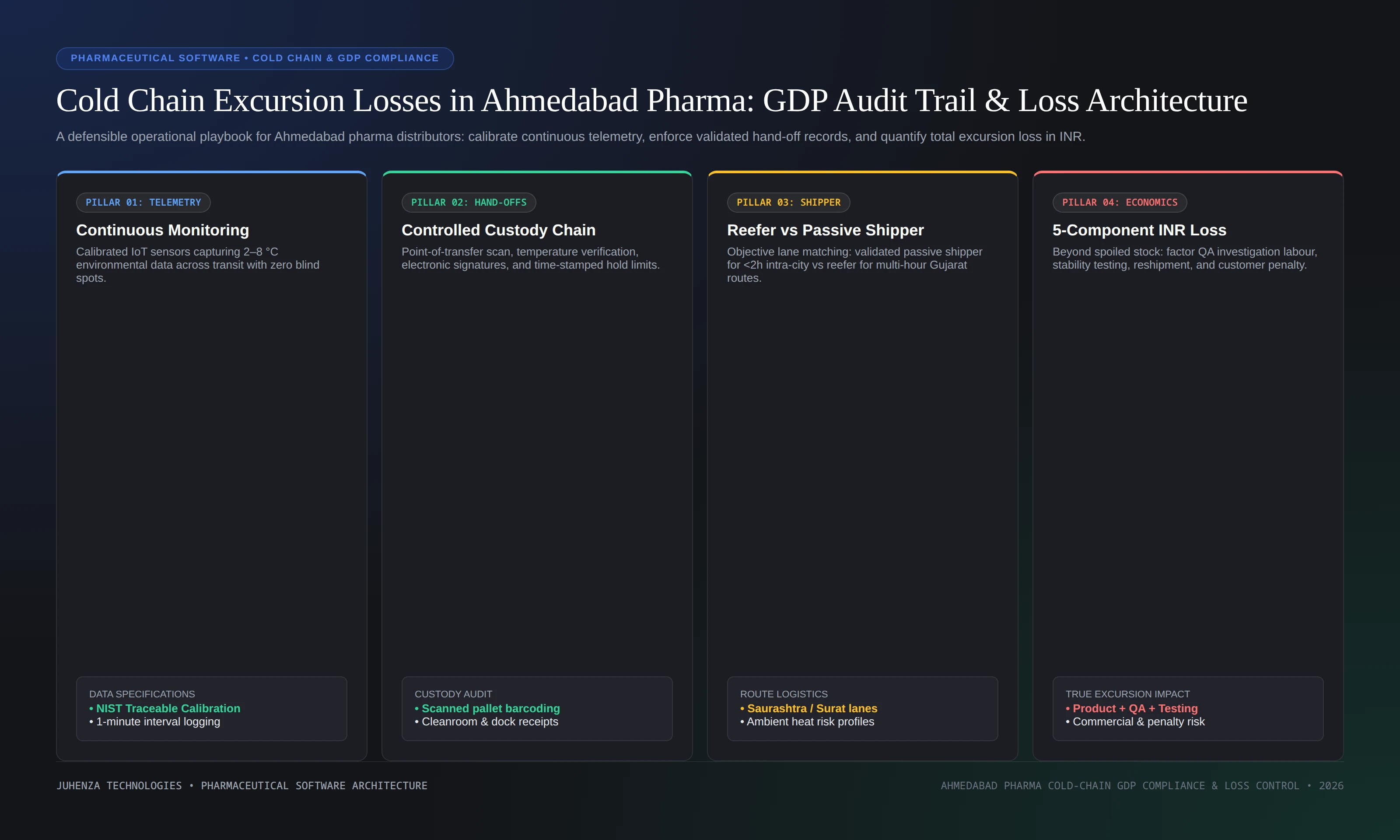
Direct answer: A cold-chain excursion is any deviation from a product’s validated temperature range during storage or transport. Under Good Distribution Practices (GDP), an Ahmedabad distributor must be able to show calibrated continuous monitoring, a controlled record for every hand-off, a documented investigation when an excursion occurs, and retention of those records. The financial loss is rarely just the spoiled stock: it includes investigation labour, reshipment, customer credits, regulatory exposure and contract risk. The calculation below makes that cost visible before the next shipment leaves the dock.
Introduction
Ahmedabad’s pharmaceutical distribution lanes are short, hot and heavily relational. A distributor may move a 2–8 °C consignment from a Naroda warehouse to a pharmacy in Satellite in under two hours, then send another consignment on a six-hour run to a C&F agent in Saurashtra. Both shipments can look compliant at the dock and still fail the only test that matters: a defensible, auditable record that the product stayed within its validated range from release to receipt.
GDP does not treat a temperature excursion as a minor logistics inconvenience. CDSCO’s GDP guidance requires procedures for investigating and handling excursions, and for maintaining storage conditions within defined limits during transport. WHO’s GDP framework takes a risk-based approach: the depth of control should match the risk to the patient and the product. For an Ahmedabad distributor, that means the question is not “do we have a data logger?” It is “can we prove what happened, decide what to do, and show the decision was controlled?”
This guide gives you three practical tools: a GDP audit-trail checklist, a reefer-versus-passive decision table with India-relevant cost ranges, and an INR loss calculator framework. It is written for distributors, C&F agents and 3PL cold-chain operators who need to reduce losses without over-engineering every lane.
What counts as a cold-chain excursion (and why GDP treats it as a patient-safety event)
A temperature excursion is any out-of-range condition during storage, handling or transport. For a 2–8 °C product, a reading of 9.1 °C is an excursion even if the vial looks normal. For a controlled-room-temperature (CRT) product, the validated range may be wider, but the principle is the same: the product has left its proven condition.
GDP does not require every excursion to be a recall. It requires a controlled investigation. CDSCO’s guidance asks for written procedures covering unexpected occurrences such as vehicle breakdown or non-delivery, and for a procedure to investigate and handle temperature excursions. WHO’s model guidance similarly places excursion tolerances within a risk-based framework: the manufacturer’s stability data and the product’s degradation mechanism should inform what counts as acceptable.
The practical distinction for a distributor is between three events:
- A transient deviation with no product impact — for example, a door-open event during loading that is corrected within minutes and supported by stability data.
- A confirmed excursion requiring assessment — the product may still be usable, but the decision must be documented.
- A loss event — the product is rejected, quarantined or destroyed, and the financial and regulatory consequences follow.
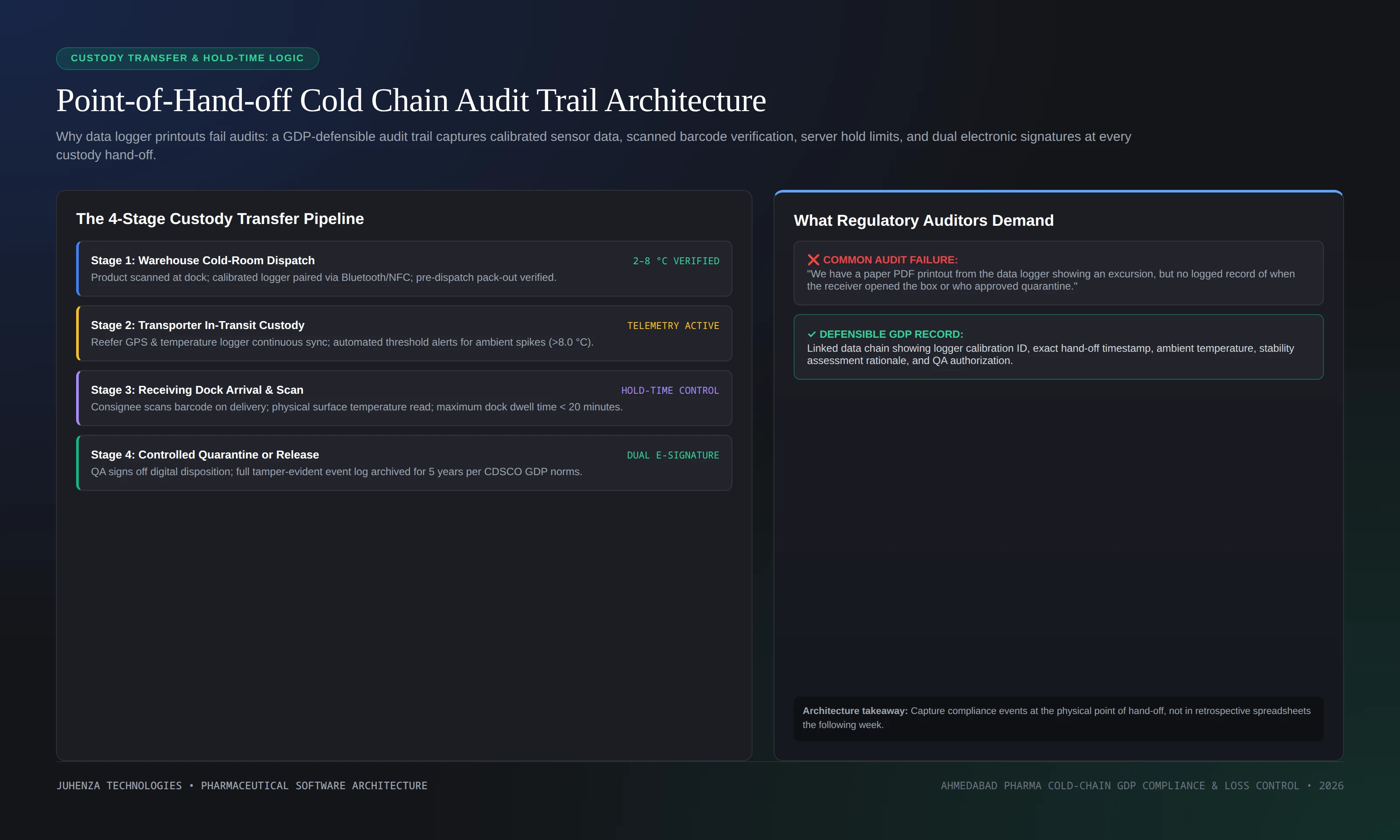
The audit trail must make it obvious which category applies. That is why a single logger printout is not enough: it shows a reading, not the investigation.
The GDP audit trail an Ahmedabad distributor must produce
A GDP audit trail is not one document. It is a linked set of records that lets an inspector or QA reviewer reconstruct what happened, who was responsible and what was decided. The following checklist maps to the expectations visible in CDSCO and WHO GDP guidance. It is not a substitute for your own SOPs or legal advice.
GDP audit-trail checklist for a cold-chain consignment
| # | Record | What “good” looks like | Common failure |
|---|---|---|---|
| 1 | Temperature mapping / lane validation | The lane or container has been qualified under representative seasonal conditions; the validation report is retrievable. | A generic “2–8 °C” claim with no lane-specific data. |
| 2 | Calibrated monitoring device | The logger or sensor has a current calibration certificate traceable to a recognised standard; calibration status is recorded before use. | An uncalibrated logger, or a calibration certificate that cannot be linked to the device ID. |
| 3 | Continuous data record | Readings are captured at defined intervals for the full journey, including hand-offs, with no unexplained gaps. | A single endpoint reading, or a logger that was started late. |
| 4 | Hand-off record | Each transfer between distributor, transporter and recipient records time, temperature (where required), condition and signature. | A signature on a manifest with no temperature check at receipt. |
| 5 | Excursion procedure | A written SOP covers detection, segregation, notification, investigation, disposition and CAPA. | An SOP that exists but has never been rehearsed. |
| 6 | Investigation record | The deviation is described, product impact assessed, stability data reviewed, decision justified and approved by QA. | A “product released” note with no rationale. |
| 7 | Retention | Records are retained for the period defined in your SOP and applicable requirements; they are retrievable and legible. | Records stored in a WhatsApp thread or a personal inbox. |
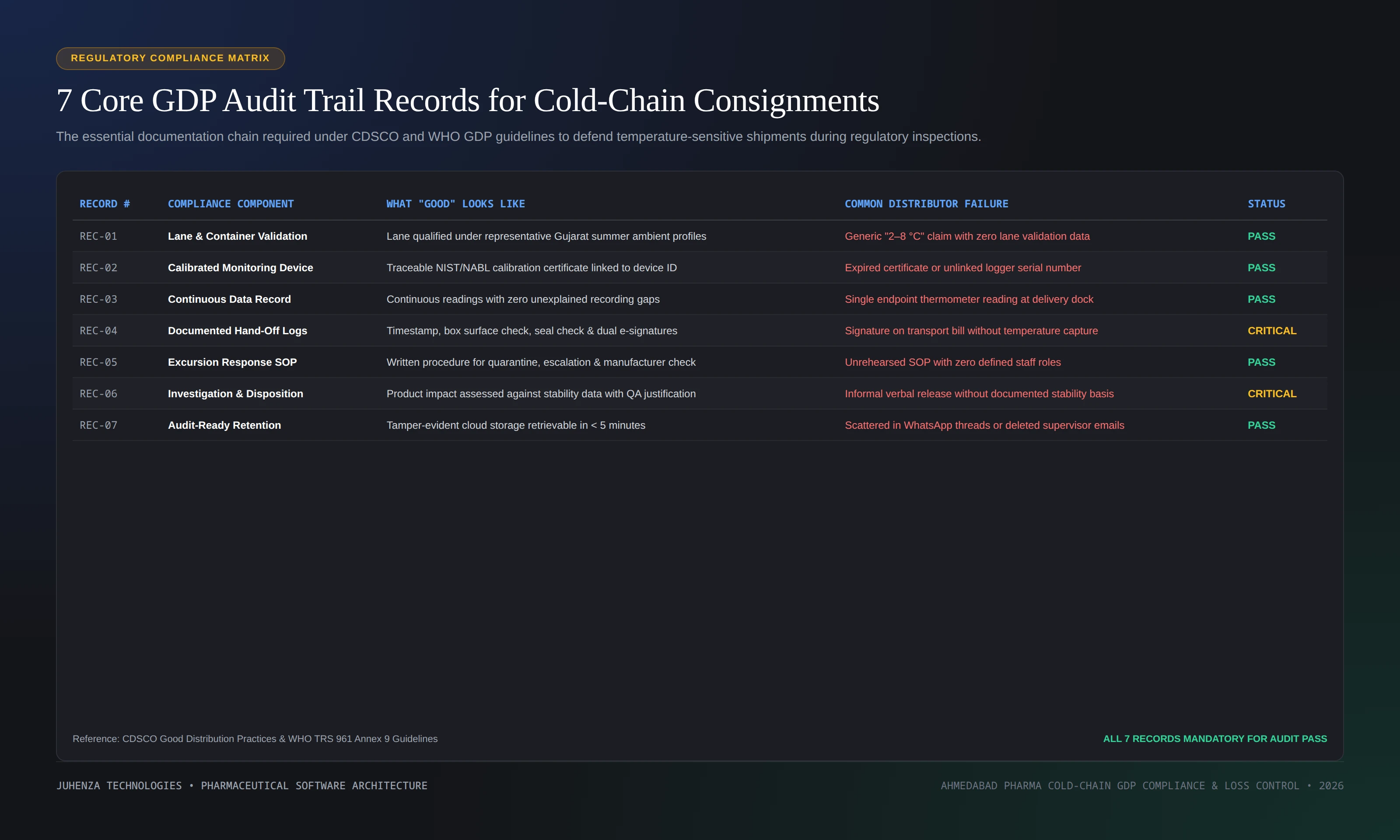
The weakest link is usually records 4 and 6. Distributors often have a logger, but not a controlled hand-off record or a documented disposition decision. Under GDP, the absence of a record is itself a compliance finding, even if the product was fine.
Practitioner observation from cold-chain deployments:
In our operational work engineering cleanroom and cold-storage tracking platforms (such as the Intas Tray Management System deployment in Gujarat), cold-chain compliance breakdowns rarely occur due to mechanical refrigeration failure alone. Instead, regulatory findings and consignment write-offs stem from unverified hand-offs: a pallet resting on an uncooled loading dock for 45 minutes during driver shift changes, or a standalone logger showing an excursion without an associated server-validated timestamp or electronic disposition signature. By integrating barcode verification, automated hold-time countdowns, and tamper-evident event logging at every custody transfer, distributors convert chaotic paper manifests into a continuous, audit-ready GDP record that withstands CDSCO and WHO regulatory scrutiny.
Reefer vs passive shipper: a cost and risk comparison for Gujarat lanes
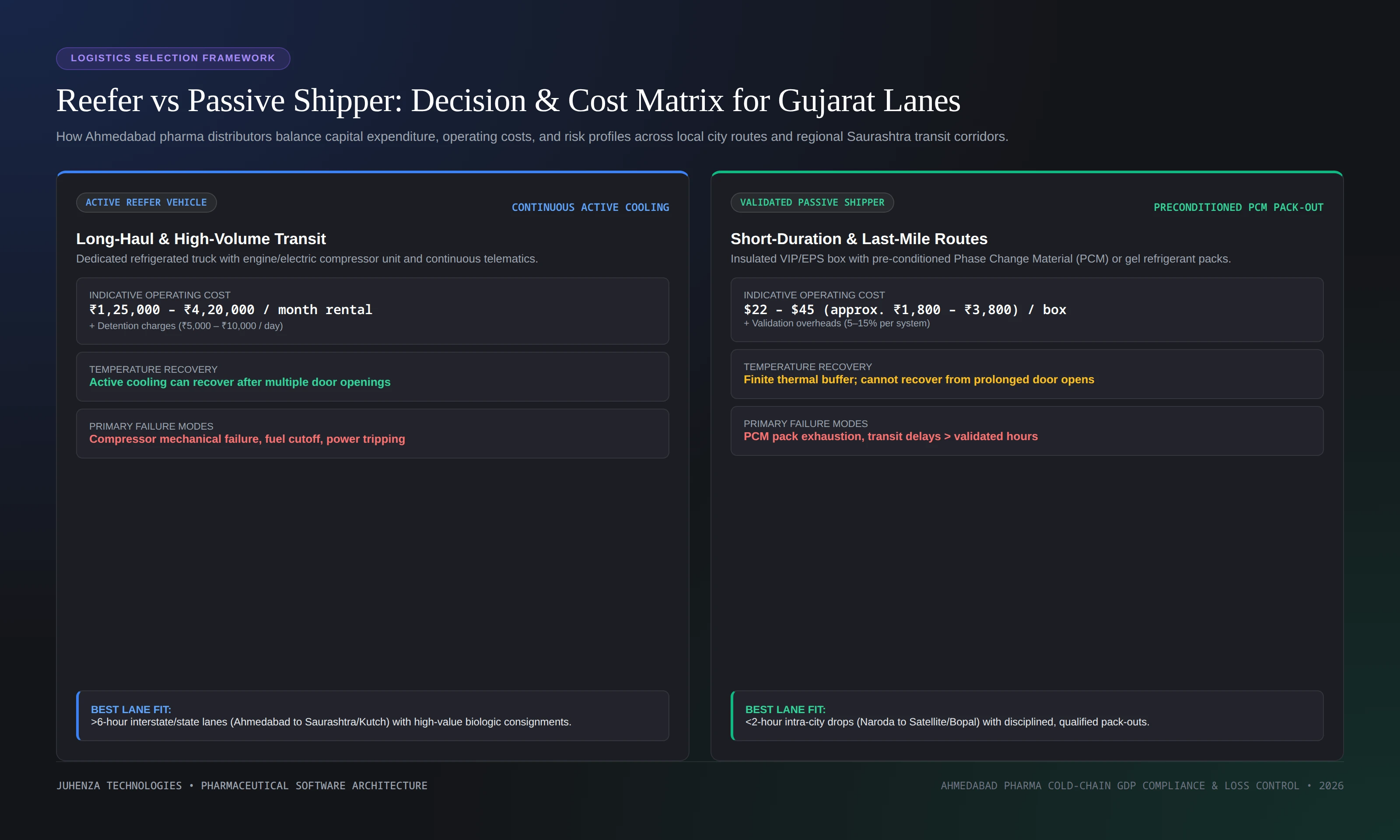
There is no universally “better” shipper. The right choice depends on lane duration, payload, product value, risk tolerance and the availability of a validated passive configuration. The table below uses reported India-relevant cost ranges from industry sources, not JUHENZA-verified pricing. Treat them as planning ranges, not quotations.
| Factor | Reefer (active) | Passive shipper |
|---|---|---|
| Typical use | Long-haul, high-value or high-volume 2–8 °C lanes; routes where mid-transit control is needed | Short-duration, validated lanes; last-mile distributor drops; lower-volume consignments |
| Temperature control | Continuous active cooling; can recover after door openings | Fixed-duration cooling from preconditioned packs; performance depends on pack configuration and ambient exposure |
| Indicative cost | Reefer rental reported at ₹1,25,000–₹4,20,000 depending on route and duration; detention charges can add ₹5,000–₹10,000 per day | Passive insulated shipper systems reported from around USD 22–45 per system, with validation adding 5–15% to system pricing |
| Visibility | Often continuous telemetry; easier to prove what happened | Depends on the logger; a single-use logger provides a record but not real-time intervention |
| Failure mode | Mechanical failure, power interruption, door management | Pack exhaustion, delayed delivery, ambient extremes |
| Best fit for an Ahmedabad distributor | Multi-hour or overnight lanes where ambient heat is severe and product value is high | Short, repeatable lanes with a validated pack-out and a disciplined dispatch process |
A practical decision rule:
- Under 2 hours, validated pack-out, low-to-moderate value: passive is usually sufficient, provided the pack-out is qualified and the hand-off temperature is recorded.
- 2–6 hours, high ambient exposure, no validated passive configuration: reefer or a validated active solution is safer.
- Overnight or multi-day, high-value biologics: reefer plus continuous telemetry and a documented contingency plan.
The cheapest shipper is not the lowest-cost option if it produces an excursion that takes three weeks to investigate.
How to calculate excursion loss in INR
Most distributors calculate loss as “cost of goods destroyed.” That understates the real impact. A defensible loss calculation has five components:
- Product loss: the landed cost of the affected units, not the selling price.
- Investigation cost: QA time, stability review, external testing, consultant fees.
- Reshipment and expediting: freight premium, emergency packaging, duplicate handling.
- Commercial cost: customer credit, contract penalty, lost margin on the replacement order.
- Regulatory and reputational cost: inspection follow-up, CAPA implementation, management time.
Illustrative calculation (not a verified client result)
Assume a consignment of 500 units with a landed cost of ₹1,200 per unit, of which 60 units are confirmed affected by an excursion.
| Component | Illustrative INR |
|---|---|
| Product loss (60 units × ₹1,200) | ₹72,000 |
| QA and investigation labour (40 hours × ₹900) | ₹36,000 |
| External stability testing | ₹15,000 |
| Emergency reshipment premium | ₹12,000 |
| Customer credit / penalty | ₹25,000 |
| Direct visible loss | ₹1,60,000 |
| Management time and CAPA (estimated) | ₹20,000 |
| Total illustrative loss | ₹1,80,000 |
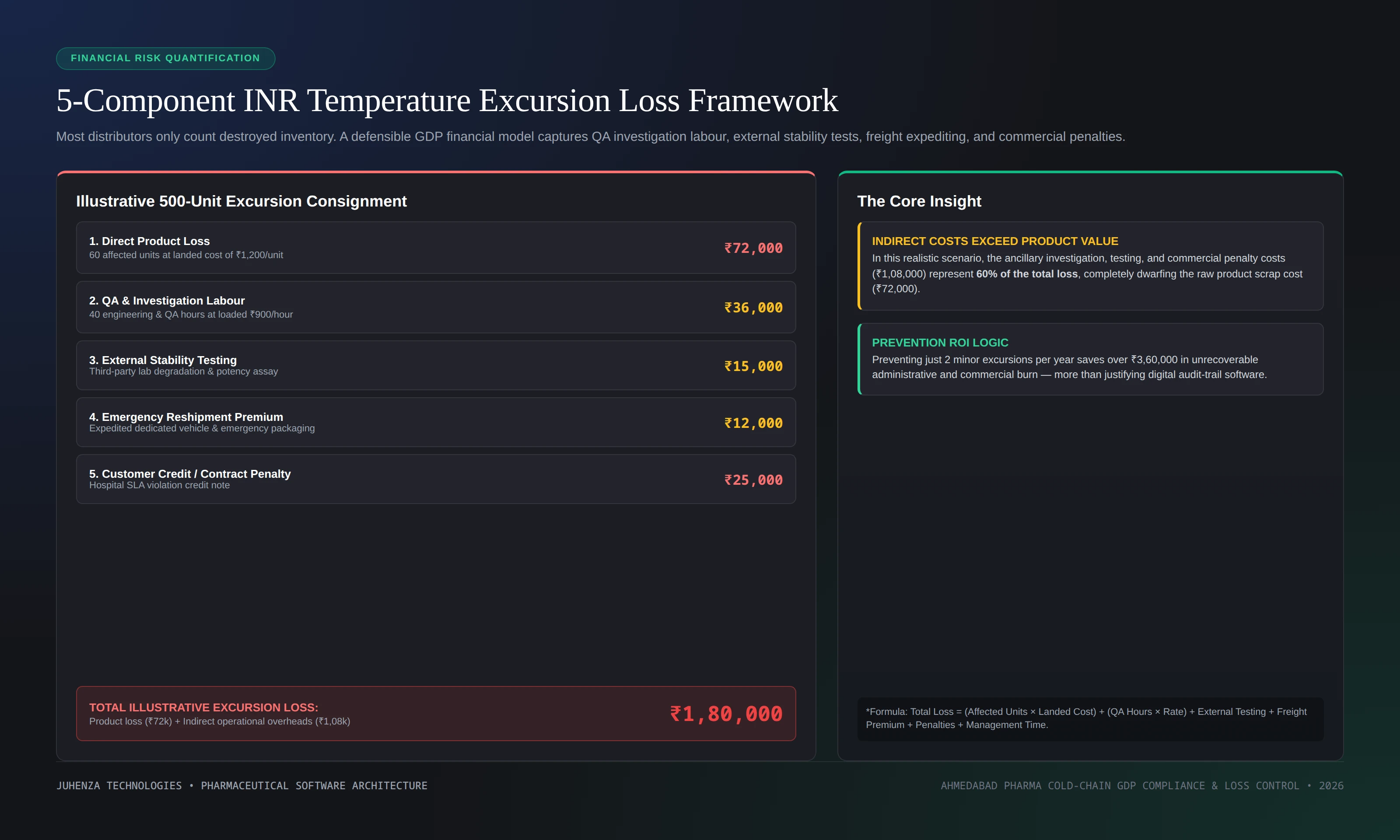
The point is not the exact number. The point is that the investigation and commercial costs can exceed the product cost. A distributor who only tracks spoiled stock will systematically under-invest in prevention.
Simple formula
Total excursion loss = (affected units × landed cost) + investigation hours × loaded labour rate + external testing + reshipment premium + customer credit/penalty + estimated management timeUse this formula for one consignment, then aggregate monthly by lane and shipper type. The lanes with the highest loss per shipment are your first candidates for a reefer, a better passive pack-out, or a dispatch-time change.
7-step excursion response checklist
When a logger shows an out-of-range reading, the first 24 hours decide whether the event becomes a controlled deviation or an audit finding.
- Stop and segregate. Do not release the consignment. Move it to a quarantine or hold area with a clear label.
- Preserve the record. Download the logger data, photograph the display, and secure the hand-off documents. Do not overwrite or discard anything.
- Notify QA and the consignee. Use a defined communication template; record who was notified and when.
- Characterise the excursion. Duration, maximum/minimum temperature, product range, pack configuration, ambient conditions, and whether the product was exposed or protected.
- Assess product impact. Review stability data, mean kinetic temperature (where applicable), and manufacturer guidance. If the assessment is inconclusive, escalate.
- Decide and document. Release, re-label, return, or destroy. The decision must state the rationale and be approved by the responsible authority.
- Close the loop. CAPA, trend review, supplier or lane change, and update the SOP if the event exposed a gap.
Common mistakes and when to involve a specialist
- Mistaking a logger for an audit trail. A logger is a sensor; an audit trail is a controlled record set.
- Using a single-use logger without a hand-off temperature check. The record shows the journey, not the acceptance decision.
- Choosing passive solely on unit cost. A cheaper shipper can produce a more expensive investigation.
- Investigating only when the product is visibly damaged. Biologicals and vaccines can be compromised without visible change.
- Storing records in WhatsApp or email. Retrievability and legibility are part of the record.
Involve a QA specialist or a qualified validator when: the product is a biologic or vaccine; the excursion is repeated on the same lane; the stability data does not clearly cover the deviation; or the consignee disputes the disposition. Involve a software team when the record set is spread across paper, spreadsheets and messaging apps and cannot be reconstructed quickly.
FAQ
What is a cold-chain excursion under GDP?
A cold-chain excursion is any deviation from the product’s validated temperature range during storage, handling or transport. GDP requires the event to be detected, investigated and documented, with a disposition decision that is justified by stability data or manufacturer guidance.
How long should an Ahmedabad distributor keep GDP records?
Record retention should be defined in your SOP and aligned with applicable CDSCO requirements and contractual obligations. CDSCO’s GDP draft guidance refers to monitoring records being kept for a defined period plus one year; confirm the current requirement with your QA lead and legal advisor. This article is not legal advice.
Is a reefer always safer than a passive shipper?
No. A reefer adds active control and visibility, but it also adds cost, maintenance and failure modes. A validated passive shipper can be appropriate for short, repeatable lanes with a disciplined pack-out and hand-off check. The right choice depends on lane duration, ambient exposure, product value and the quality of the validation.
How do I calculate the cost of one excursion?
Use the five-component formula above: product loss at landed cost, investigation labour, external testing, reshipment premium, and customer credit or penalty. Add estimated management time if it is material. The result is usually higher than the spoiled-stock figure alone.
What should I do first when a logger shows an excursion?
Stop and segregate the consignment, preserve the data, notify QA and the consignee, and characterise the excursion before making any disposition decision. Do not release the product based on a visual check.
Can software replace a GDP audit-trail procedure?
No. Software can make the record more reliable, retrievable and tamper-evident, but it does not replace the SOP, the investigation or the QA decision. Software is an enabler; the controlled process is the requirement.
Where this fits
This post sits in our Pharmaceutical Software series under cold-chain operations and GDP compliance. The verified engineering foundation behind this guidance includes our work on the Intas Tray Management System, which showcases how cleanroom hand-offs, cold-room transfers, and electronic signatures can be captured in real time. A related read is JUHENZA’s guide to AI workflow automation vs RPA, which explains why controlled, auditable processes require resilient event architectures rather than generic screen automation.
Conclusion
Cold-chain excursion losses are not inevitable. They are the result of unvalidated lanes, weak hand-off records and slow investigations. An Ahmedabad distributor can reduce them by treating the audit trail as an operational system: calibrated monitoring, controlled hand-off records, a rehearsed investigation procedure and a loss calculation that includes investigation and commercial costs, not just spoiled stock.
Next step: If your excursion records are spread across standalone loggers, paper manifests and fragmented messaging threads, describe the workflow to JUHENZA. We build controlled record systems around real QA and operations processes, including cold-room hand-off tracking and audit-ready event histories. Start a scoped conversation with our engineering team.
References
- Central Drugs Standard Control Organisation (CDSCO). Guidelines on Good Distribution Practices for Biological Products. CDSCO/GDP.BP Ver. 00.
- World Health Organization. Model guidance for the storage and transport of time- and temperature-sensitive pharmaceutical products. WHO Technical Report Series 961, Annex 9 (2011). Cited for the risk-based approach to excursion management.
- Industry cost ranges: DHL cold-chain guidance (reefer rental ranges) and IndexBox passive-shipper pricing, as reported in industry logistics analysis. These are planning ranges, not JUHENZA-verified quotations.