

How to Choose a Software Company in Indore: 12 Evidence Checks Beyond Portfolio Screenshots
How to choose a software company in Indore: 12 evidence checks beyond portfolio screenshots for ownership, team, testing, support and contract terms today.
TechApp Dev

A portfolio screenshot proves a designer made a good image. It does not prove a team shipped working software, protected your data, or handed over code you can run without them.
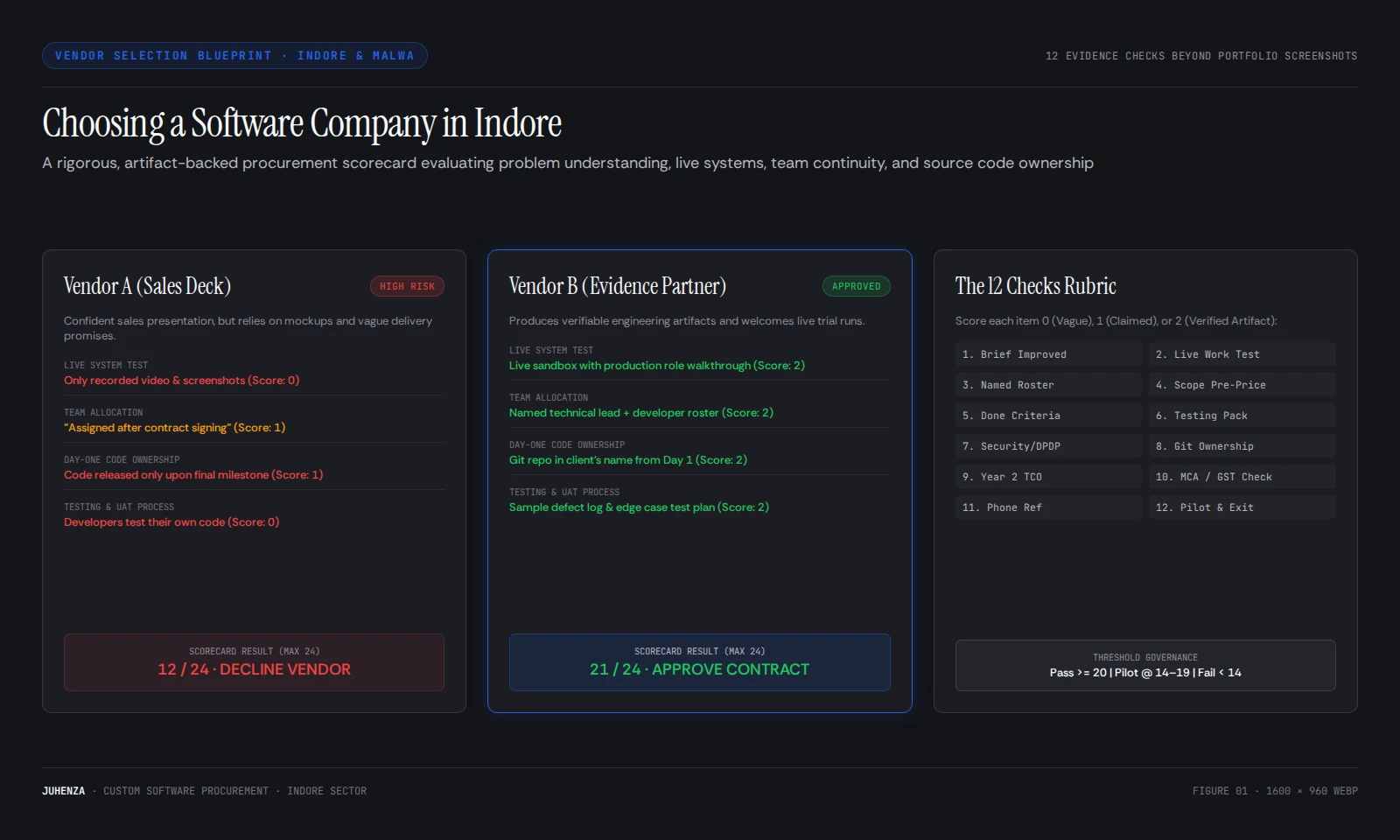
Direct answer: To choose a software company in Indore, score each vendor on 12 evidence checks: problem understanding, live work you can use, named team, written scope, acceptance checks, testing evidence, security and data protection, ownership, itemised price plus year-two cost, legal existence, independent references, and a paid pilot with a clear exit. Score each check 0 for absent or vague, 1 for explained but unverified, and 2 for backed by an artifact you have seen. Approve only a vendor with strong evidence (20+ points with no zero in security, ownership, or legal existence), not strong slides.
Introduction
Most Indore vendor websites sound alike. They list the same services, the same technologies, and the same promise of quality. That is why this guide focuses on proof. If you are comparing a software company in Indore for a first custom system, use the checks below on every shortlisted vendor, on the same requirements, and keep the evidence beside each score.
How to use the 12 checks
Send every shortlisted vendor the same one-page brief. Ask for the same artifacts. Score independently, then compare totals.
Use this scale for every check: 0 means absent or vague, 1 means explained but unverified, 2 means backed by evidence you have seen. Maximum is 24. Use these decision rules as recommendations to adapt, not as an industry standard: approve at 20 or more with no zero in checks 7, 8 or 10, pilot first at 14 to 19 or with any evidence still pending, decline below 14 or on a failed legal, ownership or security check.
Do not let a confident call outweigh a missing artifact. A vendor who cannot show proof before signing rarely produces better proof after signing.
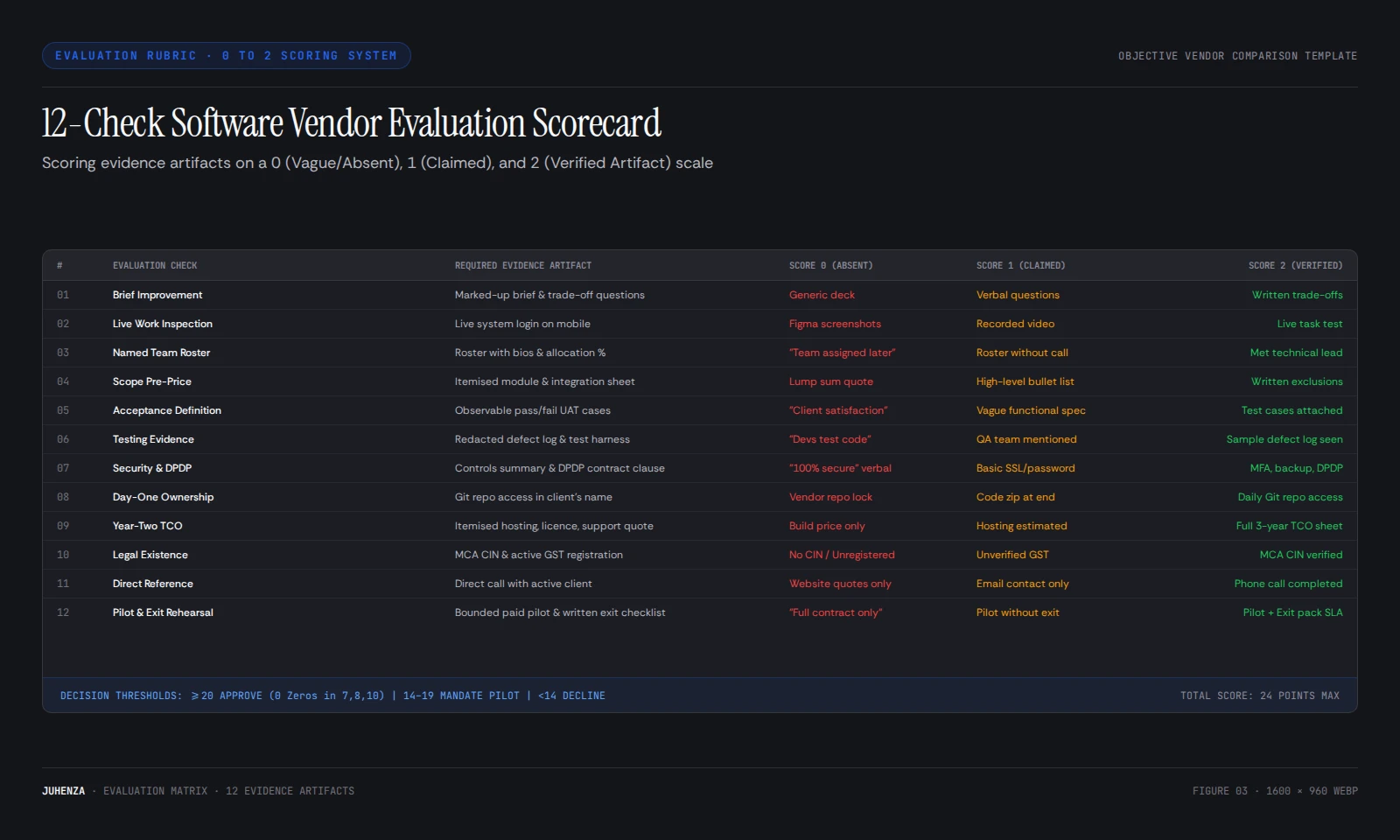
1. Do they improve your one-page brief?
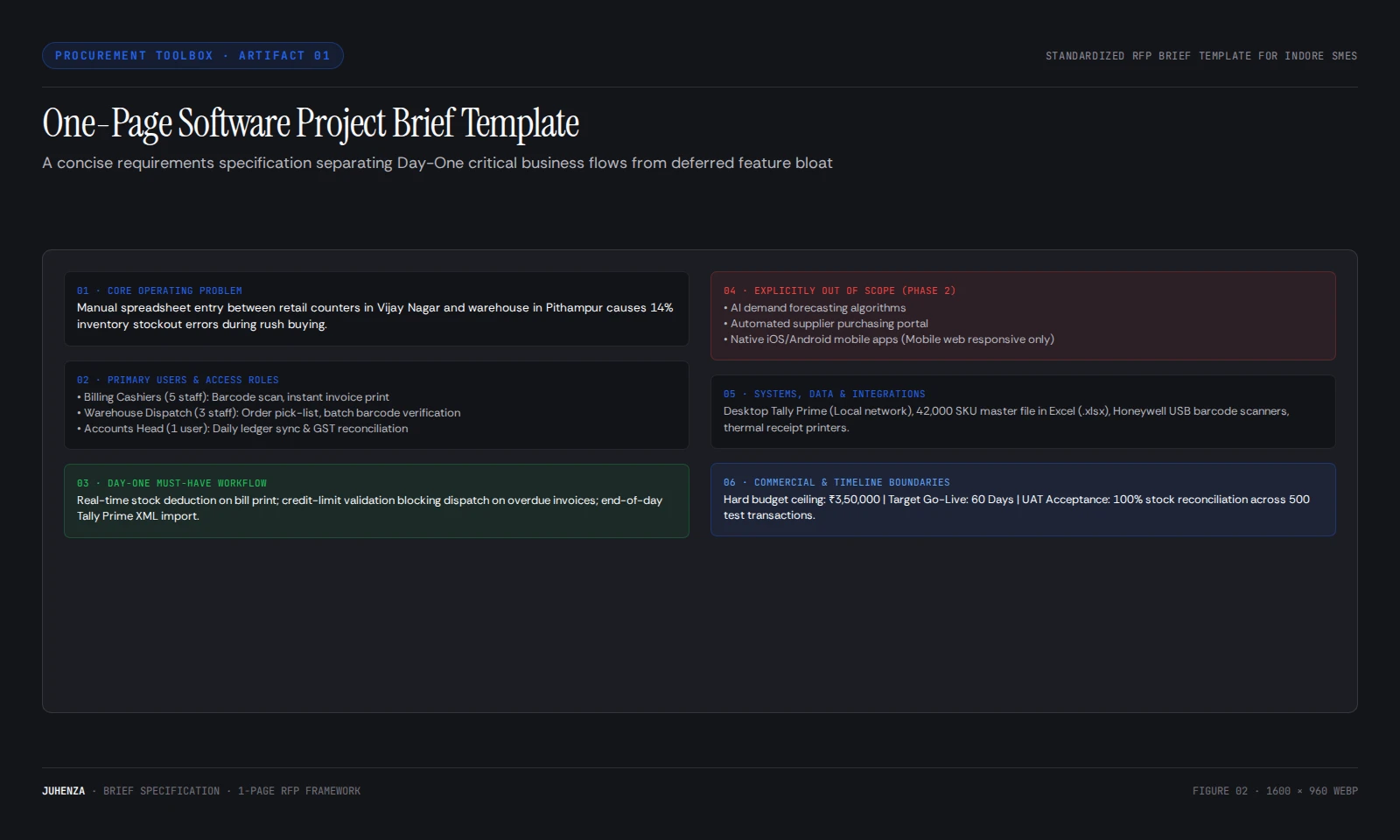
Before you contact anyone, write one page covering the problem, the users, the must-have workflow for day one, what can wait, existing systems, rough budget, and deadline. A good vendor should return questions that sharpen that page, not a quote that ignores it.
Ask: what did you understand as the riskiest part of our workflow, and what would you leave out of the first release? A vague answer means they have not thought about your operation yet. A useful answer names a workflow, a role, and a trade-off.
2. Can you use a live system they built?
Ask to use a live system, not to view a gallery. Open it on a phone. Complete one real task in it. Notice speed, clarity, error messages, and whether the flow feels finished.
Ask who did what on that project. Some portfolios include work done by a previous employer or a subcontractor. A team that built the system can explain the hard decision in it, what broke in production, and how they found out. If they can only show mockups or edited videos, score 0.
3. Who will actually build your system?
In many firms, a senior person sells the project and a junior team builds it. That handoff is where requirements get lost. Ask for a named roster with roles, time allocation, employee versus subcontractor status, and a backup for each key person.
Ask to speak with the technical decision maker before signing. If the answer is "team assigned after signing," treat that as a risk, not as normal process. Continuity matters more than team size for a first custom system, and a direct line to the builder is a real advantage of a small, founder-led team.
For the wider delivery model question, see the comparison of a software company versus a freelancer.
4. Is scope written before price?
Be cautious of a firm quote within minutes, with no questions asked. A serious vendor runs a short discovery step and returns an itemised scope: modules, user roles, integrations, data migration, what is explicitly out, and acceptance checks.
Compare proposals on identical scope before comparing rates. A lump sum with no scope behind it is not a lower price. It is an unpriced argument you will have later, at your cost. Insist on the written scope first, every time.
5. What counts as finished?
"Finished" should be observable, not a matter of opinion. Ask for acceptance checks in plain language. For an order system, a check might read: a new order appears in stock, invoice, and dispatch views with the same quantity, and a cancelled order restores stock once, not twice.
Agree who tests acceptance, with what data, and what happens if a check fails. If acceptance is only "client approval" with no test cases, you have no shared definition of done. This check separates vendors who plan delivery from vendors who plan demos.
6. What testing evidence can they show?
Ask for a sample test plan, defect log, and release checklist from a past project, with client details removed. Ask how they test failure paths: duplicate submissions, dropped connections, wrong scans, permission errors, and payment failures.
Ask who tests. "Developers test their own code" is not a testing process. Look for code review, a separate check by someone other than the author, and a record of what was fixed before release. For a system that must work at 500,000 records, ask how they test performance before you complain about it.
7. How do they protect data and handle security?
Do not accept "your data is secure" as a complete answer. Ask for a controls summary: role-based permissions, multi-factor authentication, least-privilege access to production data, credential storage, dependency updates, backups, and a tested restore routine.
If the system handles personal data, such as employee, customer, or visitor records, ask how the contract allocates duties under India's Digital Personal Data Protection Act, 2023 and the DPDP Rules, 2025. The MeitY publishes the Rules and the phased enforcement timeline. This is general information, not legal advice. Ask for a lawyer to review data and contract terms for your project.
Also ask whether AI coding tools will touch your code, what data leaves your boundary, and how generated code is reviewed and tested before release. If an AI agent can send messages, modify records, or trigger payments, ask which actions require explicit approval.
8. Do you own everything from day one?
Your agreement should state clearly that you own the source code, designs, documentation, and data once payments are made. The code should live in a repository you can access from day one, not only at handover.
Confirm that domains, hosting, app store accounts, and third-party services are registered in your company's name. Ask for a third-party licence list. Payment alone does not settle every rights question, so have counsel review the intellectual property and exit clauses. A vendor who resists any of these is planning to make leaving difficult.
9. What does year two cost?
Development is only one part of the software investment. Ask for an itemised quote plus running costs: hosting, cloud infrastructure, model or API usage, third-party licences, monitoring, security updates, maintenance, and support.
Ask what is not included, how change requests are priced, and what support costs after any free period. A higher initial price may give better long-term value if it includes better documentation, testing, and support. A very low quote usually means something is missing: testing, design, migration, or a clear understanding of the requirement.
For context on delivery models and scope, JUHENZA explains its founder-led custom software work as scope before development, with deliverables, exclusions, and acceptance checks documented before work starts.
10. Is the contracting entity real and traceable?
Match the contracting entity against the MCA company master data for corporate identity number, status, registered office, and directors, and confirm GST registration. The MCA portal is the primary source for company master data.
Refusal to share a corporate identity number, or a contract from an unrelated entity, is a red flag. Registration proves existence, not engineering quality. It belongs in the checklist because it is fast, verifiable, and often skipped.
11. Can you contact a reference yourself?
A written testimonial is not a reference. Ask for one client you can contact through their official channel. Ask that client what went wrong, how it was handled, and whether the vendor met the support terms after launch.
Ask for a support sheet at the same time: severity tiers, response versus restoration targets, coverage hours, and an escalation contact. "We are always available" is not a support term. A vendor with real support terms will state them in writing without drama.
12. Will they do a small paid pilot and a clean exit?
The strongest predictor on this list is a bounded paid pilot. A one to two week task on one anonymised workflow, with output you keep, answers questions a sales proposal cannot. Use it to test communication, code quality, testing, and handover.
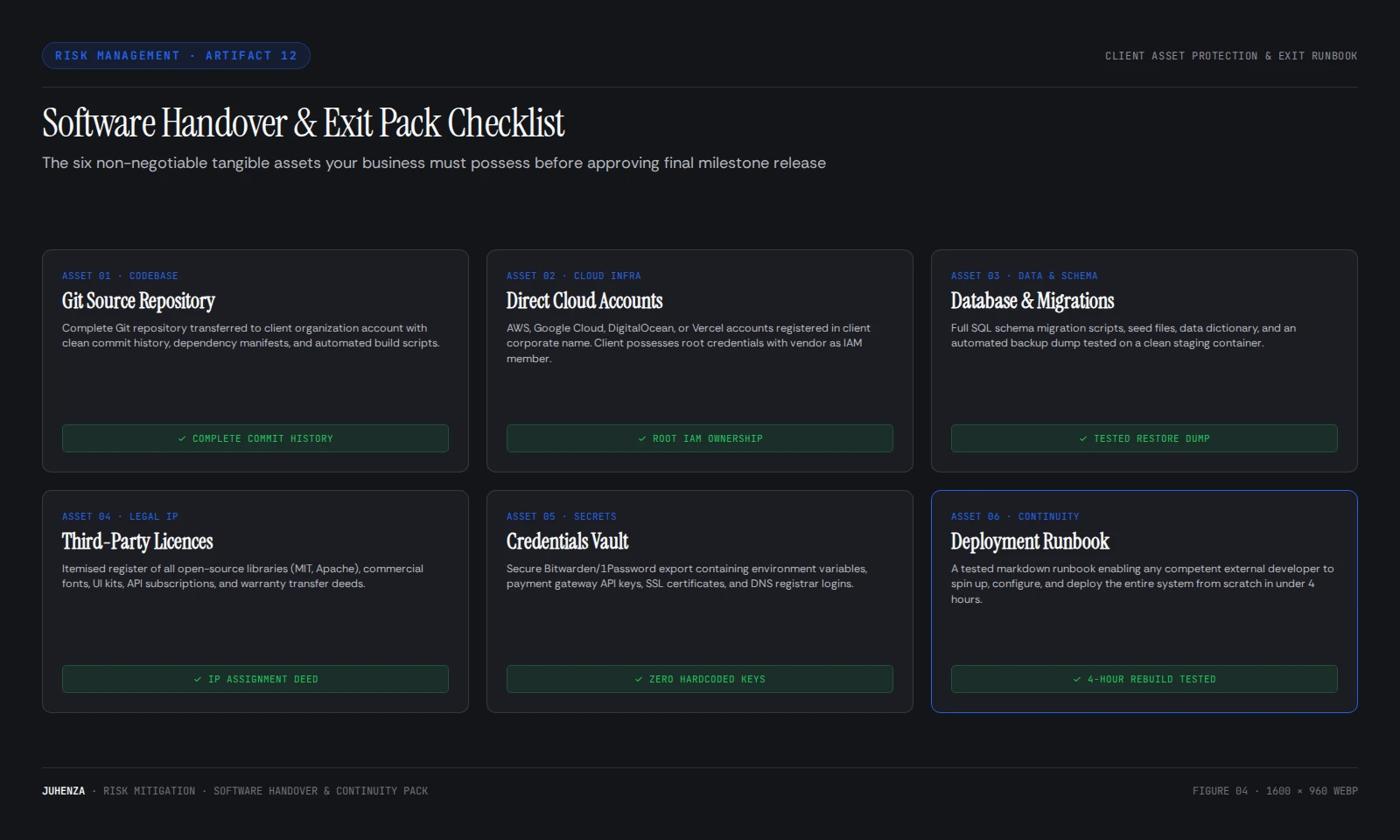
Then ask the exit question before you need it: if we part ways next year, what exactly do we walk away with? The honest answer is a short list: repository, cloud accounts, data exports in usable formats, documentation, credentials, and licence list. If that list is vague now, it will not get clearer later.
Scorecard and worked example
| Check | Vendor A score | Vendor B score | Evidence seen |
|---|---|---|---|
| 1. Brief improved | 2 | 1 | Vendor A returned marked-up brief |
| 2. Live system used | 0 | 2 | Vendor B screen-shared a live system |
| 3. Named team | 1 | 2 | Vendor B roster with backups |
| 4. Scope before price | 2 | 2 | Both itemised |
| 5. Acceptance checks | 1 | 2 | Vendor B test cases attached |
| 6. Testing evidence | 0 | 1 | Vendor B sample defect log |
| 7. Security and data protection | 1 | 1 | Both explained, neither showed restore test |
| 8. Ownership from day one | 2 | 2 | Both in draft contract |
| 9. Year-two cost | 1 | 2 | Vendor B separated build and running cost |
| 10. Legal existence | 2 | 2 | Both verified |
| 11. Independent reference | 0 | 2 | Vendor B reference contacted |
| 12. Pilot and exit | 0 | 2 | Vendor B offered paid pilot |
| Total out of 24 | 12 | 21 |
Illustrative example: an Indore trading firm
This is a planning scenario, not a client result. A 35-person trading business in Vijay Nagar wants order, stock, and billing in one system instead of spreadsheets. Vendor A gives a fast, low lump sum and a polished deck. Vendor B is slower to quote, asks to watch one order from enquiry to dispatch, and offers a two-week paid pilot syncing one product category.
Vendor A scores higher on confidence. Vendor B scores higher on evidence. The firm pilots with Vendor B, phase by phase. The lesson is the same across Indore, Pithampur, and Sanwer Road: evidence outranks eloquence.
For factory-specific checks, including shop-floor usability, integration with ERP, and machine data, use the manufacturing software vetting checklist.
What this guide is based on
Evaluating software vendor engagements for trading, manufacturing, and distribution businesses across Indore—from industrial tooling units in Pithampur and pharmaceutical stockists in Sanwer Road to corporate service desks in Vijay Nagar and the Crystal IT Park—reveals a predictable failure pattern: projects rarely fail because developers do not know how to code; they fail because acceptance criteria were never written in operational terms.
In a consultation for an Indore FMCG wholesale distributor managing 450+ daily retailer orders across Malwa, the firm had previously paid ₹3.5 lakhs to a local vendor who delivered a visually impressive web dashboard. However, during month-end billing, the system froze: multi-line GST round-offs didn't reconcile with their desktop Tally instance, and credit limits failed to block dispatch for overdue accounts. When the distributor requested fixes, the vendor claimed changes were 'out of scope' because the initial contract only specified 'order management screens.'
We restructured their procurement process around 3 tangible evidence artifacts:
- Operational Acceptance Checks: Every requirement was phrased as an observable event (e.g., 'A credit-hold order cannot generate a dispatch challan without a managing partner override PIN').
- Live Tally Sync Rehearsal: The vendor had to demonstrate bidirectional sync with a 50,000-ledger test database before frontend coding began.
- Escrow-Style Milestones: Payments were pegged to passing end-to-end user acceptance tests rather than calendar dates.
By requiring vendors to score themselves against these concrete artifacts, the distributor eliminated vague bids and selected a partner who delivered a stable system deployed across both shifts.
Common mistakes, limitations, and when to involve a specialist
Mistakes: buying the demo, comparing lump sums without normalising scope, treating "Agile" or "ISO" labels as proof, skipping operator interviews, and asking about ownership only in the final week.
Limitations: no checklist guarantees delivery. A five-person studio can be excellent without formal audit reports if its controls are documented and tested. A large firm can fail if the senior who scoped the work disappears after signing. Apply the checks proportionately to the size and risk of your project.
Specialists: a lawyer for intellectual property, data protection, and contract terms; a chartered accountant for vendor financial health; an automation or operations engineer if machine controllers or shop-floor systems are in scope; an independent technical adviser if nobody in-house can review a code or architecture sample. For AI-heavy builds, use the AI development company hiring checks for evaluation, security, and failure handling.
Frequently asked questions
How do I verify a software company in India is genuine?
Check the entity on the MCA portal for corporate identity number, status, and registered office, confirm GST registration, and speak to a reference you sourced independently. Registration proves existence, not engineering quality, so run the other evidence checks too.
Who should own the source code and production data?
Your business should own them through a written assignment covering code, documentation, and data, plus a list of third-party licences and their terms. Confirm repository, cloud, domain, and app store accounts are in your company's name from day one. Have counsel review the clauses before you sign.
Does the vendor need to be based in Indore?
No. What matters is availability for site visits or live walkthroughs, working-hour overlap with your team, and a support plan for go-live. A remote-first team can pass every check in this guide. Local presence helps for factory visits and staff training, but it should not replace evidence.
Fixed price or time-and-materials for a first system?
A bounded pilot suits fixed price. Evolving scope suits time-and-materials with a spending cap and written change approval. Compare proposals on identical scope before comparing rates, and ask what would change the estimate if requirements move.
How much should we pay upfront?
Keep advances modest and tied to defined deliverables and milestones, with acceptance checks at each stage. Avoid large unsecured prepayments. A small paid pilot is a safer first commitment than a big advance, and it gives you real output to judge.
What if the vendor shuts down mid-project?
Own the repository, cloud accounts, and documentation from day one, keep data exports current, and rehearse a handover. Continuity clauses help, but practical access matters more than promises. If another team cannot run the system from your handover pack, the exit plan is not complete.
Where this fits
This post sits under Software Development. If you are still deciding between delivery models, read the company versus freelancer comparison next. If the system will run on a factory floor, read the manufacturing vetting checklist next.
Approve on evidence, not enthusiasm
Run the 12 checks on every shortlisted vendor, then run the pilot and exit test on the leader. If you want a scoped, reviewable proposal for a website, custom system, or integration project, share your project brief with JUHENZA. JUHENZA works remotely with founder-led delivery, so expect questions, assumptions, and boundaries before a price.
References
- Ministry of Corporate Affairs, Government of India, company master data service, via mca.gov.in
- Ministry of Electronics and Information Technology, Government of India, Digital Personal Data Protection Rules, 2025, via meity.gov.in
Regulatory mentions are general information, current as of November 2026, and not legal advice. Consult a qualified professional for your project.