

Rajkot Foundry Melt Loss Sheet That Stops Quoting Every Casting at One ₹/Kg Rate
Rajkot foundry melt loss sheet shows how heat-wise melt loss, yield and rejection change cost per kg, so you stop quoting every casting at one ₹/kg rate.
TechApp Dev

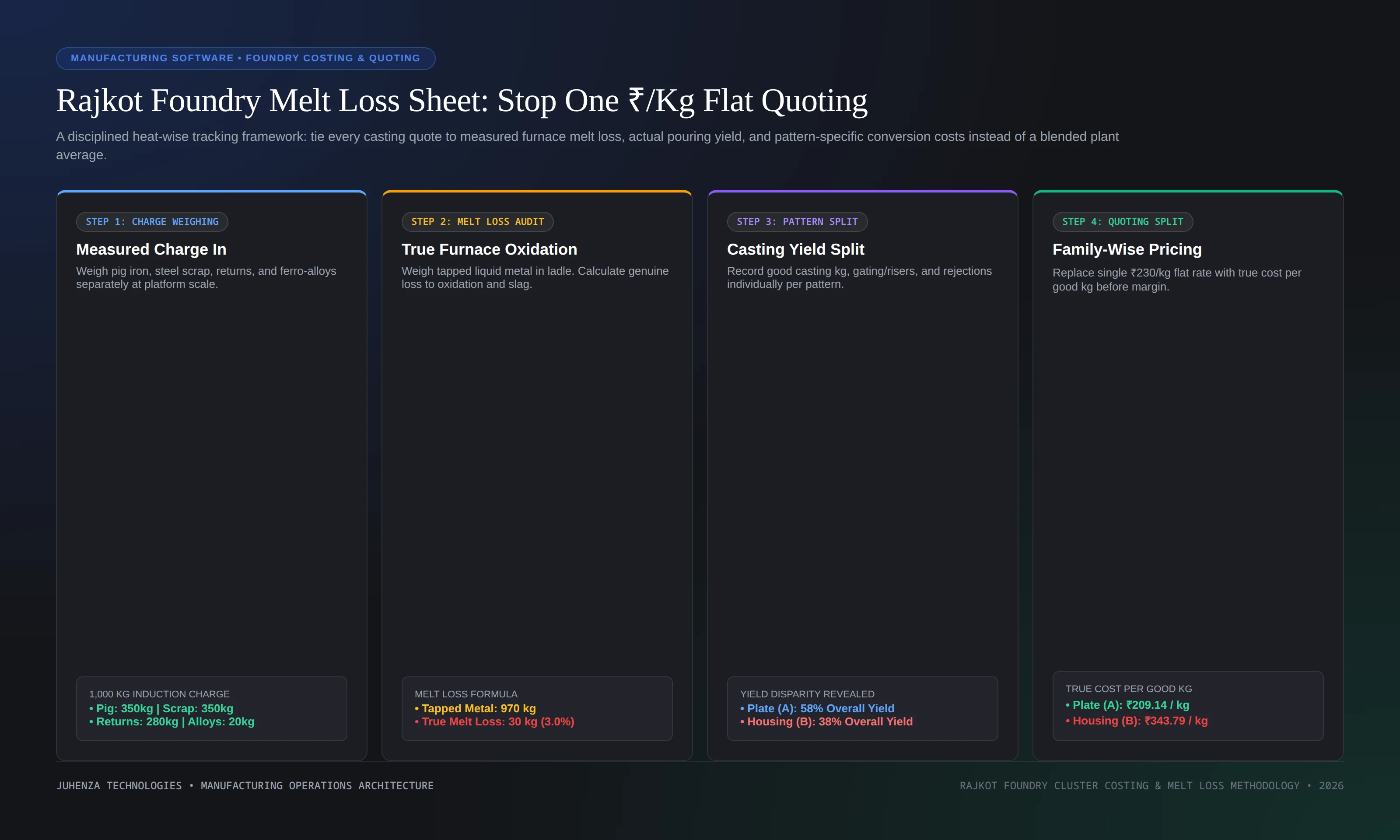
Stop quoting every casting at one ₹/kg rate. Use a heat-wise melt loss sheet that records charge, tapped metal, melt loss, poured metal, good castings, gating and risers, and rejections for each heat, then works out cost per good kg by casting type. That split shows which castings carry more melt, energy, and rejection cost, and which ones your flat rate is quietly subsidising.
A single ₹/kg rate feels fair until month-end shows the melt shop made money on one casting and lost it on the next. The Rajkot foundry melt loss sheet below fixes that by tying every quote to a heat, not to an average. You do not need new software to start. You need weights that close, one definition for yield, and a weekly review that turns the sheet into rates.
Why one ₹/kg rate fails in Rajkot
Rajkot foundries rarely pour one kind of casting. One shift can pour a heavy, simple plate and a light, cored housing. Both use metal, but they do not use the melt shop in the same way.
The heavy plate may pour cleanly, with a high share of poured metal becoming good castings. The cored housing may need more gating, more cores, more fettling, and more rejections. A flat rate hides all of that. It charges the easy casting too much and the hard casting too little.
Buyers notice. The easy work goes to a competitor who priced it correctly. The hard work stays with you, because your flat rate looks cheap for complex castings. Over a quarter, that selection effect is more damaging than one bad heat.
A heat-wise sheet breaks the pattern. It shows cost per good kg by casting type, not cost per kg of metal charged. That is the number a quote should use.
If you are also checking whether a vendor can build this kind of tracking, use the manufacturing software vetting checklist before you sign anything.
What melt loss actually is
Melt loss is metal lost in the furnace through oxidation, slag, and spillage. It is expressed as a percentage of the charge. It is a genuine loss. It does not come back.
Gating and risers are not melt loss. Rejected castings are not melt loss. Both go back as returns and get remelted. Returns cost energy and fresh melt loss each time they go through the furnace, but they are not the same as metal that left the system.
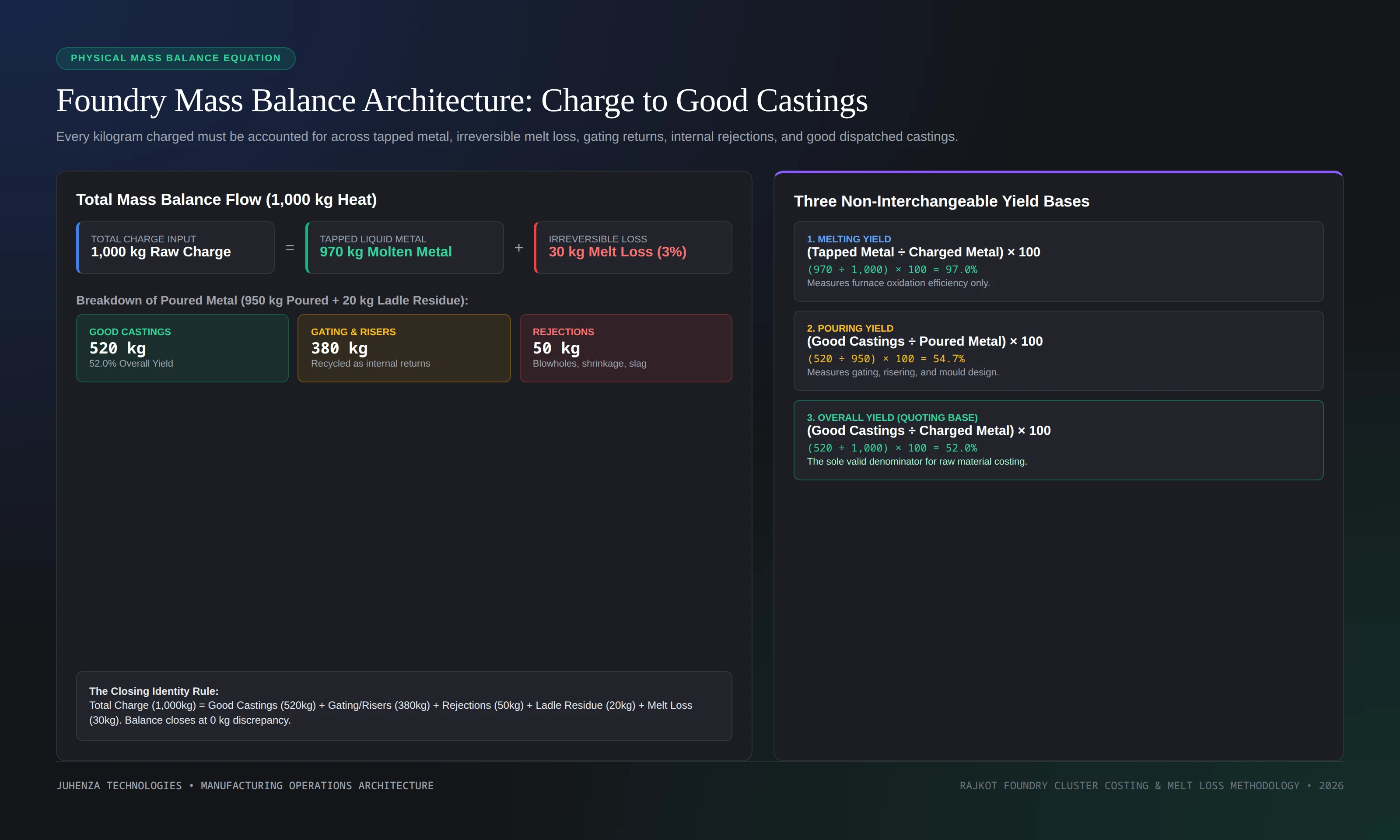
Use three yield definitions and keep them separate:
| Yield | Formula | What it tells you |
|---|---|---|
| Melting yield | Tapped metal divided by charged metal, times 100 | How much metal survives the furnace |
| Pouring yield | Good castings divided by poured metal, times 100 | How much poured metal becomes good castings |
| Overall yield | Good castings divided by charged metal, times 100 | The whole chain, charge to good castings |
Always write the base next to every yield number. A pouring yield of 60 percent and an overall yield of 52 percent can describe the same heat. Without the base, two people will argue about one heat and both will be right about different things.
Published furnace ranges help you sanity check your own numbers, not replace them. University of Minnesota MnTAP lists induction melt loss at 0.75 to 3 percent, cupola at 3 to 12 percent, and gas crucible at 4 to 6 percent. Your furnace, scrap grade, holding time, and slag practice decide where you sit inside, or outside, that range. Measure it heat by heat.
The heat-wise melt loss sheet
One row is one heat. One heat is one furnace, one charge, one tap. If a heat pours two patterns, use one row per pattern plus one heat total row, so shared melt loss can be split fairly. Do not average melt loss across a month and apply it to every casting. That average is exactly the flat rate problem in another form.
Use these columns:
| Column | What to record | Source |
|---|---|---|
| Heat number, date, furnace, shift | Identity for traceability | Charge sheet |
| Grade | Grey iron, SG iron, steel, alloy | Charge sheet |
| Charge by material | Pig iron, scrap, returns, alloys, in kg | Weighbridge or platform scale |
| Total charge | Sum of charge lines, in kg | Scale |
| Tapped metal | Liquid metal tapped, in kg | Scale or ladle weight |
| Melt loss kg and percent | Charge minus tapped, and percent of charge | Calculated |
| Poured metal | Metal poured into moulds, in kg | Pouring record |
| Residue | Ladle skull, spillage, furnace heel, in kg | Pouring record |
| Pattern and good castings | Pattern name and good kg | Dispatch and quality |
| Gating and risers | Kg that become returns | Moulding record |
| Rejections | Kg, stage found, cause code | Quality record |
| Returns generated and reused | Kg generated, kg reused | Returns ledger |
| Energy | kWh for the heat, if metered | Energy meter |
| Scrap grade and supplier | Grade, supplier, notes on rust or sand | Stores record |
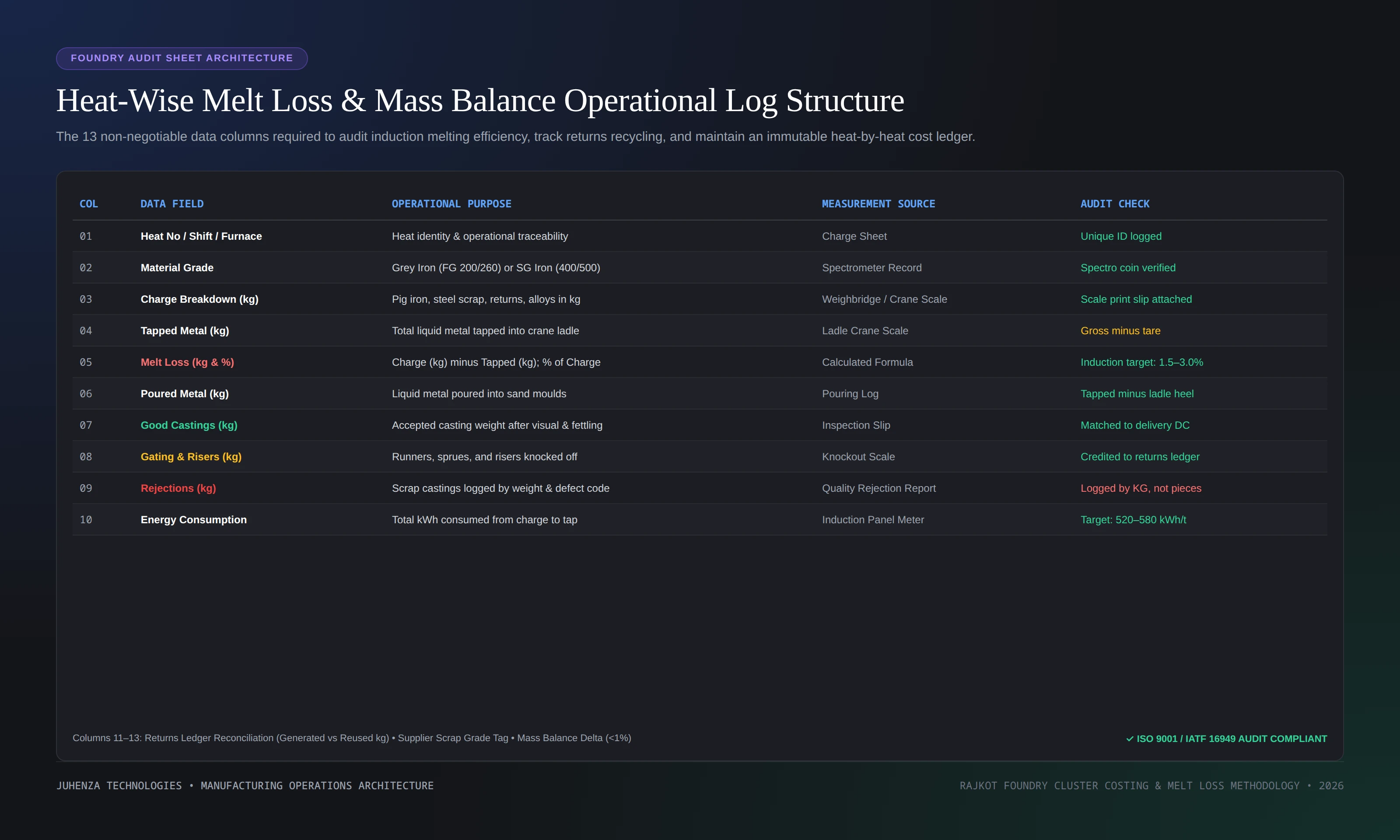
The returns ledger is the control that keeps the sheet honest. Record returns generated against returns reused for every heat. If you reuse more returns than you generate, your returns stock falls and your yield and cost look better than they really are. In steady state, fresh metal needed equals good castings plus melt loss plus residue. Anything else is borrowed stock.
Practitioner observation from Rajkot foundry operations:
In an operational assessment with a 15-tonne medium-frequency induction foundry in the Shapar-Veraval industrial zone near Rajkot, the melt shop poured heavy diesel-engine agricultural baseplates alongside thin-walled automotive pump housings from shared 1,000 kg grey iron (FG 200) heats. Quoting a uniform ₹210/kg flat rate led to heavy recurring margin leaks on the pump housings. Because the cored housings required extensive core-making and yielded only 38% good casting weight versus 58% on simple plates, the foundry was losing ₹114 on every good kilogram of complex castings produced.
When the plant implemented a heat-wise tracking sheet that recorded charge weights, tapped ladle weights, and pattern-specific gating returns, the true cost delta became undeniable. Within two billing cycles, the foundry re-quoted the cored housings into a dedicated high-integrity casting tier and reclaimed over 4% in overall operating margin.
How to fill the sheet in 5 steps
Step 1: Weigh the charge by material. Record pig iron, scrap, returns, and alloys separately. Do not record a single total from memory. Scrap grade matters. Rusty, sandy, or mixed scrap changes melt loss and chemistry.
Step 2: Weigh tapped metal and work out melt loss. Melt loss percent equals charge minus tapped, divided by charge, times 100. For a 1,000 kg charge with 970 kg tapped, melt loss is 30 kg, or 3 percent.
Step 3: Split poured metal by pattern. Record poured metal, residue, good castings, gating and risers, and rejections for each pattern. Check the balance: good plus gating plus rejections must equal poured metal. If it does not, find the missing weight before you move on.
Step 4: Close the heat balance. Charge must equal good castings plus gating and risers plus rejections plus melt loss plus residue. If the balance does not close, the yield figure is an estimate, not a measurement.
Step 5: Work out cost per good kg by pattern. Use the charge formula below. Update rates weekly from your own records, not from a national price table.
For planning a heat, work backwards: Charge equals molten metal needed divided by 1 minus melt loss as a decimal. If you need 970 kg of liquid metal and expect 3 percent melt loss, charge is 970 divided by 0.97, which is 1,000 kg. Add residue to the molten metal needed before you divide.
From melt loss to true cost per kg
True cost per good kg has three parts: metal and melting cost spread over good kg, plus conversion cost per good kg, plus any finishing and overheads that belong to that pattern. Overall yield already includes rejection, because rejection reduces good kg. Do not add a separate rejection percentage on top of overall yield, or you will double count rejection.
Use this framework:
True cost per good kg equals charge cost per kg charged plus melting cost per kg charged, divided by overall yield, plus conversion, finishing, and overheads per good kg.
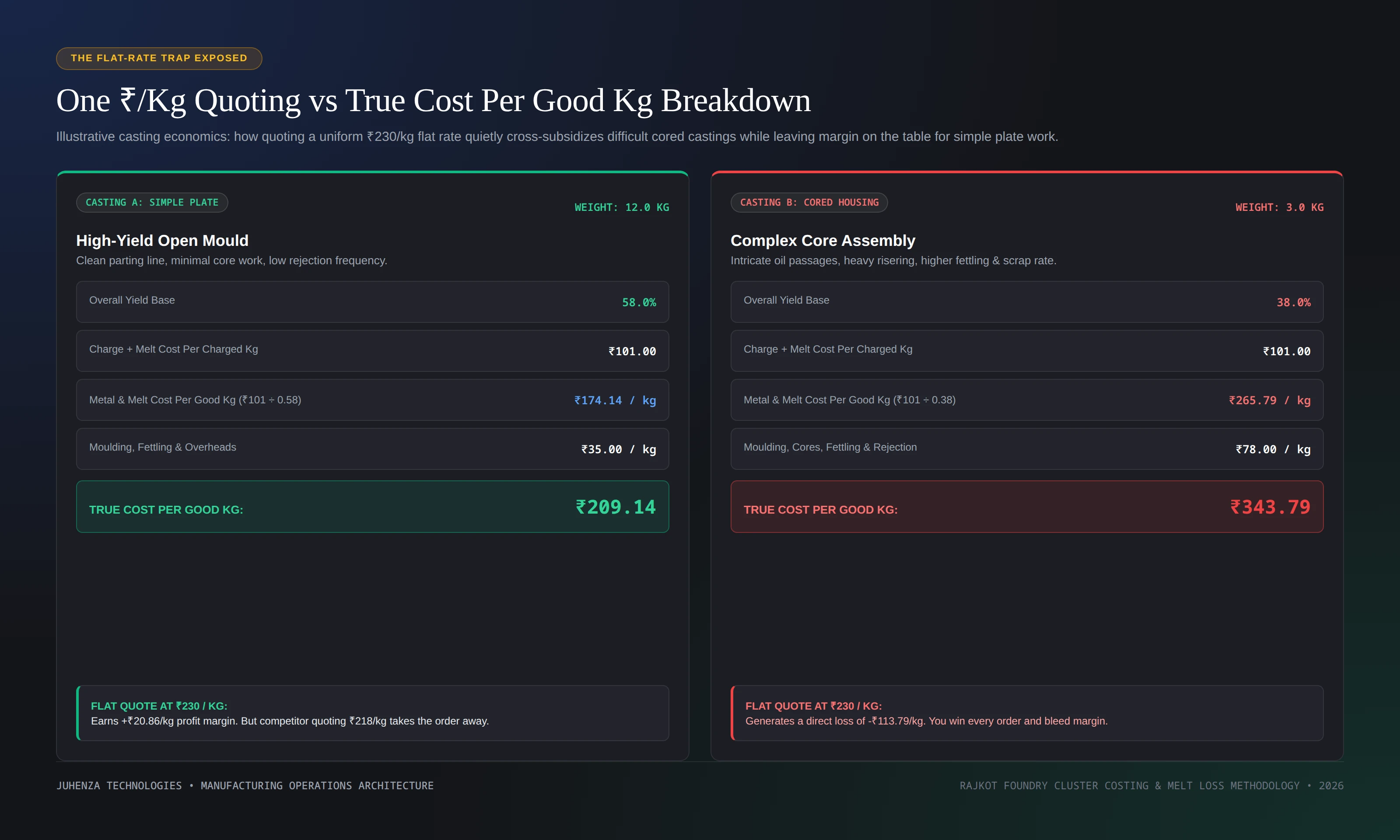
The table below is illustrative. All inputs are planning assumptions, not market prices and not a JUHENZA quote. Replace them with your own charge mix, energy, labour, and overhead figures. The point is the split, not the numbers.
| Input, illustrative | Casting A: Simple plate, 12 kg | Casting B: Cored housing, 3 kg |
|---|---|---|
| Overall yield | 58 percent | 38 percent |
| Charge plus melting cost per kg charged | ₹101 | ₹101 |
| Metal and melting per good kg | ₹174.14 | ₹265.79 |
| Moulding, cores, fettling, overheads per good kg | ₹35 | ₹78 |
| True cost per good kg, before profit | ₹209.14 | ₹343.79 |
| Flat quote at ₹230 per kg | Margin looks comfortable (+₹20.86/kg) | Direct loss of -₹113.79/kg |
Workings: For Casting A, ₹101 divided by 0.58 equals ₹174.14, plus ₹35 equals ₹209.14. For Casting B, ₹101 divided by 0.38 equals ₹265.79, plus ₹78 equals ₹343.79.
The flat rate is the trap. At ₹230 per kg, Casting A looks profitable and Casting B looks acceptable. In truth, Casting B costs about ₹114 more per good kg than Casting A in this illustrative example. If you quote both at one rate, you will win too much hard work and lose too much easy work.
Use the sheet to set two or three rates by casting family, not one rate for the whole foundry. A simple family, a cored family, and a high rejection family is enough to start. Review the families monthly. Move a pattern when its yield or rejection history moves.
For a wider view on how automation payback should be judged, see the AI automation ROI calculator for India, which uses the same discipline: baseline first, then measured change.
What to do when the numbers do not close
A small gap is normal. Scale error, moisture, and timing differences cause it. A large or one-sided gap is a signal.
Check in this order:
- Did returns generated and reused get recorded for this heat, or only reused?
- Did rejections found after machining get added back by weight, not just by piece count?
- Did ladle residue get weighed, or estimated?
- Did two patterns share one heat and split poured metal by guess?
- Did the charge sheet use a weighbridge slip, or a month-end estimate?
Set a tolerance in advance: investigate any heat where the balance gap is more than 1.0 percent of total charge. This 1 percent benchmark accounts for normal crane scale calibration tolerances and slag skimming variance. Log the root cause and the corrective adjustment immediately. A heat log that always balances to zero without variance is usually a log that is being forced to balance on paper.
Common mistakes
- Mixing yield bases. Publishing a pouring yield next to an overall yield without labels. Fix: write the base next to every yield number.
- Treating returns as free. Returns cost remelting energy and fresh melt loss. Fix: cost returns through the heat, not at zero.
- Applying melt loss to casting weight only. Melt loss applies to all metal melted, including gating and risers. Fix: apply melt loss to charge, then divide by overall yield.
- Logging rejections by count only. A heavy casting rejected once matters more than a light casting rejected five times. Fix: record rejected kg, stage, and cause code.
- Using one month average for every pattern. Averages hide the pattern that is losing money. Fix: keep rates by casting family.
- Comparing cost per kg across different parts. Cost per kg only compares fairly within similar weight, process, and gating design. Fix: compare within a family, not across the foundry.
Spreadsheet or software
A spreadsheet is enough for one furnace, one supervisor, and a weekly review. It fails when heats run across shifts, returns move between bays, and rejections are found in machining days later. Then weights sit in different places: weighbridge slips, charge sheets, quality reports, and dispatch records. Someone has to key them together, and the balance rarely closes.
Build software when any of these are true: you run more than 20 heats per week, you pour multiple patterns per heat, you need traceability by heat for a customer or quality requirement, or your monthly reconciliation takes more than a day. A useful build starts small: heat log, returns ledger, rejection by weight and cause, and a rate sheet by casting family. It should read weights at source where possible, not rely on retyping.
If you are comparing a spreadsheet fix with a custom build, the software development company vs freelancer guide explains how JUHENZA scopes a first useful release before quoting.
FAQ
What is melt loss in a foundry?
Melt loss is metal lost in the furnace through oxidation, slag, and spillage. It is shown as a percentage of the charge. It is a genuine loss, unlike gating and risers, which return to the next charge as returns.
How do I calculate melt loss for one heat?
Subtract tapped metal from total charge, then divide by total charge and multiply by 100. For a 1,000 kg charge with 970 kg tapped, melt loss is 30 kg, or 3 percent. Use scale weights, not month-end estimates.
What is the difference between melt loss and casting yield?
Melt loss measures metal lost in the furnace. Casting yield measures how much poured metal becomes good castings after gating, risers, and rejections. Melt loss is one part of the chain. Yield covers the whole chain from charge or poured metal to good castings.
How do I split melt loss when one heat pours two patterns?
Split shared charge, melt loss, and energy in proportion to poured metal per pattern, then work out cost per good kg separately for each pattern. Keep one heat total row plus one row per pattern, so the split can be checked and the heat balance still closes.
What melt loss should I expect for induction melting?
Use your own measured heat history. Published ranges are only a sanity check. University of Minnesota MnTAP lists induction melt loss at 0.75 to 3 percent. Scrap quality, holding time, and furnace practice move your figure inside or outside that range.
How often should I update my ₹/kg rates?
Update the sheet every heat, review rates weekly, and reset casting family rates monthly. Update immediately if charge mix cost, energy cost, scrap grade, or rejection rate moves materially. A stale rate is a flat rate with a new date.
Should I include returns at full metal cost?
No. Returns are not new metal. Cost them through remelting energy and fresh melt loss, plus handling. The fresh metal you must buy is good castings plus melt loss plus residue in steady state. Charging full metal cost for returns overstates material cost.
Where this fits
This post sits in our Manufacturing Software series. It pairs with the manufacturing software vetting checklist for choosing a build partner, and with the E-Way Bill mismatches guide for keeping dispatch and accounting records consistent.
Conclusion
Stop letting one rate decide which work you win. Run one furnace on the heat-wise sheet for one week. Weigh the charge, weigh the tap, split by pattern, close the balance, and price by casting family. The sheet will show you which castings to reprice, which gating to review, and which rejections to attack first.
If you want that sheet turned into an automated operational software system that your shop floor can run without retyping scale weights, share your project brief with JUHENZA. We respond with questions, assumptions, and boundaries before quoting a price.
References
- University of Minnesota, Minnesota Technical Assistance Program (MnTAP), Ferrous Casting Furnace Melt Loss and Thermal Efficiency. https://www.mntap.umn.edu