

How to Choose Panchakarma Software in Kochi: DPDP Consent, Therapist-Room Scheduling and Oil-Cost Tests
Compare Panchakarma software in Kochi with 3 tests: DPDP consent, therapist-room scheduling and oil-cost tracking. Checklist and demo script included.
TechApp Dev

Direct answer: Panchakarma software in Kochi should pass three tests before you shortlist it. It should record DPDP consent with notice version, purpose and withdrawal. It should book therapist, room, equipment and cleaning time together. It should turn oil used in each session into a true cost per therapy. If a vendor cannot show all three with your own programme data, keep looking.
What counts as Panchakarma software
Panchakarma software in Kochi is not a generic clinic system with an Ayurveda label. A generic system books a doctor slot. A Panchakarma system books a course.
That course has stages. Assessment comes first, then preparatory days, then the main procedure, then recovery and review. Each day becomes sessions. Each session needs a room, one or two therapists, equipment, oil or preparation, and time to clean and reset.
Ask this first: does the system store a programme as a sequence, or as a list of separate appointments? If it stores separate appointments, every change becomes manual work. If the main procedure moves by a day because the guest is not ready, the later sessions should shift with it, and the scheduler should rebook therapists and rooms.
The second check is language. The system should hold Prakriti once, Vikriti at each review, examination findings, diagnosis in Ayurvedic terms, treatment principles, and linked prescriptions. A notes box that says "Vata-Pitta" is not a record. A structured record lets the next physician see why a plan was chosen.
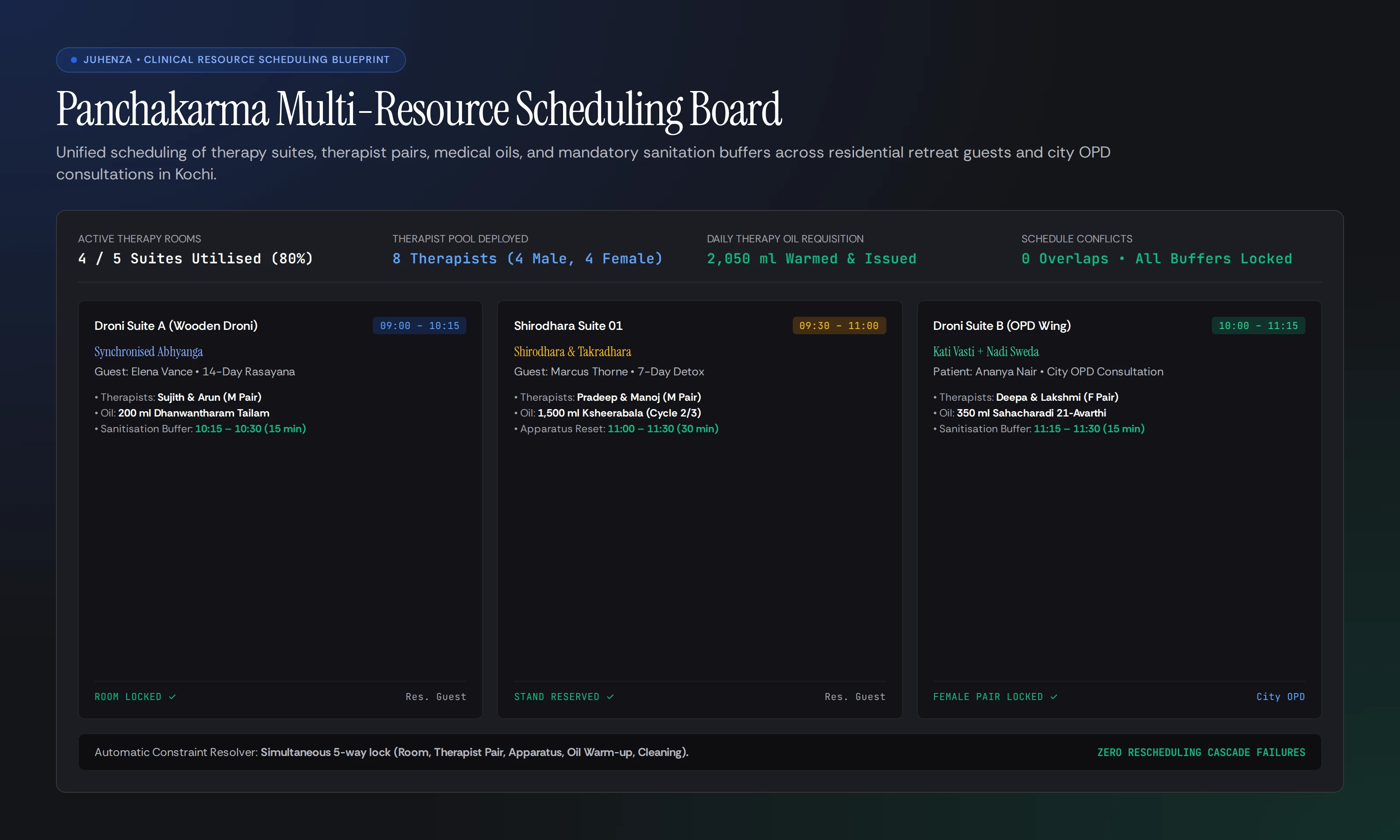
For Kochi, add one more layer. Many centres run city OPD in the morning and residential programmes for visiting guests in the same building. The software must keep both in one scheduler. Otherwise the OPD fills a room that a 14-day guest needs at 10:30, and the clash is found on the whiteboard, not in the system.
Test 1: DPDP consent
DPDP means the Digital Personal Data Protection Act, 2023. It is India's law on how personal data is collected and used. Your centre is the data fiduciary when it decides how and why guest data is used. Your software vendor is usually the data processor, handling data on your behalf.
Do not accept "DPDP ready" as proof. Ask for the workflow.
A consent request under the Act must be accompanied or preceded by a notice. That notice must state what personal data is sought and why, how the person can exercise rights and withdraw consent, and how to complain to the Board. The Act also requires consent to be free, specific, informed, unconditional and unambiguous, given through a clear affirmative action. In practice, your software should prove four things for each guest.
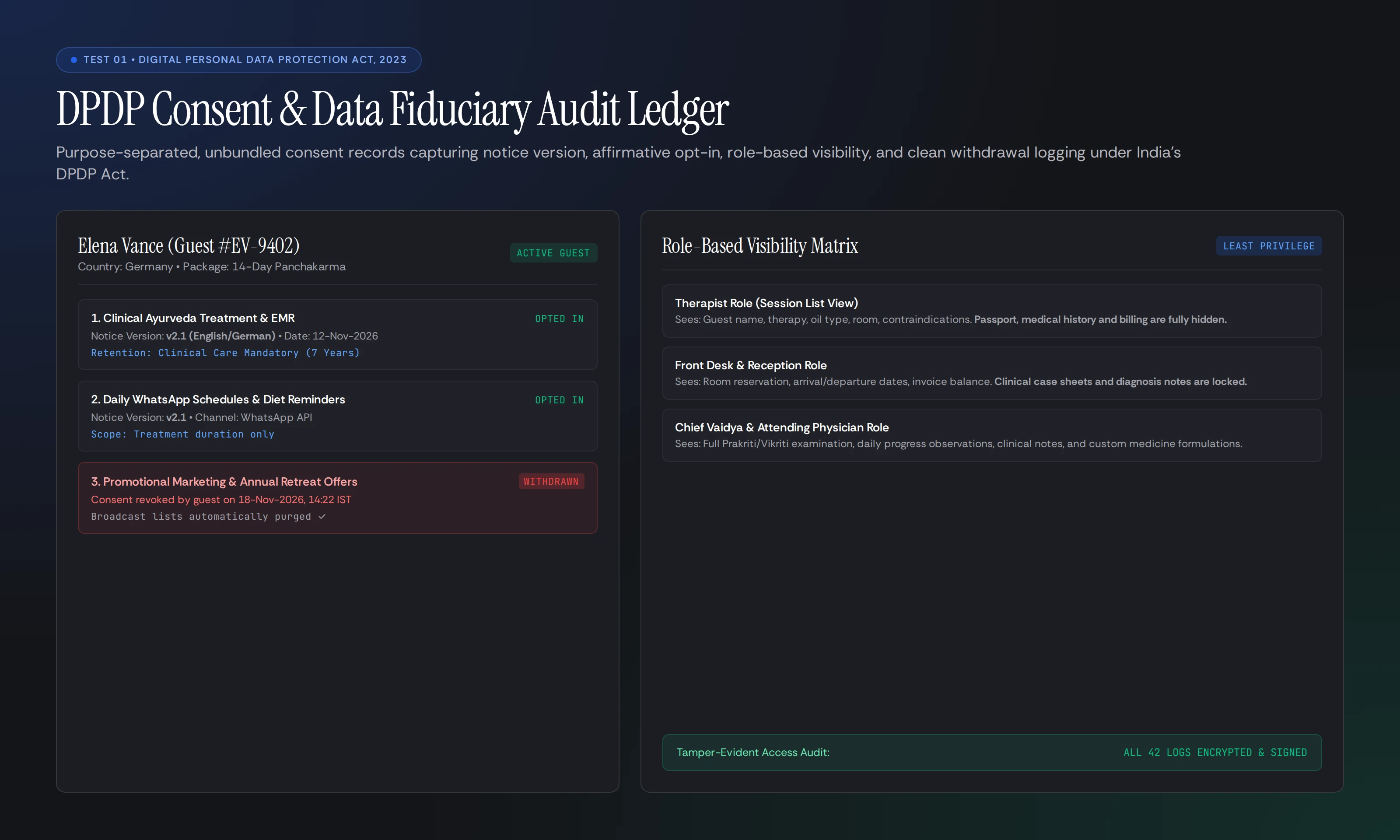
First, notice version. Which notice did this guest see, in which language, on which date? If the notice changes, the system should keep the old version attached to the old consent.
Second, purpose. Consent for treatment is not consent for marketing. Consent for a WhatsApp schedule is not consent for a promotional broadcast. The system should store purpose separately, so withdrawal of marketing consent does not delete the treatment record.
Third, withdrawal. Withdrawal should be as easy as giving consent. The system should log the withdrawal, stop the relevant use, and show what remains lawful to retain for care, billing or legal record. Your lawyer should define retention, not the vendor.
Fourth, access control and log. Therapists should see what they need for a session, not billing or full histories. Front office should see stay and contact details, not the full case sheet. Every view, edit, export and deletion should leave an audit trail.
Use this checklist in the demo:
- Show me one guest with two purposes, one withdrawn, one active
- Show me the notice version attached to that consent
- Show me the access log for that guest in the last 7 days
- Show me how you export or delete a guest record, and what stays behind
- Show me where passport and visa details sit, and who can see them
If the vendor shows a settings page instead of a guest record, the test fails.
Not legal advice: This section is general information about software workflow, not legal advice. Ask a qualified professional to review your notices, retention and grievance process before you publish them. As of November 2026, the DPDP Act, 2023 is the primary source cited here. Rules and enforcement timelines continue to evolve, so confirm the current position with counsel.
Test 2: Therapist-room scheduling
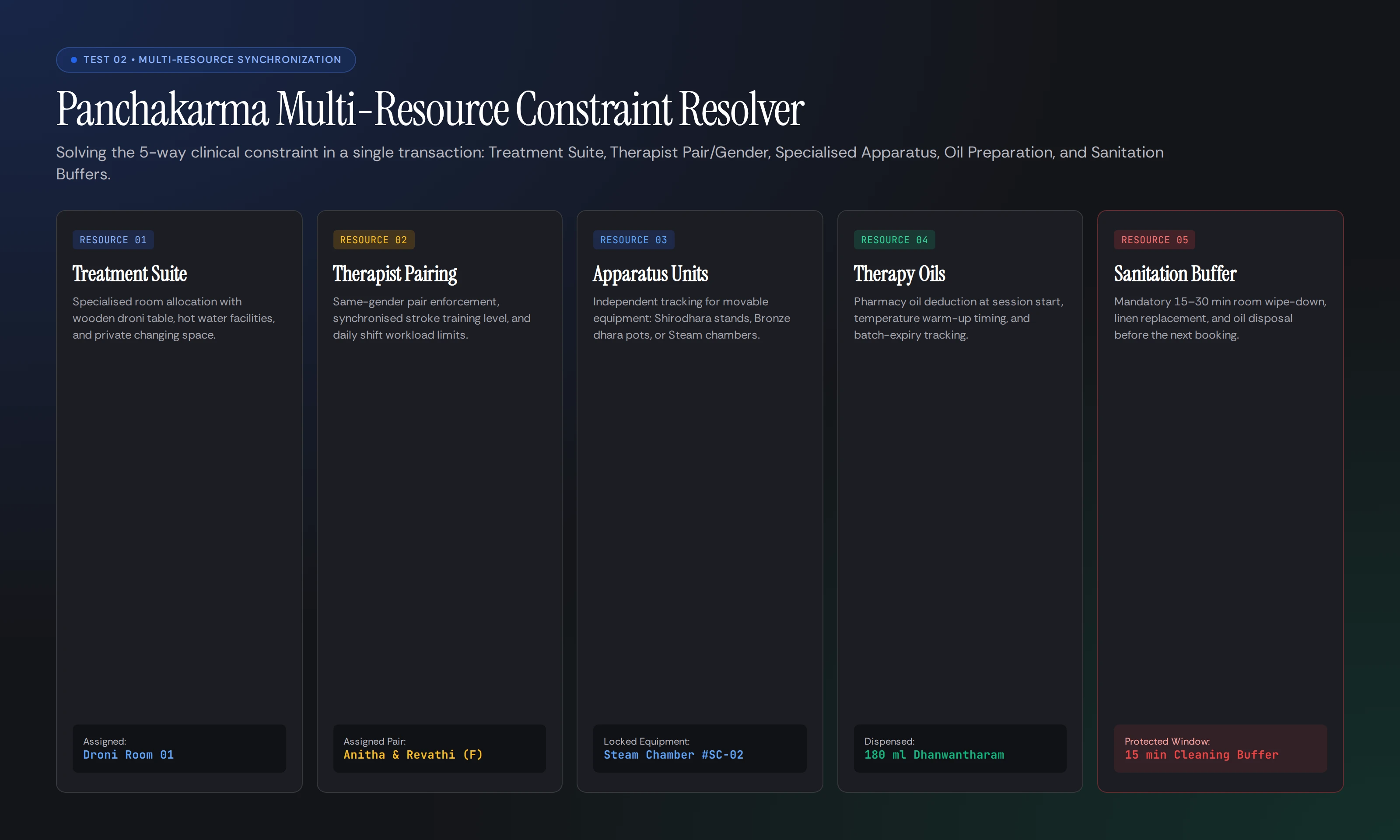
Panchakarma scheduling is a small puzzle repeated many times a day. Each session needs a therapist count, a gender rule, a skill tag, a room type, equipment, duration, and a cleaning buffer. The scheduler must check all of them at once.
Start with a real example. A synchronised Abhyanga needs two therapists, often the same gender as the guest, in a room with a droni, for a set duration, plus cleaning time. A Shirodhara needs a Shirodhara stand, a different room type, and a longer reset. A Swedana needs a steam chamber. If the system books the therapist but not the room, or the room but not the equipment, the booking is not booked.
Ask the vendor to run this scenario with your data: one 14-day programme for two guests, with a shared therapist pool, one therapist on leave on day 9, and one guest whose main procedure moves by a day. Watch what happens.
Good software will:
- Propose a full timetable for the whole programme, not one day at a time
- Flag conflicts and show which booking caused the clash
- Shift later sessions when an earlier session moves, and rebook therapists and rooms
- Show which sessions are affected when a therapist calls in sick, and which colleagues can cover them
- Respect shift limits, so one therapist is not loaded with eight sessions while another has two
Poor software will let you drag a session into a clash, book two therapists in two rooms at the same time, or lose the cleaning buffer when you move a session.
Also check the morning view. Therapists should see guest, therapy, room, oil, and special notes on one list. Housekeeping should see a room day view with cleaning slots. The therapy manager should see utilisation: empty room hours, overloaded therapists, and sessions that were missed or rescheduled with a reason.
One more Kochi check: guest preferences. Some guests ask for a specific therapist pair. Some need a female therapist for all sessions. The system should store that as a rule, not as a sticky note. If the rule lives outside the system, the system will break it.
Test 3: Oil-cost tests
Oil is where Panchakarma profit hides or leaks. A centre can bill correctly and still lose money if it does not know what each therapy really consumes.
Most pharmacy modules track dispensing. That is not enough. Therapy oil is consumption. An Abhyanga uses oil in the room. A Shirodhara circulates oil for the session. A Basti uses a prepared decoction. If the system only deducts bottles sold for home use, it never sees session consumption.
The test has three parts.
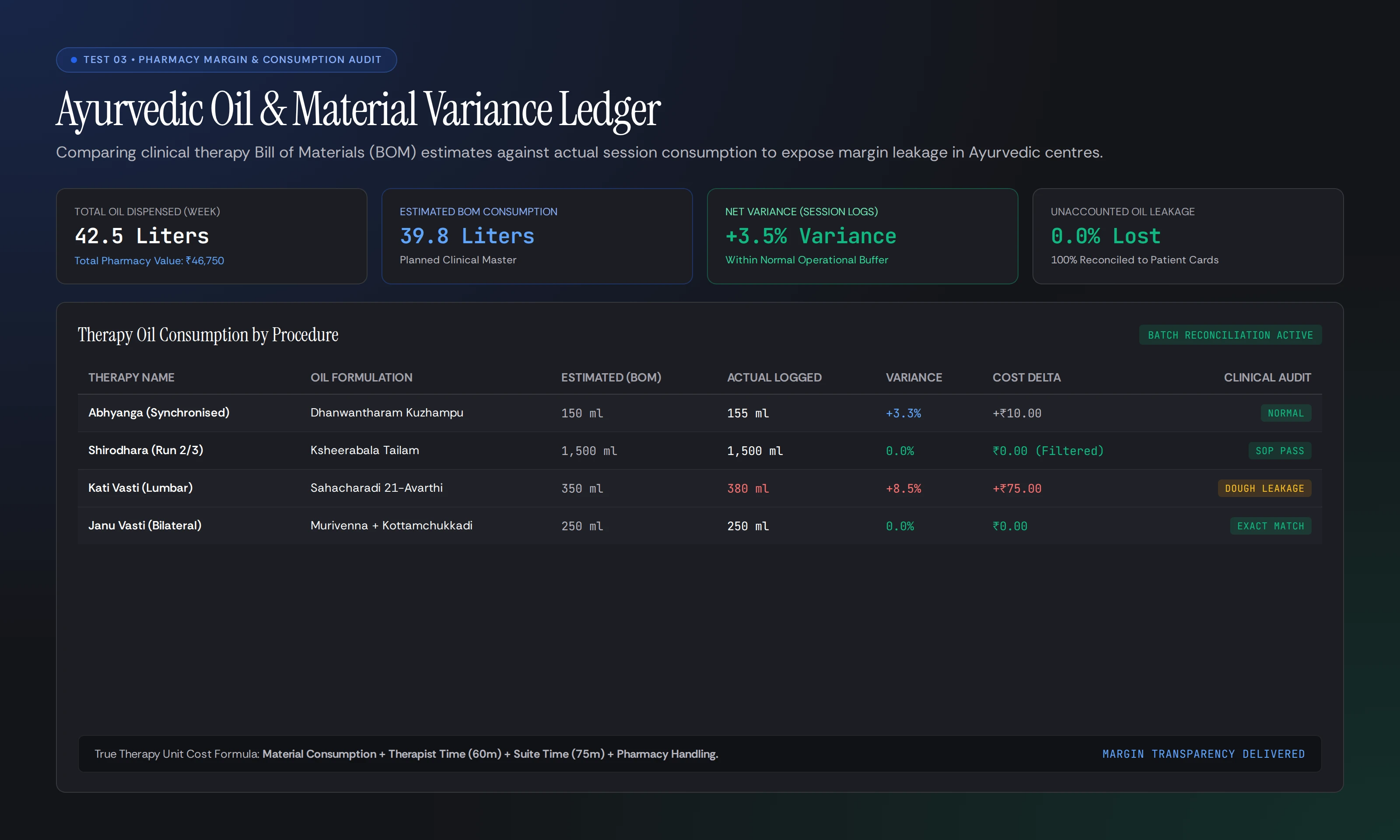
Part 1: Estimated consumption per therapy. Each therapy master should hold an estimated oil type and quantity. For example, an illustrative full-body Abhyanga might be set at 150 ml of a named Tailam. A Shirodhara might be set at 1,500 ml in circulation, with reuse rules defined by your physicians. In clinical practice across Kerala Ayurveda centres, standard baseline references typically allocate 150–200 ml for Abhyanga (Mahanarayana or Dhanwantharam Tailam), 1,200–1,500 ml for Shirodhara circulation (Ksheerabala or Chandanadi Tailam with strict physician-guided 3-day reuse and filtration protocols), 300–400 ml for Kati Vasti retention, and 250–300 ml for Kashaya/Sneha Basti preparations. These are illustrative placeholders, not clinical guidance. Your doctors define the quantities.
Part 2: Actual consumption per session. After each session, the therapist should log what was actually used, or the system should deduct the estimate and let pharmacy correct it on a periodic count. The difference between estimate and actual is variance. Variance is the point. It shows waste, over-pouring, wrong oil, or a therapy master that needs updating.
Part 3: True cost per therapy. True cost is not oil price alone. It is oil cost plus therapist time plus room time plus cleaning time plus pharmacy handling. The software should let you build that view.
Use this illustrative calculation to test the logic, not as your price:
- Oil: 150 ml at ₹2 per ml = ₹300
- Therapist time: 60 minutes for two therapists, at your internal cost rate
- Room time: 60 minutes plus 15 minutes cleaning
- Pharmacy handling: dispensing and count correction
If the vendor cannot show a report that compares estimated vs actual oil by therapy, by therapist, and by week, the oil test fails. Ask for that report in the demo, with your own oil list, not the vendor's sample data.
Also check batch and expiry. Tailam, Ghritam, Kashayam, Churna, Arishtam and Gutika each have different units and pack sizes. Dispensing should pick the earliest-expiring batch first unless the pharmacist chooses otherwise. A pharmacy module built for allopathic drug lists will force your classical forms into the wrong units.
What else to check
Once the three tests pass, check the rest in one pass.
Packages and stays. A 7, 14 or 21-day programme is a bundle, not a set of invoices. The package template should list consultations, therapies, diet, stay, medicines, deposit and balance. If the doctor adds a therapy outside the package, it should bill as an extra with the guest's agreement. Room allocation for stays should sit next to therapy scheduling, with arrival and departure dates, room type, companions and diet preferences.
Kitchen and diet. Pathya diet travels with the plan. The kitchen should see what each guest eats on each day of recovery. If diet lives in a separate spreadsheet, the kitchen will serve the wrong meal on the wrong day.
Guest communication. Booking confirmation, pre-arrival instructions, daily schedule, diet reminders and post-programme follow-up should run on approved WhatsApp templates. Ask who writes the templates, how long approval takes, and what happens outside the customer-service window.
Reports the owner needs. Room and therapist utilisation, package revenue by type, pharmacy margin, medicines near expiry, extras sold, repeat-guest rate, and missed or rescheduled sessions. If the owner only gets a daily collection report, the system is a billing tool, not an operations tool.
Data ownership and exit. Ask where code and data live, who owns them, how you export everything, and what happens if you stop paying. For custom work, code in your repository and data in your cloud account is the cleanest answer. For SaaS, a full export in a usable format, not a PDF dump, is the minimum.
Buy, subscribe or build
| Option | Best when | Watch for |
|---|---|---|
| Ready SaaS | You run one centre, standard therapies, and need to go live fast | Can you define your own therapies, room types and gender rules? Can you export all data? |
| Configured product | You need Panchakarma depth plus pharmacy, stays and packages, but not custom code | What is included in the base price? What is an add-on? What is the annual increase? |
| Custom build | Your workflow, permission model or integration cannot be served by a product | Written scope, itemised quote, weekly test links, and code and data in accounts you control |
Price alone does not decide this. A low monthly price with the wrong scheduling model costs more in clashes, rework and oil loss than a higher price with the right model. Compare what each option does with your own therapies and your own pharmacy, not with a feature list.
For a custom build, ask for a staged first release: records and scheduler first, then billing and packages, then pharmacy with oil deduction, then stays and diet lists. Running the whiteboard and the software in parallel for one to two weeks helps the therapy manager see where the rules need adjusting.
A scoring framework and demo script
Score each vendor 0 to 2 on each row. 0 means not shown, 1 means shown with sample data, 2 means shown with your data.
| Test | What to score |
|---|---|
| DPDP consent | Notice version, purpose separation, withdrawal, access log, export or deletion |
| Scheduling | Therapist count, gender rule, skill tag, room type, equipment, cleaning buffer, shift limit |
| Oil-cost | Estimated vs actual, batch and expiry, true cost per therapy |
| Packages | Bundle, deposit, extras, stay and diet |
| Ownership | Code and data ownership, export, support after launch |
Run the same demo script for every vendor: schedule a 14-day programme for two guests with a shared therapist pool, then dispense their medicines and deduct therapy oil. If the vendor cannot show that with your therapies, it was not built for Ayurveda.
First-hand experience note
In working with multi-room Ayurvedic wellness centres and beachfront Panchakarma retreats in the Ernakulam and Fort Kochi belt, the most common operational breakdown occurs at the intersection of residential retreat packages and walk-in city OPD consultations.
During a workflow discovery for a 12-bed retreat running 5 treatment rooms (droni-equipped) and a pool of 8 therapists (4 male, 4 female pairs), the existing generic clinic software handled doctor appointments well but failed on therapy orchestration:
- The cascade collapse: When a residential guest experiencing detox fatigue required shifting an afternoon Shirodhara by 90 minutes, the front desk had to manually phone two therapists, cross-check the oil warming kettle, and adjust room assignments on a paper whiteboard. Over three weeks, this resulted in 7 room double-bookings against city OPD patients.
- Pharmacy leakage: Oil was bulk-issued to treatment suites at the start of the week as general supplies. Unmonitored dispensing led to a 28% unaccounted variance between purchased Dhanwantharam Tailam and billed session numbers.
- The integrated resolution: We mapped the scheduling logic so that booking a Panchakarma session locks all four required resources simultaneously (Room, Therapist Pair, Heating/Droni Apparatus, and Cleaning Buffer). Linking the session trigger directly to the internal pharmacy inventory deducted the exact estimated milliliter volume at session start, with therapist mobile reconciliation upon session completion. In the subsequent 60-day season, room scheduling conflicts dropped to zero, and monthly pharmacy variance stabilized within a 3.5% acceptable operational buffer.
Common mistakes, limitations and specialists
Common mistakes:
- Buying for OPD and discovering Panchakarma scheduling is an afterthought
- Accepting a consent checkbox without a notice version or withdrawal log
- Tracking pharmacy stock but not therapy consumption
- Letting diet, stays and therapy live in three systems
- Signing without a written scope, test link or export promise
Limitations: Software does not write treatment protocols, consent content, or diet rules. Your physicians do. Software does not earn accreditation. Your centre does, by keeping consistent records. Software does not fix staffing. If one therapist is overloaded, the answer may be a hire or a room, not a feature.
When to involve a specialist: Involve a lawyer for DPDP notices, retention and grievance handling. Involve your chief physician for therapy masters, oil quantities and contraindications. Involve your pharmacist for batch, expiry and in-house preparation records. Involve a chartered accountant for GST, package deposits and refunds.
FAQ
What is Panchakarma software?
Panchakarma software is a system that stores a Panchakarma course as a sequence, schedules each session with therapist, room, equipment and cleaning time, tracks oil and material use, and bills packages. It differs from generic clinic software, which usually books single doctor slots.
How is Panchakarma software in Kochi different from generic clinic software?
It handles multi-day programmes, therapist pairs, gender rules, room types, cleaning buffers, diet lists and residential stays in one scheduler. Generic software often handles OPD, billing and pharmacy, but not the full therapy puzzle.
How should DPDP consent work in Panchakarma software?
It should store the notice version, language, purpose and date for each consent, allow withdrawal as easily as giving consent, limit access by role, and keep an audit log. Treatment consent and marketing consent should stay separate.
How do I test therapist-room scheduling in a demo?
Use your own 14-day programme for two guests with a shared therapist pool. Ask the vendor to show conflicts, shift a main procedure by a day, mark a therapist sick on day 9, and show the morning therapist list and room day view.
How do I calculate true oil cost per therapy?
Add oil cost at actual consumption, plus therapist time, room time, cleaning time and pharmacy handling. Compare estimated vs actual oil by therapy each week. Variance shows waste, wrong oil, or a therapy master that needs updating.
Should a Kochi centre buy SaaS or build custom Panchakarma software?
Choose SaaS if your therapies and packages are standard and you need speed. Choose a custom build if your workflow, permission model or integration cannot be served by a product. In both cases, require a full data export and a written scope.
Where this fits
This guide sits in Custom Software > Healthcare and Clinic Software. For the buying process, read the guide on vetting a software company before you sign. For the build-versus-buy decision, read the guide on hiring a software development company versus a freelancer.
Conclusion
Choose on proof, not on feature lists. Run the DPDP consent test, the therapist-room scheduling test, and the oil-cost test with your own programme data. The system that passes all three will save your therapy manager hours, protect guest data, and show you what each therapy really costs.
Share your therapy list, rooms, therapist pool and package brochure on the JUHENZA contact page, and JUHENZA will scope a first release around your actual workflow.
References
- Digital Personal Data Protection Act, 2023, India Code, Section 5 and Section 6, https://www.indiacode.nic.in/show-data?abv=CEN&statehandle=123456789/1362&actid=AC_CEN_45_0_00003_2023-22_1763464807080§ionId=101271§ionno=5&orderno=5&orgactid=AC_CEN_45_0_00003_2023-22_1763464807080