

How to Choose EPC Software in Vadodara: Retention, Milestone Billing and Drawing Revision Tests
Choose EPC software in Vadodara with 3 live tests for retention, milestone billing and drawing revisions. Includes scoring checklist and Vadodara workflow.
TechApp Dev

A demo can show every screen and still hide the three failures that cost Vadodara EPC firms money.
Direct answer: Choose EPC software in Vadodara by running three live tests on your own data. Test retention end to end, from deduction on each bill to release after the contract trigger. Test milestone billing from verified progress to invoice, including partial milestones and disputed measurements. Test drawing revisions by proving a superseded sheet cannot reach site. Score each test on evidence, not on how smooth the demo looks.
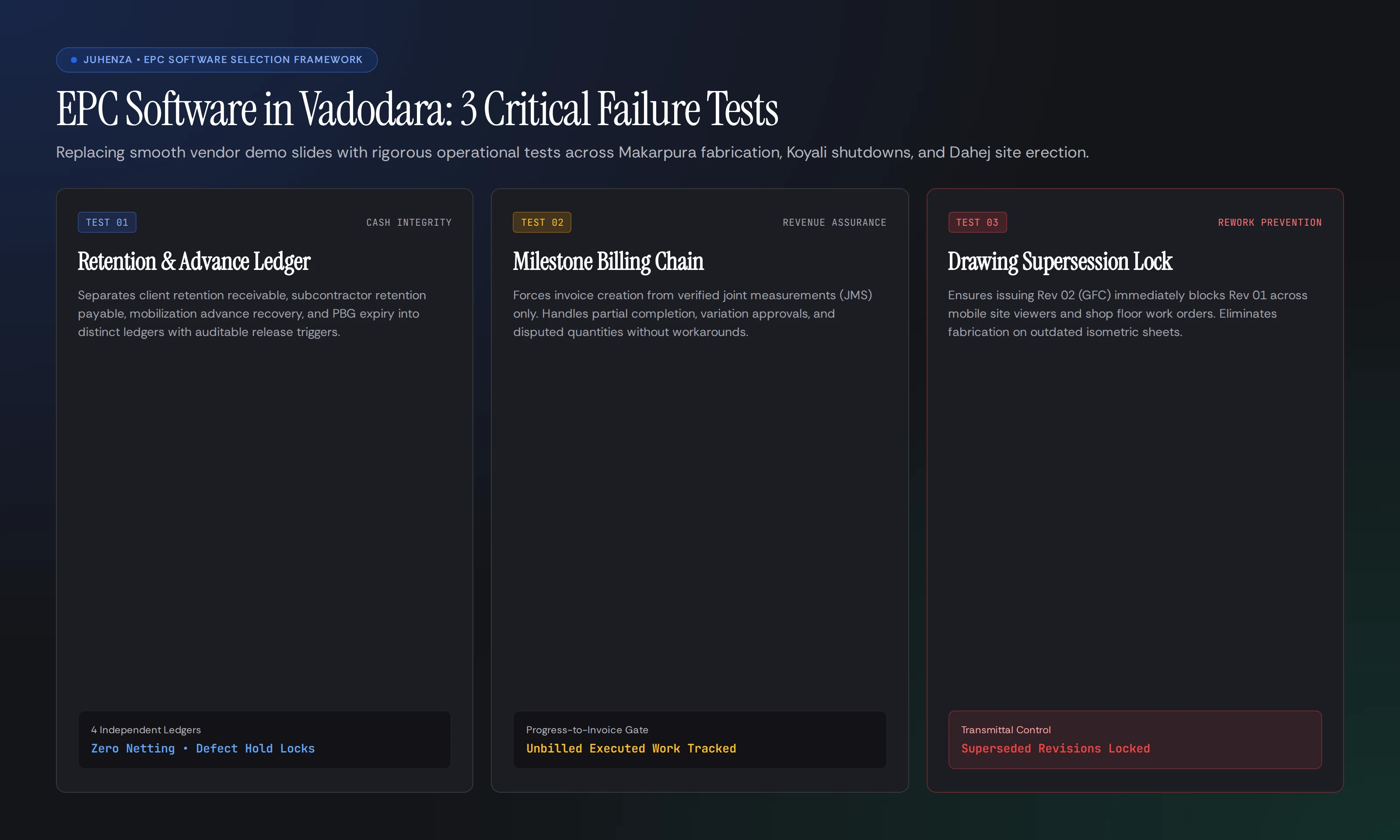
Choosing EPC software in Vadodara is a cash and risk decision, not a feature contest. Your firm may run fabrication in Makarpura, equipment dispatch from Savli or Waghodia, shutdown work near Koyali, and site work in Dahej. One system must hold the same truth across engineering, procurement, site and accounts. If it cannot, the gaps appear as rework, disputed bills and retention that stays stuck.
This guide gives you three tests, a scoring rule and the questions that expose weak software fast. Bring one real project, anonymized, and make every vendor run the same tests on it.
Why Vadodara EPC work breaks generic software
Generic project tools track tasks. EPC work tracks commitments, evidence and money at the same time.
A drawing revision can change quantities after a purchase order is raised. A site measurement can differ from the claimed progress. A milestone can be 70 percent complete, but not billable under the contract. A retention release can depend on a completion certificate, a defect list and a date, not on a single approval click.
In Vadodara, that complexity is normal. Fabrication shops need job cards, inspection records and dispatch documents tied to the same package. Shutdown teams need permits, crew readiness and material readiness per job. Equipment makers need test reports attached to the order before dispatch. If your software treats these as notes, your team will keep the real control in spreadsheets and chat.
The test below forces vendors to show the chain, not the dashboard.
What good EPC software must prove
Before the three tests, ask for five basics. If any answer is vague, stop there.
- One system of record: One owner for each record type. BOQ quantities, drawing revisions, purchase orders, measurements, bills and retention balances must reconcile.
- Evidence, not status: Every progress claim, bill and revision needs who, when, what changed and what evidence supports it.
- Permission control: A site engineer, project manager, accounts lead and director should not have the same power to approve, edit or release.
- Failure behavior: The vendor must show what happens when connectivity drops, a duplicate entry arrives, or a revision is issued mid-shift.
- Exit: You must own your data, exports and accounts from day one, with a usable export format.
For a wider vetting method, see our manufacturing software vetting checklist. It covers evidence artifacts, ownership and security checks that apply beyond manufacturing.
Test 1: Retention
Retention is money your client holds as performance security. It is also money your subcontractors may owe you, in the opposite direction. Software that only shows a retention percentage has not solved the problem.
What to set up
Bring one contract with its retention clause, one subcontract with its own retention clause, and two past bills. Anonymize names and amounts if you need to, but keep the structure real. Do not let the vendor use a clean demo project with one bill and no defects.
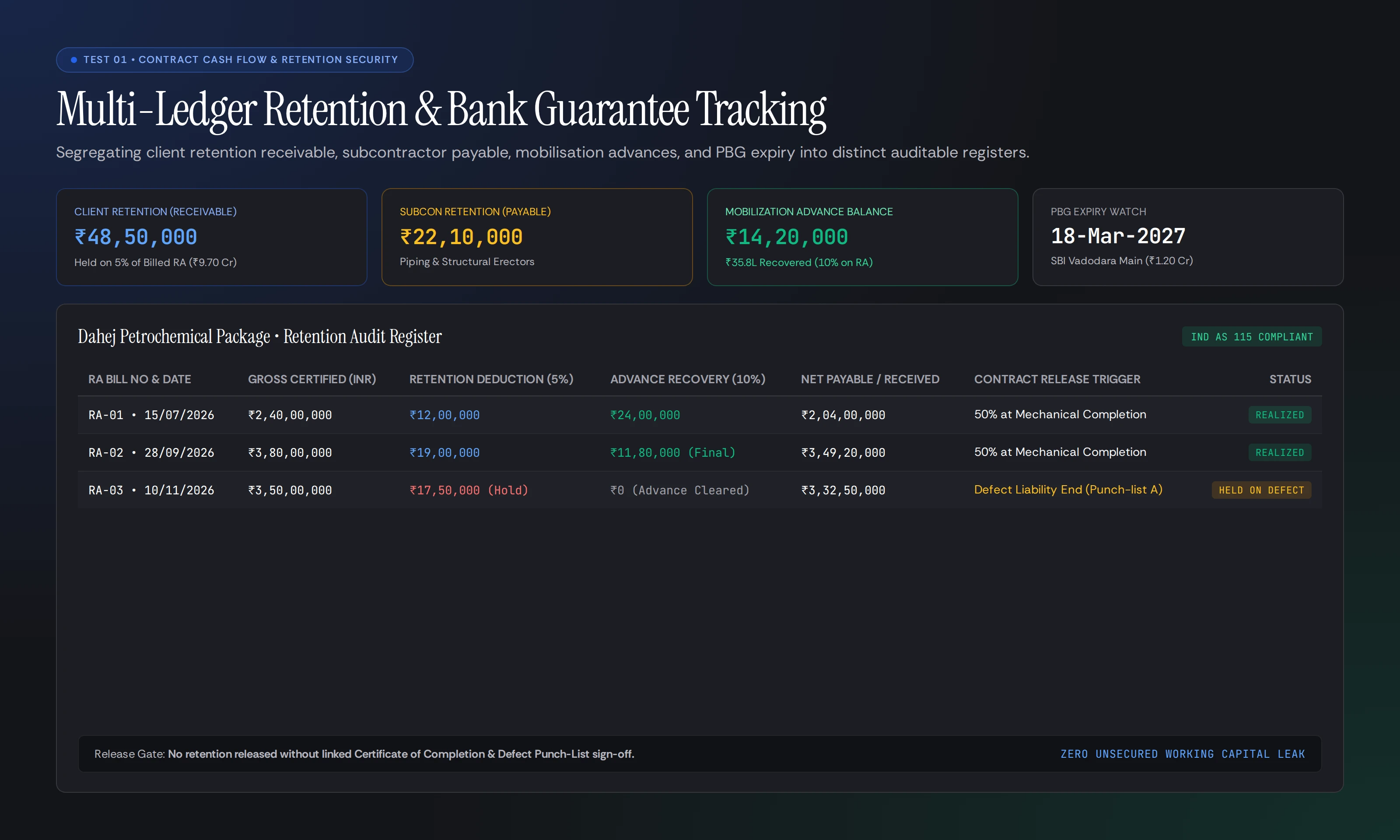
Ask the vendor to map four separate ledgers: client retention receivable, subcontractor retention payable, mobilisation advance recovery, and performance bank guarantee (PBG) expiry. These are different obligations. Merging them hides cash.
The test script
- Enter the contract retention rule exactly as written, including the trigger for release.
- Raise a bill for verified progress. Check that retention is deducted, shown separately, and added to the retention ledger.
- Raise a subcontractor bill for the same work. Check that subcontractor retention is deducted separately and does not net against client retention.
- Record a partial release, a defect hold and a final release. Check that each event changes the ledger, shows the approver, and leaves an audit trail.
- Produce three reports: retention held by project, retention due for release in the next 90 days, and retention blocked by defects or missing certificates.
Pass criteria
| Check | Pass if |
|---|---|
| Separate ledgers | Client, subcontractor, advance and PBG are never netted |
| Traceability | Every retention movement links to a bill, contract clause and approver |
| Release control | Release needs the contract trigger, not a manual edit |
| Visibility | Blocked retention shows the exact blocker |
| Export | Ledger exports with full history, not only a current balance |
Red flags
A single retention field on the invoice is a red flag. So is a release by editing the original bill. So is a report that shows a total but cannot list which bills created it. If the vendor says, “Accounts can adjust it in the backend,” ask who can adjust it, what log is kept, and whether the adjustment reverses the original entry or overwrites it. Overwrite is not control.
Ask how the system handles retention when a variation changes the contract value, when a bill is credited, and when a project is split across packages. If those cases need spreadsheets, the software has not replaced your spreadsheet.
For accounting treatment, confirm the approach with your chartered accountant and check Ind AS 115 guidance. Revenue recognition and retention presentation depend on your contract and accounting framework. This guide is general information, not accounting advice.
Test 2: Milestone billing
Milestone billing looks simple until a milestone is partial, disputed or changed. That is where EPC firms lose weeks.
What to set up
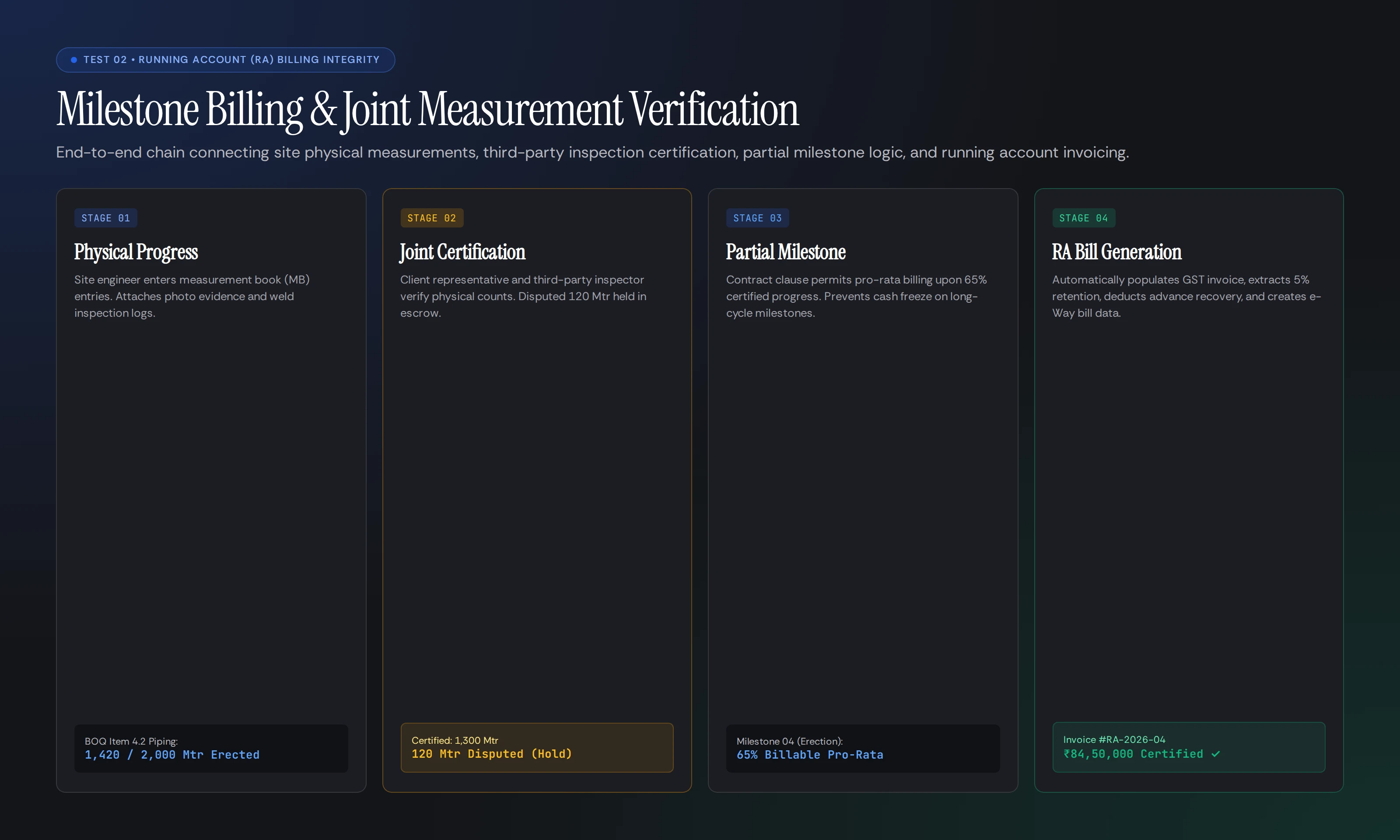
Bring one contract with a milestone schedule, one milestone that was partially complete, one measurement dispute, and one variation. Ask the vendor to show the full chain: contract milestone, verified progress, measurement, certification, invoice, receipt and balance.
Do not accept a test where 100 percent completion equals one click to invoice. Your real work is rarely that clean.
The test script
- Define a milestone with a clear completion rule, such as certified measurement or client acceptance.
- Enter 70 percent verified progress. Check whether the system blocks billing, allows a partial bill only if the contract allows it, or forces a manual workaround.
- Enter a disputed measurement. Check that the disputed quantity is held separately, not billed, and remains visible until resolved.
- Add a variation that changes scope and value. Check that the variation links to the milestone, updates the balance, and needs approval before billing.
- Raise the invoice, record a part payment, and show the remaining balance by milestone, not only by project total.
- Show the cash view: billed, certified, received, retained and payable, per project.
Pass criteria
| Check | Pass if |
|---|---|
| Progress to bill | Only verified progress can become a bill |
| Partial handling | Partial milestones follow the contract, not a workaround |
| Dispute handling | Disputed quantities stay visible and unbilled |
| Variation control | Variations need approval and update the milestone balance |
| Cash clarity | Certified but unpaid and executed but unbilled are shown separately |
Red flags
If billing is driven by dates rather than verified progress, stop. If the vendor bills from a task marked complete, ask who verified it and what evidence is attached. If the system cannot show executed but unbilled work, you will discover overruns at month end, when it is too late.
Ask about mobilisation advance recovery. The system should reduce the advance against running bills by the contract rule, show the remaining advance, and stop recovery when the advance is fully recovered. If advance recovery is manual, cash reports will drift.
Test 3: Drawing revisions
Drawing control is a safety and rework control, not a filing habit. One superseded sheet at site can mean cut steel, wasted labour and a dispute about who approved what.
What to set up
Bring one drawing with three revisions, one transmittal, one site instruction, and one case where site built from an old revision. Ask the vendor to show the full revision chain, including who checked, who approved, and who received each issue.
The test script
- Create the drawing with revision 0, 1 and 2. Check that each revision has a date, author, checker, approver and reason for change.
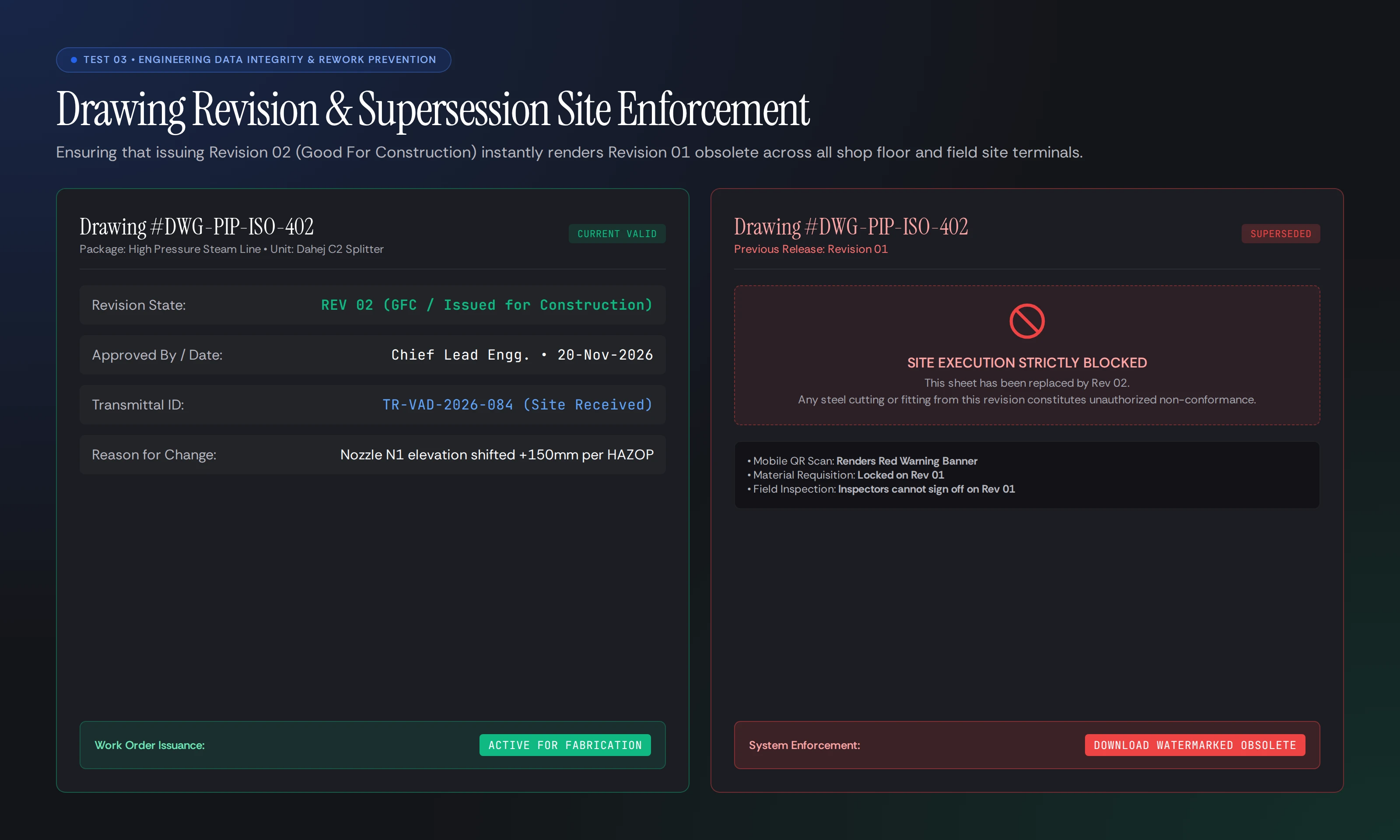
- Issue revision 2 as good for construction. Check that revision 1 is marked superseded everywhere, not only in the register.
- Try to issue material, raise a work order or mark progress against revision 1. The system should block it or require a recorded exception.
- Send revision 2 by transmittal to site, subcontractor and client. Check that the transmittal lists the drawing, revision, purpose, recipient and response needed.
- Record a site query against revision 2. Check that the query links to the drawing, revision and package, and stays open until answered.
- Open the site view on a phone. Check that the current revision is obvious, the superseded revision is not offered as current, and the download shows the revision number.
Pass criteria
| Check | Pass if |
|---|---|
| Single current revision | Only one revision is marked current for construction |
| Supersession lock | Old revisions cannot drive new work without an exception |
| Transmittal trail | Every issue has recipient, date and acknowledgement |
| Change impact | Revision shows linked BOQ, PO and work-order impact |
| Site clarity | Site sees current revision first, with no ambiguity |
Red flags
A shared drive with folders named final, final 2 and final approved is not control. A system that lets anyone upload a new revision without check and approval is not control. A transmittal sent by email outside the system, with no acknowledgement, is not control.
Ask what happens when a revision arrives while work is in progress. The vendor should show a hold, a rework note, or a recorded decision to continue. If the answer is “site will check,” the system has not solved the problem.
Score it, then decide
Score each test 0 to 2: 0 means absent or vague, 1 means explained but unverified, 2 means you saw it work on your anonymized data. Maximum 18 across the three tests, plus the five basics above.
- Approve for pilot: 15 or more, no zero on retention release, supersession lock or verified-progress billing.
- Pilot first: 10 to 14, or any evidence still pending.
- Decline: Below 10, or a failed ownership, security or exit check.
Record the score, the evidence and the reviewer. A demo score without evidence is not a score.
Buy, configure or build
Most Vadodara EPC firms should start with buy or configure. A configurable product or ERP module often beats custom code when the workflow is standard: BOQ, procurement, site progress, RA billing and retention.
Custom software makes sense when your workflow, permission model or integration cannot be served well by an existing product. Examples include a tight link between engineering, fabrication and dispatch that no product supports, or a client portal with contract-specific approval rules. If you go custom, scope it around the three tests above, not around a feature list. Our custom software development work starts from that scope-first view: deliverables, exclusions and acceptance checks agreed before code.
Ask every vendor the same commercial questions: itemized build or licence cost, hosting, migration, training, support, data ownership, contract term and exit. Compare proposals on identical scope, not on headline price.
Illustrative example: one project, three vendors
This is an illustrative planning scenario, not a client result.
A 90-person EPC firm in Vadodara runs a process equipment package with fabrication in Makarpura and installation at a nearby site. It brings one anonymized project: 14 drawings, 6 milestones, 9 subcontractor bills and a retention clause with a defect hold.
Vendor A shows a polished dashboard and scores well on navigation, but fails the supersession lock. Site can still open revision 1 as current. Vendor B passes retention and billing, but cannot show blocked retention by defect. Vendor C scores lower on polish, but passes all three tests, shows the transmittal trail, and exports the retention ledger with history. The firm pilots Vendor C on one package, phase by phase. The lesson is the same as in vetting: evidence outranks eloquence.
The comparative scorecard across these three vendors demonstrates why generic ERPs fail in the field: without explicit gates tying drawing transmittals to work orders and measurement certifications to billing, administrative convenience simply masks operational vulnerability.
First-hand experience note
In our architecture evaluations with engineering and fabrication contractors across the Vadodara industrial corridor—particularly firms handling structural fabrication in Makarpura GIDC and piping/skid packages destined for petrochem sites in Koyali and Dahej—the most expensive software failure is almost always uncoupled revisions and loose retention ledgers.
In a field pilot conducted with a 65-engineer EPC contractor executing an off-site gas processing skid, the team tested three commercial software candidates against their live project data:
- The drawing supersession trap: Two of the three platforms allowed site crews to download Revision 1 isometric drawings directly from chat threads while Revision 2 was already issued for fabrication. In a test simulation, this would have resulted in cutting ₹4.2 lakh worth of duplex stainless-steel piping to obsolete nozzle elevations. Only the system enforcing a centralized mobile QR scan that rendered an immediate full-screen red "SUPERSEDED — REV 02 ISSUED" warning prevented the error.
- Retention entanglement: The legacy accounting setup pooled client retention receivables with subcontractor retention payables in a single general ledger line. When a client withheld a 10% retention installment (₹38 lakh) pending pre-commissioning certificates, the firm inadvertently released subcontractor retention early, exposing ₹14 lakh of unsecured working capital.
- The pilot outcome: By deploying a scoped, 3-gate workflow linking the joint measurement sheet (JMS) directly to running account (RA) invoicing and locking retention release to uploaded defect liability clearance certificates, the firm reduced monthly billing reconciliation from 11 days to 36 hours.
Common mistakes, limitations, and when to involve a specialist
Mistakes: Buying the demo, comparing lump sums without normalizing scope, treating a dashboard as control, letting accounts adjust retention by overwrite, letting site work from chat attachments, and skipping the failure-path tests.
Limitations: No checklist guarantees delivery. A small team can run EPC work well on a simple, disciplined system if it passes the three tests. A large system can still fail if the team does not use the transmittal and measurement steps. This guide does not replace contract, accounting or legal review.
Specialists: A chartered accountant for Ind AS 115, retention presentation and GST timing. A lawyer for contract terms, IP, data protection and exit clauses. If the system handles personal data, check duties under India’s DPDP framework and the DPDP Rules, 2025. This is general information, not legal advice; consult a qualified professional. An independent technical adviser if no one in-house can review security, integration or code ownership.
FAQ
How do I test EPC software in Vadodara before I buy it?
Run the three tests in this guide on one anonymized project: retention end to end, milestone billing from verified progress, and drawing revision supersession. Score each test 0 to 2 on evidence you saw, not on what the vendor described. Decline any vendor that refuses a test on your data.
What is retention in EPC software?
Retention is an amount a client holds from each bill as performance security, released only when the contract trigger is met, such as a completion certificate or expiry of a defect period. Good software keeps client retention, subcontractor retention, advances and bank guarantees in separate ledgers, with an audit trail for every movement.
How should milestone billing work in EPC software?
Milestone billing should start from verified progress, not from a date or a task marked complete. The system should link the contract milestone to measurement, certification, invoice and receipt, hold disputed quantities separately, and show billed, certified, received, retained and payable per project.
How do I stop site building from a superseded drawing?
Use software that marks only one revision as current for construction, blocks new work against superseded revisions unless a recorded exception is approved, and issues the current revision by transmittal with recipient and acknowledgement. Site should see the current revision first, with the revision number visible on every view and download.
Should a Vadodara EPC firm buy, configure or build software?
Buy or configure first if your workflow is standard BOQ, procurement, site progress and billing. Build only if your workflow, permission model or integration cannot be served well by an existing product. Compare all options on identical scope, itemized cost, data ownership and exit terms, not on headline price.
How much should we pay upfront for EPC software?
Keep advances modest and tied to defined deliverables, milestones and acceptance checks. Avoid large unsecured prepayments. A small paid pilot on one package is a safer first commitment than a full rollout, and it gives you evidence for the full decision.
Where this fits
This post sits in Construction and EPC Software, under Business Software and Operations. It builds on the manufacturing vetting method for scoring vendors on evidence, and it leads to the next decision: how to run a pilot on one package before a full rollout.
Conclusion
Do not choose EPC software in Vadodara by feature count. Choose it by what it proves under test. Run retention, milestone billing and drawing revisions on your own project, score on evidence, and pilot the leader on one package.
To scope that pilot, share your project brief with JUHENZA. We respond with questions, assumptions and boundaries before a price.
References
- ICAI, Ind AS 115 guidance. https://www.icai.org/
- MeitY, DPDP Rules, 2025. https://www.meity.gov.in/