

Missed-Call Booking for Dental Clinics in Ahmedabad: Recover After-Hours Patients With Chair-Wise Scheduling
Missed calls after hours cost Ahmedabad dental clinics bookings. Use this missed-call + chair-wise playbook to recover patients and fill chairs faster.
AIApp DevTech

Your clinic does not lose most after-hours patients because they chose another dentist. It loses them because no one answered, and no clear next step arrived in time.
Direct answer: Missed-call booking for a dental clinic means a missed call triggers an immediate, consent-aware reply with a booking link, and the patient picks a dentist, procedure, date, and chair from real availability. For Ahmedabad clinics, the fix is not just faster callbacks. It is a chair-wise calendar that blocks the dentist and the chair together, plus a morning triage queue that turns overnight requests into confirmed sittings. This guide gives you that playbook.
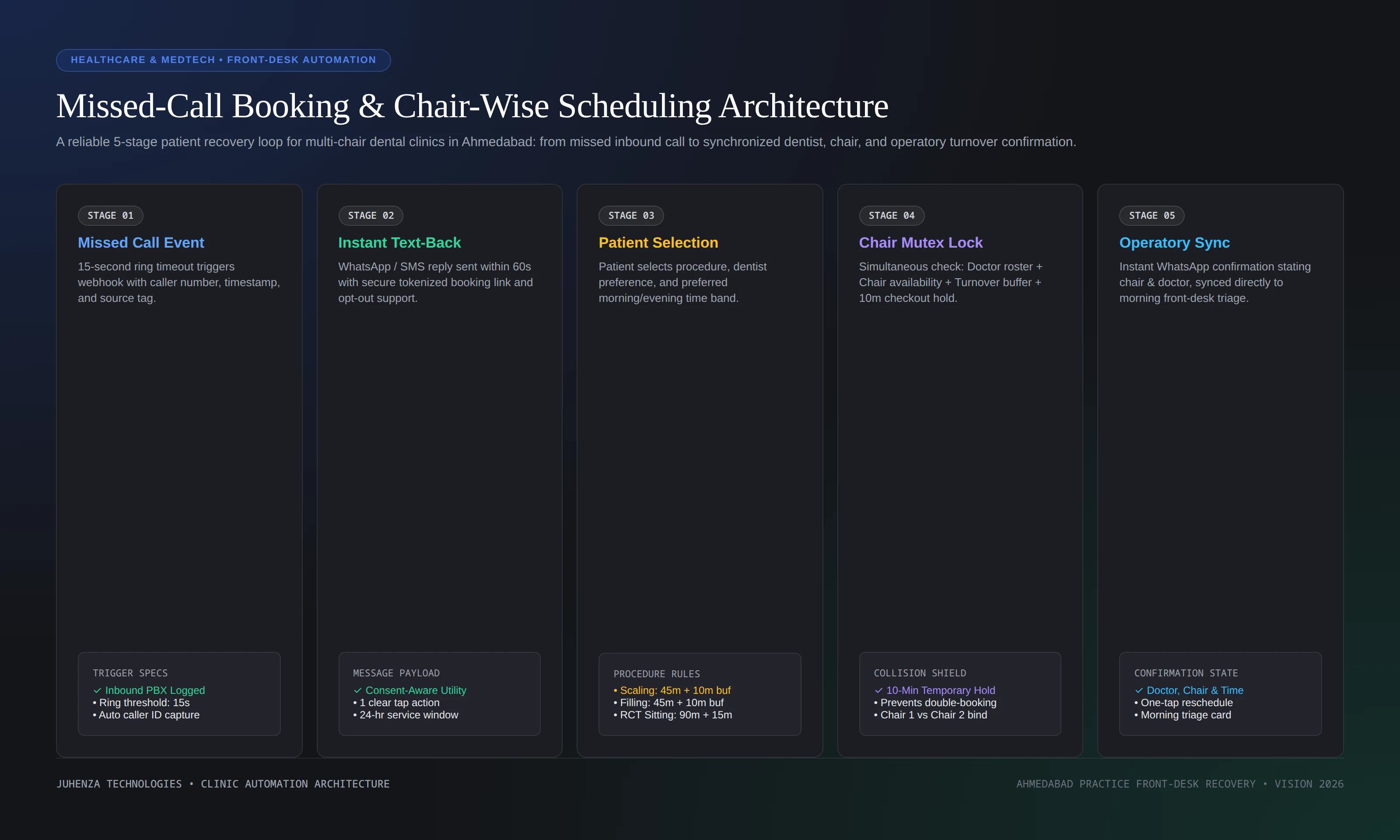
Why after-hours calls leak patients in Ahmedabad
Ahmedabad dental clinics run split shifts, lunch breaks, and procedure-heavy evenings. A patient with acute tooth pain often calls at lunch, after 8:00 pm, or on Sunday. If the call rings out, that patient rarely waits. They dial the next clinic on Google Maps, or they send an inquiry message to a competing practice.
Missed-call booking dental clinic systems exist to close that operational gap. The objective is direct:
- Every missed call receives a fast, useful reply.
- Every reply leads to a real, synchronized slot.
- Every slot strictly respects both the attending dentist and physical chair availability.
Do not evaluate this problem by staff memory or intuition. Measure it for two weeks. Log every missed call, its timestamp, caller source, and whether the caller booked later. That log establishes your baseline. Without it, you cannot determine whether automated recovery actually improved your appointment pipeline.
No-show rates also fluctuate significantly across practice types. Published Indian healthcare commentary reports ranges rather than a single stable national benchmark, and several peer-reviewed Indian figures originate from dental teaching hospitals. Your clinic should rely on its own missed-call volume, confirmation ratios, and no-show metrics rather than borrowed national figures.
What missed-call + chair-wise booking actually means
Missed-call booking is a structured workflow where an inbound missed call triggers an automated event notification and an immediate booking path. The missed-call alert is the trigger event. The tokenized booking link is the patient action. A confirmed chair appointment is the operational outcome.
Chair-wise booking means each appointment reserves three distinct assets simultaneously:
- The specific dentist
- The physical operatory or chair
- The allocated time block required for that clinical procedure
A shared front-desk queue cannot accomplish this. A generic queue shows merely that the clinic is open; it cannot identify that Chair 2 is vacant while Chair 1 is occupied mid-procedure by a 90-minute root canal treatment.
Turnover buffer is the mandatory cleaning, surface disinfection, and tray setup interval between consecutive patients. A 30-minute scaling consultation requires a different turnaround buffer than a 90-minute surgical extraction or crown prep. When your booking calendar ignores turnover buffers, your schedule appears balanced on screen but collapses into rolling delays on the clinic floor.
This playbook leverages WhatsApp workflow automation as the primary reply channel because Ahmedabad patients already communicate via WhatsApp daily. The identical operational logic applies via SMS if patient demographics dictate. The underlying channel matters far less than the core architectural rule: one missed call, one instant reply, one guided booking path, and one atomic chair record.
The 6-step missed-call + chair-wise booking playbook
Step 1: Detect the missed call and reply in seconds
Establish a precise ring timeout, such as 15 seconds. When an inbound call rings out or disconnects without an answer, the telephony system logs the caller's phone number, timestamp, and referral channel, then dispatches an immediate text reply within 60 seconds.
An effective reply identifies the practice, acknowledges the missed call briefly, and provides a single, friction-free action:
"Sorry we missed your call at [Clinic Name]. Tap here to select your dentist, procedure, and chair time: [Booking Link]. Our front desk will confirm your slot immediately."
Do not send multiple messages. Do not ask the patient to dial back. Never dispatch a vague "we will call you shortly" message that lacks an interactive booking path.
Rule: If caller lookup identifies an existing patient with an active, multi-sitting treatment plan, the automated link should offer their next scheduled sitting rather than a generic new consultation.
Step 2: Let the patient pick procedure, dentist, and time
The booking interface should capture only the inputs required to calculate and hold the slot:
- Procedure or reason for visit
- Dentist preference (or "First available dentist")
- Date preference
- Preferred time window (Morning shift vs. Evening shift)
- Patient name and phone number
Avoid asking for comprehensive medical histories or past dental records inside the initial booking link. Collect detailed clinical questionnaires during physical check-in or via a separate, encrypted patient onboarding form.
Each procedure requires a defined duration in your booking rules engine. Use these baseline operational defaults before calibrating them to your clinic's actual turnaround times:
| Procedure | Suggested slot | Turnover buffer | Total operatory block |
|---|---|---|---|
| New consultation | 30 minutes | 10 minutes | 40 minutes |
| Scaling and polishing | 45 minutes | 10 minutes | 55 minutes |
| Composite filling | 45 minutes | 10 minutes | 55 minutes |
| Root canal sitting | 90 minutes | 15 minutes | 105 minutes |
| Crown preparation | 90 minutes | 15 minutes | 105 minutes |
| Orthodontic review | 30 minutes | 10 minutes | 40 minutes |
These durations represent practical scheduling defaults. Always review and customize them with your resident dentists and dental hygienists.
Step 3: Check dentist + chair availability together
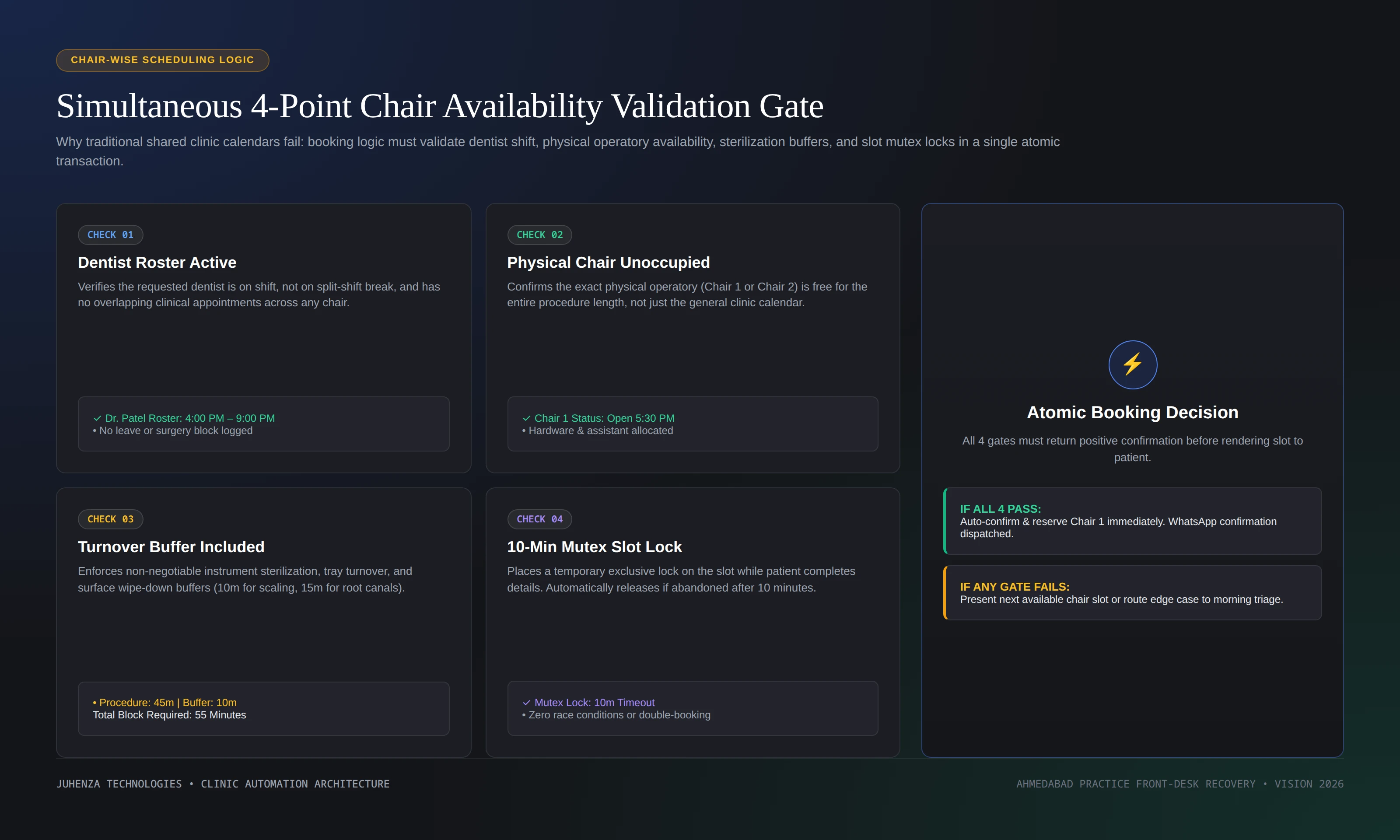
This is the failure point of off-the-shelf booking tools. Prior to displaying any available time slot to the patient, the scheduling engine must run four simultaneous checks:
- Is the requested dentist active on shift during that block?
- Is the designated operatory (Chair 1 or Chair 2) free for the full procedure duration plus the turnover buffer?
- Is required equipment or chair-side support available for that specific clinical task?
- Is the slot currently held by another patient completing checkout?
If any of these conditions fails, suppress the slot. Present only valid slots where both the clinician and the chair are completely unencumbered.
Decision rule: Auto-confirm reservations only when clinician roster, operatory availability, and duration thresholds align perfectly. Route requests for emergency toothaches, trauma, or non-standard hours to the front-desk hold queue for human review.
Step 4: Confirm with one message that states the chair
A complete confirmation message removes ambiguity before the patient arrives. It must explicitly state:
- Patient full name
- Treating dentist
- Assigned chair number or operatory room
- Procedure name and anticipated duration
- Appointment date, reporting time (e.g., 10 minutes prior), and clinic Google Maps link
- One-tap cancellation or rescheduling instruction
Example:
"Appointment Confirmed: Dr. Patel, Chair 2, Scaling & Polishing, Tuesday at 5:30 PM. Please arrive by 5:20 PM. Clinic directions: [Maps Link]. Reply RESCHEDULE if you need to alter your time."
Specifying the chair number sets clear expectations and eliminates the standard reception question: "Which doctor am I seeing, and which room do I enter?"
Step 5: Send reminders that protect the chair
Appointment reminders must do more than broadcast a static alert; they must actively protect operatory utilization by facilitating early rescheduling.
Implement a 3-stage cadence:
- Immediate confirmation: Dispatched immediately upon slot reservation.
- Day-before confirmation: Sent 24 hours prior, asking the patient to tap "CONFIRM" or "RESCHEDULE".
- Same-day reminder: Dispatched 3 to 4 hours prior to the appointment with parking and check-in instructions.
When a patient replies to reschedule or cancel, instantly release the dentist and chair back into the public inventory. If a patient does not respond to the day-before reminder, do not assume attendance; flag the appointment as unverified and route it to the morning triage list.
Apply the architectural principles outlined in our guide on AI agents for business operations: allow automated systems to draft messages, monitor response windows, and release open inventory, but maintain human supervision for consequential changes such as reallocating multi-stage treatment plans.
Step 6: Run a 15-minute morning triage
Each morning, your front-desk coordinator should process one consolidated queue rather than checking multiple disconnected messaging tools. The triage dashboard groups overnight activity into four clear buckets:
- Confirmed overnight: Appointments successfully booked through the automated link with both dentist and chair reserved. Zero front-desk intervention needed; staff simply pulls patient charts.
- Needs confirmation: Patients who initiated the booking link but did not complete mobile verification, or high-urgency pain inquiries. Staff places one phone call or sends a single direct prompt.
- Needs rescheduling: Patients requesting conflicting slots or sittings outside standard hours. Staff offers two immediate alternative chair options.
- Spam or wrong number: Automated telemarketers or misdials. Marked, archived, and excluded from follow-up cadences.
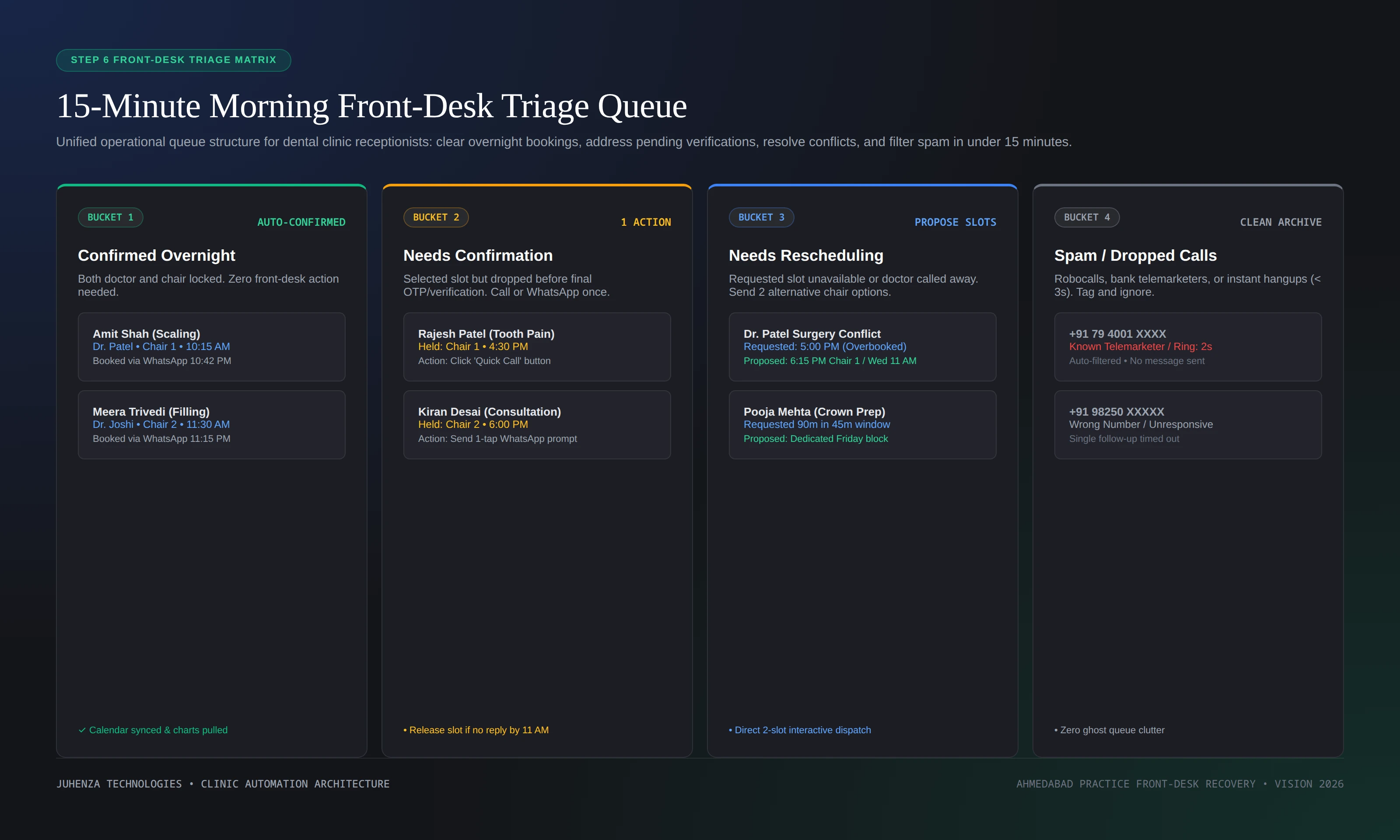
Assign strict individual ownership for the morning triage. If no single receptionist owns this checklist, unresolved requests accumulate and patient response times degrade.
Chair-wise rules that prevent double-booking
Whether you configure specialized dental software or commission custom clinic workflow engineering, embed these six core rules into your system logic:
- One slot = One dentist + One chair. Never book a clinician without an assigned operatory, and never hold an operatory without a scheduled clinician.
- Lock the slot on selection. When a patient selects an available time window, apply a temporary 10-minute mutex lock. If the patient abandons the booking flow, release the slot back to the public pool automatically.
- Enforce buffer separation. A 5:30 PM appointment requiring a 45-minute procedure and a 10-minute sterilization buffer occupies the chair until 6:25 PM. The subsequent patient cannot begin at 6:15 PM on that operatory.
- Isolate new consultations from procedure sittings. Initial check-ups can be assigned to whichever chair is free. Multi-visit root canal or prosthetic cases must prioritize the same dentist and operatory for continuity of care.
- Permit chair transfers only with logged justification. If Chair 1 suffers compressor or handpiece failure, the system must record the relocation reason and automatically inform the patient of their updated operatory number.
- Maintain an immutable audit trail. Log every booking creation, cancellation, slot override, and chair transfer with staff timestamps. Audit trails are critical for diagnosing how and why scheduling conflicts occurred.
What to measure in the first 30 days
Avoid evaluating automation success by "total incoming calls." Track conversion velocity and chair utilization. Following our AI automation ROI calculator methodology, distinguish between reclaimed staff capacity and incremental clinic revenue.
Review these operational metrics on a weekly basis:
| Metric | Calculation formula | Target benchmark |
|---|---|---|
| Missed call volume | Total unanswered calls logged by PBX | Track baseline trend |
| Recovery reply rate | Missed calls sent a booking text within 5 mins | > 98% within 2 minutes |
| Booking conversion rate | Recovered callers who finalize an appointment | 25% – 40% of missed calls |
| Chair utilization rate | Booked chair-hours / Total operational chair-hours | 75% – 85% balanced capacity |
| Operatory no-show rate | Confirmed bookings resulting in patient absence | < 8% with 3-stage reminders |
| Reschedule velocity | Appointments adjusted > 4 hours before the slot | > 70% of cancellations rescheduled |
| Triage clearance time | Minutes elapsed to clear the 4-bucket morning queue | < 15 minutes daily |
Establish a single operational goal for month one: dispatch a personalized booking link to 100% of missed callers within 5 minutes. Perfecting response velocity consistently produces higher conversion gains than adding complex features.
Illustrative calculation: Consider an independent 2-chair dental clinic in Ahmedabad missing an average of 8 patient calls daily across lunch breaks and evening hours. If the automated text-back recovers 4 of those callers into confirmed bookings averaging 45 minutes of operatory time, the practice recaptures approximately 3 chair-hours of productive clinical capacity each day. Over a 25-day working month, this equates to 75 additional chair-hours of recovered consultation and procedure volume. This model is purely illustrative to demonstrate capacity mechanics; actual financial returns depend on location, procedure mix, and patient retention.
Common mistakes, limitations, and when to involve a specialist
Common implementation mistakes
- Linking to a generic calendar: Sending patients to an unconstrained doctor calendar that ignores physical operatory occupancy.
- Unchecked auto-confirmation: Automatically booking clinical emergencies that require immediate human triage and chair prioritization.
- Static reminders: Omitting interactive "Confirm" or "Reschedule" buttons from WhatsApp reminders, forcing frustrated patients to no-show.
- Split-brain booking records: Allowing receptionists to confirm phone bookings without updating the unified digital chair calendar.
- Chat-based clinical data collection: Requesting confidential diagnostic details or medical history inside unencrypted messaging chats.
Operational limitations and compliance guardrails
- Emergency triage boundaries: Missed-call automation cannot evaluate clinical urgency. Patients presenting with acute swelling, uncontrolled hemorrhage, trauma, or severe pain must encounter immediate emergency routing and direct physician escalation rather than autonomous booking.
- WhatsApp Business Messaging Policy: Meta enforces strict messaging standards. Marketing outreach outside active customer windows requires explicit template pre-approval. Automated appointment confirmations, reschedule notices, and service alerts must adhere to Meta's utility messaging guidelines under the standard 24-hour service conversation window.
- Digital Personal Data Protection Act (DPDP Act 2023): Under India's DPDP Act, clinics act as data fiduciaries. Practices must observe purpose limitation and data minimization: collect only necessary contact identifiers on the initial text-back, refrain from storing or transmitting diagnostic radiographs or sensitive health records via consumer chat platforms, log affirmative consent, and provide straightforward opt-out mechanisms.
- Disclaimer: This article provides operational workflow architecture and does not constitute formal legal counsel. For specific compliance with the DPDP Act and state healthcare establishment regulations, consult a qualified data privacy professional.
When to engage custom software specialists
- Legacy practice management integration: Connecting telephony and WhatsApp webhooks directly with proprietary clinic databases, digital imaging (RVG/CBCT), or billing systems.
- Multi-location operatory synchronization: Orchestrating centralized patient records across multiple satellite dental branches in Ahmedabad.
- Automated clinical triage logic: Designing decision-tree algorithms for emergency scoring and after-hours doctor escalation.
- Enterprise security audits: Establishing role-based access control (RBAC), end-to-end data encryption, and verifiable compliance audit logs for patient privacy.
First-hand experience
Practitioner observation from clinic workflow deployments:
During an operational assessment with a high-volume 2-chair dental practice on Sindhu Bhavan Road in Ahmedabad, the clinic initially deployed a standard third-party appointment link triggered by missed calls. Within three weeks, reception encountered persistent chair collisions: two patients would arrive simultaneously for 6:00 PM appointments, both booked with different associate dentists, only to discover that Chair 2 was already immobilized for a 90-minute endodontic procedure.
The root cause was architectural: the software booked against clinician shifts but treated dental chairs as infinite resources, completely ignoring 15-minute operatory sterilization buffers.
To eliminate the conflict, we redesigned the booking logic to enforce an atomic 4-point gate: the system required an active doctor shift, verified physical operatory vacancy for procedure duration plus buffer, and engaged a 10-minute temporary mutex lock while the patient completed the form. Within 14 days of deployment, double-booking incidents dropped to zero, while the automated text-back converted an average of 4 out of 7 evening missed calls into confirmed morning slots without adding reception headcount.
FAQ
How does missed-call booking work for a dental clinic?
When a patient calls and the front desk cannot answer, the clinic telephony system logs the caller's phone number and automatically dispatches a WhatsApp or SMS message containing a dedicated booking link. The patient selects their procedure, dentist, date, and preferred time. The system evaluates dentist rosters and physical chair availability simultaneously before confirming the appointment and adding it to the morning reception triage list.
How fast should the reply arrive?
Target a delivery window under 60 seconds, and never exceed 5 minutes. When a prospective patient with tooth pain encounters an unanswered call, they typically dial a competing clinic within 3 to 5 minutes. Instant response velocity is the single most important factor in recovering after-hours inquiries.
Will missed-call booking double-book my chairs?
Not if your scheduling engine enforces the rule that one booking equals one dentist plus one physical operatory plus procedure duration plus turnover buffer. The system must apply an exclusive 10-minute mutex lock on the slot during patient entry and immediately release the reservation if the user drops off before completion.
Can patients book after hours for the same night?
Only if your clinic maintains an active on-call emergency rota. For standard practices, after-hours booking links should present next-day and upcoming calendar openings. Severe pain, facial swelling, bleeding, or dental trauma should be directed to emergency contact instructions rather than self-service booking.
What if the patient does not reply to the booking link?
The unconfirmed request remains visible in the morning triage dashboard. Staff conducts a single phone follow-up the following morning. If the caller does not answer or declines, the request is archived and the held time slot is released immediately. Avoid sending automated spam follow-ups.
Do I need to change my clinic phone number?
No. A properly architected system connects directly behind your existing clinic landline or mobile PBX. Retaining your established phone number preserves your existing Google Business Profile, local directory listings, printed collateral, and patient referral recognition.
Should I use AI voice, WhatsApp, or both?
Start with a WhatsApp or SMS text-back workflow. Text-based self-service is cost-effective, straightforward to deploy, and preferred by most Ahmedabad patients for routine booking. Introduce conversational AI voice agents only after your core chair-wise logic, buffer rules, and triage queues are thoroughly battle-tested.
Where this fits
This operational guide belongs to our Healthcare & MedTech workflow series. To understand the underlying messaging architecture, review our guide on WhatsApp workflow automation. To implement guardrails that maintain data security and human oversight across your clinic operations, explore our guide on AI agents for business operations.
Next step
If your Ahmedabad dental practice is losing after-hours callers to nearby competitors, begin by tracking an accurate two-week missed-call log, then map your physical chairs, clinical procedure durations, and turnover buffers.
JUHENZA engineers custom healthcare platforms, front-desk workflow automation, and bounded AI systems built around verified operational requirements, with complete scope and acceptance criteria established before development begins.
To engineer a resilient missed-call and chair-wise scheduling system tailored to your practice, discuss your project with our engineering team. Share your chair count, doctor roster, procedure list, and current software stack, and we will architect your clinic recovery workflow.
References
- Softpital, Software Built for a Multi-Chair Dental Practice — Operational reference for per-chair, per-dentist scheduling models and treatment-plan management. https://www.softpital.in/specialties/dental-clinics
- Bolo, Missed Call Revenue Recovery for Clinics — Industry reference for missed-call telephony detection and rapid automated text-back flows. https://www.bolospeak.com/
- Hasster / SpaceEdge, Can Doctors' Clinics Manage Appointment Bookings with Missed Call Alerts? — Telephony alert workflows and patient self-service mechanics. https://hasster.com/blogs/198115/Can-Doctors-Clinics-Manage-Appointment-Bookings-with-Missed-Call-Alerts?lang=nl_nl
Note: References provide background technical context on scheduling patterns. External vendor recovery statistics represent vendor claims and are not cited as Ahmedabad clinic benchmarks.