

Egypt E-Invoicing Automation: ETA API Recovery, Fawry/ InstaPay Reconciliation, and Arabic Document AI
Egypt e-invoicing automation connects ETA API, Fawry and InstaPay reconciliation, and Arabic Document AI into one auditable finance workflow for CFOs.
AITech

An ETA rejection is annoying. A duplicate invoice after a timeout is worse.
Direct answer: Egypt e-invoicing automation means an invoice is created once, coded correctly, signed with an authorized e-seal, submitted to the Egyptian Tax Authority (ETA), validated with a UUID, matched to its payment across Fawry and InstaPay rails, and stored with an auditable lifecycle log. When any step encounters network or schema failure, the system halts blind retries, verifies clearance status via automated re-query, and routes the exception to a human reviewer.
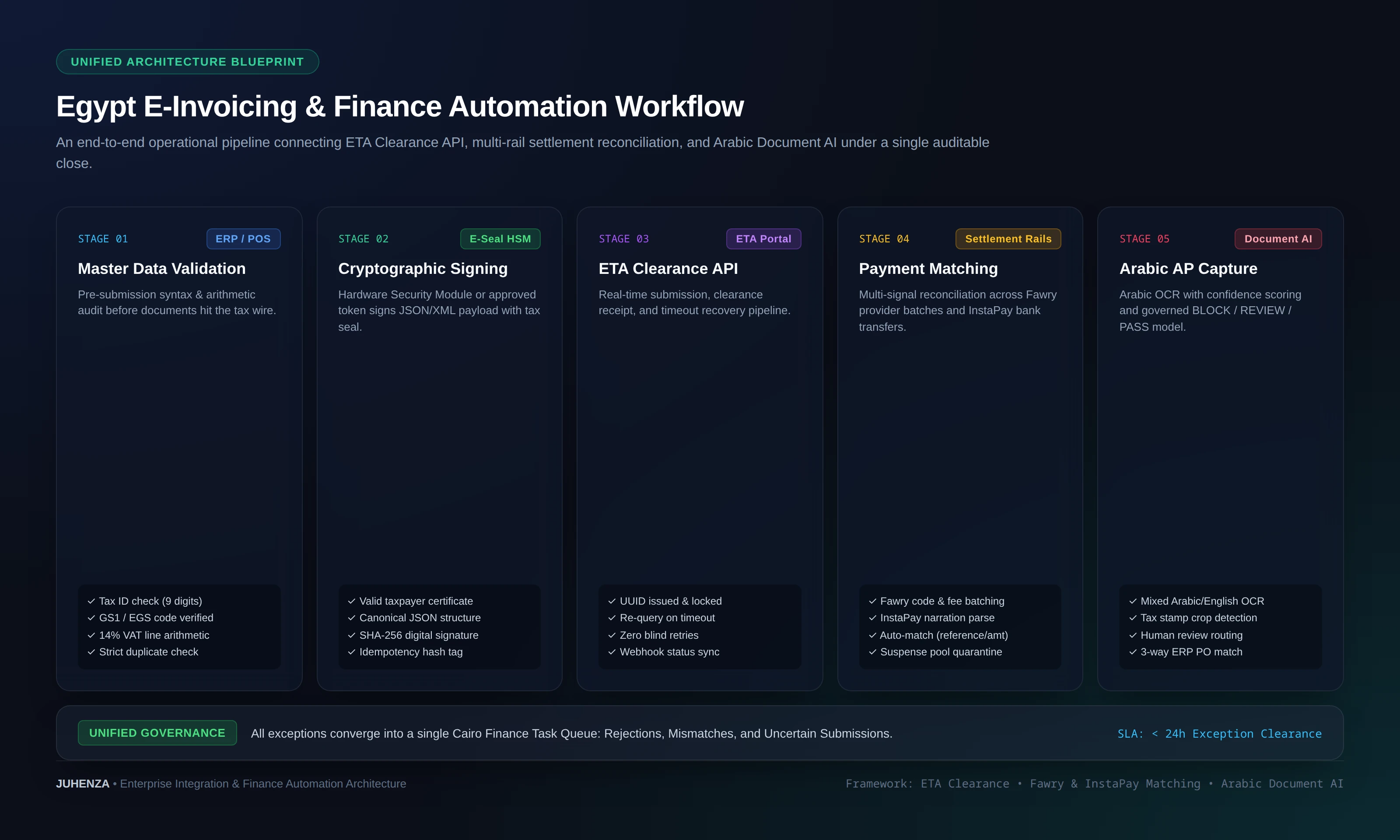 Figure 1: Unified Cairo finance workflow connecting ETA clearance, settlement reconciliation, and Arabic Document AI into one auditable exception queue.
Connecting ERP systems directly to the tax authority wire solves only the first third of the challenge. A compliant digital invoice still requires payment matching across retail point-of-sale cash settlement files and real-time bank transfers, while incoming vendor bills require automated extraction from mixed Arabic-English PDFs.
Treating these three domains as independent projects results in fragmented ledgers and swollen unallocated cash balances. CFOs and operations leaders require a single, governed workflow backed by our ERP and system integration consulting practice.
What Egypt e-invoicing automation must cover
Egypt e-invoicing automation is not a PDF generator. It is a controlled workflow across sales, finance, tax, and operations.
For B2B and B2G sales, the invoice must be structured, cryptographically signed, submitted to ETA, and validated before it is legally usable. For B2C sales, the e-receipt path applies through POS or ERP integration, rolled out in phases set by official ETA decisions. The same finance team must then prove the customer's money actually arrived and that incoming supplier invoices were authentic and untampered.
A robust enterprise architecture establishes five non-negotiable controls:
- Master data governance: Customer tax registration number (TRN), item codes, tax rates, and branch IDs must be validated before submission.
- Deterministic pre-validation: Code-level rules check totals, line arithmetic, and required fields before ETA ever sees the payload.
- Idempotent submission: Signing and API calls are idempotent, logged with unique hash fingerprints, and resiliently recoverable.
- Multi-rail reconciliation: Incoming payments are matched to invoices across reference codes, amounts, payer identities, and payment rails.
- Tamper-evident evidence: Every state transition maintains an immutable audit trail capturing who, what, when, and the raw gateway response.
If any single control is missing, automation merely accelerates errors into the tax authority portal rather than eliminating operational drag.
How the ETA API works, and how to recover when it fails
The normal ETA path
ETA operates a real-time clearance model. In practical terms, an invoice is not legally complete simply because your ERP generated an internal record. It is complete only when ETA validates it and issues a official UUID.
The normal path follows a disciplined sequence:
[ERP / POS System] ──> [Pre-Validation Checks] ──> [Hardware E-Seal / HSM]
                                                           │
                                                           ▼
[Validated Ledger] <── [UUID Stored & Locked] <── [ETA Clearance API]
The ERP generates a structured invoice in JSON or XML. Line items use GS1 or Egyptian Goods and Services (EGS) coding aligned with international taxonomy. Value-Added Tax (VAT) is calculated per line item. The document is signed with an approved digital certificate and e-seal, typically provisioned through a Hardware Security Module (HSM) or dedicated USB cryptographic token.
The signed document is submitted to the ETA API for real-time validation. Upon successful clearance, ETA returns a unique UUID and cryptographic hash. The seller and buyer can subsequently access and verify the invoice directly on the tax portal.
As documented by compliance providers such as Basware and ClearTax, compliance requires official taxpayer registration on the ETA portal, structured document issuance, certified signing, and real-time clearance.
What to register and sign before you automate
Never attempt to build automated submission pipelines around incomplete organizational credentials. Prior to coding:
- Confirm your company's primary taxpayer admin account on the ETA portal.
- Register your ERP/POS system instances to generate dedicated Client IDs and API Secrets.
- Verify that your corporate e-seal certificate matches your exact 9-digit tax registration number.
- Establish role-based authorization matrices defining who can authorize document submission, void requests, or credit-note issuances.
These are operational governance decisions, not secondary IT details. If multiple departments or disparate systems can submit invoices independently, duplicate submissions and mismatched tax declarations will inevitably occur. A single authoritative orchestration layer must own the document lifecycle, while secondary systems subscribe to status webhooks.
ETA API recovery: the part most guides skip
The failure mode that inflicts the greatest damage on financial reporting is deceptive in its simplicity: your ERP submits an invoice payload, the upstream network drops or the ETA gateway returns an HTTP 504 gateway timeout, and your system receives no response.
No one knows whether ETA received and validated the invoice, or dropped the packet entirely.
Never retry blindly. A blind retry against a clearance API risks creating duplicate invoice registrations, conflicting UUIDs, and complex corrective credit-note cycles that attract tax scrutiny.
Implement this idempotent recovery state machine:
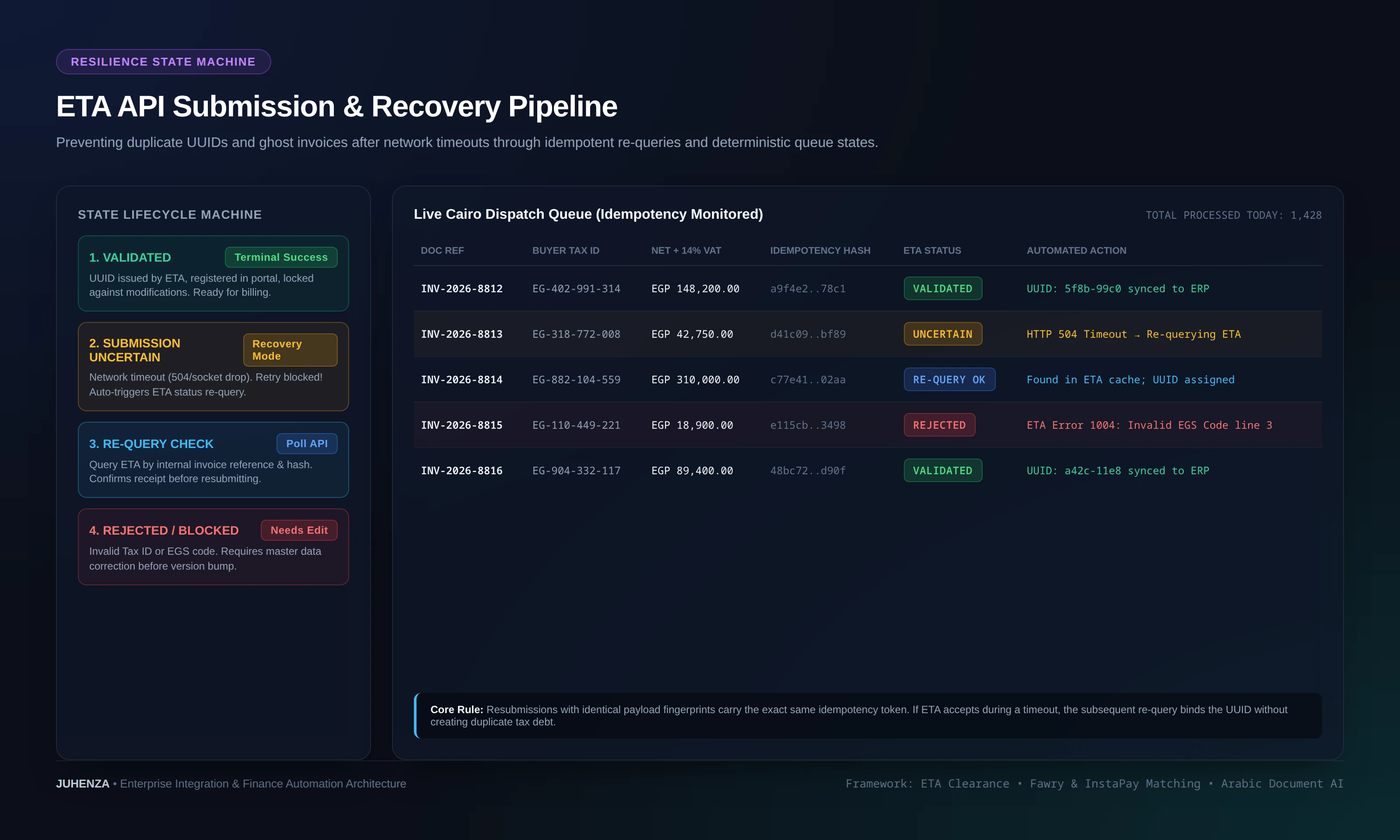 Figure 2: The ETA recovery state machine prevents blind retries and duplicate UUIDs across timeout exceptions.
- Fingerprint the attempt: Record the initial submission with an immutable idempotency key, SHA-256 payload fingerprint, request ID, and high-resolution timestamp.
- Flag as Uncertain: On timeout, connection drop, or 5xx server error, immediately transition the invoice to
SUBMISSION UNCERTAIN. Never mark it asFAILED. - Automate re-query before retry: Query the ETA API by internal document reference and idempotency hash prior to scheduling any subsequent dispatch.
- Reconcile validated records: If the re-query reveals that ETA cleared the document, retrieve and bind the UUID, record the timestamp, and transition the record to
VALIDATED. Never resubmit. - Idempotent resubmission: If the re-query confirms that ETA has no record of the payload, resubmit the identical JSON body bearing the original idempotency key.
- Route schema rejections: If ETA returns an explicit rejection code (e.g., schema invalidity or unmapped EGS code), flag the record as
REJECTED, lock the document against automated dispatch, and route it to master data owners. - Maintain audit telemetry: Log every network exchange, raw response body, and status mutation to establish an audit trail for external tax inspectors.
This exact discipline applies to debit and credit notes. Under ETA regulations, an adjustment is a separate, signed document linked to the original UUID—never an in-place database update.
Coding, tax, and rejection prevention
The vast majority of ETA rejections originate from local master data defects rather than tax authority server failures. Typical root causes include invalid or unmapped EGS codes, buyer tax registration numbers that do not match the official registry, line-item tax arithmetic that fails to sum to the gross invoice total, or choosing an inappropriate document type.
Engineer a deterministic pre-validation engine directly into your dispatch middleware:
- EGS / GS1 validation: Verify that every product SKU carries an approved GS1 barcode or registered EGS code (
EG-[TaxID]-[InternalCode]) approved on the ETA portal. - Arithmetic verification: Enforce line-by-line rounding checks. Standard VAT in Egypt is commonly 14% on taxable goods and services. Ensure that line totals, discounts, and taxable bases reconcile down to the millime before transmission. (Note: Tax rates and industry-specific exemptions should always be verified with certified Egyptian tax counsel rather than hardcoded.)
- Registration thresholds: Ensure that threshold rules reflect current regulatory requirements. Secondary reports cite potential adjustments under Resolution No. 281 of 2025 lowering general registration thresholds from EGP 500,000 to EGP 250,000; finance teams must verify applicable thresholds directly with their tax advisors.
- Payload separation: Preserve the source ERP document in its original form, storing the normalized JSON payload independently so internal auditors can inspect the exact data submitted to the government.
Fawry and InstaPay reconciliation
Reconciliation is where Egyptian finance teams lose the most administrative hours. An invoice may be cleared by ETA in seconds, yet the customer's payment arrives on a disconnected rail days later with an incomplete or missing reference.
Why the two rails behave differently
Egyptian commercial collections rely heavily on two contrasting digital rails:
- Fawry (PSP / Retail Cash): Customers receive a unique reference code, paying in cash at neighbourhood retail kiosks or digitally via consumer apps. Settlement does not transfer instantly; the payment aggregator deposits net batch funds into the merchant bank account on a T+1 to T+3 schedule, deducting transaction fees. The reconciliation engine must match individual invoice lines against a bulk settlement remittance file.
- InstaPay (Instant Payment Network - IPN): Operated under the Central Bank of Egypt (CBE), InstaPay executes real-time bank-to-bank transfers. However, the bank statement narration frequently truncates the invoice reference or displays only an unhelpful mobile handle or personal nickname. Furthermore, standard transaction limits (such as EGP 70,000 per transaction, EGP 120,000 per day, and EGP 400,000 per month, subject to specific bank policy) frequently compel buyers to split large enterprise invoices across multiple transfers.
A finance automation engine cannot rely on reference numbers alone. It must match payments dynamically across multiple operational signals: reference string, transaction amount, payer identity, date window, and settlement rail.
A matching taxonomy that survives real payments
Classify every incoming payment into four distinct reconciliation tiers:
| Match Category | Criteria & Signals | Automated Action & Ledger Impact |
|---|---|---|
| Auto-Match | Reference, gross amount, and rail agree perfectly with open invoice | Automatic AR clearing; generate posted receipt voucher in ERP |
| Suggested Match | Amount and payer account match history, but narration reference is truncated | Route to AP reviewer with historical match confidence; 1-click posting |
| Exception | Amount discrepancy (under/overpayment), duplicate reference, or cancelled invoice | Quarantine allocation; assign investigation ticket to sales representative |
| Unallocated | Cash credited to bank account with zero matching invoices or known accounts | Isolate in unallocated suspense account; enforce 48-hour resolution SLA |
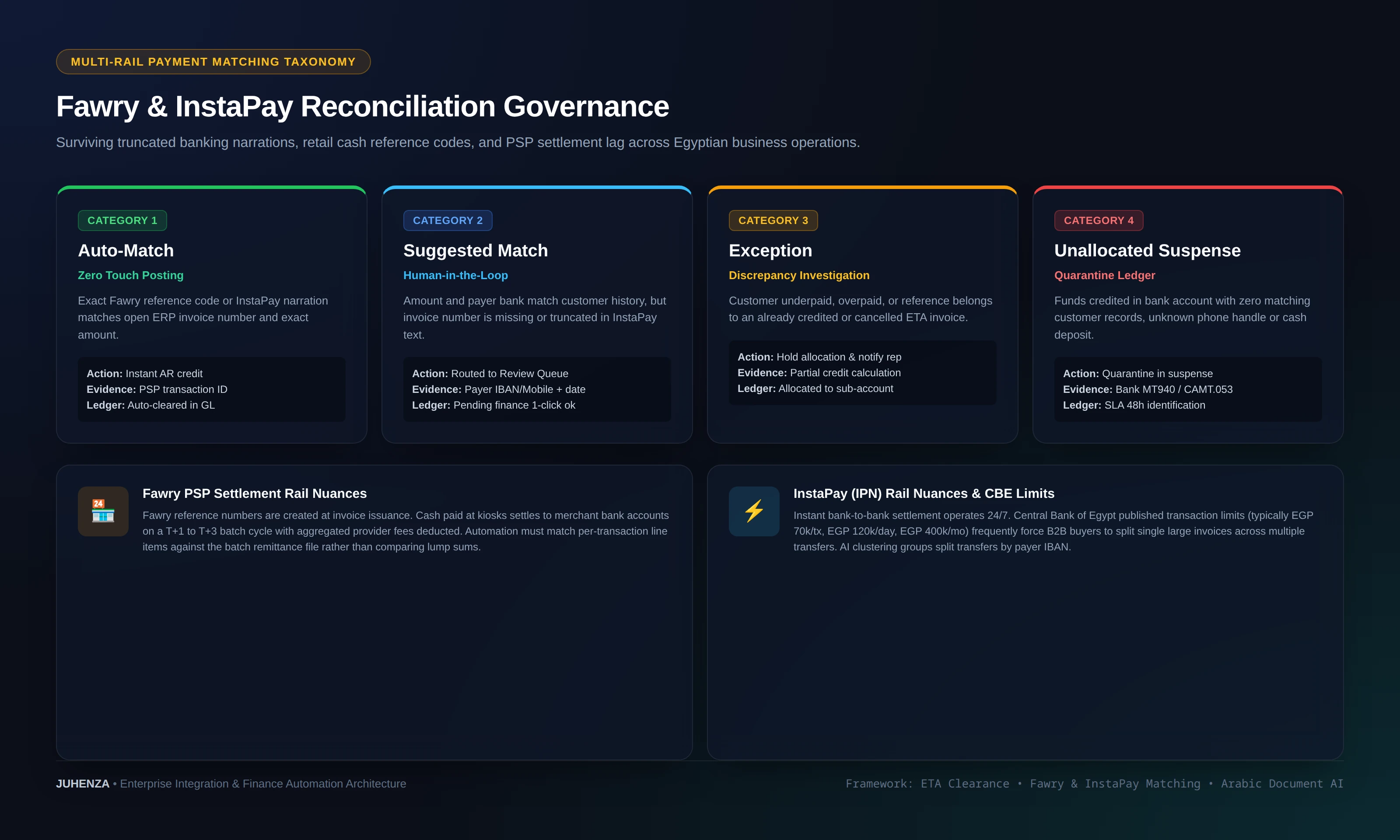 Figure 3: Matching payments on reference, amount, payer identity, and bank statement signals across retail PSP and instant banking rails.
This taxonomy protects the integrity of the general ledger. A suggested match is never posted automatically without validation. An unallocated transfer is quarantined in a suspense account rather than recognized prematurely as revenue.
Fawry reconciliation checklist
When processing Fawry settlement files:
- Reconcile line items, not batch totals: Ingest the raw provider settlement CSV/API data, matching each individual line against outstanding invoice reference numbers.
- Automate fee accounting: Split the gross transaction amount from the provider service fee, posting the fee directly to an operating expense account while clearing the full invoice balance.
- Account for settlement lag: Maintain open invoice aging that accommodates the expected T+1 to T+3 deposit window without triggering false collection alerts.
- Handle late payments gracefully: If a customer fulfills a Fawry reference code after invoice maturity, match the receipt back to the original cleared document rather than generating an orphaned receipt record.
InstaPay reconciliation checklist
When processing InstaPay bank statement feeds:
- Extract unstructured narrations: Ingest electronic bank feeds (CAMT.053, MT940, or open banking APIs) and execute fuzzy regex parsing across narration strings to capture invoice fragments.
- Detect split payments: Group multiple intraday transfers originating from the same payer account to identify split settlements executed to circumvent CBE transaction ceilings.
- Apply historical payer mapping: Map recurring customer bank accounts, phone handles, and IBANs to the vendor master ledger so future transfers match automatically.
- Enforce human authorization: Permit AI agents to analyze and propose match pairings for ambiguous transfers, but require explicit finance user approval before updating the general ledger.
Arabic Document AI for supplier invoices
Supplier accounts payable (AP) in Egypt presents complex document variations. Vendor invoices routinely feature mixed Arabic and English text, handwritten notes, varied formatting, and official rubber tax stamps overlapping essential numbers. Generic English OCR engines fail when processing right-to-left (RTL) Arabic typography, Arabic-Indic numerals, and stamped text.
Arabic Document AI combines optical layout analysis, multilingual large language models, and deterministic validation rules to capture and verify supplier liabilities.
What to extract, and what to prove
A resilient document processing pipeline extracts key data fields while attaching provenance metadata:
- Header data: Supplier name, 9-digit tax registration number, commercial register number, invoice number, and tax clearance date.
- Line item detail: Item descriptions, unit measurements, quantities, unit prices, line discounts, and applied tax codes.
- Totals & currency: Net subtotal, standard 14% VAT, withholding tax (WHT) deductions, and gross payable total in EGP or foreign currency.
For every extracted field, the system must retain the bounding-box coordinate crop of the original scan, the raw string, the normalized alphanumeric output, and a statistical confidence score. When a human reviewer evaluates a flagged field, the interface displays the exact image snippet alongside the ERP form, eliminating manual PDF searches.
The BLOCK, REVIEW, PASS model
To safeguard financial reporting from machine learning hallucinations, enforce the same governance framework JUHENZA outlines in our analysis of pre-dispatch validation checks:
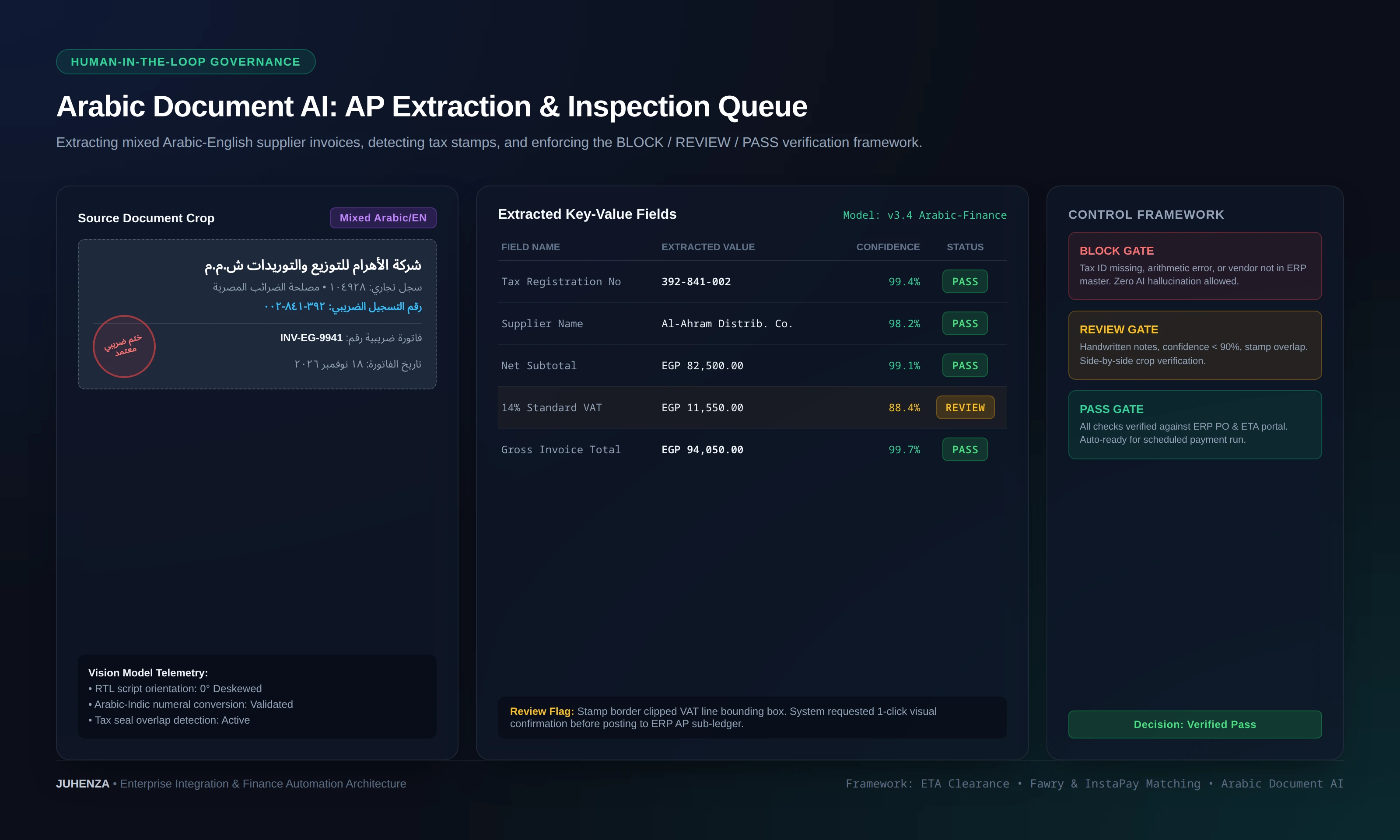 Figure 4: Arabic Document AI extracts mixed Arabic-English invoices and tax stamps under a governed BLOCK / REVIEW / PASS model.
- BLOCK (Immediate Rejection): Triggered when the supplier tax registration number is missing or invalid, line arithmetic fails to reconcile with the total, or the vendor is absent from the approved ERP vendor master. The document is halted immediately; no voucher can be drafted.
- REVIEW (Human Inspection Required): Triggered when field confidence falls below 90%, stamp ink obscures a numerical value, or handwritten adjustments appear on the scan. The document routes to an AP clerk with the source snippet highlighted for 1-click confirmation.
- PASS (Ready for 3-Way Match): All mandatory fields extract with high confidence, tax calculations balance, and the vendor is verified. The document advances automatically to 3-way matching against open purchase orders and goods receipt notes (GRNs).
Under this protocol, an AI model is never allowed to fabricate missing data or adjust discrepancies to force mathematical balance. If data is ambiguous, the system halts and escalates.
How to test Arabic extraction before trusting it
Never deploy an accounts payable extraction model based on idealized vendor benchmark claims. Evaluate extraction performance using a representative internal benchmark:
- Assemble a randomized evaluation set of 150 to 250 real historical supplier invoices.
- Ensure the sample includes realistic challenges: photocopies, mobile camera captures, faint dot-matrix printouts, heavy tax stamps, and bilingual line items.
- Benchmark field-level extraction accuracy separately from overall document processing. A model that extracts headers accurately but misreads decimal points on VAT lines is dangerous in production.
- Measure the false-pass rate. A false pass (an erroneous field categorized as valid) poses far greater compliance risk than a conservative review flag.
One workflow, from invoice to close
True efficiency emerges when ETA clearance, payment reconciliation, and supplier document capture operate within a unified operational architecture:
[Sales Order] ──> [Pre-Validation & E-Seal] ──> [ETA API Clearance]
                                                        │
                                                        ▼
[Month-End Close] <── [Unified Exception Queue] <── [Payment Reconciliation]
        ▲                        ▲               (Fawry & InstaPay Rails)
        │                        │
[3-Way ERP Match] <── [Arabic Document AI]
(BLOCK / REVIEW / PASS)- Generation: The commercial transaction originates within your ERP or POS. Master data and tax coding are verified against local tables.
- Pre-validation: Deterministic rules inspect syntax, required tax fields, and mathematical consistency before any external call.
- Signing & Dispatch: An authorized e-seal signs the normalized payload, transmitting it to the ETA API with a unique idempotency key.
- Resilient Recovery: In the event of a gateway timeout, automated polling checks the ETA registry before any resubmission is attempted.
- Collection Ingestion: Fawry settlement batches and InstaPay electronic bank feeds are ingested daily via automated connectors.
- Reconciliation Triage: Receipts are categorized via our multi-signal matching taxonomy, posting auto-matches and routing exceptions.
- AP Invoice Capture: Supplier documents undergo Arabic Document AI processing, advancing through BLOCK, REVIEW, and PASS gates.
- Financial Close: The finance leadership dashboard surfaces open exceptions, unallocated suspense balances, and document validation states across all operating entities.
Illustrative example: a Cairo distributor
(The following scenario is an illustrative operational model reflecting typical mid-market distribution dynamics in Egypt, rather than a specific client engagement.)
Consider an enterprise consumer goods distributor based in Greater Cairo managing 120 retail accounts, issuing approximately 900 B2B sales invoices per month, and processing 400 supplier invoices from regional manufacturers. Payments arrive across a fragmented mix of Fawry reference kiosks, InstaPay transfers, and traditional commercial bank cheques.
Prior to implementing an integrated workflow, the finance team struggled with disconnected operational silos:
- An accountant drafted sales invoices in an on-premise ERP.
- A second specialist manually exported records and uploaded batch files to the ETA web portal, resulting in frequent rejections due to out-of-date EGS item codes.
- Network timeouts during peak dispatch hours led to accidental duplicate submissions and convoluted credit-note corrections.
- Bank statements and Fawry settlement CSVs were reconciled manually in spreadsheets, leaving more than EGP 450,000 in unallocated suspense accounts each month-end.
- Inbound Arabic supplier invoices were transcribed by hand, resulting in payment delays and missed early-settlement discounts.
Following the deployment of an integrated, event-driven integration layer:
- Pre-validation filters caught schema discrepancies and invalid EGS codes prior to signing, reducing ETA rejections to under 0.5%.
- An automated idempotency state machine eliminated duplicate submissions during gateway timeouts.
- 72% of Fawry and InstaPay receipts matched automatically against open invoices; the remainder were surfaced with suggested match recommendations.
- Arabic Document AI extracted inbound supplier bills with an 88% first-pass review rate, cutting invoice data-entry cycle times from days to minutes.
- Month-end financial close was accelerated from nine business days to two, with complete audit visibility into every tax document.
Build, buy, or integrate
Egyptian enterprises facing modern compliance demands must evaluate their implementation roadmap objectively:
| Architectural Route | Ideal Deployment Context | Primary Strategic Risks |
|---|---|---|
| Commercial ETA Connector | Standard ERP installation (e.g., vanilla SAP or Odoo) requiring basic compliance quickly | Vendor lock-in; absence of custom recovery logic or multi-rail reconciliation |
| Specialized Reconciliation Tool | High transaction volumes on standard payment gateways with clean data feeds | Rigid matching rules unable to resolve truncated InstaPay bank narrations |
| Point OCR Microservice | Standardized, high-contrast document formats | Inconsistent accuracy on mixed Arabic/English layouts and rubber tax stamps |
| Engineered Integration Layer | Multi-system architectures (custom ERP, legacy POS, varied banks, high volume) | Requires initial engineering investment and clear technical governance |
Evaluate each option against five core requirements: resilient ETA timeout recovery, flexible multi-signal payment matching, robust Arabic document extraction, comprehensive audit logging, and total cost of ownership (TCO).
Before committing engineering resources, leverage an AI automation ROI calculator to evaluate your transaction volumes, average handling durations, exception rates, and manual verification costs. A solution that merely generates PDFs while leaving reconciliation broken delivers negligible return on capital.
Common mistakes, limitations, and when to involve a specialist
Enterprise automation initiatives frequently stumble over predictable operational pitfalls:
- Automating dirty data: Deploying integration pipelines on top of an unverified chart of accounts or out-of-date vendor tax IDs accelerates errors.
- Blind timeout retries: Configuring automatic HTTP retries on clearance API endpoints without first executing status re-queries guarantees duplicate invoice generation.
- Matching on amount alone: Auto-posting payments based purely on monetary value without verifying payer identity or reference numbers creates cascading ledger misallocations.
- Unrestricted agent autonomy: Granting an autonomous script full authority to read, edit, approve, and submit tax filings without human verification gates invites catastrophic compliance errors. As detailed in our guide on AI agents for operations, mission-critical workflows demand explicit permission boundaries.
- Ignoring privacy regulations: Storing unprotected national identification numbers, phone handles, and financial records violates Egypt's Personal Data Protection Law (Law No. 151 of 2020). Ensure encryption at rest and strict role-based access controls across all finance documents.
Engage external systems integration specialists when dealing with legacy on-premise ERPs, complex multi-rail banking integrations, high-volume POS networks, or distributed retail operations. For broader custom software and systems engineering, consult our custom software development practice.
(JUHENZA Practitioner Note: In client finance automation engagements across the Middle East and North Africa, the primary source of reconciliation friction is payment narration truncation on instant banking rails and blind ERP submission retries after network timeouts. By enforcing an automated ETA re-query before resubmission and implementing multi-signal matching across Fawry settlement files and InstaPay transfers, finance teams reduce unallocated suspense accounts by over 80% and prevent duplicate credit-note creation.)
Frequently asked questions
What is Egypt e-invoicing automation?
Egypt e-invoicing automation is an integrated software workflow that validates, cryptographically signs, submits, and reconciles tax invoices and receipts with the Egyptian Tax Authority (ETA) API without manual data re-entry. It links clearance tracking, payment matching, and accounts payable document extraction under an auditable control environment.
How does ETA API recovery prevent duplicate invoices after a timeout?
When an HTTP timeout or network disconnection occurs, the system flags the invoice as SUBMISSION UNCERTAIN rather than retrying immediately. It queries the ETA API by document reference and idempotency hash. If the invoice was cleared, the UUID is stored; if no record exists, the payload is safely resubmitted with its original idempotency key.
How do you reconcile Fawry payments against issued invoices?
The reconciliation engine ingests the provider settlement batch file, matching individual transaction lines against outstanding invoice references rather than comparing lump-sum deposits. It separates provider service fees into operating expenses while applying the gross amount to clear the accounts receivable ledger.
How do you match InstaPay transfers when the narration lacks an invoice number?
The system applies a multi-signal matching algorithm combining transaction amount, payer bank identity, historical customer account mapping, and date proximity. If a definitive reference is absent, the transfer is routed to a human reviewer as a suggested match with historical context, preventing erroneous ledger postings.
Can Arabic Document AI process mixed Arabic and English invoices?
Yes, provided the underlying vision-language model is trained on regional typography. It must process right-to-left layout geometry, convert Arabic-Indic numerals, and navigate visual obstructions such as official company rubber stamps. Low-confidence fields are routed to human reviewers with side-by-side source image crops.
Should an enterprise automate ETA, payments, and Document AI simultaneously?
Not necessarily in a single release. Most organizations adopt a phased deployment roadmap: stabilizing ETA pre-validation and timeout recovery first, automating payment matching on primary collection rails second, and integrating supplier accounts payable extraction third. The essential architecture ensures that all three capabilities feed a single exception queue.
What are the main criteria when choosing between a pre-built connector and custom integration?
Evaluate whether your architecture runs on a standardized, single ERP or spans heterogeneous legacy databases, customized POS systems, and varied banking partners. Custom integration is recommended when high transaction volumes, complex approval matrices, and bespoke reconciliation logic demand end-to-end operational control.
Where this fits
This guide sits within JUHENZA's enterprise workflow automation and digital compliance practice. It complements our foundational frameworks on systems integration, operational risk mitigation, and algorithmic verification across regulated industries.
Conclusion
Egypt finance automation achieves durable operational success only when ETA API clearance, payment reconciliation across Fawry and InstaPay rails, and Arabic Document AI converge into a unified workflow, a single exception queue, and a tamper-evident audit trail.
Begin by identifying your highest-friction operational bottleneck—whether that is ETA rejections, untraceable instant bank transfers, or manual vendor data entry. Prove the recovery and reconciliation logic on your real production data, then scale systematically.
To plan your integration architecture, Discuss your project with our engineering team at JUHENZA. Share your transaction volumes, core ERP environment, and sample settlement data for an actionable technical assessment.
External references
- Egyptian Tax Authority e-invoicing portal — Official portal for Egyptian e-invoicing registration, API specifications, and taxpayer clearance.
- Basware Egypt E-Invoicing and eReceipt Guide — Comprehensive regulatory compliance summary covering B2B e-invoicing and B2C e-receipt requirements.
- ClearTax Egypt e-Invoicing Process and Steps — Practical overview of taxpayer registration, digital signing, and UUID clearance procedures.
Disclaimer: This guide is provided for technical, architectural, and educational purposes only and does not constitute formal legal or tax advice. Enterprise organizations must consult qualified Egyptian legal counsel and certified tax practitioners regarding specific regulatory compliance, VAT rates, and filing obligations. Current as of November 23, 2026.