

When Billing Software Must Become a GST, Batch and Expiry-Control System: A Practical Test for Indore Pharmacies and Supermarkets
When does billing software need to become a GST, batch and expiry-control system? A practical test for Indore pharmacies and supermarkets.
TechApp Dev

Direct answer: A basic billing tool records a sale. It does not, by itself, prevent a Schedule H1 register from being incomplete, an expired batch from reaching a customer, or a GST credit note from missing its statutory window. The moment your shop carries regulated drugs or perishable FMCG stock across more than one counter, billing software stops being a cash register and becomes a control system—or it becomes the source of the loss. This guide gives you a three-layer test to find out which one you are running today.
Why this question matters now in Indore
Indore’s retail landscape is not a single market. A pharmacy in Sarafa or Rajwada operates on footfall rhythms and distributor relationships shaped by the old-city wholesale ecosystem, while a supermarket in Vijay Nagar or Scheme 54 manages a wider SKU range with higher shelf-turn expectations and multiple billing counters during peak hours. The common thread is that both formats now sit inside the same regulatory perimeter: GST invoicing under Rule 46 of the CGST Rules, Schedule H and H1 record-keeping under the Drugs and Cosmetics Rules, 1945, and—for pharmacies—the CDSCO guidance on expired and unused drug disposal issued in May 2025.
Most billing software sold to Indore retailers advertises “GST billing” and “batch/expiry tracking” as feature bullets. That is not the same as controlling the three layers. The gap only becomes visible when something goes wrong: a drug inspector asks for a Schedule H1 entry that the billing system never prompted the counter staff to capture; a near-expiry return goes back to the distributor after the credit-note window has closed; or a batch of antibiotics expires on the shelf because the software recorded expiry dates but never surfaced them as an actionable alert. The question is not whether your software has a batch field. The question is whether the batch field is connected to the decisions that protect you.
The Three-Layer Test: GST, Batch, and Expiry Are Not the Same Thing
A billing system that passes the “GST-compliant” test can still fail the batch test and the expiry test. Treat them as three distinct layers, each with its own failure mode.
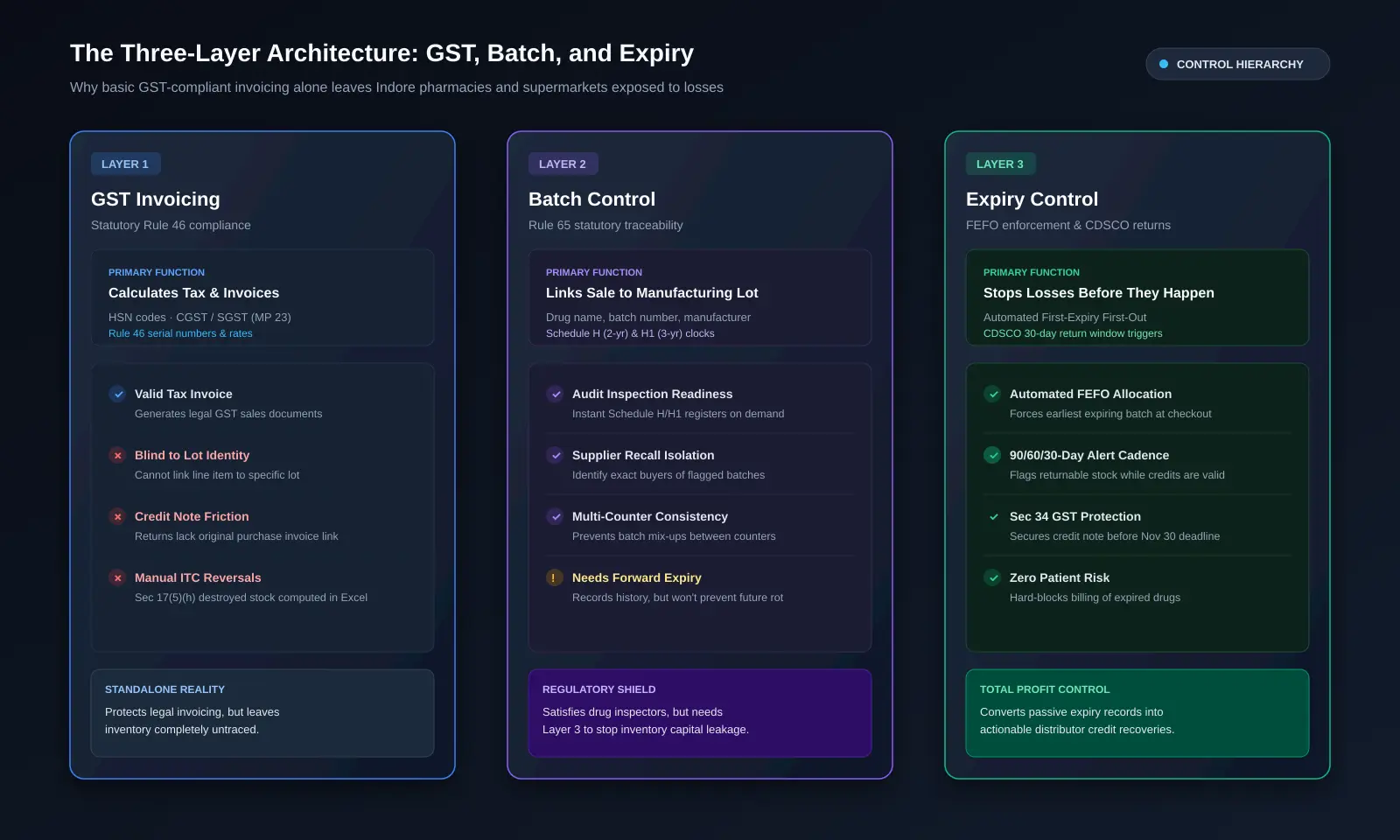
Layer 1 — GST billing: necessary, but blind to stock identity
GST compliance means the invoice carries the particulars required under Rule 46: supplier GSTIN, a consecutive serial number, HSN code, taxable value, tax rate and amount, and place of supply where applicable. A basic billing tool can generate this output. What it cannot do, by design, is link the invoiced line to a specific batch with its own expiry date and return history.
That blind spot matters because GST treatment of expired or returned stock depends on batch-level traceability. When near-expiry stock goes back to a distributor, the credit note mechanism under Section 34 of the CGST Act reduces output tax liability only if the credit note is issued and reported within the statutory window—on or before 30 November following the financial year of the original supply, or the annual return date, whichever is earlier. If your billing system cannot tell you which original invoice a returned batch belongs to, you are reconstructing that link from paper at the exact moment the clock is running.
The same batch-to-invoice gap appears on the ITC side. When expired stock is destroyed rather than returned, Section 17(5)(h) of the CGST Act blocks input tax credit on goods that are lost, destroyed, or written off. The reversal has to be computed against the destroyed batch. A billing system that tracks stock value but not batch identity forces that computation into a spreadsheet—or into an audit finding.
Layer 2 — Batch control: the traceability layer
Batch control is the layer that connects a sale to a specific manufacturing lot. In a pharmacy, that connection is not optional: Rule 65(3)(1) of the Drugs and Cosmetics Rules requires a prescription register to capture the drug name, quantity, manufacturer, batch number, and expiry date at the time of supply. The register exists to make every prescription-only sale traceable from manufacturer batch to patient. A drug inspector typically asks for it early in a visit because it is the clearest evidence of whether Schedule H compliance is happening in practice, not just on paper.
The retention clocks differ by schedule. The ordinary Schedule H register must be preserved for not less than two years from the last entry under Rule 65(7), while the separate Schedule H1 register carries a three-year retention requirement under clause (h). A billing system that treats “sales register” as one undifferentiated report makes it impossible to demonstrate which record belongs to which clock when an inspector asks.
For a supermarket, batch control applies to dairy, bakery, packaged foods, and any FMCG line with a manufacturing or best-before date. The failure is less regulatory and more operational, but the mechanism is identical: without batch identity, a recall or a quality complaint cannot be traced to the affected stock, and a supplier return cannot be matched to the original purchase invoice.
Layer 3 — Expiry control: where FEFO and alerts decide your loss
Expiry control is the forward-looking layer. Batch control tells you what you sold; expiry control tells you what you must act on before it becomes a write-off or a compliance event. The operational rule is First Expiry, First Out (FEFO): the batch closest to expiry should be dispatched first, automatically, without relying on counter-staff memory. Near-expiry alerts at defined intervals—90, 60, and 30 days are common operational thresholds in Indian pharmacy software—turn an expiry date in a database into a decision: return to distributor, discount for accelerated sale, or plan for disposal.
This layer is where the CDSCO disposal framework intersects billing. The May 2025 guidance places the first move on the retailer: expired stock should be returned to the supplier or manufacturer within 30 days of expiry, and each level of the supply chain is expected to pass the return up within the same window. A billing system that does not flag a batch as “expired and returnable” at the right moment leaves that 30-day clock to human vigilance. In a multi-counter shop during a festival rush, human vigilance is not a control system.
A 10-Point Diagnostic Checklist for Your Current Software
Use this checklist to score your current billing setup. A “no” on any GST-linked item is a compliance exposure; a “no” on a batch or expiry item is a loss exposure.
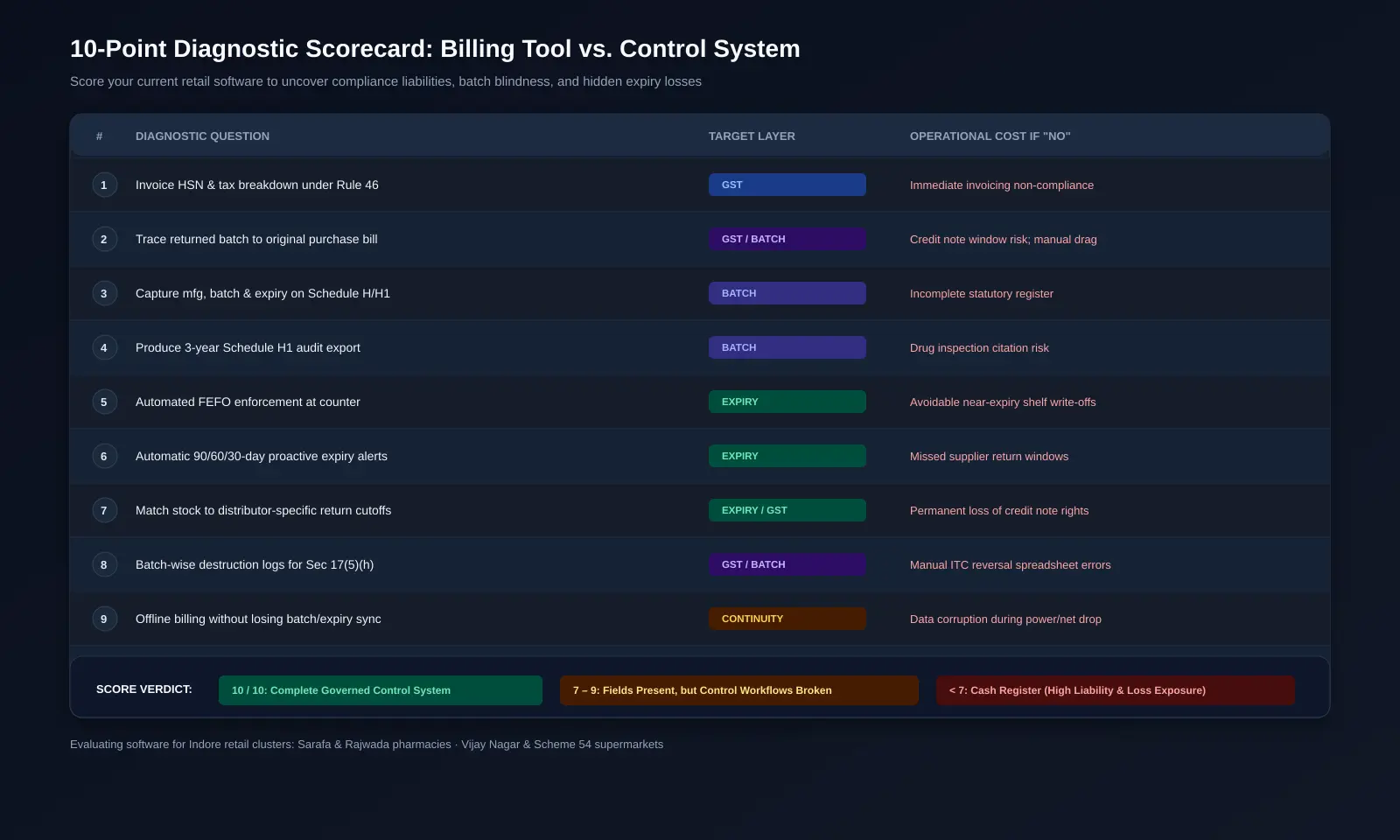
| # | Question | Layer | If “no” |
|---|---|---|---|
| 1 | Does every invoice line carry the HSN code and tax particulars required under Rule 46? | GST | Immediate invoicing non-compliance |
| 2 | Can you trace a returned batch back to its original purchase invoice without opening a separate register? | GST / Batch | Credit-note window risk; reconciliation burden |
| 3 | Does the system capture manufacturer, batch number, and expiry date at the point of billing for Schedule H/H1 drugs? | Batch | Incomplete statutory register |
| 4 | Can you produce a Schedule H1 register filtered by date, drug, or batch for the three-year retention period? | Batch | Inspection readiness gap |
| 5 | Does the system enforce FEFO automatically at billing, rather than defaulting to the most recently purchased batch? | Expiry | Avoidable expiry loss |
| 6 | Are near-expiry alerts generated at fixed intervals before the expiry date, without manual report-running? | Expiry | Reactive rather than preventive returns |
| 7 | Can you identify which batches are within the distributor’s near-expiry return window? | Expiry / GST | Missed return opportunity; credit-note timing pressure |
| 8 | When stock is destroyed, can the system produce a batch-wise destruction record linked to the original purchase? | GST / Batch | ITC reversal computation becomes manual |
| 9 | Does the software work offline and sync without losing batch or expiry data? | Continuity | Continuity risk during connectivity failure |
| 10 | Can a second counter see the same batch-level stock position in real time or near-real time? | Continuity | Duplicate sales, batch mix-ups across counters |
A score of 10 is a control system. A score of 7–9 means you have the fields but not the controls. A score below 7 means your billing software is still a cash register, and the gaps are being absorbed by staff workarounds and after-the-fact reconciliation.
What Happens When You Stay on Basic Billing
The cost of inaction is not a single invoice. It accumulates across four categories.
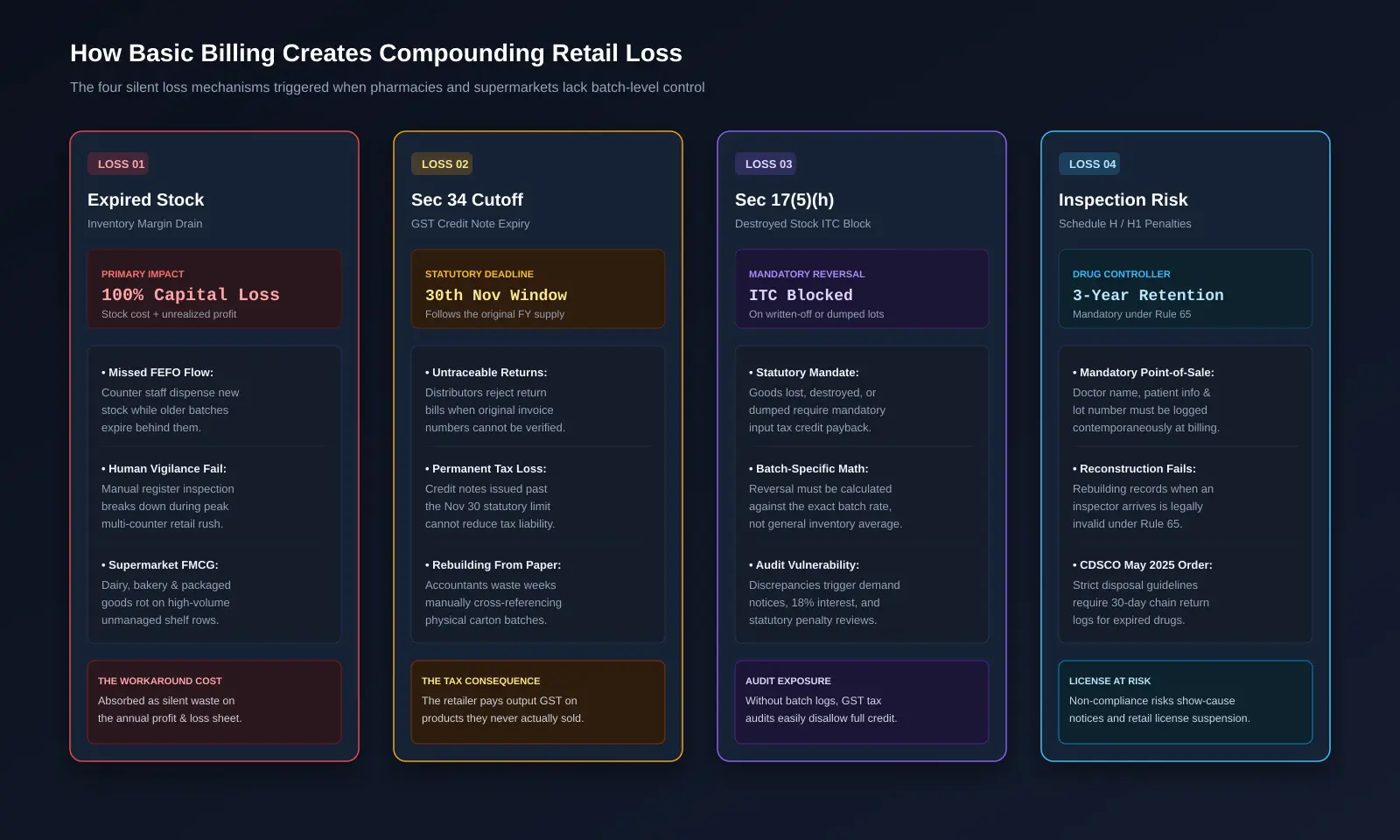
Expired-stock write-off
Every batch that passes its expiry date without being returned or sold represents inventory cost plus the lost margin. In pharmacy, where shelf life is fixed and distributor return windows are finite, the write-off is often avoidable—but only if the system surfaced the batch early enough. When products expire on the shelf without triggers, retail owners take a 100% loss on both product cost and working capital.
GST reconciliation drag
Credit notes issued after the Section 34 window cannot reduce output tax liability. The 30 November deadline is not a guideline; it is the statutory outer limit, and a credit note issued after it is invalid for GST reduction. If your software cannot flag which returned batches are approaching that window, the tax cost becomes permanent, forcing the business to pay tax on goods it never realized revenue from.
Inspection exposure
An incomplete Schedule H1 register is a record-keeping failure under the Drugs and Cosmetics Rules. The register must be maintained at the time of supply and kept for three years, open to inspection. Reconstructing entries after an inspector arrives is not a defence; the rule requires contemporaneous recording. Incomplete registries risk show-cause notices, product seizures, or temporary license suspensions.
Customer trust and recall risk
A supermarket that cannot trace a batch through a supplier recall, or a pharmacy that dispenses a near-expiry strip because FEFO was not enforced, faces a trust cost that does not appear on any GST return. In tight-knit commercial areas like Indore's Sarafa, Rajwada, or Vijay Nagar, repeat retail footfall relies on confidence in fresh, authentic inventory.
When Custom or Integrated Software Becomes the Right Answer
Off-the-shelf pharmacy or supermarket billing software can handle the three layers if it is genuinely batch-aware and expiry-aware. The decision to move toward custom or integrated software usually arises when the shop’s operating reality exceeds the product’s design assumptions:
- Multi-counter, multi-location synchronisation where batch-level stock must be visible across counters in real time, not reconciled at end of day.
- Distributor-specific return policies that differ by manufacturer, with near-expiry windows that the billing system must apply at the batch level rather than as a generic reminder.
- Integration with existing accounting or ERP systems where the billing layer is one part of a larger stock-to-books flow.
- Schedule H/H1 workflow enforcement that the current tool treats as an optional free-text field rather than a mandatory billing step.
At that point, the question shifts from “which billing package has the most features” to “what data model connects GST invoicing, batch identity, and expiry action in one flow.” That is a software architecture question, not a product comparison question.
When off-the-shelf tools hit these scaling boundaries, teams look to a dedicated custom software development practice to engineer unified stock models, or leverage integration and data workflow consulting to tie counter registers directly into accounting ledgers. As explored in our published client case studies and detailed in JUHENZA's delivery model, scoping from the exact operational bottleneck prevents both inventory leakage and regulatory exposure.
This article is based on published regulatory guidance under the CGST Rules, Drugs and Cosmetics Rules, CDSCO disposal directives, and operational patterns observed across Indian multi-counter retail; no confidential client-specific implementation is described here.
Frequently Asked Questions
Is GST billing software automatically compliant with Schedule H1 requirements?
No. GST billing compliance under Rule 46 and Schedule H1 record-keeping under the Drugs and Cosmetics Rules are separate obligations. A GST invoice can be fully compliant while the Schedule H1 register remains incomplete if the billing system does not require the manufacturer, batch, expiry, prescriber, and patient details to be captured at the time of supply. The two layers must be deliberately connected in the software workflow.
How long must a pharmacy keep Schedule H and Schedule H1 registers?
The ordinary Schedule H register must be preserved for not less than two years from the date of the last entry under Rule 65(7). The separate Schedule H1 register carries a three-year retention requirement under clause (h) of Rule 65(3)(1). The clocks are different, and a billing system that produces a single undifferentiated “sales register” export makes it difficult to demonstrate compliance with either one.
Can a pharmacy return expired stock to the distributor after expiry?
Under the CDSCO guidance issued in May 2025, the retailer is expected to return expired stock to the supplier or manufacturer within 30 days of expiry, and each level of the supply chain is expected to pass the return up within the same window. The GST side operates separately: a credit note under Section 34 must be issued and reported within the statutory window—on or before 30 November of the following financial year, or the annual return date, whichever is earlier—for the output tax liability to be reduced.
What happens to input tax credit when expired stock is destroyed instead of returned?
Section 17(5)(h) of the CGST Act blocks input tax credit on goods that are lost, stolen, destroyed, written off, or disposed of by way of gift or free samples. When expired stock is destroyed, the ITC attributable to that batch must be reversed. The computation is batch-specific, which is why a billing system that does not maintain batch-to-purchase linkage forces the reversal into manual reconciliation.
Does a supermarket need batch and expiry control, or is that only a pharmacy requirement?
The regulatory driver is pharmacy-specific, but the operational driver applies to any retail format carrying dated stock. Dairy, bakery, packaged foods, and FMCG lines with manufacturing or best-before dates face the same FEFO and write-off logic. A supermarket without batch-level expiry visibility absorbs avoidable waste on short-shelf-life categories and cannot trace a supplier recall to the affected sale.
Can basic billing software be upgraded, or does the shop need a new system?
It depends on whether the current software exposes batch-level data at the billing line and supports automated near-expiry workflows. If batch and expiry are free-text fields or optional add-ons, upgrading the same product may not close the control gap. The practical test is the 10-point checklist above: if the software cannot produce a batch-wise Schedule H1 register or a near-expiry return list without manual compilation, the limitation is structural rather than cosmetic.
Is offline billing compatible with batch and expiry control?
Offline capability is a continuity requirement, not a compromise on control—provided the offline mode captures the same batch and expiry fields as the online mode and syncs without data loss. The risk arises when offline billing is treated as a separate “lite” mode that records the sale but drops the batch-level detail, because that is exactly the data the GST and Schedule H registers depend on.
The Next Step
If the 10-point checklist left more than two “no” answers, the next conversation is not about buying a billing package. It is about mapping which layer is failing first—GST linkage, batch traceability, or expiry action—and what it would take to connect them in one workflow.
If your operations team or pharmacy leads are managing batch reconciliation manually across counters, book a retail systems consultation with JUHENZA to map your current data model and evaluate automated compliance workflows. Bring your current software’s batch report and your last near-expiry return list to a consultation, and the operational gap becomes visible in one session.
References
- Central Board of Indirect Taxes and Customs, CGST Rules, 2017 — Rule 46 (Tax Invoice). Official Rules. Mandatory invoice particulars, including HSN code, taxable value, tax rate and amount, and place of supply.
- Central Drugs Standard Control Organization, Guidance Document on Disposal of Expired/Unused Drugs (May 2025). Official Guidance. Framework for retailer return of expired stock within 30 days and supply-chain pass-through obligations.
- Drugs and Cosmetics Rules, 1945 — Rule 65(3)(1) and Rule 65(7). Compliance Guide. Schedule H register retention: two years from last entry; Schedule H1 register: three years.