
Direct answer: Chandigarh advocates should treat client money as trust property, run a dated conflict check before every new brief, and reconcile the advance, daily and supplementary cause lists against a single matter register at least twice a day. These three controls share one rhythm: every rupee and every hearing is traceable to a named matter and a responsible advocate.
Client money, conflict checks and cause-list discipline are usually taught as three separate subjects. In a Chandigarh chamber they are one risk system. The same matter with an unreconciled ledger entry is often the matter with an unchecked conflict or a missed supplementary listing.
This guide gives small-firm partners and sole practitioners a minimum viable control set — practical enough for a two-partner office, disciplined enough to survive scrutiny.

Why the three controls belong together
A client-money breach, a missed conflict and a dropped hearing share one root cause: the absence of a single matter register that every control reads from. When the ledger, the conflict list and the cause list sit in three different files, each fails independently — and the failure surfaces only when a client complains or a court notices.
The Bar Council of India Rules frame the financial side as a fiduciary duty, not a bookkeeping preference. Rules 25 to 30 cover accounts, the distinction between fees and expenses, intimation of receipts, appropriation after a matter concludes, and the client's right to a copy of the account. Courts have repeatedly treated the advocate–client relationship as one of trust in disciplinary proceedings.
That is the legal baseline. The operational question is how a small Chandigarh chamber meets it without hiring a compliance officer. Verify the current text of any specific rule before relying on it, and take advice on a live matter.
Client-money ledger discipline
Direct answer: maintain two ledgers per matter — a client ledger for money held for court fees, stamp duty, commissioner fees and other hard costs, and a fee ledger for professional fees, whether advance or billed. Never let the two merge. Reconcile the client ledger against the bank account monthly and be able to issue a client statement on demand.
What the rules require in practice
| Rule | Requirement | What it means day to day |
|---|---|---|
| Rule 25 | Accounts showing amounts received, expenses incurred, fee debits and dates | Every entry is dated and tied to a matter, not a lump-sum "office" column |
| Rule 26 | Entries must state whether money is for fees or expenses; no diversion without written consent | Split fees and expenses at the point of entry, not at invoicing |
| Rule 27 | Intimate the client of receipts as early as possible | Same-day acknowledgement with a ledger extract attached |
| Rule 28 | After the proceeding ends, appropriate unexpended expense money toward settled fees | Do this only after the matter is formally closed, and record it |
| Rule 29 | If the fee is unsettled, deduct the settled fee and refund the balance | Do not retain a float against an undetermined future fee |
| Rule 30 | Furnish a copy of the client's account on demand | Keep the ledger exportable at any time |
Rule wording is summarised here; check the current published text.
The two-ledger structure
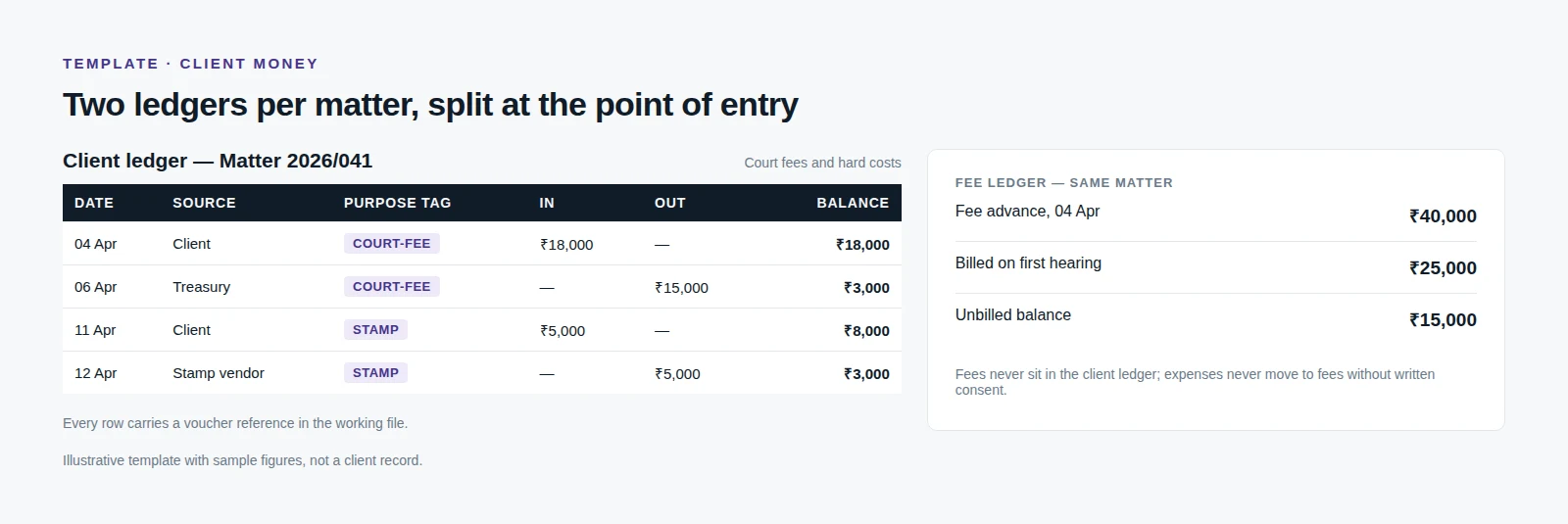
For each matter the client ledger should show:
- Date and mode of receipt — cash, cheque, UPI, RTGS.
- Source — client, opposing party, court deposit, insurer.
- Purpose tag —
COURT-FEE,STAMP,COMMISSIONER,MISC-EXPENSEorFEE-ADVANCE. - Disbursement voucher reference for every payment out.
- Running balance, reconciled to the bank.
The fee ledger stays separate because the distinction has to be visible at entry, not reconstructed at invoice time. A combined ledger that records "₹1,00,000 received" and later deducts "₹40,000 fee" cannot demonstrate on its face that expense money was not diverted.

Minimum reconciliation cadence for a small chamber
| Frequency | Action | Time cost |
|---|---|---|
| Every receipt | Post to the matter ledger with a purpose tag; send the client acknowledgement | 3–5 minutes |
| Weekly | Scan for unmatched disbursements and negative client-ledger balances | 20–30 minutes |
| Monthly | Three-way reconciliation: bank balance = sum of client-ledger balances = register total | 45–60 minutes |
| On demand | Export the client's ledger and furnish it | 10 minutes |
Conflict-check discipline
Direct answer: a conflict check is a documented search of every new party, counsel and connected entity against your current and former client list, completed before the vakalatnama is signed. It records three questions: is the new matter adverse to a current client, is it adverse to a former client in a related matter, and does any advocate in the chamber hold confidential information material to it?
The three conflict questions that matter at intake
- Current-client adversity. You are asked to act against a party the chamber currently represents in another live matter, even an unrelated one.
- Former-client adversity. The new matter is adverse to someone the chamber previously acted for, and could use confidential information from that engagement.
- Individual-knowledge conflict. A partner or associate personally holds information from a prior role or connection that is material to the new matter, even where the firm's records do not show it.
A Chandigarh-specific trigger list
Because the Punjab and Haryana High Court at Chandigarh serves Punjab, Haryana and the Union Territory, a chamber's conflict universe is wider than one state's party list. Before accepting a brief, search the party and connected-entity names against:
- Existing and former clients across all three jurisdictions.
- Matters before the Punjab and Haryana High Court and its benches.
- Chandigarh District Court and the district courts of adjoining Punjab and Haryana districts where the chamber appears.
- CAT, AFT, NCLT, DRT and consumer commissions where the chamber has an active practice.
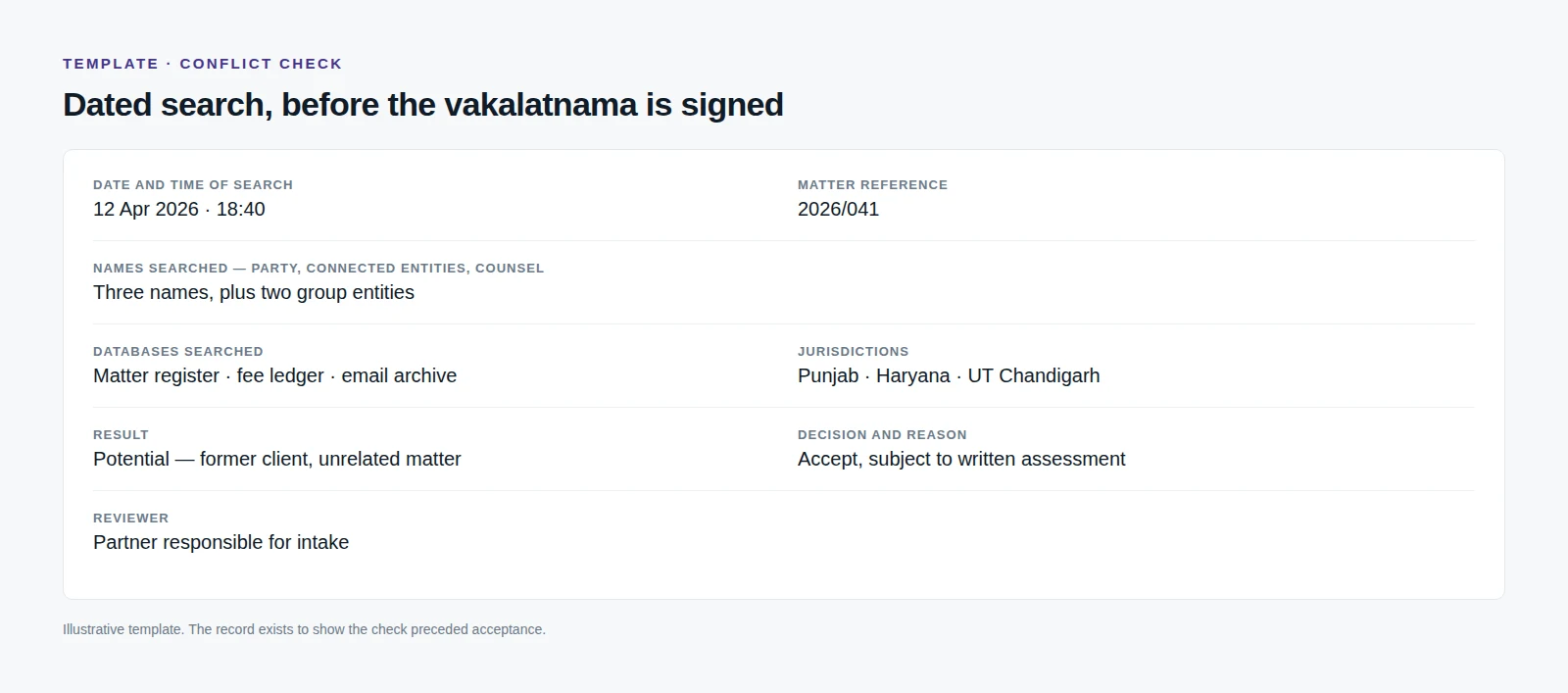
What a conflict-check record should contain
| Field | Why it matters |
|---|---|
| Date and time of search | Shows the check preceded acceptance |
| Names searched — party, connected entities, counsel | Demonstrates scope |
| Databases searched — register, ledger, email archive | Shows the check was not a memory exercise |
| Result — clear, potential or conflict | Creates an audit trail |
| Decision and reason | Separates a curable conflict from a mandatory decline |
| Reviewer name | Fixes responsibility |

When a conflict is discovered after acceptance
This is the hardest scenario in small-firm practice. The practical sequence is: stop new work on the conflicting matter, disclose to the affected client in writing, assess whether the conflict is curable by consent or information barriers, and if not, apply to be discharged. Do not keep acting while the conflict is unresolved. The exact position depends on the facts and the stage of proceedings — this is a point to take a second opinion rather than improvise.
Cause-list discipline in a three-jurisdiction High Court
Direct answer: the Punjab and Haryana High Court at Chandigarh carries matters from Punjab, Haryana and the Union Territory on a single listing system, and supplementary lists can be published or updated on the morning of the hearing. Cause-list discipline means checking the advance, daily and supplementary lists against one matter register, with a named advocate responsible for each listed matter.
The three lists, and why one check is not enough
| List type | When it appears | Risk if unchecked |
|---|---|---|
| Advance / weekly | Published in advance | Preparation and witness scheduling fail |
| Daily | Evening before the hearing | Wrong courtroom, wrong bench, wrong order of items |
| Supplementary | Often the same morning, sometimes updated | A matter mentioned for urgent listing or moved from another bench is missed |
The supplementary list is the highest-risk list for a small chamber because it does not respect the previous evening's planning. Check it at least twice — once early and once mid-morning — because a published list may be updated rather than reissued.
A cause-list register that works at two-partner scale
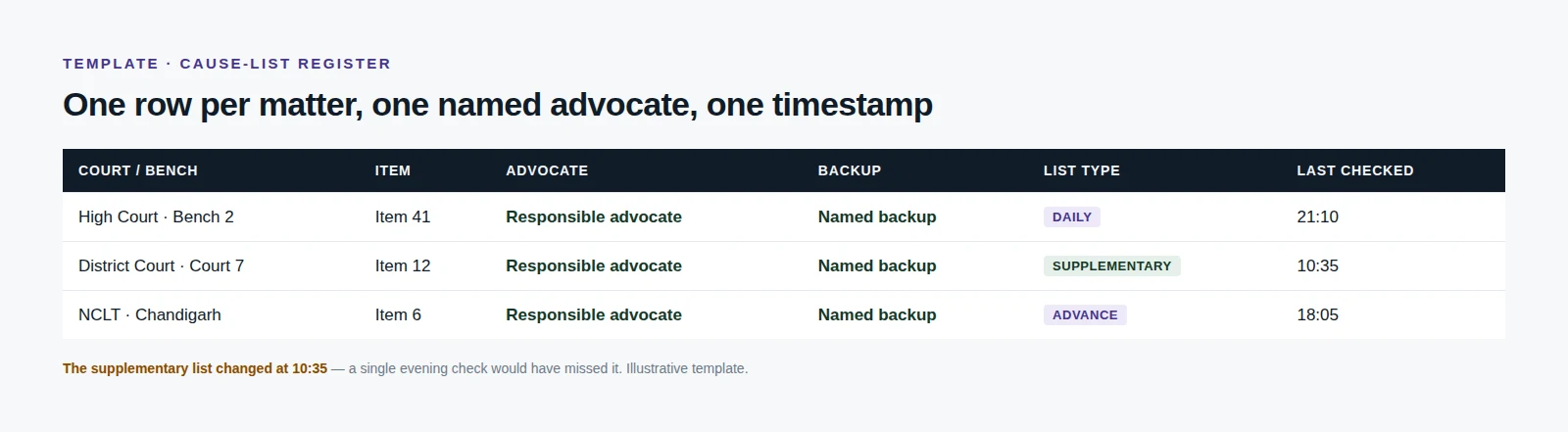
For every active matter the register should carry:
- Court, bench and courtroom.
- List type and date.
- Item number and expected calling time.
- Responsible advocate — not "the chamber".
- Backup advocate for days when the responsible advocate is in another courtroom.
- Last-checked timestamp.
The register should be reconciled to the cause list by a named person at a fixed time each evening and again each morning. The purpose is not bureaucracy; it is to make the handover between courtrooms explicit. Where one partner is before the High Court and the other before the District Court, the supplementary list is where handover failures become visible.

The weekly operating rhythm
The three controls only work if they are read together. A practical rhythm:
| Day | Control | Output |
|---|---|---|
| Monday morning | Ledger scan: unmatched receipts, negative balances, fee advances older than 30 days | Exception list for the week |
| Monday evening | Conflict check for every new enquiry logged that day | Completed conflict records |
| Daily evening | Cause-list reconciliation across advance, daily and supplementary lists | Updated register with named advocate |
| Daily morning | Supplementary-list re-check before court | Handover confirmed |
| Last working day of month | Three-way ledger reconciliation and client-statement run | Reconciled trust position |
This is an illustrative rhythm, not a verified case. The point is that the ledger, conflict and cause-list checks share the same register and the same weekly review. Separated, each decays at a different rate and the chamber cannot see which control is failing.
Decision frameworks and scorecards
Framework 1: Is this conflict curable?
| Scenario | Default position | Action |
|---|---|---|
| New matter adverse to a current client in an unrelated matter | Generally not acceptable without informed written consent and, where appropriate, an information barrier | Decline unless both clients consent after full disclosure |
| New matter adverse to a former client in a related matter | High risk of confidential-information use | Presume decline; test whether the information is material |
| New matter adverse to a former client in an unrelated matter | May be permissible if no confidential information is material | Document the assessment and the basis for accepting |
| Personal knowledge of a partner material to the matter | Not curable by consent alone in every case | Escalate; consider declining or screening the individual |
This framework is illustrative guidance, not a statutory test. The correct answer in a live matter depends on the facts and the applicable decisions.
Framework 2: Monthly practice-hygiene scorecard
| Control | Minimum standard | Score (0–2) |
|---|---|---|
| Client ledger has a purpose tag on every entry | 100% of entries tagged | 0 = none; 1 = partial; 2 = complete |
| Fees and expenses separated at entry | Two-ledger or two-column structure | 0 = combined; 1 = inconsistent; 2 = consistent |
| Monthly three-way reconciliation completed | Signed and dated | 0 = not done; 1 = late; 2 = on time |
| Client statement available on demand | Exportable within one working day | 0 = manual rebuild; 1 = partial; 2 = automated |
| Conflict check completed before acceptance | Dated record in every new file | 0 = none; 1 = some files; 2 = all files |
| Cause-list register names a responsible advocate | Every active matter | 0 = no register; 1 = partial; 2 = complete |
| Supplementary list checked twice daily | Timestamped | 0 = once or never; 1 = once; 2 = twice |
A score below 10 out of 14 is a signal to fix the control system before the next busy listing week, not after the next complaint.
Common mistakes and limitations
- Treating a spreadsheet as a system without a reconciliation habit. A disciplined two-ledger spreadsheet beats an undisciplined software install for a two-partner chamber — but only if the monthly reconciliation actually happens.
- Recording client money as revenue. Booking an advance as income destroys the audit trail before the first invoice.
- Running the conflict check after the vakalatnama is signed. That is not a conflict check; it is damage control.
- Checking only the daily list. The supplementary list is where same-day urgent listings and bench transfers appear.
- Assuming the firm's memory is the conflict database. A chamber appearing across Punjab, Haryana and the UT has a party universe larger than any partner's recall.
Limitations: this is a practice-management guide, not legal advice. Applying specific rules or the conflict framework to a live matter depends on the facts, the stage of proceedings and the applicable decisions. A chamber facing a live conflict or a client-money complaint should consult a qualified lawyer or the Bar Council's disciplinary guidance.
Frequently Asked Questions
Can a Chandigarh advocate deposit client money in a personal or office account?
No. Client money must be kept and accounted for separately under the Bar Council rules, and courts have treated client funds as held in trust. Depositing it into an operating account exposes it to the firm's creditors and undermines the audit trail.
What is the difference between a client ledger and a fee ledger?
A client ledger records money held for hard costs — court fees, stamp duty, commissioner fees and similar disbursements. A fee ledger records professional fees, whether received in advance or billed. The distinction must be visible in the accounts, with no diversion of expense money without the client's written consent.
How often should a small chamber reconcile client money?
At minimum monthly, using a three-way reconciliation: the bank balance should equal the sum of client-ledger balances and the register total. Weekly exception scans catch unmatched receipts before they compound. A client statement should be available on demand.
What should a conflict-check record contain?
Date and time, names searched, databases searched, result, decision and reason, and the reviewer's name. The record should show that the check preceded acceptance. A check completed after the vakalatnama is signed serves a different purpose.
Is a conflict always a reason to decline a brief?
Not always. A conflict with a former client in an unrelated matter may be permissible if no confidential information is material. A conflict with a current client is generally not acceptable without informed written consent and, where appropriate, an information barrier. Document the position.
Why is the supplementary cause list a separate risk?
Because it can be published or updated on the morning of the hearing, after the previous evening's planning is complete. It may carry matters mentioned for urgent listing or transferred from another bench. Check it at least twice on the day.
How does Chandigarh's three-jurisdiction High Court affect conflict checks?
The Punjab and Haryana High Court at Chandigarh carries matters from Punjab, Haryana and the Union Territory. A chamber's conflict universe therefore includes parties and counsel across all three, not just the UT. Search the full matter register, not only the current court's list.
Does this article constitute legal advice?
No. It is a practice-management guide based on published Bar Council rules and court guidance. A chamber facing a specific client-money, conflict or cause-list issue should consult a qualified lawyer or the Bar Council's disciplinary guidance.
Next step
The first step is not software. It is a one-page matter register carrying the client-ledger reference, the conflict-check date and the cause-list responsibility for every active matter. Build that, run the weekly rhythm for a month, and score the chamber against the practice-hygiene scorecard.
If you want a structured starting point, the JUHENZA blog publishes practical guides to compliance-oriented operating systems, and the JUHENZA home page explains how we build custom registers and workflow tools for professional firms. To discuss a chambers-specific template, describe your current ledger and cause-list setup, or review our application development services for how a small internal tool is scoped.
References
- Bar Council of India — Rules of Professional Conduct, Part VI, Chapter II.
- High Court of Punjab and Haryana — official site, including published practice guidance on client-money accounts.
- India Code — Advocates Act, 1961, the statutory framework under which the Bar Council rules are framed.
Image credits
Photographs are used under their original open licences, with no changes beyond cropping and conversion to WebP.
- Judicial Courts Complex, Mohali, Punjab — Harvinder Chandigarh, CC BY-SA 4.0.
- Books on shelf at the Ghalib Chamber Law Library — Linason Blessing, CC BY-SA 4.0.
- Legal Gavel & Open Law Book — howtostartablogonline.net, CC BY 2.0.
- High court Chandigarh — public domain.


Rule summaries, scorecard bands and the weekly rhythm are planning aids, not legal advice or a guarantee of compliance.