
Direct answer: For most Australian enterprise and field apps in 2026, React Native is the lower-friction choice if you already have React or TypeScript capability in-house, while Flutter is the stronger choice when custom UI consistency, predictable rendering, and a long mobile-only product life matter more than immediate hiring depth. Neither framework wins on offline capability alone—offline reliability is determined by your local database and sync architecture, not the framework logo.
Australian enterprise mobile decisions are shaped by operating realities that generic framework comparisons often overlook: a smaller domestic talent pool, diverse hardware fleets including ruggedized Android devices, remote and regional connectivity dropouts, and annual iOS/Android OS updates that arrive on a fixed schedule.
The framework evaluation is therefore not "which technology is better?" It is "which option introduces the lowest operational risk for our team, product roadmap, and support model over the next three to five years?" Both Flutter and React Native are fully mature in 2026. The real architectural differences are narrower than marketing claims suggest, but their impact on long-term budgets is substantial.
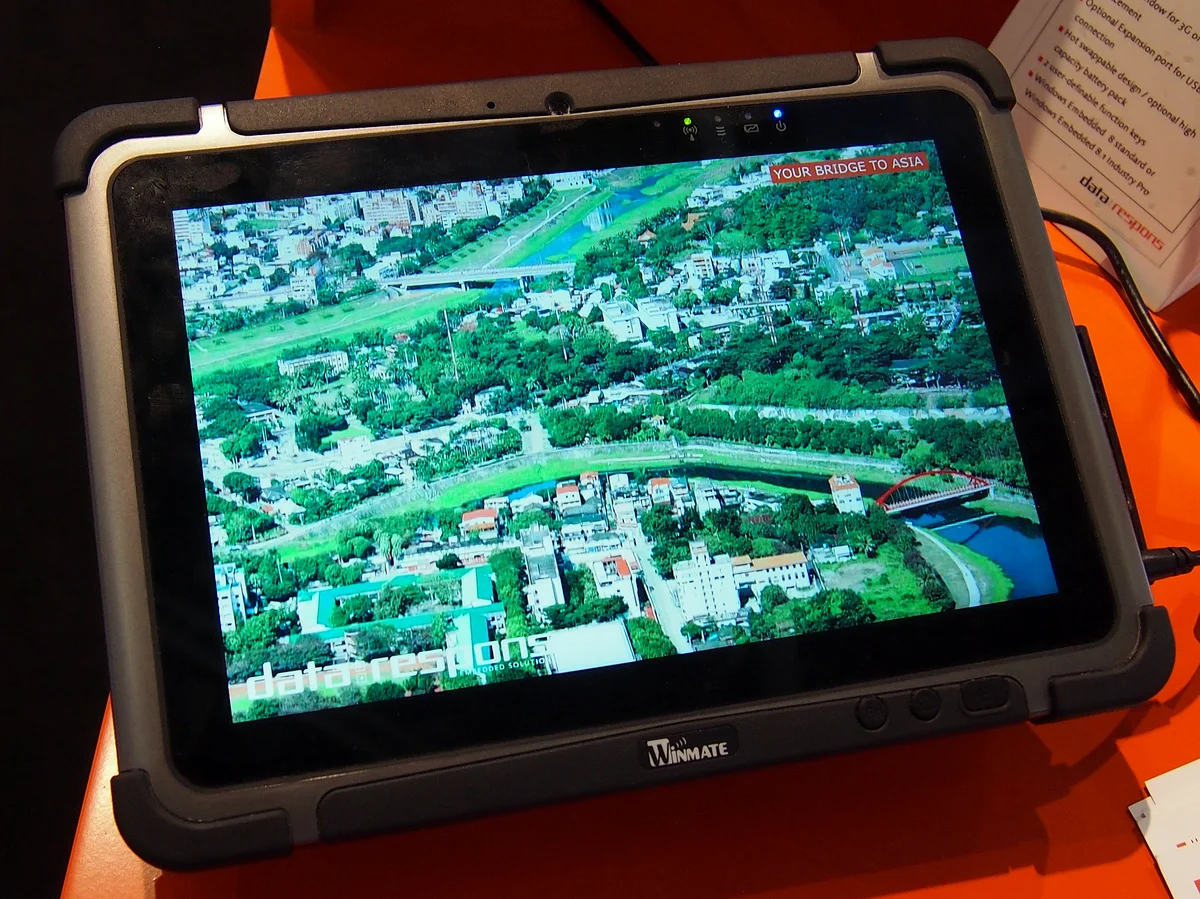 Figure 1: Rugged Android tablet hardware deployed in Australian mining, resources, and field inspection operations.
What Australian enterprises actually need from a mobile framework in 2026
When evaluating cross-platform mobile frameworks through JUHENZA's application development practice, Australian engineering leaders must balance three competing requirements:
- Staffing continuity in a compact talent market: Sourcing senior mobile engineers in Sydney, Melbourne, Brisbane, or Perth carries tangible recruitment friction. A framework that requires six months to replace a departed lead developer introduces severe project risk.
- Defensible field reliability: Apps utilized across mining in the Pilbara, regional utility networks in Queensland, or agricultural transport in regional New South Wales cannot depend on continuous 4G or 5G coverage.
- Predictable long-term maintenance: The initial build quote represents merely 20–30% of lifetime expenditure. Long-term operating costs are dictated by framework upgrade friction, native module deprecations, and device-specific QA.
Offline sync: how Flutter and React Native actually differ
The fundamental principle of offline-first mobile engineering is straightforward: the framework does not make an application offline-first; the architecture does. Both Flutter and React Native can deliver resilient offline experiences. The practical distinctions reside in their local database libraries, background thread concurrency, and native hardware integration overhead.
How offline-first architecture actually works
An offline-first field app treats local device storage as the authoritative source of truth for the user interface. Cloud connectivity is treated as an intermittent transport layer. A standard enterprise offline architecture consists of four distinct components:
- Encrypted local database: Holds the working record set directly on device storage (e.g., SQLite with SQLCipher).
- Change queue (outbox): Captures every local mutation as an immutable event so changes can be replayed sequentially when connectivity is re-established.
- Reconciliation sync engine: Pushes queued outbox mutations, pulls server-side updates using cursor-based pagination, and commits changes within a transactional boundary.
- Deterministic conflict resolution policy: Establishes explicit business rules when identical records are modified concurrently across multiple offline field devices.
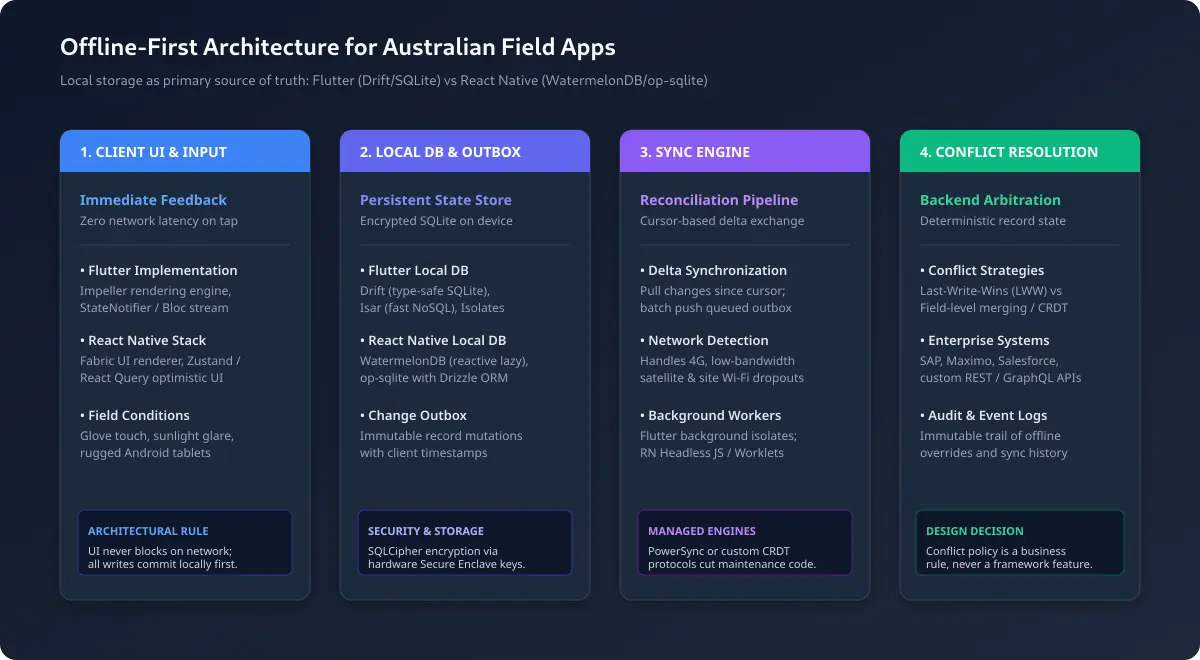 Figure 2: The framework changes the libraries, not the underlying offline architecture.
Flutter offline stack
Flutter's offline ecosystem is compact and cohesive:
- Drift (formerly Moor): A reactive, type-safe SQLite abstraction for Dart with schema migrations and compile-time query verification. It pairs naturally with Dart isolates to offload heavy database read/writes from the main UI thread.
- Isar: A high-speed NoSQL database designed specifically for Flutter, offering fast indexing for large local datasets.
- PowerSync: A managed sync middleware supporting Postgres backends that simplifies client-side SQLite replication.
- Platform channels: Required when interfacing with specialized hardware peripherals (such as Zebra barcode scanners or RFID readers) that lack maintained pub.dev packages.
Flutter's rendering engine (Impeller) ensures that offline forms, complex data grids, and interactive diagrams render identically across all Android hardware models. The trade-off is that niche hardware vendor SDKs frequently require writing custom native bridging code in Kotlin and Swift.
React Native offline stack
React Native benefits from the broader JavaScript and web data ecosystem:
- WatermelonDB: A reactive database engineered specifically for high-volume data sets in React Native apps, utilizing lazy loading and structured
pullChanges/pushChangessynchronization hooks. - op-sqlite / expo-sqlite with Drizzle: High-performance direct SQLite access utilizing the JavaScript Interface (JSI) for near-instant query execution.
- PowerSync: Fully supported on React Native for automated local-to-cloud Postgres synchronization.
- Legacy Realm notice: While Realm was historically popular, MongoDB's Atlas Device Sync reached end of life in September 2025. New enterprise field builds should avoid building architectures dependent on it.
React Native's New Architecture (Fabric, TurboModules, JSI) has eliminated the legacy asynchronous JSON bridge. Calling native hardware interfaces—such as thermal cameras, Bluetooth Low Energy (BLE) beacons, or encrypted keychains—is now synchronous and strongly typed. However, third-party library maintenance varies, and writing TurboModules still requires direct Kotlin and Swift engineering capability.
Offline comparison at a glance
| Architectural component | Flutter ecosystem | React Native ecosystem |
|---|---|---|
| Local database standards | Drift (SQLite), Isar, ObjectBox | WatermelonDB, op-sqlite, expo-sqlite + Drizzle |
| Sync middleware | PowerSync, custom REST/GraphQL outbox | PowerSync, WatermelonDB sync protocol, custom outbox |
| Background concurrency | Dart Isolates; separate memory threads prevent UI drops | JSI + C++ background worklets; Headless JS |
| Peripheral hardware SDKs | Platform channels; custom Kotlin/Swift wrapper often needed | TurboModules; wider open-source package catalog, but variable maintenance |
| Multi-device rendering | High consistency—Impeller draws every pixel | Native OS components; requires QA across diverse Android skins |
| Conflict resolution | Custom business logic applied at sync transaction layer | Custom business logic; WatermelonDB expects server-side diffs |
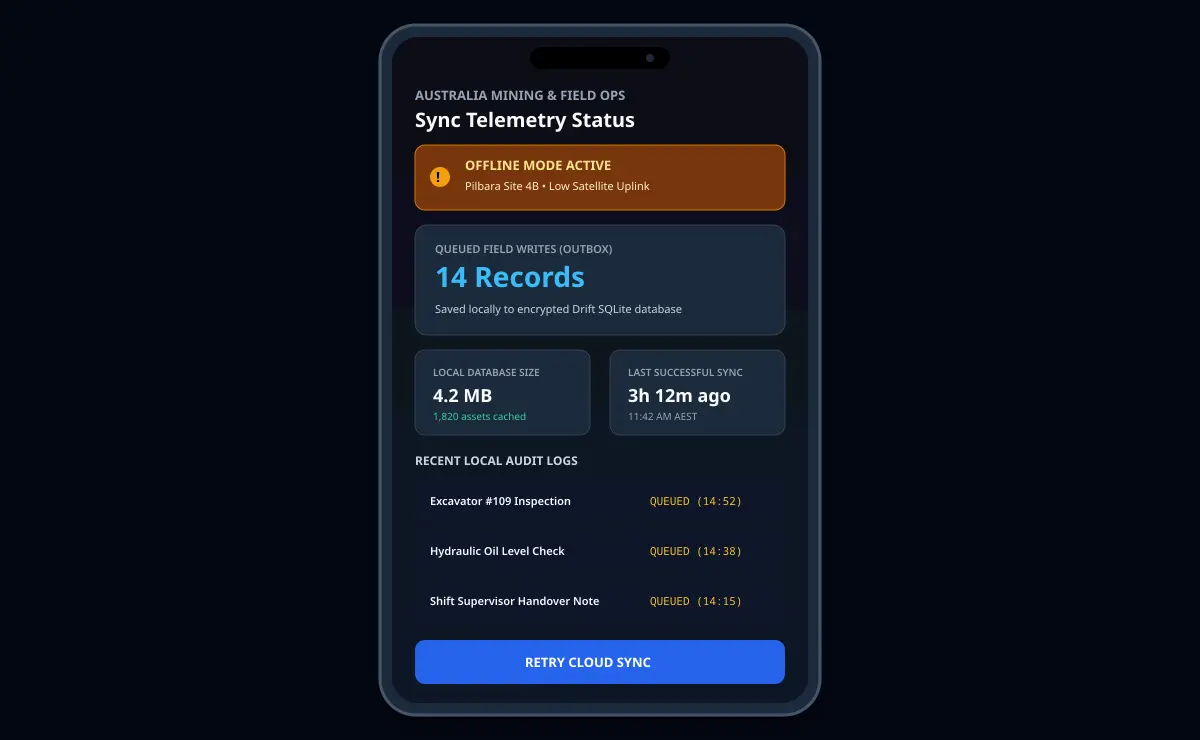 Figure 3: Production offline telemetry showing local SQLite storage, queued field inspections, and satellite uplink status.
The Australian hiring market: supply, rates, and replacement risk
Engineering labor accounts for 70–85% of an application's total lifetime expenditure. In Australia, the developer supply profile represents the core financial consideration when choosing a tech stack.
Advertised salary and contractor day-rate benchmarks (Late 2026)
Public recruitment listings across Sydney, Melbourne, Brisbane, and Perth demonstrate overlapping compensation bands, though candidate availability differs substantially:
| Role & engagement type | Advertised Australian range (AUD) | Market context & recruitment observation |
|---|---|---|
| Senior Flutter developer (Permanent) | $120,000–$165,000 + super | SEEK listings reflect $100k–$110k for mid-level roles, reaching $165k for senior leads in Brisbane/Sydney |
| Flutter developer (Contract) | $100–$150/hr ($850–$1,200/day + GST) | Concentrated in enterprise mobile programs; smaller talent pool creates hiring lag |
| Senior React Native developer (Permanent) | $130,000–$175,000 + super | Enterprise banking and retail roles reaching $190k–$210k including superannuation |
| React Native developer (Contract) | $800–$1,100/day + GST | Broad contractor availability across major Australian metropolitan centers |
| Glassdoor Australia benchmark | ~$132,500 base average | Comparable base compensation across mid-level mobile engineering cohorts |
The structural talent pool advantage
While advertised salary bands are comparable, the candidate pool volume is not:
- React Native draws upon the global JavaScript and TypeScript ecosystem: React web developers can cross-train into React Native within four to eight weeks because state management, hooks, component lifecycles, and npm tooling are directly transferable.
- Flutter requires Dart specialization: Developers must master Dart and Flutter's widget composition tree simultaneously. Cross-skilling backend or web engineers into Flutter requires a longer learning curve.
- Quantifying replacement risk: If a lead Flutter developer departs an Australian regional enterprise, recruiting a qualified replacement typically takes 6–10 weeks longer than hiring a React Native engineer. Maintaining an interim contractor at $1,000/day during that gap incurs a $30,000+ replacement premium before accounting for onboarding friction.
2026 maintenance TCO: a 3-year model for an Australian field app
Industry planning models routinely allocate 15–25% of initial build costs annually for application maintenance. While useful as a top-line heuristic, this percentage obscures where technical maintenance capital is actually spent:
- Managing annual major iOS and Android platform releases;
- Upgrading deprecated third-party libraries and resolving security vulnerabilities;
- Adapting to evolving Google Play and Apple App Store compliance policies;
- Executing regression QA across rugged Android device fleets (e.g., Zebra, Honeywell, Panasonic Toughbook);
- Maintaining native peripheral bridges for hardware barcode scanners and sensors;
- Continuous performance tuning for heavy list virtualization and map layers.
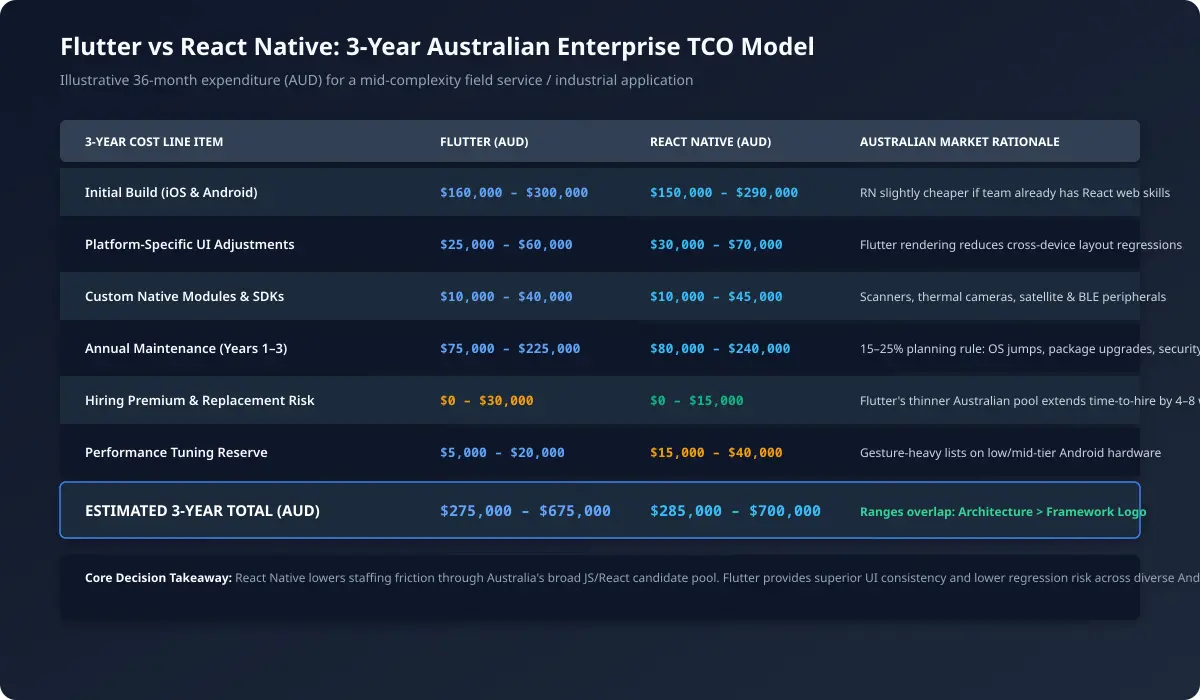 Figure 4: Ranges overlap; the bigger variables are team quality and native-module surface.
Framework maintenance profiles
| Maintenance vector | Flutter profile | React Native profile |
|---|---|---|
| Framework upgrade stability | High stability—unified Google toolchain with centralized breaking change notices | Materially improved via Expo and New Architecture; legacy bare apps still carry upgrade friction |
| Dependency vulnerability risk | Lower risk—smaller, tightly curated pub.dev ecosystem | Higher risk—broad npm dependency trees require continuous Dependabot/Snyk triage |
| UI regression surface | Minimal—independent canvas rendering isolates UI from OEM OS interface updates | Moderate—underlying native component updates across Android skins require device QA |
| Native bridge upkeep | Low surface, but custom platform channels require internal Kotlin/Swift maintenance | High availability of community TurboModules, but package abandonments occur |
| Performance tuning reserve | Low—Impeller engine eliminates shader compilation jank on Android | Moderate—requires disciplined FlashList optimization and memoization for long data lists |
Illustrative 3-year TCO model (AUD)
Financial model context: The figures below illustrate planning assumptions for a mid-complexity Australian field operations app featuring biometric login, offline database synchronization, background GPS tracking, push notifications, and 20 bespoke workflow screens maintained across an enterprise fleet.
| 3-year expenditure line item | Flutter implementation (AUD) | React Native implementation (AUD) | Practical Australian considerations |
|---|---|---|---|
| Initial dual-platform build | $160,000 – $300,000 | $150,000 – $290,000 | React Native is slightly cheaper if the team already possesses React web capability |
| Platform-specific UI adjustments | $25,000 – $60,000 | $30,000 – $70,000 | Flutter's custom rendering reduces cross-device Android visual bugs |
| Hardware SDKs & native bridging | $10,000 – $40,000 | $10,000 – $45,000 | 2–5 peripheral integrations (scanners, RFID, BLE) over three years |
| Annual maintenance (Years 1–3) | $75,000 – $225,000 | $80,000 – $240,000 | Calculated at 15–25% of build annually to accommodate major OS releases |
| Hiring friction & replacement risk | $0 – $30,000 | $0 – $15,000 | Refers to interim contractor premiums during extended recruitment searches |
| Performance tuning reserve | $5,000 – $20,000 | $15,000 – $40,000 | Higher for React Native on low-tier rugged hardware running complex lists |
| Estimated 3-Year Total (AUD) | $275,000 – $675,000 | $285,000 – $700,000 | Total ranges overlap significantly |
Enterprise readiness: security, compliance, and device fleets
Both Flutter and React Native meet enterprise-grade compliance benchmarks when engineered within a zero-trust mobile architecture:
- Australian Privacy Act 1988 & APPs: Field apps caching sensitive personal, location, or telemetry data must utilize AES-256 database encryption (SQLCipher) backed by device hardware keychains (Android Keystore / iOS Keychain) with remote wipe capability.
- Accessibility standards (WCAG 2.2 & DDA 1992): Neither framework provides automated compliance. Flutter requires explicit
Semantics()widget wrapping; React Native requires disciplined accessibility attributes on custom UI components. - Mobile Device Management (MDM): Check Microsoft Intune, VMware Workspace ONE or Jamf support for your target devices, distribution method and security controls. Certificate provisioning, app wrapping and jailbreak detection may need platform-specific configuration.
A weighted decision scorecard for Australian teams
Use this evaluation scorecard in your technical discovery workshop. Assign weights from 1 (low) to 5 (critical) based on your operational constraints, score each framework from 1 to 5, and calculate the weighted total:
| Evaluation factor | Weight (1–5) | Flutter score (1–5) | React Native score (1–5) | Practical assessment criteria |
|---|---|---|---|---|
| Existing team skillset | ___ | ___ | ___ | React Native wins if React/TypeScript developers exist in-house |
| Local talent pool depth | ___ | ___ | ___ | React Native provides substantially lower recruitment friction in Australia |
| Custom UI consistency | ___ | ___ | ___ | Flutter's Impeller engine guarantees pixel-identical layout across devices |
| Offline-first architecture | ___ | ___ | ___ | Tie: Architectural design and local SQLite schema dictate reliability |
| Rugged hardware & SDKs | ___ | ___ | ___ | Prototype the most challenging native scanner SDK before finalizing |
| Multi-platform roadmap | ___ | ___ | ___ | Flutter provides superior desktop (Windows/macOS) code reuse |
| Maintenance predictability | ___ | ___ | ___ | Flutter offers a unified toolchain; React Native requires npm hygiene |
| Low-tier hardware performance | ___ | ___ | ___ | Flutter avoids shader jank on sub-$400 Android devices |
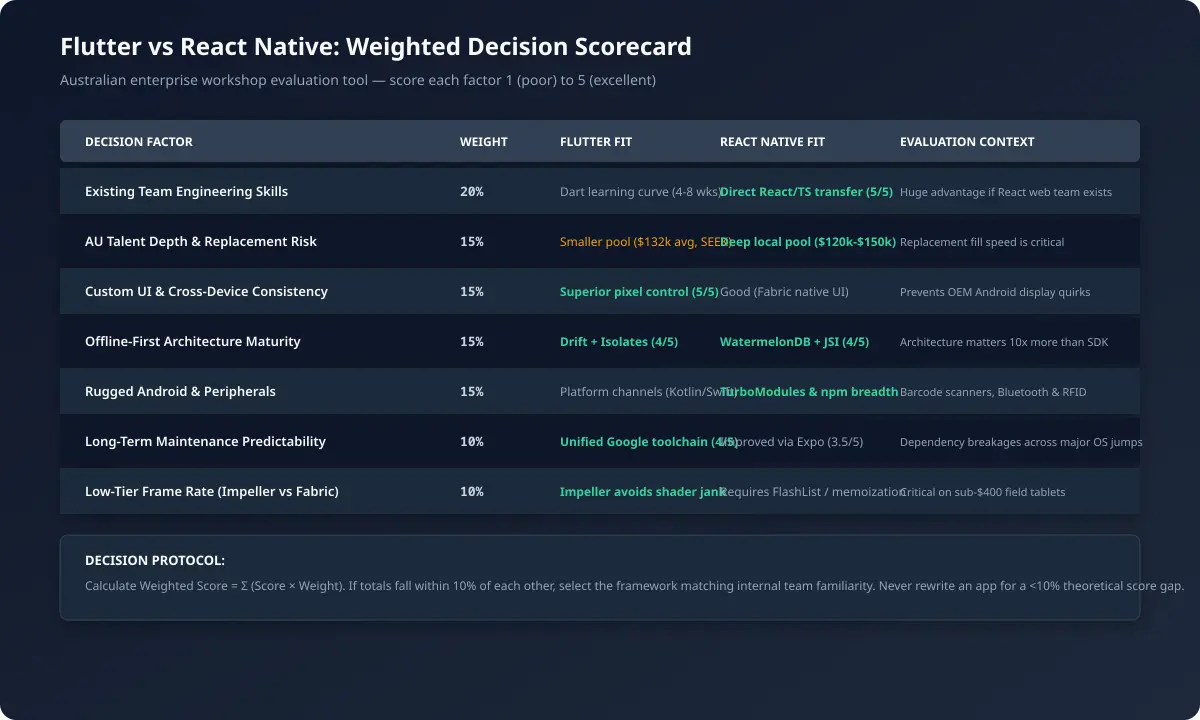 Figure 5: Weighted decision scorecard for workshop evaluation against your team's real constraints.
When native Swift and Kotlin remain the superior choice
Cross-platform development is the correct default for 90% of business applications. However, teams should choose native Swift and Kotlin when:
- The application is centered around advanced LiDAR scanning, augmented reality (ARKit/ARCore), or raw camera frame manipulation;
- Continuous low-latency background Bluetooth Low Energy (BLE) peripheral streaming is required with strict OS execution constraints;
- A mission-critical vendor SDK lacks functional cross-platform wrappers and writing a comprehensive C++ TurboModule or platform channel adds excessive overhead;
- Strict defense, aviation, or banking certification requires platform-attested native binary binaries.
Common mistakes and when to involve a specialist
Common engineering pitfalls
- Selecting a framework prior to prototyping the offline sync engine: The local database schema and conflict resolution model should be validated before frontend framework decisions are signed off.
- Assuming cross-platform eliminates native mobile engineering: Managing background location, camera permissions, push notifications, and cryptographic keychains still requires native Android and iOS comprehension.
- Treating initial build price as total expenditure: Failing to budget for annual OS upgrades, device testing matrices, and package deprecations leads to emergency budget requests in Year 2.
- Overlooking replacement hiring risk: Building in a niche framework without a talent pipeline creates critical key-person dependencies.
When to engage external architecture specialists
Organizations should seek specialized external mobile advisory when:
- Designing complex offline-first data replication across intermittent satellite and 4G links;
- Replacing legacy Xamarin or Cordova applications while maintaining live field operations;
- Requiring an independent 3-year TCO audit to justify capital expenditure to an executive board.
Our team at JUHENZA helps enterprise organizations design mobile systems, evaluate cross-platform architecture trade-offs, and implement reliable offline solutions. Review our client case studies to see how we approach complex digital product delivery, or contact our engineering team to review your mobile roadmap.
FAQ
Is Flutter or React Native cheaper for Australian enterprises?
React Native is typically cheaper to staff upfront because it leverages Australia's extensive React and JavaScript talent pool. Flutter can prove more cost-effective across a multi-year product lifecycle when complex custom UI reduces platform-specific QA overhead. Over three years, total costs frequently converge within 10%.
Can Flutter and React Native handle offline field data reliably?
Yes. Both frameworks support offline-first architectures with encrypted local SQLite databases, immutable outbox change queues, and background synchronization engines. Offline reliability is a function of database architecture and conflict resolution rules, not framework choice.
Which framework is easier to recruit for in Australia?
React Native offers a significantly larger candidate pool across Sydney, Melbourne, Brisbane, and Perth. Furthermore, web developers proficient in React and TypeScript can transition into React Native within four to eight weeks, providing internal cross-training flexibility.
What is the standard annual maintenance cost for an enterprise mobile app?
The standard industry planning benchmark is 15–25% of the original build cost per year. For an app with an initial build cost of $250,000, annual maintenance budgets typically range from $37,500 to $62,500 to accommodate OS platform updates, dependency patches, and device QA.
When should an enterprise choose native mobile development instead?
Choose native Swift and Kotlin when your application requires low-level hardware control (such as advanced LiDAR, continuous BLE streaming, or heavy background processing), when a critical vendor SDK lacks cross-platform bindings, or when regulatory standards mandate native binary attestation.
Conclusion and next step
The choice between Flutter and React Native for Australian enterprise and field applications is not a matter of framework superiority. React Native represents the lowest-friction option for organizations with existing React or TypeScript capabilities seeking the deepest local recruitment pool. Flutter represents the stronger choice when cross-device visual consistency, predictable rendering on varied Android hardware, and long-term mobile-only focus take priority.
The recommended immediate step is to evaluate your specific architectural constraints:
- Conduct an audit of your internal engineering skillset;
- Prototype your most challenging hardware peripheral integration (e.g., barcode scanner or offline database);
- Apply the weighted scorecard in this guide during technical discovery.
If you are planning an enterprise mobile deployment and require experienced architecture guidance, contact JUHENZA to schedule a technical discovery review.
References
- Flutter Official Documentation — Architecture, rendering engine, and platform channel specifications. docs.flutter.dev
- React Native Documentation — New Architecture, TurboModules, and Fabric native components. reactnative.dev
- SEEK Australia — Advertised mobile engineering salary and contractor rate benchmarks. seek.com.au