
Direct answer: Fixing a broken SME dashboard in Singapore requires treating it as a governed data product: re-establish one trusted source and agreed metric definitions, make pipeline failures visible, apply PDPA role-based access controls at the dashboard layer, and assemble EDG/EDGE-ready evidence. Repair before rebuild, run old and new reports in parallel, and assign a named owner for every metric and source.
If your Singapore SME dashboard shows three different revenue figures and nobody trusts the numbers, the problem is rarely the chart library. It is the governed data pipeline, the metric definitions, and the access model behind it. A dashboard is only as reliable as the data flowing into it and the controls around who can see and export that data. This guide gives finance and operations leads a practical repair sequence, a decision framework, a PDPA access matrix, and a grant-readiness checklist—with the EDG→EDGE transition stated accurately as of 14 November 2026.
Why fixing broken SME dashboards in Singapore starts upstream
Most broken dashboards are not broken at the visual layer. They are broken upstream: the data pipeline is unmonitored, the metric definitions are owned by nobody, or the access model was copied from a shared drive. For mid-sized businesses evaluating custom software development to untangle their back-office systems, three failure modes account for most of the damage.
Failure mode 1: the stale or silent pipeline
A dashboard that shows last month’s figures is treated as a report, not a tool. Reports get filed; tools get used. When the pipeline fails silently—a connector token expires, a POS export changes format, a spreadsheet is renamed—the dashboard keeps displaying numbers that look current but are not. The absence of a freshness timestamp is itself a governance defect.
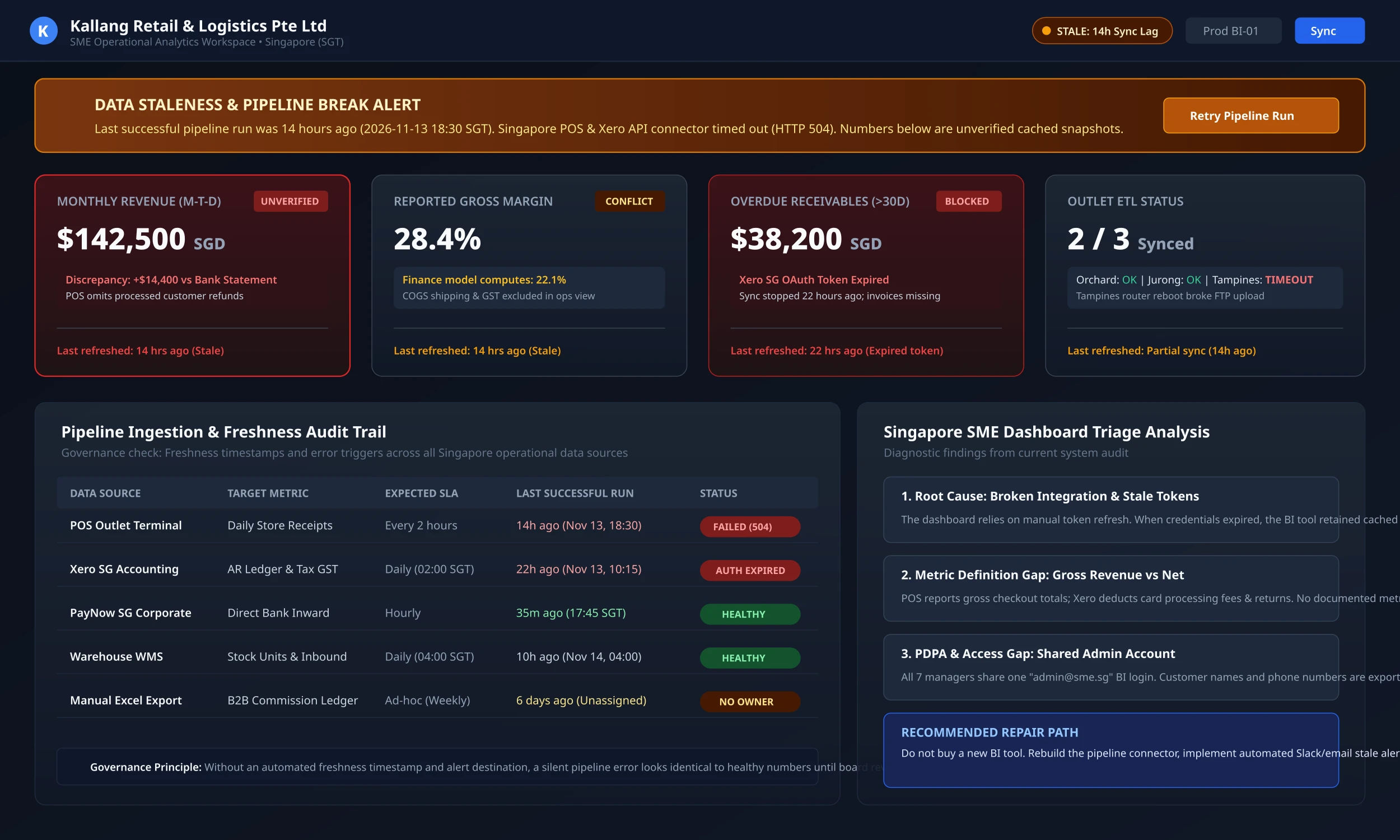 A freshness timestamp is a governance control, not a cosmetic feature.
Failure mode 2: conflicting metric definitions
Finance defines revenue one way; operations defines it another; the dashboard uses a third. This is not a data-quality problem that a cleaner can fix. It is an ownership problem. If no one owns the definition of "active customer", "gross margin", or "overdue receivable", every rebuild will reproduce the same argument in a new tool.
Failure mode 3: uncontrolled access at the dashboard layer
Many SMEs tighten database permissions but leave the BI tool open to everyone. A finance analyst can export customer-level transactions; an operations coordinator can see payroll-linked cost centres; a former employee still has a saved login. Singapore's Personal Data Protection Act (PDPA) requires reasonable security arrangements, and the PDPC’s ICT guide expects access controls, authentication, and monitoring around systems holding personal data. The dashboard is part of that system.
The six-step repair sequence
Step 1: Triage the dashboard before rebuilding it
Do not start with a new tool. Start with a score. The triage score tells you whether the dashboard should be repaired, rebuilt, or retired. A low score is not a failure; it is a decision.
| Criterion | Score 1–5 | What a low score looks like |
|---|---|---|
| Trust | 1 = nobody trusts the numbers | Three different revenue totals in one meeting |
| Freshness | 1 = data is weeks old | "Last refreshed" is hidden or absent |
| Ownership | 1 = no named owner | "IT built it" or "the vendor set it up" |
| Access control | 1 = everyone can see everything | Shared BI login; no role separation |
| Grant evidence | 1 = no documentation | No problem statement, baseline, or acceptance criteria |
| Actual use | 1 = nobody opens it | Dashboard is bookmarked but not used weekly |
Illustrative scoring rule, not a verified benchmark: 6–12 suggests retire or rebuild; 13–20 suggests targeted repair; 21–30 suggests optimise and monitor. The thresholds are planning aids, not universal standards.
Step 2: Re-establish the single source of truth and metric definitions
A single source of truth (SSOT) means there is exactly one authoritative place where each piece of business data lives, and every report references it rather than keeping its own copy. For most Singapore SMEs, the sensible system of record is the accounting platform for financials, the POS for sales transactions, and the inventory module for stock—not a manually updated master spreadsheet.
Write a one-page metric dictionary. For each metric, record: the definition, the source system, the owner, the refresh frequency, and the acceptable error tolerance. This document is also useful evidence for a grant application because it demonstrates that the project is a capability-building exercise, not just a software purchase.
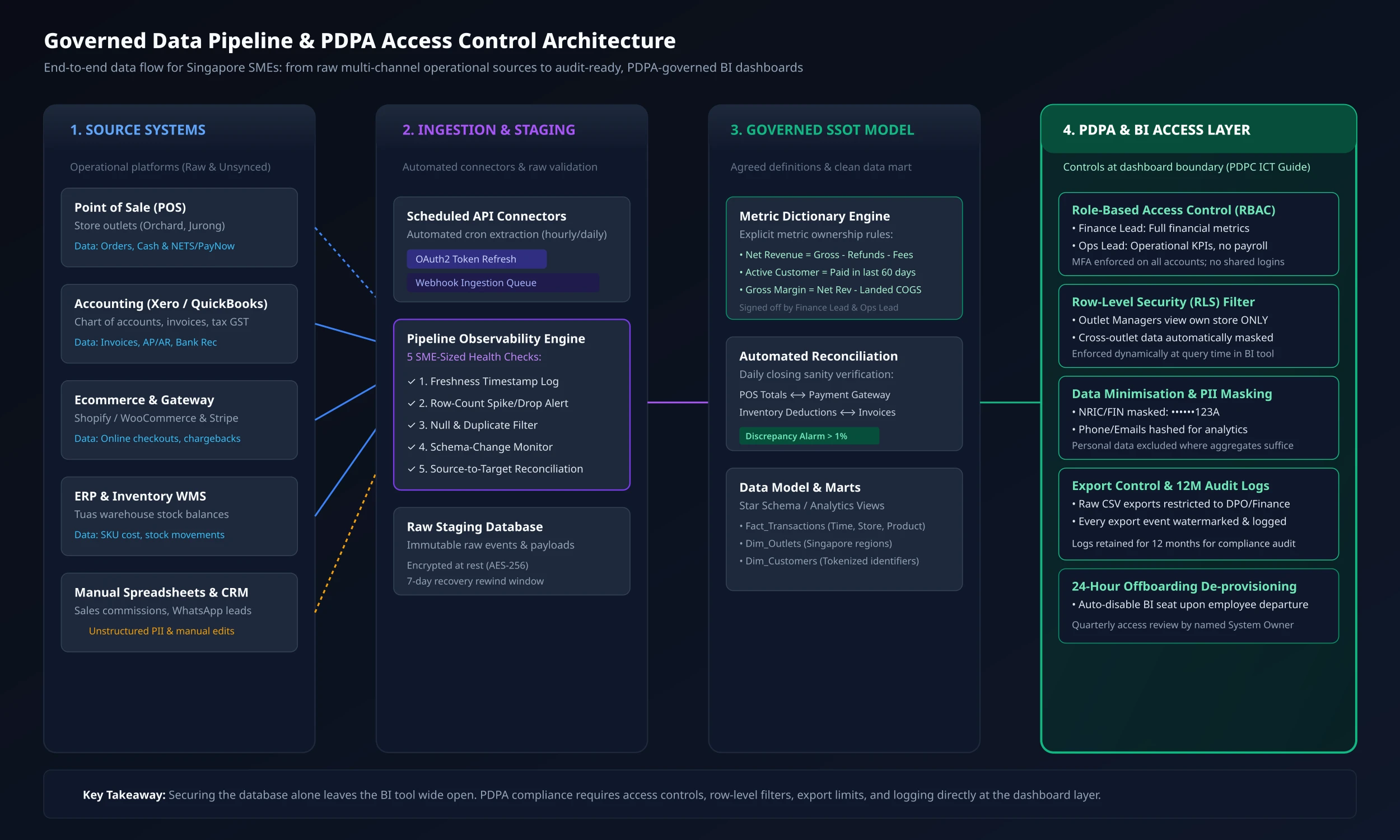 The access-control layer belongs at the dashboard, not only at the database.
Step 3: Rebuild the pipeline with observable failures
A pipeline that fails silently is worse than a pipeline that fails loudly. Add five SME-sized checks:
- Freshness timestamp on every dashboard tile or page.
- Row-count check against the previous run; alert on unusual drops or spikes.
- Null and duplicate checks on key fields such as invoice number, customer ID, and transaction date.
- Schema-change alert when a source column is renamed, added, or removed.
- Reconciliation check between the dashboard total and the source-system total for at least one critical metric.
These checks do not require a large data team. They require an owner, a scheduled query, and an alert destination that someone actually reads. For a governed pipeline that connects operational systems, a custom integration layer is often more reliable than a chain of manual exports; this is the kind of work covered under custom software development and integration and data workflows.
Step 4: Put PDPA access controls around the dashboard, not just the database
PDPA applies to SMEs; there is no small-business exemption. The Protection Obligation requires reasonable security arrangements to prevent unauthorised access, collection, use, disclosure, or disposal of personal data. PDPC enforcement has treated encryption, multi-factor authentication (MFA), role-based access control (RBAC), and logging as expected practices. For a dashboard, this means four controls:
- Role-based access to the BI workspace, not just the database.
- Row-level security so a regional manager sees only their region and a finance lead sees consolidated financials without customer-level identifiers where those are not needed.
- Export and download restrictions for roles that do not need raw data.
- Audit logging of dashboard access, export events, and permission changes, retained for at least 12 months as a practical baseline.
Separate requirements from recommendations from optional best practices:
| Type | Control |
|---|---|
| Requirement (PDPA-aligned) | Role-based access, MFA for remote access, account disablement within 24 hours of termination, access logging |
| Recommendation | Quarterly access reviews, row-level security in the BI tool, export whitelisting |
| Optional best practice | Just-in-time access for sensitive dashboards, data-loss-prevention alerts on large exports, separate staging and production BI workspaces |
Step 5: Make the repair grant-ready under EDG/EDGE
The grant landscape changed on 30 September 2026. EDGE replaced EDG, PSG and MRA for new applications, and it supports digitalisation activities including data analytics and BI. This matters for accuracy: an article that tells you to apply for "EDG" in November 2026 is giving you a stale process. Confirm the current supportable activity and transitional rules directly with EnterpriseSG before you commit to a vendor or sign a contract.
A dashboard repair can be structured as a capability-building project if it includes process redesign, integration, governance, and measurable outcomes—not just a licence purchase. The evidence pack should include:
- The operating problem and the cost of the current failure.
- Baseline metrics: reconciliation errors, hours spent on manual reporting, number of conflicting definitions.
- Scope, deliverables, and acceptance criteria.
- A data-flow map showing source systems, transformations, and dashboard outputs.
- A PDPA access-control matrix and a data-protection impact assessment where personal data is involved.
- Vendor quotations and a cost breakdown separated into consultancy, implementation, software, and internal manpower.
- A post-implementation measurement plan.
Requirements vs recommendations vs optional practices for grant readiness:
| Type | Item |
|---|---|
| Requirement (verify with EnterpriseSG) | Singapore-registered entity; at least 30% local equity; financially viable; project must fall within a supportable activity; do not sign a vendor contract before approval if the scheme requires prior approval |
| Recommendation | A clear problem statement, baseline metrics, and measurable outcomes; a phased scope; a named project owner |
| Optional best practice | A pre-project data-governance review; a post-project access-review cadence; a handover clause giving the SME ownership of credentials and documentation |
This is not legal or grant advice. Grant rules change and individual eligibility depends on facts. Consult EnterpriseSG and a qualified adviser before applying.
Step 6: Prove the fix with a parallel run and a named owner
Run the repaired dashboard alongside the old report for one or two reporting cycles. Compare totals, investigate every material variance, and only then retire the old report. Assign an owner for every source and every metric. The owner is not necessarily the person who builds the pipeline; it is the person who is accountable for the number being right and for escalating when it is not.
Decision framework: repair, rebuild, or retire
| Symptom | Likely cause | Action | Effort | Evidence to keep |
|---|---|---|---|---|
| Numbers are stale but the model is sound | Broken connector or expired token | Repair the pipeline; add freshness alerts | Low–medium | Before/after refresh log |
| Different teams quote different totals | No metric owner or definition | Repair with a metric dictionary and SSOT | Medium | Signed-off definitions |
| Dashboard is rarely opened | Too many metrics; no decision linked | Retire or rebuild around 3–5 decisions | Low | Usage data; decision log |
| Access is broad and unlogged | BI permissions copied from shared drive | Repair access model; add RBAC and logging | Medium | Access matrix; audit-log sample |
| Vendor owns the pipeline and will not hand over | Contract and handover gap | Renegotiate or rebuild with ownership clauses | High | Handover checklist; credential inventory |
| The underlying data is fundamentally untrustworthy | No source ownership; manual spreadsheets | Rebuild from the source system outward | High | Data-flow map; reconciliation report |
Illustrative example, not a verified client case: A Singapore SME with three retail outlets discovers that its monthly revenue dashboard is off by 8–12% because a payment-gateway export omits refunds. The repair is not a new BI tool. It is a reconciliation check between the POS, the gateway, and the accounting system, plus a named owner for the revenue metric. The parallel run compares the repaired figure with the accountant’s closing figure for two months before the old dashboard is retired.
PDPA access-control matrix for a finance/ops dashboard
This matrix is a starting point, not a legal opinion. Map it to your own data inventory and DPO’s advice.
| Role | Data scope | Dashboard capability | Required control | Evidence |
|---|---|---|---|---|
| Owner/Director | Consolidated financials; no unnecessary customer identifiers | View all tiles; export summary | MFA; named account; access review quarterly | Access approval record |
| Finance Lead | Full financials; customer-level only where needed for reconciliation | View and export finance tiles; no raw customer export by default | RBAC; export whitelist; logging | Role definition; export log |
| Operations Director | Operational KPIs; aggregated customer data | View operations tiles; drill to outlet level | Row-level security by outlet; no payroll data | RLS configuration; access review |
| Outlet Manager | Own-outlet KPIs; no other outlets | View own outlet; no export of customer lists | Row-level security; export disabled | RLS test; permission screenshot |
| Analyst/BI Builder | Source data and transformation logic | Build and publish; separate production access | Separate staging/production roles; change log | Role separation evidence |
| Contractor/Vendor | Only the systems in scope | Time-bound access; no standing production access | Just-in-time access; NDA; offboarding checklist | Time-bound approval; removal record |
PDPC guidance also recommends disabling accounts within 24 hours of termination and retaining access logs for at least 12 months as a practical baseline. Apply the same discipline to BI accounts, not just email and finance systems.
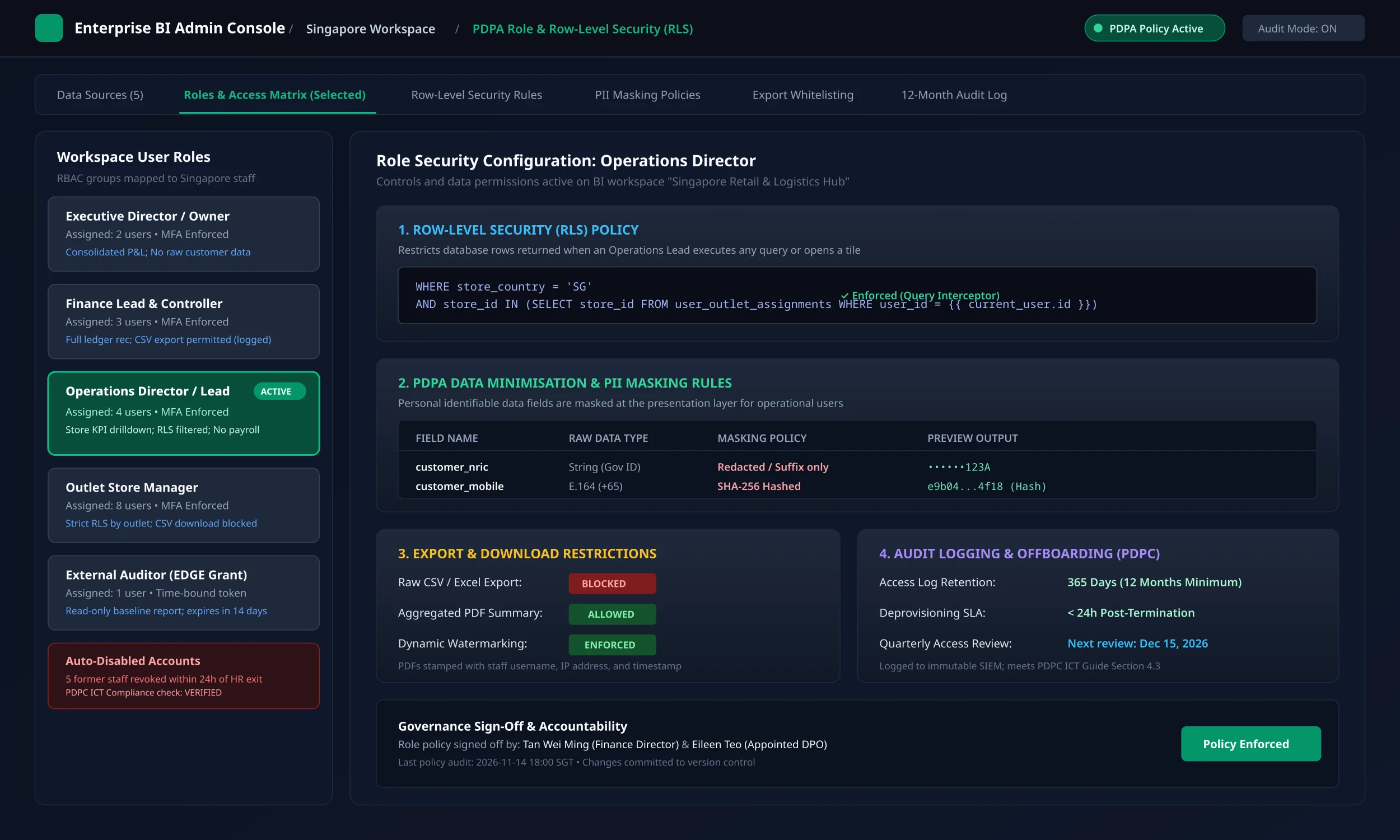 Role-based access in the BI tool, not just the database, is the practical PDPA control.
EDG/EDGE readiness checklist
Use this checklist before you approach a vendor or submit an application.
Requirements to verify with EnterpriseSG
- Singapore-registered business entity.
- At least 30% Singaporean/PR ownership.
- Financially viable; able to start and complete the project.
- Project fits a supportable activity under the current scheme.
- No vendor contract signed before approval if prior approval is required.
Recommendations
- One-page problem statement with the cost of the current dashboard failure.
- Baseline metrics: reconciliation errors, manual reporting hours, number of conflicting definitions.
- Scope with deliverables and acceptance criteria.
- Data-flow map and access-control matrix.
- Vendor quotes broken down by cost category.
- Outcome measurement plan.
Optional best practices
- Pre-project data-governance review.
- Post-project quarterly access review.
- Handover clause covering credentials, documentation, and source-code or configuration ownership.
- A named dashboard owner in the project charter.
Common mistakes
- Buying a new BI tool before fixing the pipeline. A new visual layer on an ungoverned pipeline produces prettier wrong numbers.
- Treating PDPA as a policy document. Access controls, logging, and offboarding are technical obligations, not just privacy-notice updates.
- Letting the vendor own the data model. If you cannot access your own transformation logic and credentials, you cannot repair or audit the dashboard independently.
- Skipping the parallel run. Retiring the old report too early removes the only baseline for detecting a regression.
- Using "EDG" without checking the transition. New applications moved to EDGE; stale process advice wastes time and can invalidate a claim.
- Giving everyone the same BI login. Shared credentials destroy auditability and make least-privilege access impossible.
- Tracking twenty metrics. If everything is highlighted, nothing is. Start with the three to five decisions the owner makes each week.
Limitations and when to involve a specialist
This guide is not legal advice. PDPA is principle-based, and the appropriate controls depend on the sensitivity and volume of personal data your organisation handles. Consult a qualified lawyer or your Data Protection Officer for a binding interpretation. Grant eligibility is fact-specific and rules change; verify current terms with EnterpriseSG. The repair sequence assumes the SME can obtain access to its own source systems, credentials, and transformation logic. If a vendor contract prevents that access, the first project may need to be a contractual and technical handover, not a dashboard rebuild.
Involve a specialist when:
- The pipeline spans multiple vendors and no one can trace a number end to end.
- Personal data is exported to a BI tool without row-level security or logging.
- The project is intended to support an EDG/EDGE application and the evidence pack is incomplete.
- The dashboard is used for board reporting, grant reporting, or regulatory reporting.
- The in-house team has no capacity to own the pipeline after handover.
What this guide is based on
This article is based on published implementation guidance from Singapore regulators and EnterpriseSG, plus publicly available practitioner guides on SSOT and dashboard repair. It is not based on a single named client engagement, and no private client result is claimed. The illustrative scenario above is labelled as illustrative. In custom software and integration workflows, dashboard triage frequently reveals unhandled webhook failures, ERP schema drift, or silent connector timeouts rather than BI calculation bugs. For teams evaluating similar architectures, review our published case studies for the engineering scope behind custom systems, or explore our custom software development practice.
FAQ
Can I fix a broken dashboard without rebuilding the data warehouse?
Yes, often. If the underlying source systems are sound and the failure is a broken connector, an undefined metric, or excessive access, a targeted repair is cheaper and faster than a warehouse rebuild. Start with the triage score and the decision framework above. Rebuild only when the source data itself is untrustworthy or the existing model cannot support the decisions you need.
Does PDPA require role-based access for dashboards?
PDPA requires reasonable security arrangements to protect personal data from unauthorised access. PDPC guidance treats access controls, authentication, and monitoring as expected practices for ICT systems holding personal data. A dashboard that exposes customer-level data to every employee is difficult to defend as "reasonable". Role-based access, row-level security, and access logging are practical ways to meet the obligation.
Is a dashboard repair EDG-eligible after the EDGE transition?
Potentially, if the project fits a supportable activity under the current scheme and meets the eligibility criteria. EDGE replaced EDG, PSG and MRA for new applications from 30 September 2026, and it supports digitalisation activities including data analytics. Do not rely on pre-transition EDG descriptions. Verify the current activity scope and approval sequence with EnterpriseSG before signing a vendor contract.
How long should a parallel run last?
One to two reporting cycles is a practical minimum for most SMEs. If the dashboard supports financial closing, grant reporting, or board reporting, run it for at least two full closes and reconcile every material variance. The parallel run is not a formality; it is the evidence that the repaired pipeline is stable.
Who should own the dashboard?
A named business owner—usually the Finance Lead or Operations Director—should own the decisions the dashboard supports and the metric definitions. A technical owner should own the pipeline and the access model. These can be the same person in a small SME, but the accountability must be explicit. "IT built it" is not ownership.
What if our vendor owns the pipeline and will not hand over credentials?
That is a governance and contractual risk, not just a technical inconvenience. Review the contract for handover, access, and source-code or configuration ownership clauses. If the vendor will not provide reasonable access, plan a rebuild or renegotiation. Do not build a grant application on a system you cannot audit or operate independently.
How should we handle personal data in a finance dashboard?
Apply data minimisation first: does the finance dashboard need customer names, NRIC numbers, or individual transaction details, or can it use aggregated or pseudonymised data? Where personal data is necessary, apply row-level security, restrict exports, log access, and include the dashboard in your data-protection impact assessment and retention schedule.
What evidence does EnterpriseSG expect for a data analytics project?
At a minimum, expect to explain the business problem, the project scope, the expected capability improvement, the cost breakdown, and the measurable outcome. A data-flow map, metric dictionary, access-control matrix, vendor quotations, and a post-implementation measurement plan make the application easier to assess and strengthen the case that the project is capability-building rather than a software purchase.
Conclusion
A broken SME dashboard is rarely fixed by a new chart library. Fix the governance first: triage the dashboard, re-establish the SSOT and metric definitions, make pipeline failures visible, apply PDPA access controls at the BI layer, and assemble the evidence that an EDG/EDGE application would require. Then prove the fix with a parallel run and a named owner.
If you need a governed pipeline, role-based dashboard access, or a handover-ready system that your team can actually operate, JUHENZA scopes custom software and integration projects from the operating problem. Start with the brief, review the company’s delivery model and Singapore and regional market coverage, or book a scoping consultation to discuss what happens today when a dashboard number is challenged. That description is more useful than a list of preferred BI tools.
References
- Personal Data Protection Commission (Singapore), Guide to Data Protection Practices for ICT Systems, revised 14 December 2024. Official PDF
- Enterprise Singapore, FAQ: EDGE Grant. Official page