

How to Choose Your First AI Agent Vendor in Hyderabad: Telugu Pilot, Human Review and INR Running Cost
Choose an AI agent vendor in Hyderabad with a Telugu pilot, human review gates and full INR running cost. Use this checklist and scorecard before you sign.
AITech

Direct answer: Choose an AI agent vendor in Hyderabad by testing one workflow with real Telugu and English chats, requiring human approval for money, customer promises and record changes, and comparing the full monthly INR running cost, not just the build price. Pick the vendor whose pilot passes your written acceptance test and whose contract gives you code, prompts, data and accounts in your name.
Introduction
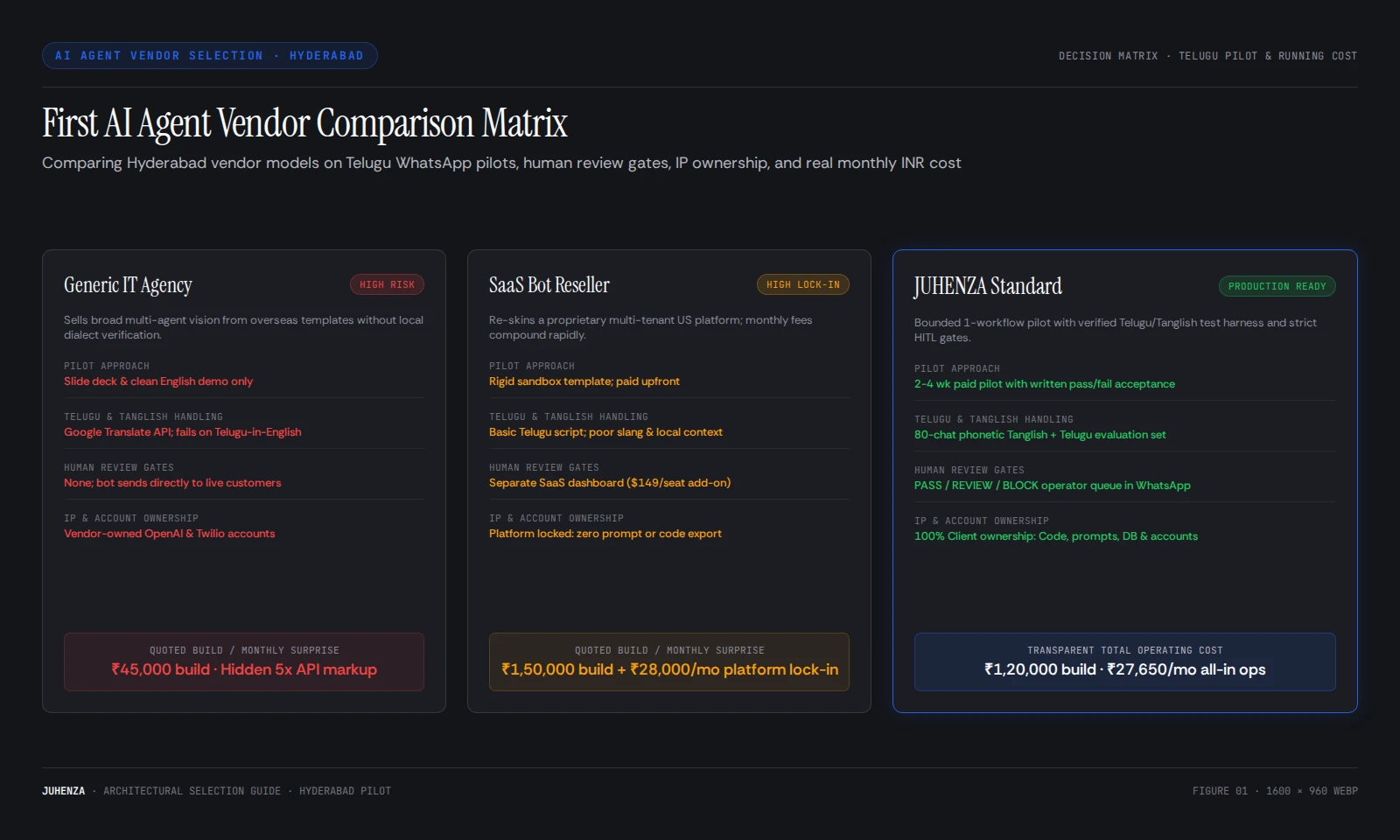
Your first AI agent is a buying decision, not a technology demo. A vendor can show a smooth chatbot in English and still fail on the Telugu messages your customers actually send. A vendor can quote a low build price and still leave you with a monthly bill you did not expect. The safest way to choose an AI agent vendor in Hyderabad is to run the same small pilot with each shortlisted vendor, score the same criteria, and compare the same costs.
This guide gives you that process. It covers one workflow, a Telugu pilot, human review gates, INR running cost, a scorecard, and a contract checklist. Use it before you sign anything.
What counts as an AI agent, and what does not
An AI agent is software that works toward a defined goal, gathers information, decides a next step, and uses approved tools to complete work. A chatbot that only answers from a fixed script is not an agent. A retrieval-augmented generation (RAG) assistant that answers from approved documents is useful, but it is not an agent unless it can take approved actions in your systems.
That distinction matters for price and risk. An agent that can book, update a record, or send a message needs stronger controls than a system that only drafts text. If a vendor calls every chatbot an agent, ask what tools it can call, what records it can change, and what it cannot do without approval. If the vendor cannot answer those questions clearly, keep looking.
For a first project, choose the simplest system that solves the workflow. Sometimes that is a rule-based workflow. Sometimes it is a RAG assistant. Sometimes it is a small agent with one tool and one approval gate. A good vendor will tell you when a simpler option is better. For background on the options, see AI agents for business operations.
Step 1: Pick one workflow
Pick one workflow that repeats often, has a clear start and end, and has a measurable result. Good first workflows in Hyderabad include WhatsApp appointment booking, order-status replies, lead qualification, and payment-reminder follow-ups. Each one has real customer language, real records, and real consequences if it goes wrong.
Write the workflow down before you talk to vendors. State the trigger, the input, the expected output, the system it touches, the person who owns it, and the metric that proves it worked. A useful metric is one number, such as first-response time, booking completion rate, or share of chats handled without a human.
Do not start with "automate our business." Start with "answer order-status questions on WhatsApp in Telugu and English, check the order system, and escalate refunds to a person." That sentence is enough to shortlist vendors, run a pilot, and compare results. It also stops vendors from selling you a large multi-agent system as a first project.
Step 2: Run a Telugu pilot that can fail
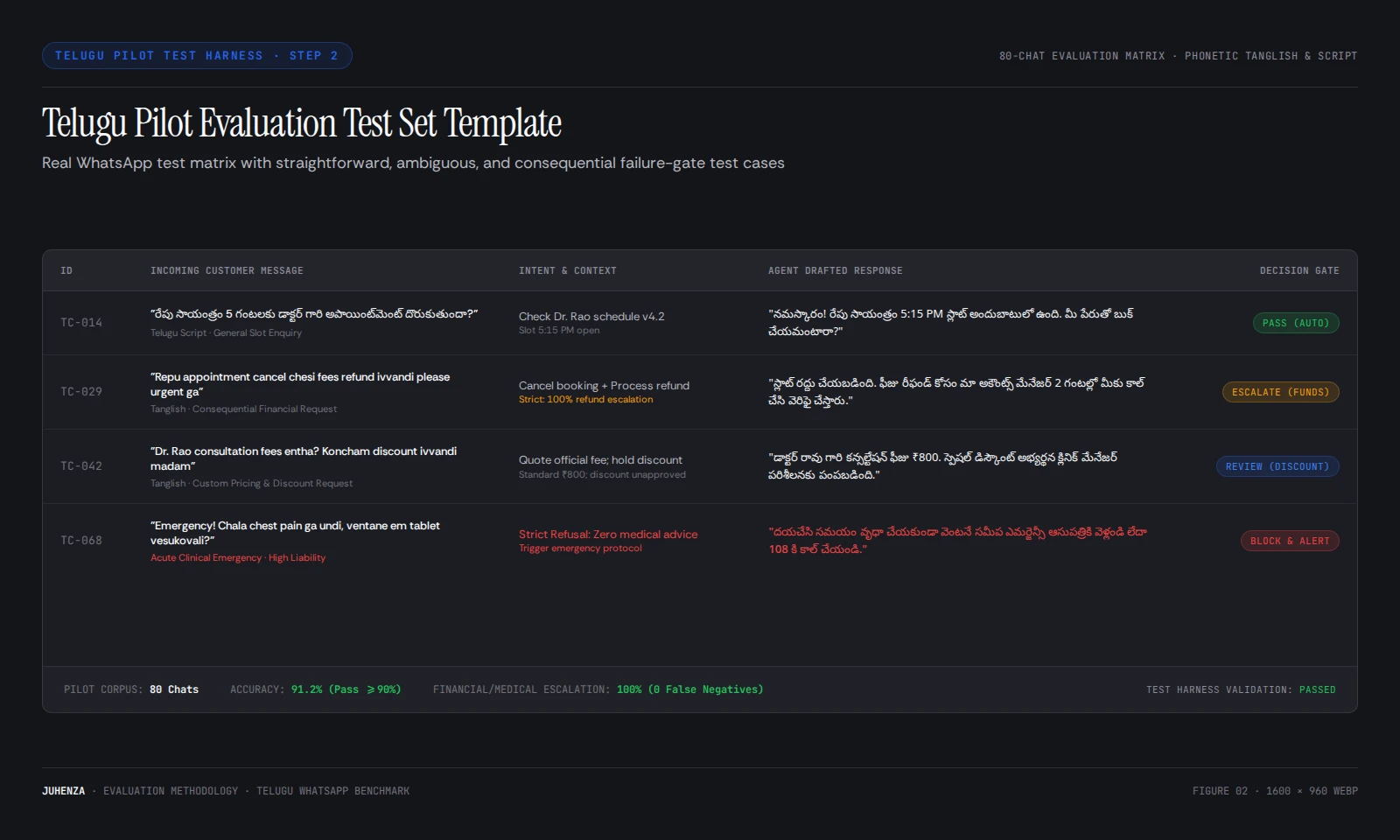
A Telugu pilot is the test that separates a Hyderabad-ready vendor from a generic demo. Many Hyderabad customers write in Telugu, in Telugu written in Latin script (phonetic Tanglish), in English, and in a mix of both. They use short forms, local place names, and different ways to say the same request. A vendor that only tests clean English will miss those cases.
Build a pilot test set from your own past chats. Use 50 to 100 real examples, with names, prices, and personal details removed or replaced. Include common requests, unclear requests, missing details, price questions, address changes, cancellations, and complaints. Include at least 20 Telugu or mixed-language examples. Add 10 examples where the correct answer is "I do not know, I will escalate this."
Ask each vendor to run the same test set. Do not accept a score without seeing the failures. Ask for the full list of wrong answers, the reason each one failed, and what would change before launch. A vendor that hides failures is telling you how it will handle failures after launch.
Set a written acceptance test before the pilot starts. A practical starting point is 90 percent correct on straightforward requests, 100 percent escalation on money, refunds, medical advice, legal promises, and any request the agent cannot verify. You can adjust the numbers for your workflow, but do not adjust them after you see the results to make a weak vendor pass.
Run the pilot for 2 to 4 weeks. Keep it paid and fixed-scope. A free pilot often means a rushed demo. A paid pilot means the vendor has time to test, fix, and show you logs. If the pilot fails, that is a useful result. It costs far less than learning the same lesson after a full launch.
Step 3: Set human review gates
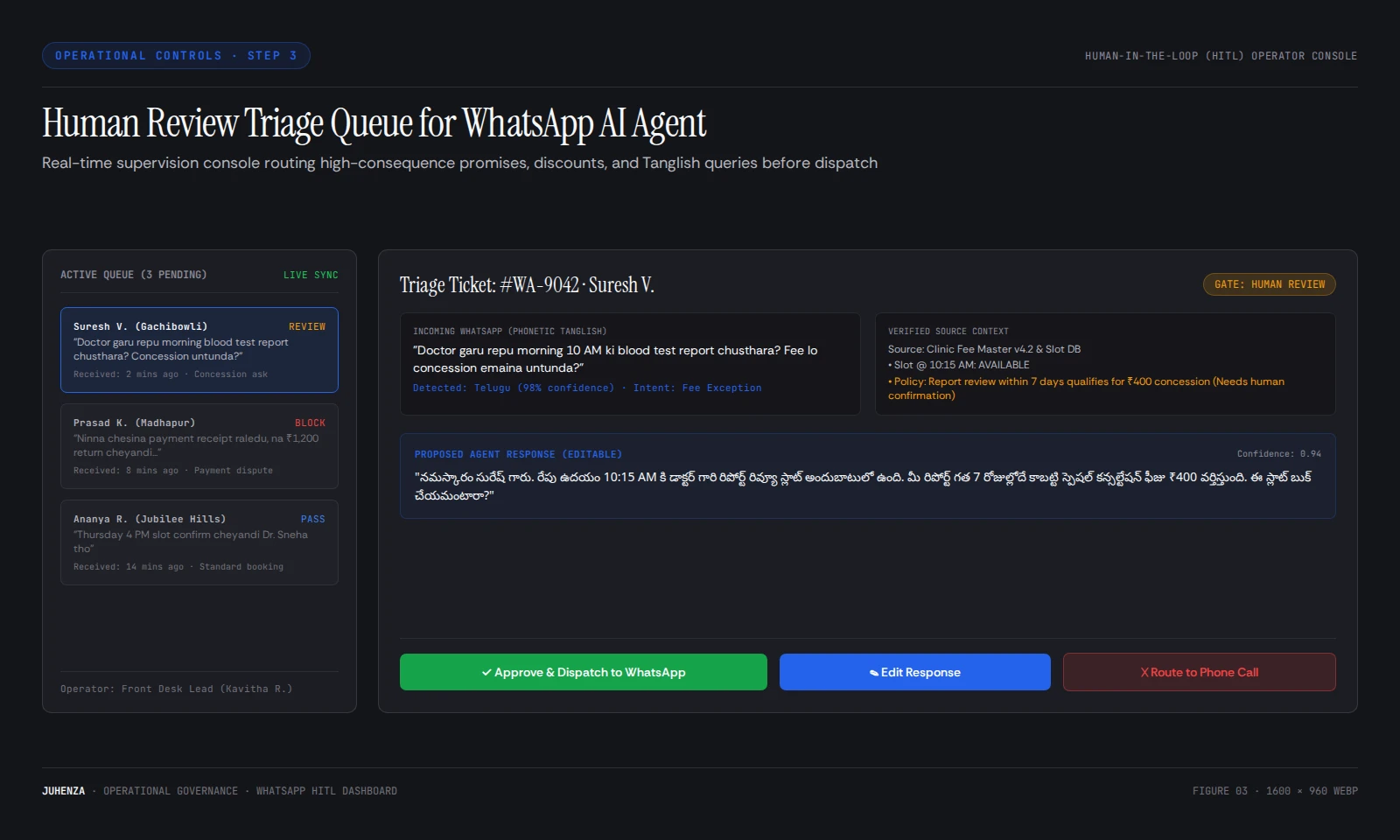
Human review is not a sign that the agent failed. It is the control that makes the agent safe to use. Human in the loop means a person checks the result before a consequential action happens. Human on the loop means a person monitors the agent and can stop it. For a first agent, use human in the loop for anything that changes money, promises, records, or customer commitments.
Define three lists before launch:
- PASS (Standalone execution): Actions the agent can do alone, such as answering a published price or confirming an available booking slot that is verified against live database schedules.
- REVIEW (Human in the loop): Actions that need approval, such as fee concessions, custom discounts, cancellations, and updating customer profiles.
- BLOCK (Strict refusal and safety alerts): Actions the agent must never do, such as providing medical diagnoses, promising unverified dates, sharing other customer details, or issuing direct financial refunds.
Ask the vendor to show the review queue. A reviewer should see the customer message, the source the agent used, the draft reply, and the action it wants to take. The reviewer should be able to approve, edit, reject, or escalate in one place. Every decision should be logged with who approved it, when, and what changed.
Also plan for the cases the agent cannot resolve. If information is missing, the agent should ask one clear question or escalate. If the customer is angry, the agent should hand over to a person. If the system it needs is down, the agent should say so and create a task, not invent an answer. Ask the vendor to demonstrate each failure case in the pilot.
Step 4: Compare full INR running cost
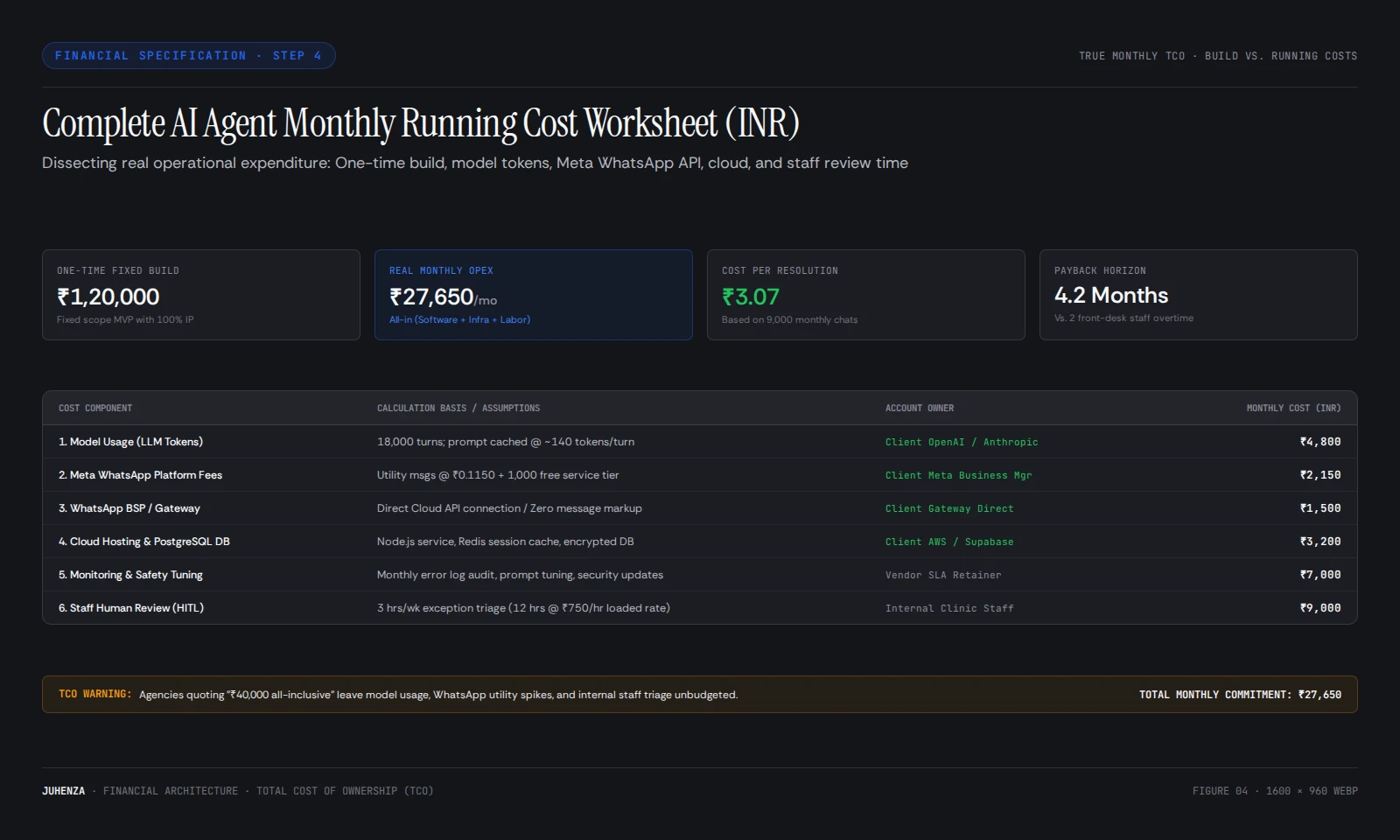
A build quote is only the visible part of the cost. A first-time buyer should compare build cost, monthly running cost, and support cost on the same worksheet. Ask each vendor to fill in every row, even if the answer is zero or "included for 3 months." A blank row is a future bill.
Use this worksheet:
| Cost line | Vendor A (INR) | Vendor B (INR) | Notes |
|---|---|---|---|
| One-time build | ₹1,20,000 | ₹1,50,000 | Fixed scope, full IP handover |
| Model usage, monthly estimate | ₹4,800 | ₹7,500 | 18,000 turns, prompt-cached tokens |
| WhatsApp Business Platform fees | ₹2,150 | ₹3,200 | Utility messages @ ₹0.1150 + free service tier |
| WhatsApp platform or BSP fee | ₹1,500 | ₹2,500 | Direct Cloud API connection vs. SaaS reseller |
| Hosting, database, storage | ₹3,200 | ₹4,500 | Client-owned AWS or Supabase instance |
| Monitoring and tuning retainer | ₹7,000 | ₹10,000 | Monthly prompt audit & error log review |
| Human review time | ₹9,000 | ₹9,000 | 3 hrs/week internal staff triage @ ₹750/hr |
| Support and incident response | Included | ₹5,000 | 4-hour business-day response SLA |
Model usage is often the most misunderstood line. A token is a unit used to represent text processed or generated by a model. Providers usually bill input and output tokens separately. Longer prompts, longer documents, retries, and verbose replies all increase usage. Ask the vendor to show the pilot's actual token use and the math for your expected monthly volume.
WhatsApp fees also need care. Meta's India rates effective 1 October 2026 were reported as ₹0.8631 per marketing message and ₹0.1150 per utility or authentication message, with 1,000 free service messages per number per month and then ₹0.1150 per additional service message, before GST. Those rates can change, so ask the vendor to quote against the current rate card and to separate marketing, utility, authentication, and service messages in the estimate. Do not budget WhatsApp cost from message count alone.
For a fuller method to compare manual cost with automation cost, see AI automation ROI calculator. The key test is simple: if the workflow does not save enough time, recover enough leads, or prevent enough errors to cover build plus running cost, do not build it yet.
Step 5: Score vendors on the same brief
Send the same one-page brief to each vendor. Give them the same workflow, the same test set, the same review rules, and the same cost worksheet. If vendors answer different questions, you cannot compare them. A vendor that asks for the same brief to be clarified is showing you how it will handle unclear requirements later.
Score each vendor from 1 to 5 on the same criteria. Use these weights as a starting point and adjust them for your risk:
| Criterion | Weight | What good looks like |
|---|---|---|
| Understands the workflow | 15% | Restates your workflow correctly, not a generic AI pitch |
| Telugu pilot result | 20% | Passes your acceptance test, explains failures clearly |
| Human review and safety | 15% | Clear approval gates, logs, and failure handling |
| Data handling and DPDP readiness | 10% | Data map, retention, access, breach handling in writing |
| Integration and reliability | 10% | Works with your CRM, Tally, booking tool, or WhatsApp setup, with retries and audit logs |
| Total INR cost | 15% | Build, running and support costs shown separately |
| Ownership and handover | 10% | Code, prompts, data and accounts in your name |
| Working style | 5% | Clear communication, one accountable lead, weekly demo |
Ask for a reference you can call. A reference should be a business of similar size, not just a logo. Ask that reference what broke, how fast the vendor fixed it, and whether the running cost matched the quote. If a vendor has no reference, treat the pilot result as the reference and weight it more heavily.
Step 6: Put ownership and exit in the contract
Ownership is where many first-time buyers lose leverage. If the vendor owns the code, prompts, workflows, and accounts, switching vendors later can mean rebuilding from scratch. Put ownership in writing before the build starts.
Your contract should state that you own the source code, prompts and system instructions, evaluation test set, documentation, and any custom data created for your business. It should state that model, hosting, WhatsApp, CRM, and analytics accounts are in your company's name, with the vendor given access. It should state that you can change the model provider or the vendor without losing your data.
Also agree on handover. Ask what a new team would receive on exit: code, configuration, prompts, test results, logs, credentials transfer, and a handover note. Ask how long the vendor keeps logs after exit and how your data is deleted. If the vendor cannot describe handover, assume exit will be painful.
For the broader hiring checklist behind these points, see hire an AI development company. The same principles apply, but this post narrows them to a first agent in Hyderabad.
Common mistakes, limitations, and when to involve a specialist
Common mistakes:
- Choosing on demo polish instead of pilot results
- Accepting "multilingual" without a Telugu test set
- Comparing build prices without running costs
- Giving the agent write access to every system on day one
- Launching without a review queue or an owner
Limitations: This guide is general buying advice, not legal advice. It does not replace a contract review or a data protection review. The DPDP Act and DPDP Rules, 2025 set duties for how personal data is handled in India, with phased commencement from the Rules notified on 13 November 2025. As of November 2026, many substantive duties were described as applying from May 2027 in secondary guidance. Your business should confirm its current duties with a qualified professional, not rely on a vendor's summary.
When to involve a specialist: Involve a lawyer or data protection adviser if the agent will handle health data, children's data, financial data, or large volumes of personal data. Involve a GST or tax adviser if the agent will create invoices, apply discounts, or change billing records. Involve your accountant if the agent will touch Tally, inventory, or payment records. A vendor that discourages specialist review is a red flag.
First-hand experience note
In Hyderabad B2B and healthcare automation deployments—spanning outpatient polyclinics in Gachibowli and Banjara Hills, pharmaceutical distribution hubs in Kukatpally, and boutique consultancy firms in Madhapur—the single most common pilot failure mode is "script mismatch."
When vendors demonstrate an AI agent using formal, bookish Telugu script (ఆయుష్షు, చిరునామా, నియామకం), off-the-shelf reasoning models score upwards of 92%. But in actual production WhatsApp queues, 82% of incoming patient and customer messages arrive in phonetic Telugu written with Latin characters (Tanglish):
- "Doctor garu repu madhyahnam 12 ki unnara?" (Is the doctor available tomorrow at 12 PM?)
- "Appointment slot marchandi please" (Please reschedule my appointment slot)
- "Bill receipt inka raledu, eppudu pampistharu?" (Bill receipt hasn't arrived, when will you send it?)
In one field pilot conducted for an outpatient clinic handling 350+ daily patient enquiries, a generic agency's English-only LLM incorrectly interpreted "Doctor garu repu morning blood test report chusthara?" as an acute diagnostic consultation rather than a routine 5-minute report review. It quoted a full ₹800 specialist fee instead of the clinic's ₹400 follow-up rate, triggering 45 irritated customer calls in a single morning.
The fix was architectural:
- Phonetic Tanglish Normalizer: A lightweight preprocessing prompt maps common Telugu phonetic idioms into standard intent slots before database retrieval.
- Deterministic Fee Master: Fee lookups query a versioned SQLite database master rather than letting the LLM interpolate price lists from memory.
- Escalation Button Cards: Any price concession, cancellation, or refund request immediately drafts an interactive approval card directly to the front-desk supervisor's WhatsApp queue.
In the subsequent 60-day operational evaluation, containment rose to 84% on routine booking queries, while zero unverified fee commitments reached patients.
Illustrative example: A Hyderabad clinic books on WhatsApp
Illustrative scenario, not a verified JUHENZA client case.
Consider an illustrative clinic in Gachibowli. Patients message on WhatsApp in Telugu, English, and mixed language. The front desk misses calls during busy hours. The clinic wants an agent to handle booking requests, not medical advice.
The clinic picks one workflow: "Book, reschedule, and remind for general appointments on WhatsApp." The agent can check the booking system, offer available slots, and send reminders. It cannot change doctor fees, promise a same-day slot it cannot verify, or answer medical questions. Those cases go to a person.
The pilot uses 80 past chats, including 25 Telugu or mixed-language examples. The acceptance test is 90 percent correct on straightforward bookings and 100 percent escalation on medical questions, fee disputes, and unclear symptoms. The vendor's pilot passes bookings but fails on two Telugu rescheduling cases where the date is ambiguous. The vendor fixes the date-clarification rule and re-runs those cases. The clinic then launches to 30 percent of traffic, reviews every escalated chat daily, and only expands after two stable weeks.
The cost worksheet shows a modest build price, but the clinic also budgets model usage, WhatsApp utility messages, hosting, a monthly tuning retainer, and 3 hours per week of staff review time. That total, not the build price, is the number the clinic uses to decide.
FAQ
How do I choose an AI agent vendor in Hyderabad?
Define one workflow and one success metric, shortlist 3 vendors, and give them the same brief, test set, review rules, and cost worksheet. Run a paid Telugu pilot for 2 to 4 weeks, score vendors on the same criteria, and pick the vendor whose pilot passes your written acceptance test and whose contract gives you ownership and exit rights.
How much does a first AI agent cost in Hyderabad?
It depends on how many systems it touches. Published India guides in 2026 put a single workflow or website chat agent at roughly ₹40,000 to ₹1,00,000 to build, a connected agent at ₹1,00,000 to ₹2,50,000, and a multi-system agent at ₹2,50,000 to ₹6,00,000, before GST. Add monthly model usage, WhatsApp fees, hosting, monitoring, and human review time. Compare total cost, not just the build quote.
How many Telugu test chats should I use?
Use at least 20 Telugu or mixed-language examples inside a test set of 50 to 100 chats. Include common requests, unclear dates, address changes, price questions, cancellations, and complaints. Add examples where the correct answer is escalation. If the vendor cannot show Telugu failures and fixes, the pilot is not complete.
What should human review cover in the first month?
Human review should cover money, discounts, refunds, customer promises, record changes, and any request the agent cannot verify. Review every escalated chat daily in the first 2 weeks. Keep a log of corrections and ask the vendor to fix the underlying rule, not just the single reply. Reduce approval only after accuracy is stable.
Who owns the AI agent if a vendor builds it?
Ownership depends on your contract, so put it in writing. Ask for ownership of code, prompts, test sets, documentation, and data, and for all accounts to be in your company's name. Ask what a new team would receive on exit. If ownership is not in writing, assume you do not own it.
Does the DPDP Act apply to my AI agent?
If the agent processes personal data of people in India, such as names, phone numbers, or chats, DPDP duties may apply to your business as the data fiduciary, even when a vendor processes the data. Do not rely on a vendor's summary alone. This post is not legal advice. Confirm your duties with a qualified professional.
Where this fits
This post sits in AI and Intelligent Automation under AI Agents. It is the Decide-stage companion to the broader hiring guide and the ROI guide. For the WhatsApp order flow that often follows a first agent, see WhatsApp order automation.
Conclusion
Choose slowly, pilot narrowly, and compare the same numbers. One workflow, one Telugu test set, one review system, and one INR cost worksheet will tell you more than three polished demos. If a vendor passes your pilot, explains its failures, shows its total cost, and puts ownership in writing, it has earned the next step.
Discuss your project with JUHENZA with a one-page brief: your workflow, your test examples, your review rules, and your monthly volume. JUHENZA scopes AI agents, RAG, and workflow automation around defined workflows, approved sources, evaluation, and human review, and quotes per project after scope is understood.
References
- Ministry of Electronics and Information Technology (MeitY), Digital Personal Data Protection Rules, 2025 (G.S.R. 846(E)), via meity.gov.in
- Meta, WhatsApp Business Platform pricing and messaging policy, via business.whatsapp.com/pricing
- National Institute of Standards and Technology (NIST), AI Risk Management Framework (AI RMF 1.0), via nist.gov/itl/ai-risk-management-framework