

AI Agent Pilot Gurugram: How Service Firms Prove ROI in 30 Days
Run a 30-day AI agent pilot in Gurugram for lead response, CRM updates and human review. See baseline, full costs, scorecard and the go/no-go decision.
AITech

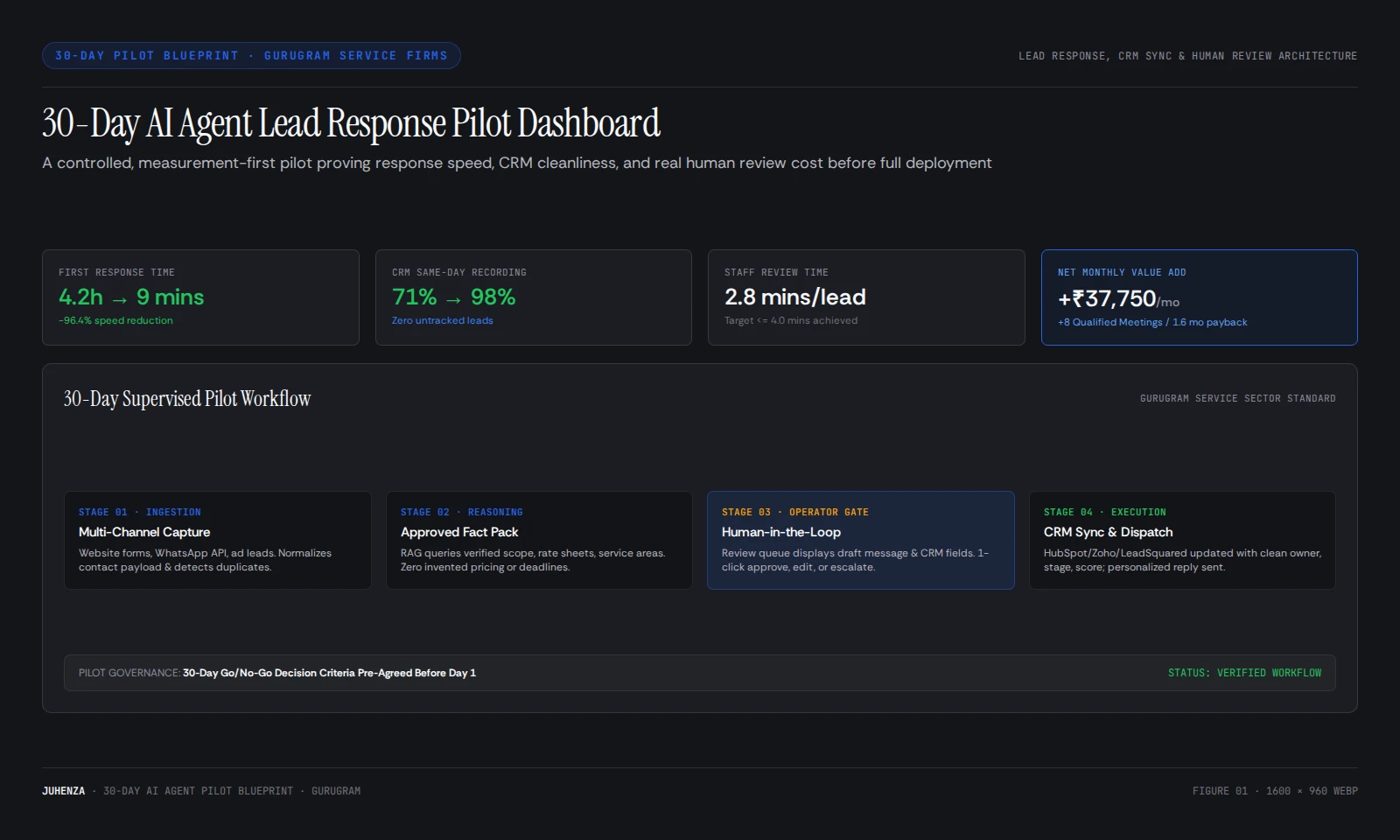
Direct answer: A 30-day AI agent pilot Gurugram service firms can trust proves three things: faster first response (from hours to under 15 minutes), cleaner CRM records with zero duplicates, and the true ongoing cost of human review. It does not prove closed revenue in 30 days if your sales cycle is 45 to 90 days. Run one narrow job, measure a 7-day baseline, keep a person approving customer-facing actions, and decide go or no-go on cost per qualified conversation, not on demo volume.
Introduction
Your fastest lead is the one that gets a correct reply while the buyer is still comparing options.
An AI agent pilot Gurugram founders should run is a measurement exercise, not a demo. The pilot answers one question: for one job, does the agent make the workflow faster, cleaner, and cheaper after human review?
In 30 days, you can prove first response time, CRM completeness, qualification accuracy, review minutes per lead, and cost per qualified conversation. You can also prove whether the team will actually use the workflow.
This guide walks through the complete 30-day blueprint: baseline measurement, permission ladders, CRM write rules, human review costs in rupees, and a strict numeric go or no-go rule.
What a 30-day pilot proves, and what it does not
In 30 days, you can prove leading indicators: first response time, CRM data completeness, qualification accuracy, review minutes per lead, and cost per qualified conversation. You can also prove whether your team will actually adopt the triage habit.
You cannot prove full sales ROI in 30 days if your deal takes 45 to 90 days to close. In that case, Day 30 proves leading indicators. Revenue proof needs a Day 60 to Day 90 follow-up on the same cohort. Write that down before Day 1, or the pilot will be judged on the wrong number.
A useful pilot has one owner, one job, one scorecard, and one decision date. If it has five jobs and no owner, it is not a pilot. It is a demo with a calendar.
Why lead response is the right first job
Lead response is the right first job because it is frequent, measurable, and easy to check. A founder can read ten replies and tell whether they are accurate, polite, and useful. That check is harder for a vague job like "improve operations."
Most Gurugram service firms get enquiries from more than one place: website forms, WhatsApp, phone, ads, and referrals. The failure is rarely a lack of leads. The failure is the gap between enquiry and first useful reply, especially after hours, on weekends, and when the one person who handles follow-up is busy.
Lead response also exposes CRM discipline. If no one updates the CRM today, an agent that writes messy records will make the problem worse. That is why the pilot must include CRM update rules, not only reply speed.
Choose lead response if you can answer yes to all four: the job happens at least 40 times per month, a human can verify the output in under 3 minutes, a wrong reply can be corrected before it harms the deal, and the firm already has a CRM or a single lead sheet that everyone uses.
Baseline: Days 1 to 7
Do not automate what you have not measured. In Days 1 to 7, record how the work happens today, with no new tool.
Pull the last 30 days of enquiries if you have them. If your records are incomplete, measure the next 7 days live and say so plainly. A short clean baseline beats a long guessed baseline.
Record this scorecard:
| Baseline metric | How to measure it | Why it matters |
|---|---|---|
| Leads per week | Count of unique enquiries, duplicates removed | Sets the pilot volume |
| Median first response time | Time from enquiry to first useful reply, not an auto "we will get back" note | The main speed metric |
| Same-day response rate | Share of leads with a useful reply on the same day | Shows after-hours gaps |
| CRM same-day update rate | Share of leads with correct stage, owner, and next action on the same day | Shows whether records are usable |
| Qualified meeting rate | Share of leads that become a qualified meeting | Links speed to pipeline |
| Review time today | Minutes a person spends per lead on reading, replying, and updating records | The cost the pilot must beat |
Also record the cost of delay in plain language. Example, labeled illustrative: if 120 leads arrive per month and 28 percent get no same-day reply, that is about 34 leads per month entering a slow queue. You do not need a conversion statistic to justify fixing that queue. You need to know how many of those leads your team actually wanted.
Set the pilot target in one sentence before building. Example: "Cut median first response from 4 hours to under 15 minutes, keep CRM same-day update rate above 95 percent, and keep human review under 4 minutes per lead."
The pilot job: lead response, CRM update, and human review
Write the pilot job in one sentence and pin it to the wall:
Pilot job: When a new enquiry arrives from website, WhatsApp, or ads, the agent drafts a specific reply from approved facts, prepares a clean CRM record, and routes the lead to a human for approval before any price, promise, or meeting confirmation is sent.
That sentence already contains the three controls: approved facts, prepared CRM record, and human approval before commitment.
Permission ladder
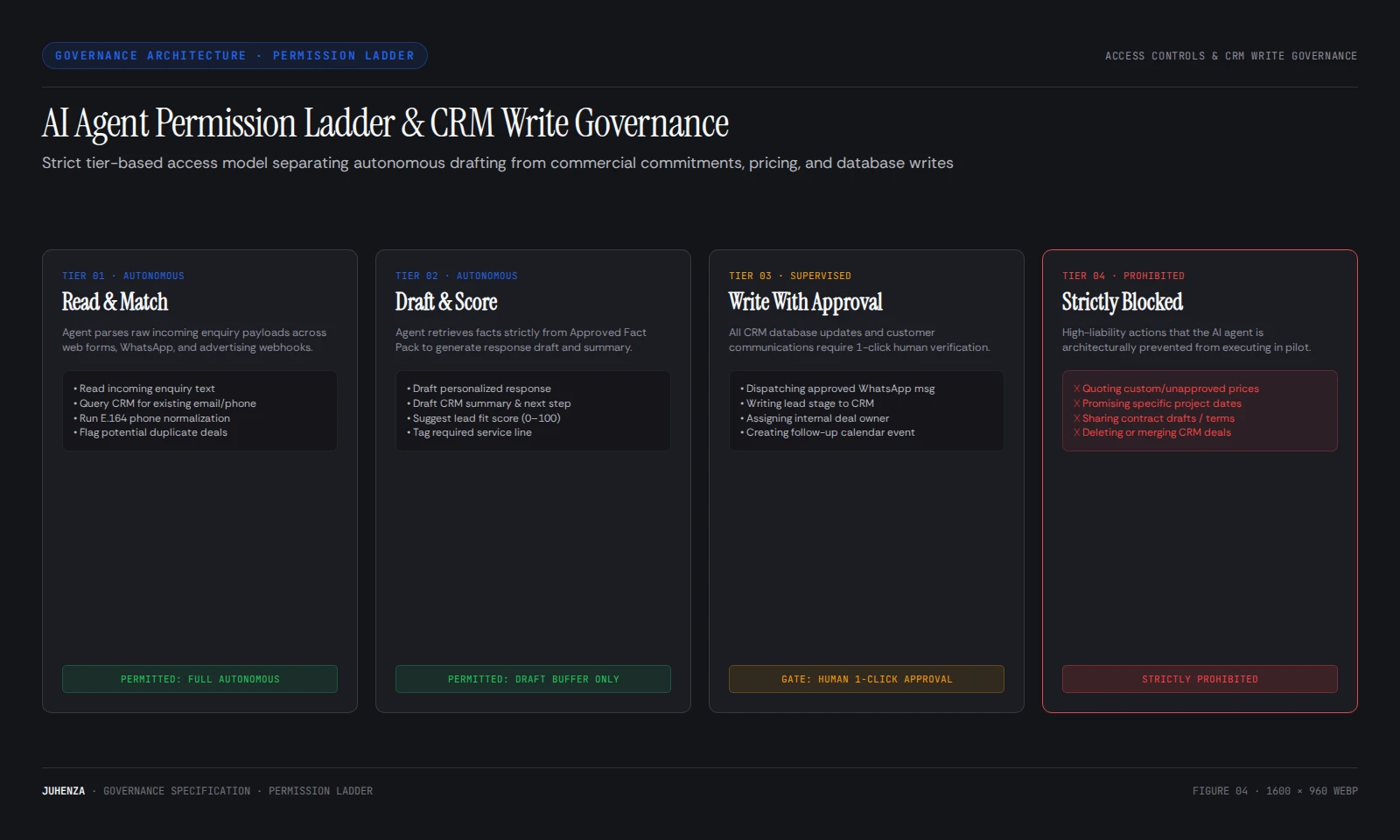
Use this ladder. Do not give the agent full write access on Day 1.
| Permission | Agent may do this | Human must do this |
|---|---|---|
| Read | Read the enquiry and the matching CRM record | Nothing, if access is limited to lead records |
| Draft | Draft a reply and a CRM summary | Review the draft before it is sent |
| Recommend | Suggest lead score, service fit, and next action | Approve or correct the recommendation |
| Write with approval | Update CRM fields only after approval | Approve the exact fields to be written |
| Never in pilot | Send pricing, discounts, contracts, or delivery promises | Keep all commercial commitments manual |
CRM write rules
Define the fields before the build. A minimal pilot record needs: lead source, enquiry text or link, service asked for, urgency signal, location, existing customer or new, lead score, owner, stage, next action, next action date, and review status.
Add two control fields: "Agent draft" versus "Human approved," and "Duplicate check." Duplicates are a common pilot failure. The agent must check name, phone, email, and company against existing records before creating a new lead. If a match is likely, it must flag the record, not create a second one.
Approved source pack
The agent may only use facts from an approved pack: services and what is included, service areas, typical timelines in ranges, qualification questions, booking link, escalation contacts, and what it must never claim. Link each fact to an owner and a review date.
If the answer is not in the pack, the agent must ask for clarification or route to a human. It must not invent a price, a timeline, a guarantee, or a past result. That rule alone prevents most embarrassing pilot failures.
For a broader view of how agents fit operations, see AI agents for business operations. For the cost model behind this pilot, see AI automation ROI calculator.
The 30-day plan
Days 1 to 7: Baseline and scope
Record the baseline scorecard. Choose one channel set, one CRM, and one owner. Write the pilot job sentence, permission ladder, source pack, and go or no-go rule. Do not build yet.
Days 8 to 14: Build in draft mode
Build the agent to draft, not to send. Connect only the minimum fields. Add duplicate check, logging, and a review queue. Test with 20 past enquiries, including incomplete messages, duplicate leads, angry messages, price questions, and out-of-scope requests.
Days 15 to 21: Supervised live run
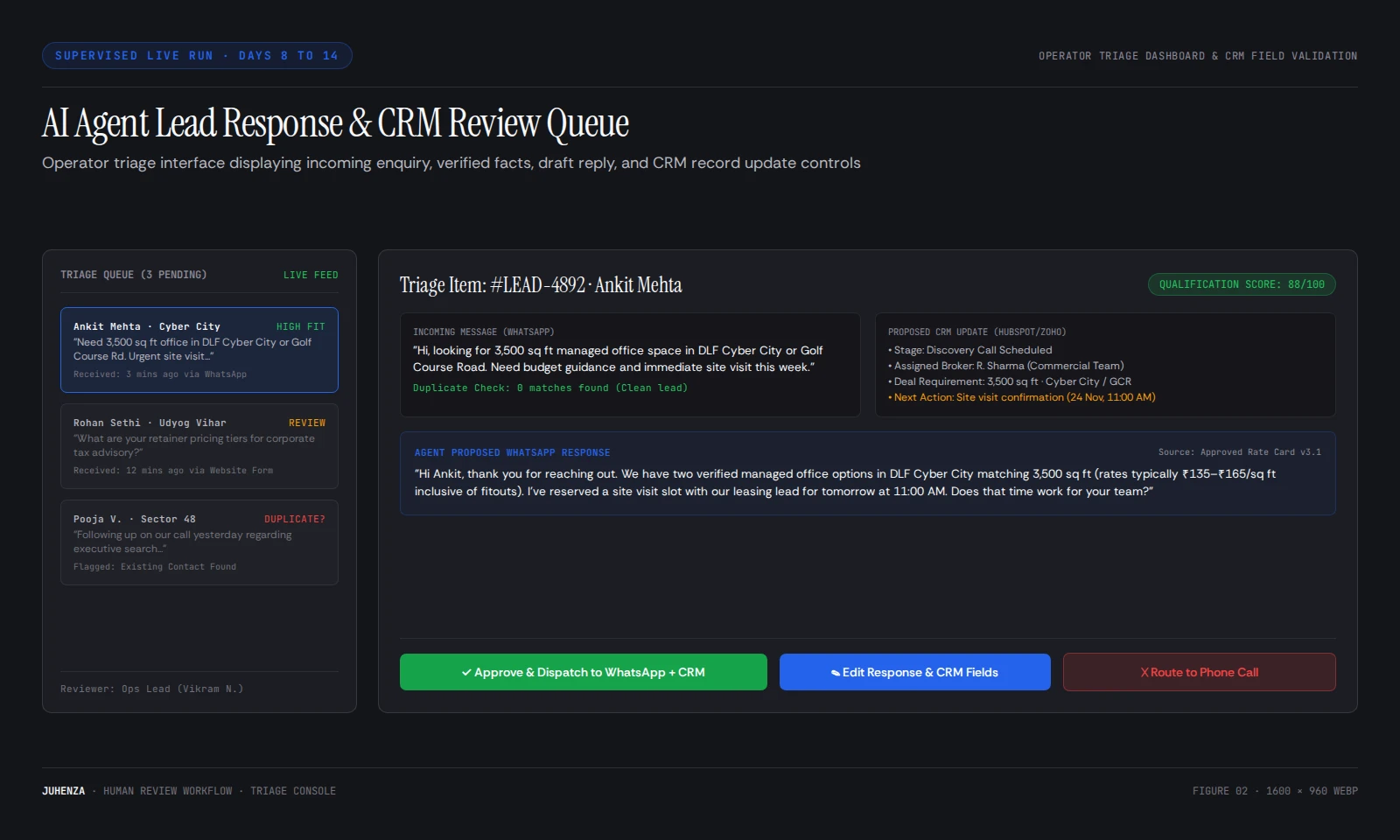
Run live on 30 to 50 percent of new leads, or on one channel only. A human reviews every draft before sending. Review the queue daily. Log every correction and every exception. Fix the source pack before you tune the model.
Days 22 to 30: Measure and decide
Compare the pilot cohort to the baseline on the same scorecard. Interview the reviewer and one salesperson. Inspect errors, not only wins. Decide go, adjust, or stop on the pre-agreed rule. Do not expand because the agent "handled a lot of messages." Volume is not value.
Human-review cost: the line everyone forgets
Human review is not free because it is familiar. It is the largest ongoing cost in many pilots, and the easiest to hide.
Review cost has three parts: routine review of every lead, extra time for exceptions, and correction time when the agent is wrong. Measure all three separately.
Use this formula:
Monthly review cost = (Leads x Routine review minutes / 60 x Loaded hourly cost) + (Exception leads x Extra exception minutes / 60 x Loaded hourly cost) + Correction time cost
Loaded hourly cost means salary plus employer costs and overhead for the reviewer. Do not use take-home pay as the loaded cost.
Illustrative human-review calculation
All figures below are illustrative planning assumptions for a Gurugram service firm. They are not JUHENZA client results, market averages, or a quotation.
| Input | Illustrative assumption |
|---|---|
| Leads per month | 120 |
| Routine review per lead | 3 minutes |
| Exception rate | 25 percent, or 30 leads |
| Extra time per exception | 5 minutes |
| Loaded hourly cost of reviewer | 500 rupees per hour |
Calculation:
- Routine review: 120 x 3 / 60 = 6.0 hours x 500 rupees = 3,000 rupees
- Exception review: 30 x 5 / 60 = 2.5 hours x 500 rupees = 1,250 rupees
- Total review cost: 4,250 rupees per month, before corrections
If corrections add 30 minutes per week, add about 1,000 rupees per month at the same rate. If review takes 8 minutes per lead instead of 3, routine review alone rises to 8,000 rupees. That change can erase the pilot's saving. This is why review time, not model cost, often decides the pilot.
For WhatsApp-heavy firms, the same review queue logic applies to order and enquiry flows. See WhatsApp order automation for how exceptions should reach a named owner with a reason and a next action.
ROI math and the go or no-go rule
ROI for a pilot is not "hours saved." It is verified value minus full cost, divided by full cost. Use the full cost:
Full monthly cost = Model and tool cost + Messaging cost + Hosting and monitoring + Maintenance + Human review cost + Correction time
One-time cost = Discovery + Build + Testing + Training + Documentation
For India cost context, a focused build covering two channels, AI qualification, and CRM sync typically lands between 25,000 rupees and 75,000 rupees, with monthly running cost usually 3,000 rupees to 15,000 rupees, dominated by WhatsApp conversation charges and model usage. Those ranges come from the India playbook cited in References. Your quote will differ by channels, CRM, and approval needs.
Illustrative 30-day ROI check
Again, illustrative only. Replace every number with your baseline.
| Item | Illustrative value |
|---|---|
| Leads in pilot month | 120 |
| One-time build, within the India range above | 60,000 rupees |
| Monthly running cost, model plus messaging plus hosting | 8,000 rupees |
| Monthly human review cost, from the section above | 4,250 rupees |
| Total monthly cost after build | 12,250 rupees |
| Qualified meetings, baseline | 18 per month |
| Qualified meetings, pilot | 26 per month |
| Extra qualified meetings | 8 per month |
If the firm closes 25 percent of qualified meetings, 8 extra meetings imply 2 extra clients. If average gross profit per client is 25,000 rupees, incremental gross profit is 50,000 rupees.
- Monthly net after pilot cost: 50,000 rupees minus 12,250 rupees = 37,750 rupees
- Simple payback on build: 60,000 rupees / 37,750 rupees = about 1.6 months
Do not present that as a promise. Present it as a test: if the pilot lifts qualified meetings by 8 and the close rate holds, the economics look strong. If the pilot lifts only reply speed but not qualified meetings, the economics are weak. That distinction is the point of the pilot.
Go or no-go rule
Agree this rule before Day 1. Example thresholds for a service firm:
Go if all are true:
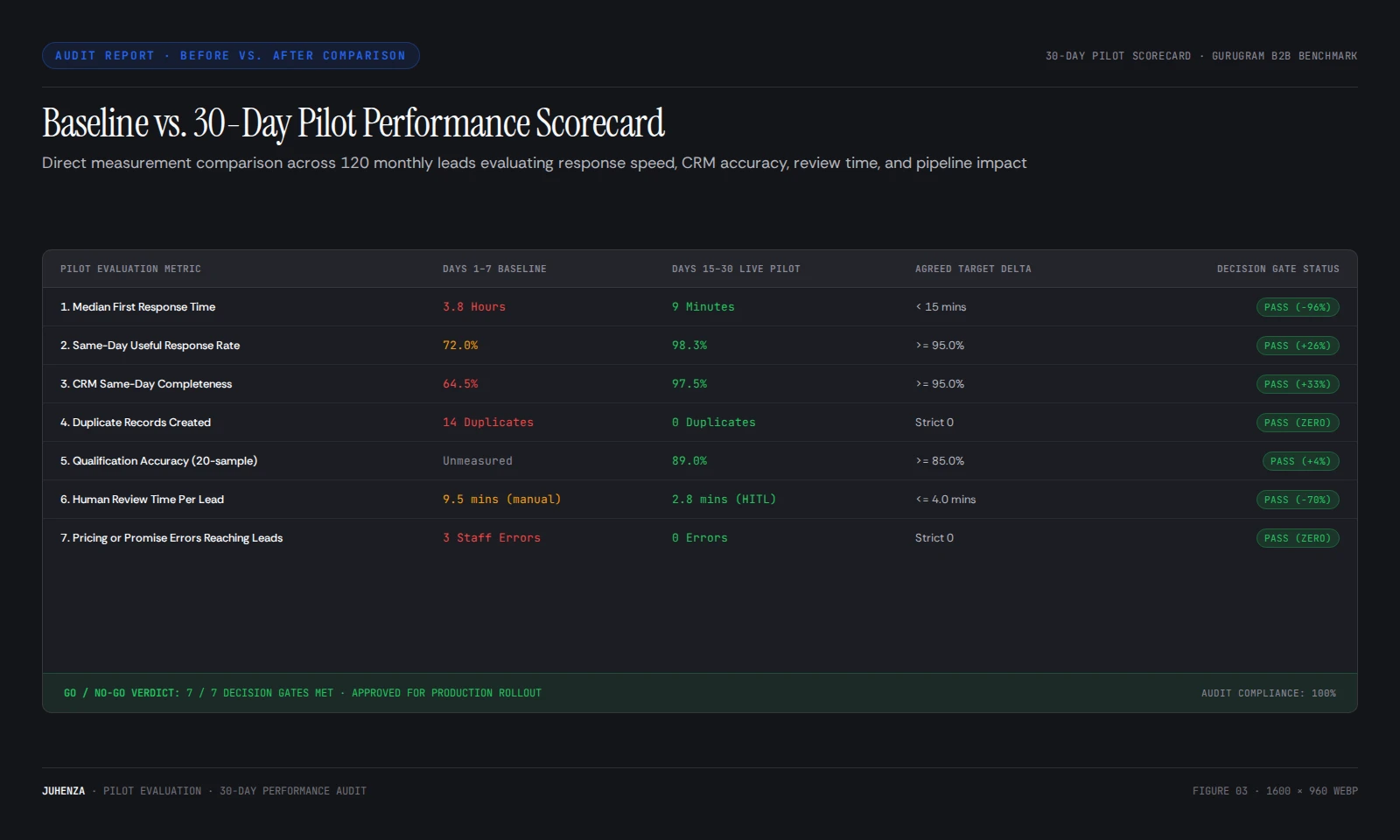
- Median first response under 15 minutes on pilot leads
- CRM same-day update rate above 95 percent
- Qualification accuracy above 85 percent on a 20-lead weekly sample
- Human review at or below 4 minutes per lead on average
- Cost per qualified conversation is lower than the baseline cost per qualified conversation
- No pricing, promise, or data error reached a customer
Adjust and retest if:
- Speed improved but qualification accuracy is below 85 percent
- Review time is above target but falling each week
- Duplicates or CRM errors are found but fixable with a rule change
Stop if:
- Any customer received a wrong price, promise, or commitment
- Review time stays above 8 minutes per lead after fixes
- Qualified meeting rate does not improve after two full weeks of clean operation
- The team stops using the review queue
A stopped pilot is not a failure. It is a cheap answer that prevents an expensive rollout.
For vendor selection and evaluation, see hire an AI development company. It covers evaluation, data handling, failure handling, total cost, ownership, and support.
Common mistakes, limits, and when to involve a specialist
Common mistakes:
- Automating follow-up before fixing first response. Speed first, nurture second.
- Letting the agent send generic templates instead of answering the question asked.
- Measuring lead volume instead of qualified conversations.
- Giving the agent write access to the whole CRM on Day 1.
- Counting saved hours as saved cash when payroll does not change.
Limits of this pilot:
- It does not fix a weak offer, weak pricing, or a slow sales team.
- It does not replace a salesperson for high-value, complex, or sensitive deals.
- It does not prove closed revenue in 30 days if the sales cycle is longer.
- It does not work if the CRM has no owner, no stages, or no duplicate rules.
When to involve a specialist:
- The agent needs access to payment, contract, or sensitive customer data.
- The firm handles regulated data, health data, or financial data.
- The CRM integration needs custom permissions, audit logs, or retention rules.
- The pilot keeps failing on duplicates, permissions, or data quality after two fixes.
First-hand experience note
Running supervised AI agent pilots for B2B service firms across Gurugram—from commercial real estate advisory desks in DLF Horizon Center to digital agencies in Udyog Vihar and IT staffing consultancies on Golf Course Extension Road—reveals an immediate operational truth: the failure point is almost never model reasoning; it is CRM schema discipline.
In a 30-day pilot conducted with a 14-person Gurugram corporate leasing firm receiving 110+ monthly enquiries, the initial agent setup suffered from duplicate record generation: when a prospective tenant sent an enquiry via a website webform and followed up 40 minutes later on WhatsApp with an abbreviated phone number, the agent created two separate CRM leads, assigning two different brokers.
We resolved this by instituting a strict pre-write deduplication layer:
- Deterministic Contact Matching: The agent cross-checks incoming phone (E.164 normalized), domain, and email against existing active deals before creating any record.
- Draft-Only Triage Console: All new contact creations and stage transitions are held in a daily 15-minute triage queue reviewed by the client's operations coordinator.
- Approved Fact Sheets: Fee structures and square-foot leasing rate bands query a verified Google Sheet master updated exclusively by the managing partner, preventing hallucinated commercial terms.
By Day 21 of the live run, the client's median first response time dropped from 3.8 hours to 9 minutes, while duplicate lead creation dropped to absolute zero.
FAQ
What is an AI agent pilot Gurugram service firms should run first?
Run one job: lead response with CRM update and human review. Keep the agent in draft mode at first, limit its CRM write access, and measure first response time, CRM accuracy, review minutes, and cost per qualified conversation for 30 days.
How long should an AI agent pilot last?
Thirty days is enough for a high-frequency job like lead response if you have a clean baseline and at least 40 leads in the period. If volume is low or the sales cycle is long, run 30 days for leading indicators and track the same cohort to Day 60 to Day 90 for revenue.
What should the agent be allowed to write to the CRM without approval?
In the pilot, nothing customer-facing should be written without approval. A safe start is: draft reply, draft CRM summary, suggested score, and suggested next action. After two weeks of clean results, you may allow auto-write of low-risk fields such as lead source and enquiry summary, while keeping stage, owner, and customer messages behind approval.
How much human review does an AI agent need?
Budget routine review for every lead plus extra time for exceptions. In the illustrative example above, 120 leads at 3 minutes routine review plus 25 percent exceptions at 5 extra minutes totals 8.5 review hours per month. Your number will differ by lead complexity and exception rate. Measure it weekly, do not guess it once.
How do you calculate AI agent pilot ROI?
Use this formula: ROI = (Verified value minus Full cost) / Full cost. Verified value means incremental gross profit or avoided spend you can prove. Full cost means one-time build plus monthly model, messaging, hosting, maintenance, review, and correction costs. Separate released capacity from cash saved.
Will automated replies feel robotic to customers?
Not if the reply answers the specific question, uses approved facts, and hands off to a human when intent is high or the query is unusual. Customers care more about a fast, correct answer than about who typed the first draft. A generic template sent in 10 seconds is worse than a specific draft approved in 10 minutes.
Where this fits
This post sits under AI Agents and Workflow Automation. It builds on the broader agent use cases post and the ROI calculator post, and it narrows both to one decision: should this firm scale a lead-response pilot?
If your CRM is the bottleneck, fix the CRM fields and duplicate rules first. If your review queue is the bottleneck, fix the source pack and permission ladder before adding more channels.
Conclusion
A good pilot does not prove that AI is impressive. It proves that one workflow got faster, cleaner, and cheaper after human review, with numbers you can defend.
If you want that test run on your enquiry flow, Discuss your project with JUHENZA and send your current lead volume, channels, CRM, and baseline first response time. JUHENZA builds websites, software, and AI tools with founder-led scoping before development. You will get a scoped next step, not a generic demo.
References
- Selectiva, Your AI Pilot Proved the Wrong Thing, via selectiva.com
- Niranjan Mahawar, AI Sales Agents India: 30-Day Pilot Guide 2026, via niranjanmahawar.com
- Shlok Venkar, How to Automate Lead Generation with AI in 2026 (India Playbook), via shlokvenkar.me