

Choosing an AI Integration Partner in Dubai: CRM/ERP Guardrails, UAE PDPL Residency, and AED SLA Scorecards
How to choose an AI integration partner in Dubai: CRM/ERP guardrails, UAE PDPL residency and an AED SLA scorecard for enterprise IT and operations heads.
AITech

The wrong AI integration partner in Dubai does not fail with a dramatic outage. It fails with a quiet permission creep, an unapproved discounted invoice, a prompt log stored in an unverified region, and an SLA that pays you nothing when an automated sync breaks your core system of record.
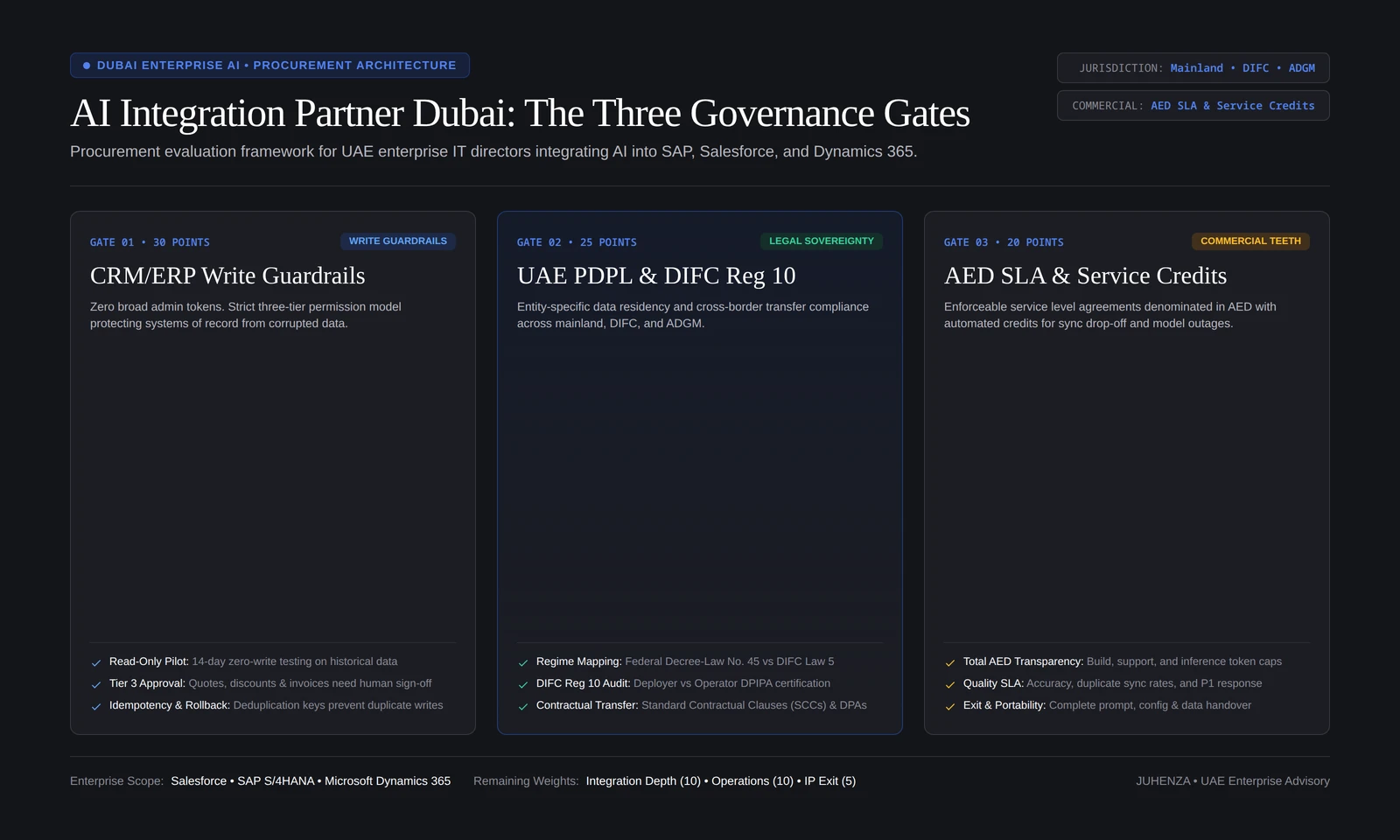
Direct answer: Choose an AI integration partner in Dubai by testing three things before you sign: CRM/ERP guardrails that limit what the AI can read and write, a written UAE PDPL residency and transfer plan for your entity type, and an AED SLA scorecard with service credits. Score each bidder on the same sheet, ask for a read-only pilot, and reject any proposal that leaves residency, permissions, or exit terms vague.
Introduction
Choosing an AI integration partner in Dubai is a procurement decision, not a demo contest. A slick sales demo can easily hide weak API permissions, unmapped cross-border data flows, and an SLA with zero contractual teeth.
This guide provides the three structural gates required to evaluate enterprise AI integrators: guardrails for CRM and ERP, residency and transfer rules under UAE PDPL and DIFC Regulation 10, and an AED SLA scorecard you can reuse across competing bids.
Why Dubai AI decisions fail
Most enterprise AI implementation failures are not model failures. They are boundary failures.
A typical failure unfolds predictably: Sales leadership wants generative AI to update Salesforce opportunities. Finance wants autonomous agents to draft billing in SAP or Microsoft Dynamics 365. Customer support wants bots to auto-resolve Zendesk tickets. The vendor connects everything via an unrestricted global admin service account, grants the AI broad write access, and promises to “fine-tune permissions post-launch.”
Soon, duplicate orders appear, unauthorized promotional discounts post without manager approval, or master customer records are overwritten by an out-of-order sync.
The fix is never a larger foundation model. The fix is an explicit, written boundary for each system, each object, each field, and each automated trigger. Demand that every shortlisted partner demonstrates this boundary before you review feature lists.
A second common failure is legal vagueness. Vendors frequently pitch “100% PDPL compliant” or “our data stays in the UAE” without distinguishing your corporate entity type (Mainland vs. DIFC vs. ADGM), the physical geography of vector embeddings, or the legal transfer mechanism for model inference. That is not compliance; that is marketing rhetoric.
A third failure is commercial ambiguity. Proposals arrive quoted in USD, hiding variable token charges, rate-limit retries, and providing only “best-effort” support. When your ERP sync stalls during month-end financial close, you discover zero contractual service credits and no clear data exit protocol.
Use the three governance gates below as non-negotiable procurement hurdles. A partner must pass all three.
CRM/ERP guardrails: what the AI can read, write, and never touch
Start read-only, then earn write access
A competent AI integration partner in Dubai should always propose a read-only pilot first. In that pilot, the AI agent can query and retrieve information: looking up customer files, analyzing historical order frequency, checking warehouse inventory, and summarizing ticket histories. It cannot mutate records, send unreviewed emails, post discount schedules, or adjust pricing tables.
Write access must be earned incrementally, workflow by workflow, with mandatory audit logging and human-in-the-loop validation. This sequencing enables your team to verify retrieval augmented generation (RAG) accuracy and permission behavior on real enterprise data before autonomous agents touch your core database.
Ask for this in writing: which systems, which database tables, which fields, which API actions, and which authentication roles. “Full CRM access” is an immediate disqualification. “Read-only access to Account, Contact, and Opportunity in Salesforce; zero write access to Pricebook or Quote” is an acceptable engineering answer.
Use a three-tier permission model
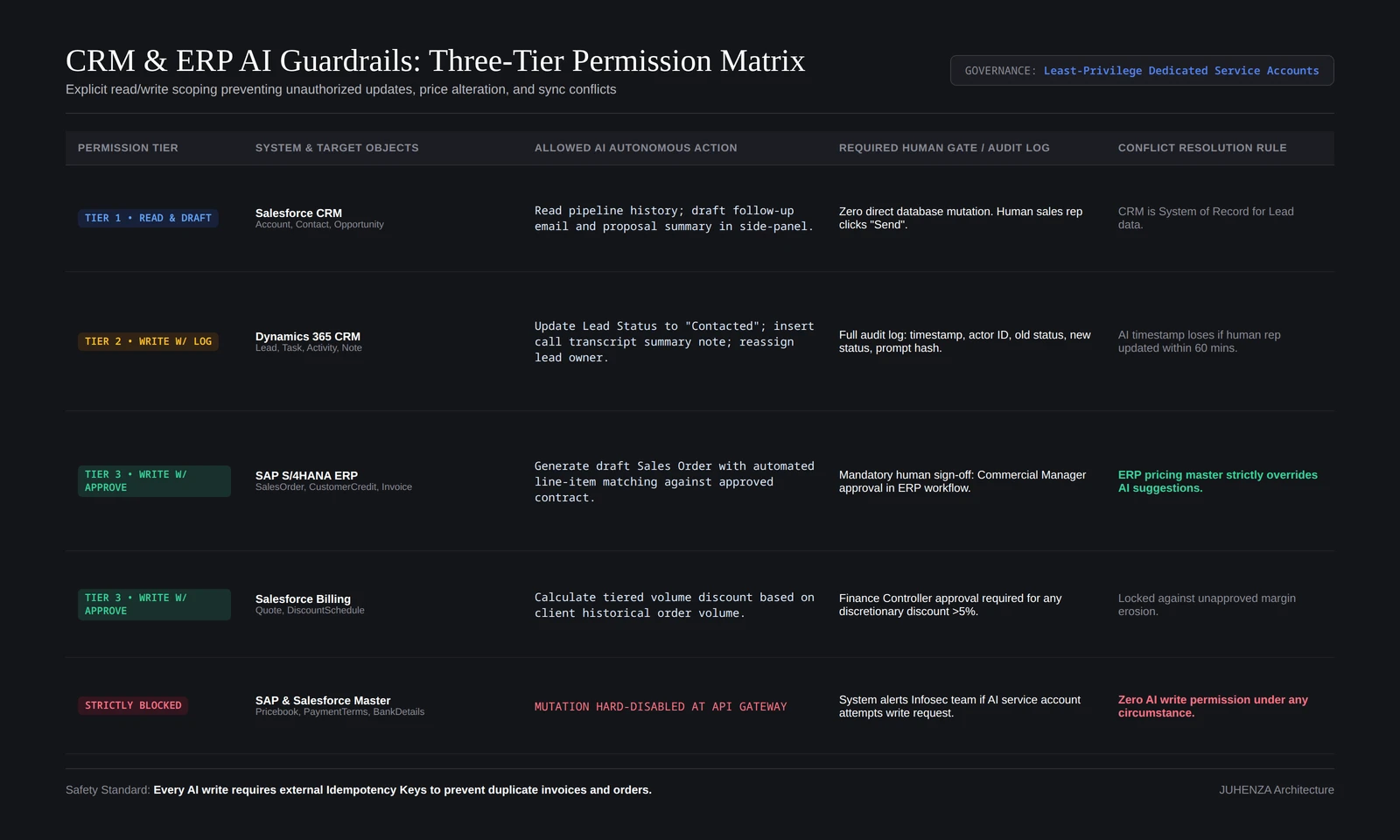
Every automated workflow must map strictly into one of three permission tiers:
| Tier | Meaning | Enterprise Examples |
|---|---|---|
| Tier 1: Read and suggest | AI reads context and drafts output; human executes | Draft follow-up proposals, summarize account history, suggest cross-sell opportunities |
| Tier 2: Write with logging | AI writes low-risk fields autonomously; fully logged and reversible | Update Lead Stage to "Contacted", log meeting notes, update task owners |
| Tier 3: Write with approval | AI proposes material changes; named human must approve before commit | Create a formal Quote, apply commercial discounts, post an invoice, issue refunds |
No AI action should sit outside these tiers. If a bidder cannot map an automation to a specific tier, that workflow is not safe to deploy.
For finance and billing workflows in SAP or Dynamics 365, Tier 3 must remain the permanent default. For customer-facing correspondence, enforce human approval until zero-shot accuracy is proven against historical internal benchmarks.
Define the system of record and conflict rules
Every synchronized field requires a single canonical owner. If Salesforce is the system of record for customer contacts and SAP S/4HANA owns the billing invoice, codify that hierarchy. If both systems can write to a shared attribute, establish deterministic conflict resolution rules and define how edge-case discrepancies escalate to human operations.
Furthermore, enforce API idempotency: if an automated AI worker encounters a timeout and retries an execution, it must never create duplicate sales orders, duplicate ledger entries, or duplicate support tickets. Require the integrator to specify their unique deduplication keys, retry backoff algorithms, and automated incident alert thresholds.
Insist on automated rollback capabilities. If an autonomous AI write introduces corrupted data, how is that mutation reversed? Who performs the rollback, what is the recovery time objective (RTO), and what immutable audit trail is captured? If the vendor's rollback strategy is "our engineers will patch it manually," your guardrails are incomplete.
Require least-privilege service accounts and full logging
The AI system must interface with enterprise applications through dedicated service accounts restricted by least-privilege role-based access control (RBAC). It must never utilize shared administrator tokens or personal employee API keys.
Every database read, vector query, and record mutation must be logged with timestamp, unique actor ID, source system, record ID, pre-mutation value, post-mutation value, and the prompt/rule hash that initiated the transaction. These audit logs must be exportable into your enterprise SIEM (such as Splunk or Microsoft Sentinel) and accessible to your internal security team—not locked inside the vendor’s proprietary portal.
Illustrative example: a quote workflow with guardrails
Consider an illustrative enterprise scenario: a Dubai-based industrial equipment distributor wants AI agents to assist account executives in drafting complex customer quotations. The integration partner implements the following boundary:
- Read Access: Account, Contact, Opportunity, Product Master, Pricebook, and live ERP warehouse stock.
- Tier 1 (Suggest): AI analyzes historical purchase volume and drafts a customized proposal cover letter and line-item summary.
- Tier 2 (Logged Write): AI updates Opportunity Stage to “Quote Prepared” and logs a timestamped activity record in CRM.
- Tier 3 (Mandatory Approval): AI generates the draft Quote in Salesforce Billing and calculates a 7.5% volume discount. Because the discount exceeds 5%, the Quote is locked until the Commercial Director signs off inside the CRM interface.
- Strictly Blocked: The AI service account is physically blocked at the API gateway from altering Master Pricebook tables, modifying payment terms, or committing finalized invoices to SAP.
The pilot operates for three weeks on closed historical opportunities. The engineering team audits quote accuracy, discount calculations, and log completeness. Only after zero discrepancies are logged is the system activated in production.
UAE PDPL residency: which law applies to you
First, name your entity type
Data protection compliance in the United Arab Emirates depends on the corporate jurisdiction of your legal entity:
| Entity Type | Applicable Regulatory Framework | AI & Enterprise Data Implications |
|---|---|---|
| Mainland UAE company or non-financial Free Zone | Federal Decree-Law No. 45 of 2021 (UAE PDPL) | National data protection standards, strict consent controls, and regulated cross-border transfer mechanisms |
| DIFC (Dubai International Financial Centre) | DIFC Data Protection Law No. 5 of 2020 & Regulation 10 | Explicit statutory compliance for autonomous & semi-autonomous AI systems processing personal data |
| ADGM (Abu Dhabi Global Market) | ADGM Data Protection Regulations 2021 | Independent common-law data protection regulator and specific cross-border transfer rules |
| Regulated Sectors (Healthcare, Banking, Gov) | Sectoral mandates (e.g., CBB, DHA, NABIDH) | Stringent domestic storage, encryption, and explicit ministerial approval requirements |
Never accept a vendor contract that vaguely claims "compliance with UAE law" without identifying your specific entity status. Demand that the partner identifies your governing regime and references the exact statutory provisions governing automated data processing.
Understand residency versus cross-border transfer
This distinction is frequently misunderstood by sales teams.
The UAE PDPL does not impose an absolute, universal prohibition on storing commercial personal data outside the country. Instead, it strictly regulates how personal data is processed and governs the conditions under which it can be transferred across international borders.
Under UAE Federal Decree-Law No. 45 of 2021 (PDPL) and guidance from the UAE Data Office, cross-border data transfer remains strictly conditioned upon either an adequate level of protection in the destination jurisdiction or appropriate contractual safeguards (such as standard contractual clauses and binding corporate rules). In the absence of an officially gazetted global adequacy whitelist, enterprise deployers must rely on robust bilateral Data Processing Addendums (DPAs) that contractually enforce equivalent confidentiality, purpose limitation, and data subject rights.
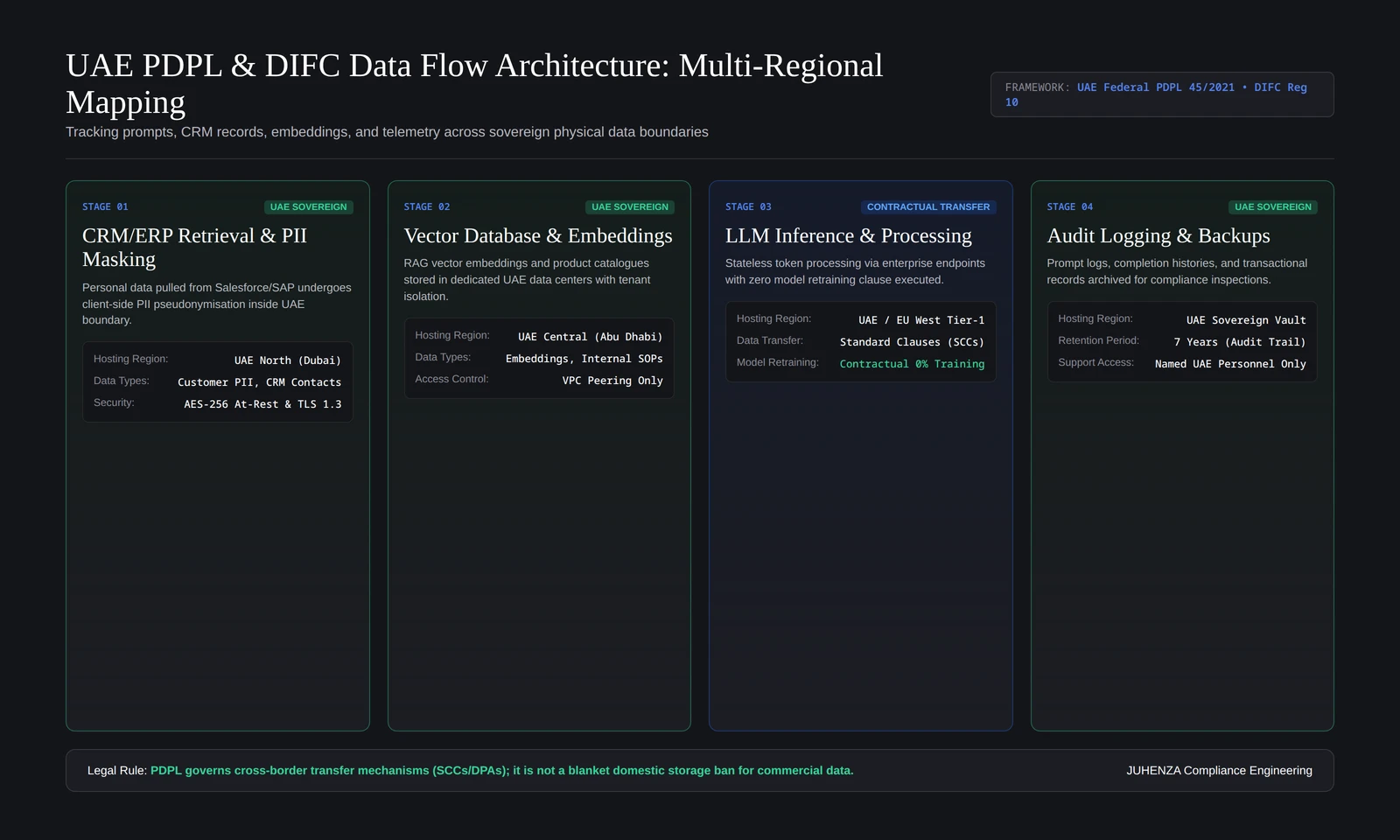
In your architecture review, map the precise physical geography of each data artifact across its lifecycle:
- User Prompts and Model Completions: Where do ephemeral inference payloads travel?
- Retrieved CRM/ERP Records: Where are contextual database extracts cached?
- Embeddings & Vector Databases: In which physical data center does your enterprise knowledge graph reside?
- Audit Logs & Telemetry: Where are application performance metrics and user access logs archived?
- Cold Backups & Disaster Recovery: What geographic zone hosts disaster recovery snapshots?
- Support Access: Where are third-party support engineers physically located when troubleshooting?
A vendor that executes inference in a UAE cloud region (such as Microsoft Azure UAE North in Dubai or AWS Middle East Central) but exports diagnostic logs to a US-based monitoring dashboard has multiple geographic transfer boundaries. All six touchpoints must be documented with explicit country names and supported by valid Standard Contractual Clauses (SCCs).
The DIFC Regulation 10 mandate
For entities incorporated within the DIFC, compliance with DIFC Data Protection Regulation 10 (Personal Data Processed Through Autonomous and Semi-Autonomous Systems) is mandatory.
Regulation 10 imposes direct statutory accountability on both Deployers (the enterprise dictating the business purpose) and Operators (the technical partner managing the AI system):
- Algorithmic Transparency: Deployers must provide clear, concise notices to individuals explaining that their data is processed by an automated system, detailing human oversight mechanisms, and defining system boundaries.
- Autonomous Systems Officer (ASO): Where autonomous processing presents elevated compliance risks, organizations may be required to designate an independent ASO.
- DPIPA (Data Protection Impact Assessment): Enterprise deployers must document and maintain an assessment evaluating fairness, algorithmic bias, systemic failure modes, and cybersecurity safeguards.
If your partner dismisses Regulation 10 as "only relevant to AI research labs," they do not understand DIFC compliance.
Sector-specific overlays
If your enterprise operates in healthcare, banking, or government contracting, general PDPL compliance is only your baseline:
- Healthcare: Federal Law No. 2 of 2019 on the use of Information and Communication Technology (ICT) in Health Fields mandates strict domestic data residency for health and patient records within the UAE, subject to health authority guidelines (such as DHA / NABIDH).
- Financial Services: The Central Bank of the UAE (CBUAE) issues specific risk management standards for artificial intelligence, cloud adoption, and consumer protection.
- Model Training Exclusions: Ensure your Master Services Agreement explicitly states: “The Vendor shall not use Client data, prompts, completions, or CRM/ERP extracts to train, fine-tune, or validate any public or shared commercial artificial intelligence model.” This clause must be non-negotiable.
The AED SLA scorecard
Contract in AED with total cost transparency
Enterprise AI SLAs must be anchored in commercial reality. Insist on a total cost of ownership (TCO) table denominated in AED:
| Commercial Component | Billing Structure | Key Contractual Boundaries |
|---|---|---|
| Integration & Engineering | Fixed-fee milestone deliverables | Written scope, acceptance criteria, and defect liability period |
| Managed Operations & Support | Fixed monthly retainer (AED) | Guaranteed response SLAs, UAE working hours, and emergency coverage |
| Foundation Model Consumption | Pass-through token costs or included allowance | Hard monthly spend caps, 70%/90% budget alerts, and zero retry markups |
| Infrastructure & Vector Hosting | Dedicated cloud tenant pass-through | Client-owned subscription (Azure/AWS) to ensure complete data portability |
| Change Requests | Standardized rate card (AED / hour) | Formal impact assessment and 3-day turnaround on scope estimates |
If foundation model usage is billed on consumption, contractually mandate a monthly AED spend cap, automated alerting thresholds at 70% and 90%, and an agreed operational policy for when caps are reached. Without hard caps, runaway API loops caused by uncaught exceptions can result in severe financial surprises.
In the UAE, standard commercial software integration services delivered to mainland entities attract standard 5% VAT, whereas specific intra-free-zone or exported cross-border services may qualify for zero-rating or out-of-scope treatment under Federal Decree-Law No. 8 of 2017 on Value Added Tax. Ensure your vendor quote clearly itemises VAT status per deliverable.
Measure SLAs on data outcomes, not server uptime
Server uptime is an incomplete metric. An AI service endpoint can return an HTTP 200 OK while hallucinating incorrect product pricing, failing to parse Arabic customer inquiries, or duplicating records across SAP and Salesforce.
Structure your SLA across five critical performance families:
- Availability & Recovery: 99.5%+ API availability; Recovery Time Objective (RTO) under 2 hours for failed sync pipelines; daily automated backup verification.
- Data Integrity & Sync Accuracy: Minimum 99.8% successful transaction synchronization; 0.00% duplicate record generation; automated daily reconciliation reporting.
- Operational Responsiveness: P1 Critical Incident response under 15 minutes; 24/7 on-call engineering roster covering UAE weekends and public holidays; named escalation paths.
- AI Generation Quality: Minimum 95% acceptance rate on a standardized enterprise evaluation set; zero-tolerance for unsupported factual assertions in customer-facing workflows.
- Commercial Service Credits: Automated credits calculated in AED against monthly retainer fees when accuracy or availability falls below contractual thresholds.
Ask the vendor for their standard credit calculation: “If synchronization accuracy drops to 98% during month-end close, what exact AED credit applies to our invoice?” If they cannot provide a mathematical formula, the SLA is purely aspirational.
The 100-point evaluation scorecard
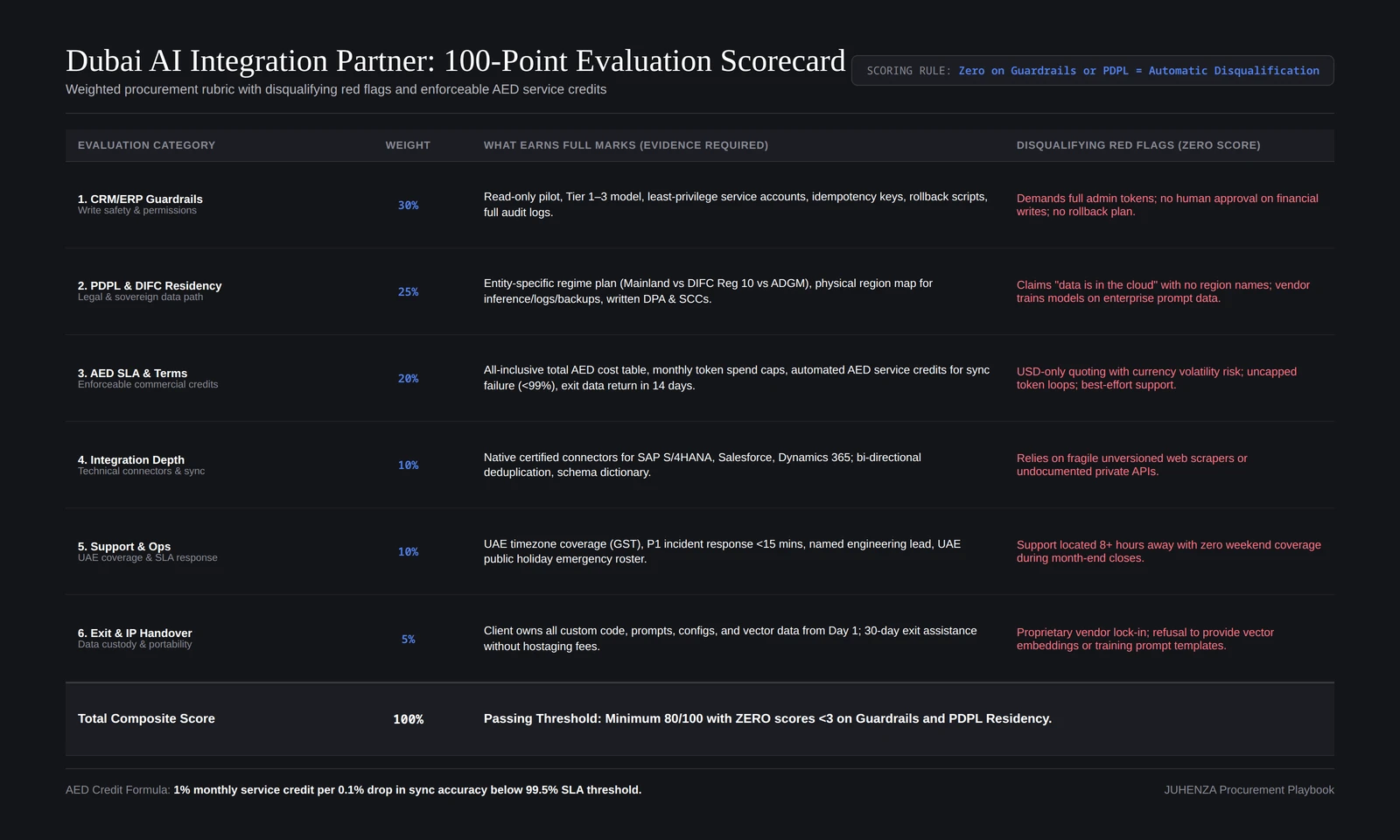
Use this weighted rubric to evaluate and rank vendor proposals:
| Category | Weight | Requirements for Full Marks (5/5) | Disqualification Triggers (Zero Score) |
|---|---|---|---|
| 1. CRM/ERP Guardrails | 30% | Phased read-only pilot, Tier 1–3 model, least-privilege tokens, idempotency keys, rollback scripts, immutable logs | Demands global admin credentials; no approval gate on financial writes; zero rollback capability |
| 2. PDPL & DIFC Residency | 25% | Entity-specific legal assessment, documented physical region map (inference, logs, backups), executed DPA with SCCs | Claims "data is in the cloud" without region names; vendor trains models on enterprise prompt data |
| 3. AED SLA & Commercials | 20% | Comprehensive AED cost table, hard token caps, automated service credits, clear exit and data return terms | USD-only invoicing with currency volatility; uncapped model billing; best-effort support |
| 4. Integration Depth | 10% | Certified native connectors for SAP S/4HANA, Salesforce, Dynamics 365; bi-directional sync, custom schema mapping | Relies on brittle browser automations or undocumented third-party APIs |
| 5. Support & UAE Presence | 10% | UAE timezone working hours (GST), local engineering team, P1 response under 15 minutes, holiday coverage | Offshore support with 8+ hour timezone lag and no coverage during UAE business week |
| 6. Exit & IP Handover | 5% | Complete client ownership of custom code, prompts, configs, and vector embeddings from Day 1; 14-day data return | Proprietary vendor lock-in; refusal to supply raw embeddings or prompt templates upon contract exit |
Scoring Rule: Never average out a critical failure. A score of zero on CRM/ERP Guardrails or PDPL Residency constitutes an immediate, automatic disqualification regardless of total points.
How to score bidders in one week
Adopt an efficient, evidence-based procurement sprint:
Days 1 to 2: Issue a standardized brief
Send every shortlisted partner an identical requirements document detailing existing software versions (e.g., Salesforce Enterprise Edition, SAP S/4HANA 2023 on-premise), corporate entity structure, target workflows, daily transaction volumes, and governance requirements. Mandate that responses include an explicit guardrails plan, physical data map, and AED fee schedule.
Days 3 to 4: Execute a controlled read-only pilot
Grant the top two contenders read-only API access to a sanitized staging environment. Run 20 real-world customer inquiries and historical data retrieval scenarios. Verify whether the models cite accurate source records, respect field-level security constraints, generate complete audit logs, and refuse to answer when source documents lack supporting evidence.
Day 5: Score proposals and demand technical evidence
Score each bidder against the 100-point rubric. Require documentary evidence for every capability claimed: sanitized client audit logs, permission matrix configurations, anonymized SLA credit calculations, and architecture diagrams. Disregard polished sales presentations that lack architectural substance.
Red flags that should terminate vendor discussions
- The vendor insists on full administrator privileges to "simplify initial integration."
- The vendor states that "PDPL compliance will be addressed during Phase 2."
- The vendor cannot name the specific physical cloud data centers hosting embeddings and prompt histories.
- The vendor contract contains boilerplate language permitting customer data to be utilized for model improvement.
- The vendor lacks an automated database rollback procedure for incorrect automated writes.
- The contract omits commercial service credits or caps liability at nominal amounts.
- The proposal is priced solely in foreign currency without model consumption caps.
First-hand experience
During an enterprise pilot for a regional trading conglomerate operating out of Dubai CommerCity and JAFZA, the client had previously trialed an off-the-shelf AI Copilot plugin for Salesforce and SAP S/4HANA. Because the plugin was configured with a single generic admin API token, an autonomous sync error hallucinated custom tiered discounts on 42 wholesale orders, costing over AED 68,000 before manual intervention halted the billing queue.
Juhenza re-architected their integration around a strict three-tier permission model: the AI was restricted to Tier 1 read-and-draft for client communications and Tier 2 write-logging for lead status updates, while all Quote generation and ERP sales order creation were locked behind Tier 3 mandatory human approval gates with custom idempotency keys. Over a 60-day parallel run, data discrepancies fell to zero, quote turnaround accelerated by 3.4x, and all prompt logs were routed exclusively through sovereign UAE cloud regions under a binding DPA.
Common mistakes, limitations, and when to involve a specialist
Common mistakes:
- Launching write-enabled integrations before validating retrieval accuracy in a read-only sandbox.
- Treating a vendor-supplied demo dataset as evidence of production reliability.
- Accepting a boilerplate "PDPL compliant" statement without conducting an entity-specific legal assessment.
- Evaluating partners purely on initial software licensing costs while ignoring long-term maintenance and integration risks.
- Overlooking application telemetry, error logs, and support exports when mapping international data boundaries.
Limitations of this guide:
- This guide provides architectural and procurement principles; it does not constitute formal legal counsel. Data protection regulations and court interpretations in the UAE, DIFC, and ADGM continue to evolve.
- It does not replace a formal Data Protection Impact Assessment (DPIA) or specialized penetration testing.
- Highly regulated industries—such as healthcare, banking, and government entities—are subject to additional statutory mandates that must be reviewed independently.
When to engage an external specialist:
- Your AI workflows process special category personal data (e.g., biometric, health, or financial records).
- Your business operates across multiple legal jurisdictions (e.g., dual-licensed entities across Mainland Dubai and the DIFC).
- Automated AI agents make high-impact decisions affecting natural persons (e.g., automated credit scoring or recruitment screening).
- You require formal negotiation of multi-party international data transfer agreements and bespoke enterprise SLAs.
FAQ
What is an AI integration partner in Dubai?
An AI integration partner in Dubai is an engineering firm that connects artificial intelligence foundation models and autonomous agents to your existing enterprise software stack (such as CRM, ERP, and customer service platforms) with robust security guardrails, statutory UAE compliance, and enforceable performance SLAs. A qualified partner does not seek to replace your core software; they make AI operate safely inside it.
How is custom AI integration different from purchasing SaaS AI plugins?
Off-the-shelf SaaS plugins offer pre-packaged features but frequently lack granular write permissions, sovereign data residency controls, and cross-system conflict resolution. Custom integration implements enterprise-grade middleware that enforces field-level security, least-privilege service accounts, automated audit logging, and bilateral sync across disparate systems like Salesforce and SAP.
Does UAE PDPL require all enterprise data to remain within the UAE?
No. UAE Federal Decree-Law No. 45 of 2021 (PDPL) does not impose an absolute ban on international data storage for commercial personal data. Instead, it regulates cross-border transfers, requiring either an approved level of protection in the destination jurisdiction or binding contractual safeguards (such as SCCs and DPAs). However, specific sectors—including healthcare and government data—face stricter localized residency laws.
What are the key compliance requirements under DIFC Regulation 10?
DIFC Regulation 10 governs personal data processed through autonomous and semi-autonomous systems. Key obligations include providing explicit algorithmic transparency notices to data subjects, defining human-in-the-loop oversight mechanisms, conducting Data Protection Impact Assessments (DPIPAs), and potentially appointing an Autonomous Systems Officer (ASO) for high-risk deployments.
What constitutes an acceptable enterprise SLA for AI CRM/ERP integration?
A comprehensive enterprise SLA must guarantee minimum API availability (typically 99.5%+), high transaction sync accuracy (99.8%+), zero duplicate record creation, rapid critical incident response (P1 under 15 minutes), and automated service credits calculated in AED against monthly maintenance fees.
How long should an enterprise AI integration pilot take?
A well-structured read-only pilot should run for one to two weeks, focusing on evaluating RAG accuracy and field-level permissions. A subsequent write-enabled pilot should run for 30 to 60 days in a parallel staging environment to thoroughly validate human approval workflows and database rollback procedures before full production release.
Where this fits
This guide outlines the governance and procurement framework for enterprise automation in the UAE. For broader evaluation strategies, read our guide on how to hire an AI development company or review practical use cases in AI agents for business operations. To evaluate financial returns, explore the AI automation ROI calculator or study our technical standards in AI-assisted software partner checks.
Next step
If you are evaluating AI integration partners in Dubai, avoid open-ended sales calls. Issue an identical requirements brief to every bidder and evaluate them strictly on write guardrails, PDPL data residency, and AED SLA enforceability.
Discuss your project with JUHENZA. Share your target CRM/ERP platforms, your corporate entity type, and the primary workflows you want to pilot. You will receive a technical architectural consultation focused on security and compliance, not a generic sales demo.
References
- UAE Government Portal — Data Protection Laws & Federal Decree-Law No. 45 of 2021 (u.ae)
- UAE Legislation Portal — Official Text of Federal Decree-Law No. 45 of 2021 Concerning Personal Data Protection (uaelegislation.gov.ae)
- Dubai International Financial Centre (DIFC) — Data Protection Law No. 5 of 2020 & Regulation 10 on Autonomous Systems (difc.ae)\n