

WhatsApp Live-Order Integration for Dubai Retail: The Sync, Cost and Build vs Buy Guide
Learn how WhatsApp live-order integration syncs menu, stock, payment and kitchen in Dubai. Compare API vs click-to-chat, costs, and build vs buy options.
TechApp Dev

Your customer should be able to order directly on WhatsApp, pay via Apple Pay or card, and receive an instant order confirmation without anyone in your shop manually retyping their message.
Direct answer: WhatsApp live-order integration connects your WhatsApp customer chat directly to your product catalogue, inventory stock levels, payment gateway, and kitchen or warehouse fulfillment queue. An incoming chat message automatically becomes an immutable order record in seconds. The menu displayed in chat mirrors your central POS, stock is reserved before payment settles, and real-time status updates broadcast from the same master order record. For retail and F&B operators across Dubai, the strategic choice is not between a website and WhatsApp—it is choosing between error-prone manual messaging, off-the-shelf SaaS apps, and a bespoke integration built around your existing POS or ERP.
Whether you operate a specialty cafe in Dubai Marina, a luxury boutique in Downtown, a community pharmacy in Jumeirah, or a multi-branch cloud kitchen, live integration separates a messaging thread that drains labor from an automated commerce channel that generates verified revenue.
To evaluate how our engineering team connects messaging channels to central enterprise backends, explore JUHENZA's integration and consulting practice and our full-stack custom software development practice.
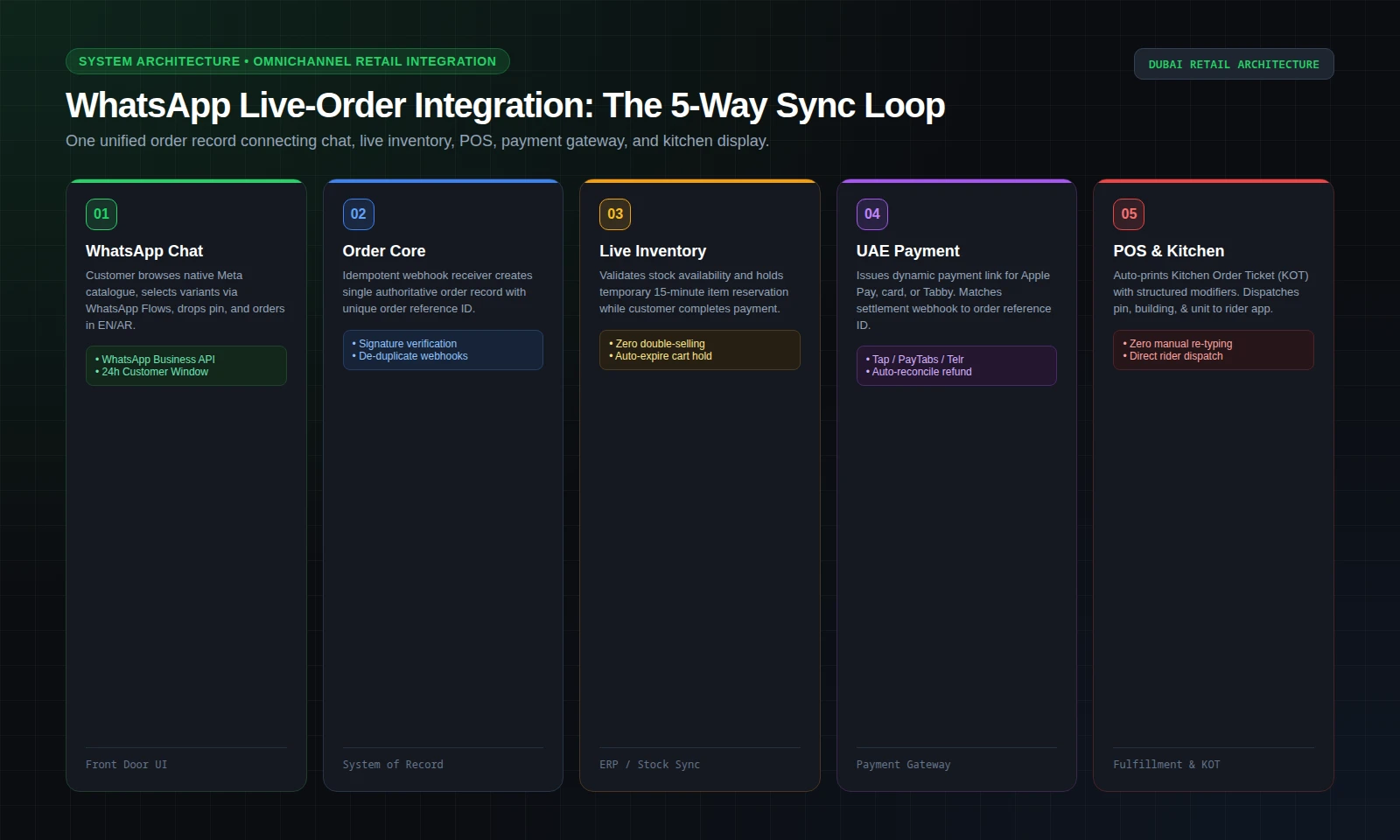 A true live integration connects five core systems: WhatsApp chat interface, central order service, live ERP inventory, UAE payment gateway, and kitchen display ticket queue.
What live-order integration actually means
Live-order integration establishes a single authoritative order record, eliminating fragmented copies across chat logs, scratchpads, and till displays.
When an order arrives, the customer conversation, POS register, payment gateway webhook, and kitchen order ticket (KOT) all reference the exact same order entity. If an item sells out, availability updates across all touchpoints simultaneously. If a network blip occurs, the order does not disappear into a digital void; it enters a persistent queue, displays a pending status, and assigns an alert to an operational lead.
In this architecture, WhatsApp operates strictly as the conversational front door, not your system of record. Your central order service, POS (such as Revel, Foodics, or NCR), or ERP (such as SAP, Odoo, or Microsoft Dynamics) remains the single source of truth for pricing, tax calculation, and inventory. WhatsApp surfaces products, collects structured customer inputs, and transmits status notifications. It is never where you discover—hours later—that a sold-out item was accidentally purchased twice.
The litmus test: If a floor supervisor or barista still has to retype items from WhatsApp into your cash register, your business does not have live integration. You have simply built a faster way to generate manual administrative friction.
The 3 ways to take WhatsApp orders
Most Dubai commercial operators operate across three distinct technical tiers:
| Architecture | How it functions | Ideal operational fit | Inherent limitations |
|---|---|---|---|
| 1. Click-to-chat & manual entry | Customer clicks a wa.me link, types free-text items, staff replies manually | Under 15 orders/day, boutique craft volume, owner-managed | Zero inventory sync; breaks under peak rush hours; severe human error |
| 2. Turnkey SaaS ordering tool | Vendor-hosted web menu, cart, payment link, and isolated order tablet | Single-outlet cafes with standardized menus and no custom ERP | Trapped in vendor's rigid data model; double entry into main ERP |
| 3. Custom API live integration | WhatsApp Business Platform integrated with central POS, ERP, and payment | Multi-branch retail, F&B chains, enterprise ERPs, custom billing | Requires technical scoping, API validation, and governance |
Click-to-chat is merely a hyperlink, not an integration. Because it lacks server webhooks, your backend cannot reliably parse unstructured chat text into a verified sales invoice.
In contrast, the WhatsApp Business Platform (API) unlocks Meta's native commerce primitives: in-chat catalogues, multi-item shopping carts, interactive buttons, WhatsApp Flows (native in-app forms for structured data collection), and real-time event webhooks.
How live integration works, step by step
A production-grade live ordering pipeline adheres to a strict, stateful lifecycle:
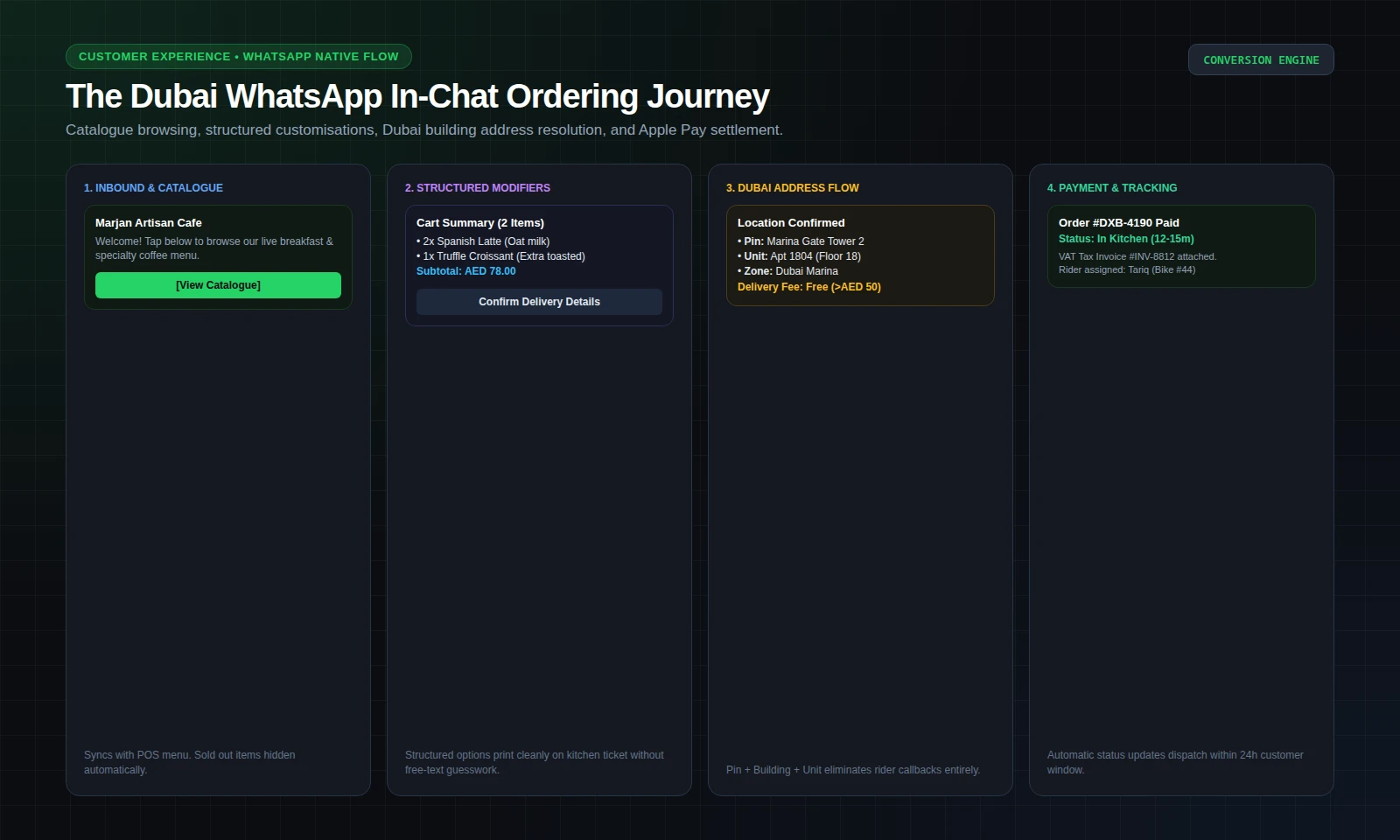 The complete customer journey: catalogue browsing, structured modifiers, Dubai building and unit address resolution, and instant in-chat payment.
- Inbound session initiation: The customer launches the conversation via a QR code, social bio link, Google Business profile, or physical receipt. The system greets them with an automated, localized prompt.
- Real-time catalogue rendering: The customer browses categories, product imagery, prices, and live availability pulled directly from the POS database. Out-of-stock items are automatically marked as unavailable.
- Structured cart construction: Customizations—such as milk preference, spice grading, garment sizing, or delivery time slots—are selected via native interactive UI components rather than free-form typing. This guarantees structured data output for the kitchen.
- Pre-payment validation & inventory hold: The system validates items against live stock balances, calculates 5% UAE VAT, applies delivery fees, and places a temporary 15-minute hold on the selected inventory.
- Payment settlement & matching: The customer settles the balance via an embedded payment link (Apple Pay, credit card, or Tabby). The payment gateway dispatches a webhook that matches the unique order reference ID, instantly updating the order status to
PAID. - Direct queue ingestion: The central order core pushes the ticket directly into the kitchen display system (KDS) or automatic KOT thermal printer with the matching order identifier and customer delivery address.
- Continuous status telemetry: As operational teams update the order state (
PREPARING→DISPATCHED→DELIVERED), matching notifications broadcast automatically to the customer's WhatsApp thread.
Two non-negotiable engineering rules
- HMAC signature verification: Every webhook received from Meta or your payment gateway must validate cryptographic signatures (
X-Hub-Signature-256) before execution. - Idempotency keys: Network retries are standard behavior across the internet. Your receiver must be strictly idempotent: processing an identical webhook payload multiple times must never generate duplicate kitchen tickets or multiple card charges.
The 24-hour customer service window
When a customer initiates an inbound message, Meta opens a 24-hour customer service window. Within this window, your system can dispatch free-form messages, interactive Flows, and catalogue updates with zero per-message utility fees.
Once this 24-hour window lapses, your system can only re-engage the customer using pre-approved Meta Template Messages. This distinction is critical: order updates sent immediately after purchase fall within the active service window, whereas promotional campaigns sent thirty days later require approved marketing templates, explicit opt-in consent, and per-message billing.
What must stay in sync
Durable synchronization requires five continuous contracts across your software architecture:
| Sync dimension | System of record | Downstream risk of synchronization failure |
|---|---|---|
| Catalogue & pricing | Central POS / ERP | Customer charged one price in chat, but billed differently at counter |
| Inventory & stock | Warehouse ERP / WMS | Double-selling out-of-stock items, triggering cancellation disputes |
| Order status lifecycle | Order Core Engine | Kitchen, delivery rider, and customer hold contradictory order states |
| Payment & settlement | Payment Gateway | Orders prepared before funds settle, or unlinked manual refunds |
| Consignee address & PII | Order Database (PDPL) | Delivery rider calls lost customer for details already submitted |
Scoping questions to audit before deployment
- When an item stock level reaches zero in the POS, how many seconds elapse before the WhatsApp catalogue reflects the change?
- What is the timeout threshold for reserved stock if a customer abandons their payment link?
- If a customer requests an order alteration after payment, does the system issue a structured credit memo, re-verify inventory, and capture incremental charges?
- If your physical POS terminal temporarily loses internet connectivity, where do pending WhatsApp orders queue, and who receives the failover alert?
A standard acceptance test is straightforward: Change a product price in your POS. Verify that the WhatsApp catalogue updates immediately. Sell the final physical unit at the register. Verify that WhatsApp flags the item as sold out. Process a partial refund. Confirm that your ERP, payment gateway, and customer WhatsApp notification all reconcile to the exact fil.
Dubai specifics: language, address, payment and data
Retail operations across Dubai and the broader UAE require localized engineering adaptations that generic Western platforms overlook.
1. Bilingual Arabic & English interfaces
Ensure your catalog data model supports native bilingual rendering. Product titles, allergen advisories, modifier options, and error messages must feature human-verified translations rather than runtime machine translations. Right-to-left (RTL) formatting must be rigorously tested within WhatsApp Flows. Ensure core internal SKUs remain uniform across both language presentations so kitchen staff view unambiguous preparation codes.
2. High-precision Dubai address resolution
Last-mile delivery in Dubai frequently fails due to non-standardized street nomenclature. Generic text fields asking for "Street Address" result in lost riders and delayed food. At checkout, collect three mandatory inputs:
- Interactive map GPS pin: Captured via WhatsApp location sharing.
- Standardized building name: Selected from a verified dropdown or autocomplete list (e.g., Marina Gate Tower 1, Index Tower).
- Unit / Apartment number: Capturing exact floor and flat coordinates.
Transmitting these three attributes directly to the driver's mobile terminal eliminates delivery friction entirely.
3. Payment gateways & Meta messaging costs
Integrate local UAE payment infrastructure (such as Tap Payments, PayTabs, Telr, or Stripe UAE) supporting native Apple Pay, credit cards, and Buy Now Pay Later (BNPL) options like Tabby.
For infrastructure budgeting, account for Meta's per-delivered-message pricing model (categorized by marketing, utility, and service tiers). Marketing messages in the UAE sit at approximately $0.0576 per delivered message, while utility messages are billed at approximately $0.0157. Confirm live rate cards directly with Meta or your Business Solution Provider (BSP) prior to commercial modeling.
4. UAE Personal Data Protection Law (PDPL) & VAT
Customer telephone numbers, GPS coordinates, residential addresses, and payment references are regulated personal data under UAE Federal Decree-Law No. 45 of 2021 on Personal Data Protection. Organizations must enforce:
- Explicit marketing opt-in: Order transactional updates do not grant permission for unsolicited promotional broadcasts.
- Role-based access masking: Restrict full customer phone numbers from delivery driver displays using masked calling proxies.
- Auditable VAT tax invoices: Invoices must be generated directly by your FTA-compliant accounting system, displaying your registered Tax Registration Number (TRN) and the 5% VAT breakdown.
Build vs buy: a decision framework
Use this objective evaluation framework to determine the optimal investment path:
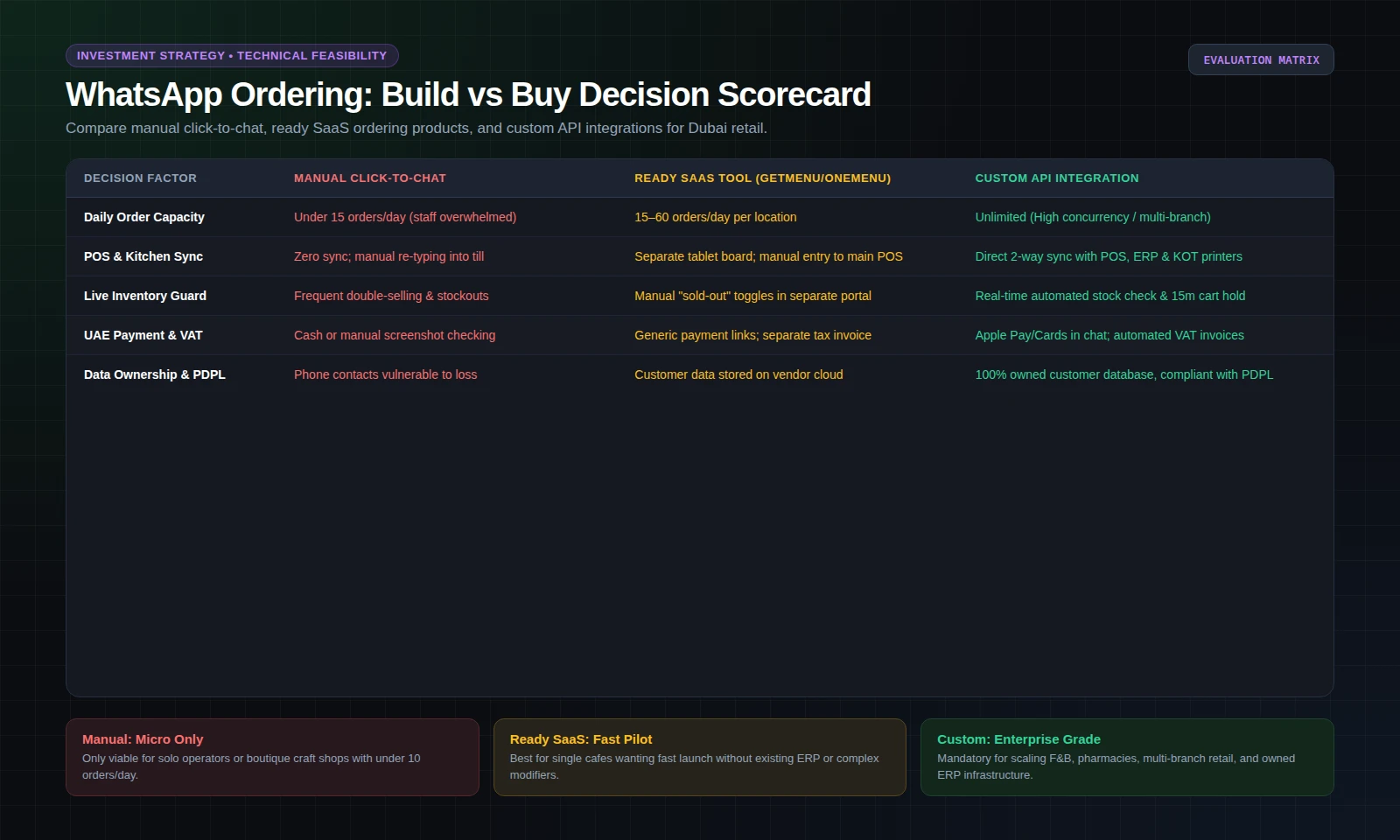 Evaluate manual click-to-chat, ready SaaS ordering tools, and custom API integrations based on order volume, POS synchronization, and data ownership.
| Operational criterion | Turnkey SaaS tool (e.g., GetMenu / OneMenu) | Custom API integration |
|---|---|---|
| POS / ERP compatibility | Limited to vendor's pre-built integration list | Custom-mapped to any API-enabled POS or legacy ERP |
| Catalogue & variant scale | Best for menus under 150 items with simple modifiers | Supports enterprise catalogues with thousands of complex SKUs |
| Bilingual RTL support | Dependent on vendor's template capabilities | Custom-engineered Arabic/English localized UX |
| Payment reconciliation | Standard checkout links into vendor merchant account | Direct settlement into your own UAE corporate bank account |
| Data equity & governance | Customer database stored on vendor infrastructure | 100% owned customer data stored in your private database |
| Time to live deployment | 2 to 5 business days | 3 to 6 weeks for complete scoping, build, and QA |
When to buy: Choose an off-the-shelf SaaS product if you operate a single-location boutique or cafe, maintain a compact menu, lack complex ERP infrastructure, and need to launch ordering within days.
When to build: Commission a custom integration if your business operates multiple branches sharing centralized warehouse stock, utilizes enterprise ERP systems (Odoo, SAP, Microsoft Dynamics), requires custom corporate credit limits, or treats customer data ownership as a non-negotiable asset.
An illustrative Dubai example
Consider a high-volume artisan bakery and cafe in Dubai Marina processing 35 to 50 WhatsApp orders daily during the morning peak:
Before integration: Two full-time employees shared a single mobile device. Customers sent fragmented messages ("Spanish latte oat milk extra hot, truffle croissant, Marina Gate Tower 2 flat 1402"). One employee retyped items into the physical POS terminal while the second called the customer to confirm payment screenshots. During morning rushes, orders were dropped, modifiers were missed, and delivery riders called customers repeatedly from building lobbies.
After custom live integration: The customer taps View Menu within WhatsApp, selects items from the real-time catalogue, selects structured modifiers, confirms their building and flat number, and checks out via Apple Pay in under thirty seconds.
The order arrives directly on the kitchen display screen, the thermal printer produces a KOT with modifiers highlighted in bold, the inventory deducts the bakery items automatically, and the rider receives GPS coordinates and unit details simultaneously. The customer receives automated preparation and dispatch updates in the same chat thread.
Operational results are measured not in message volume, but in reduced kitchen rework, zero manual re-typing, and faster order-to-door cycle times.
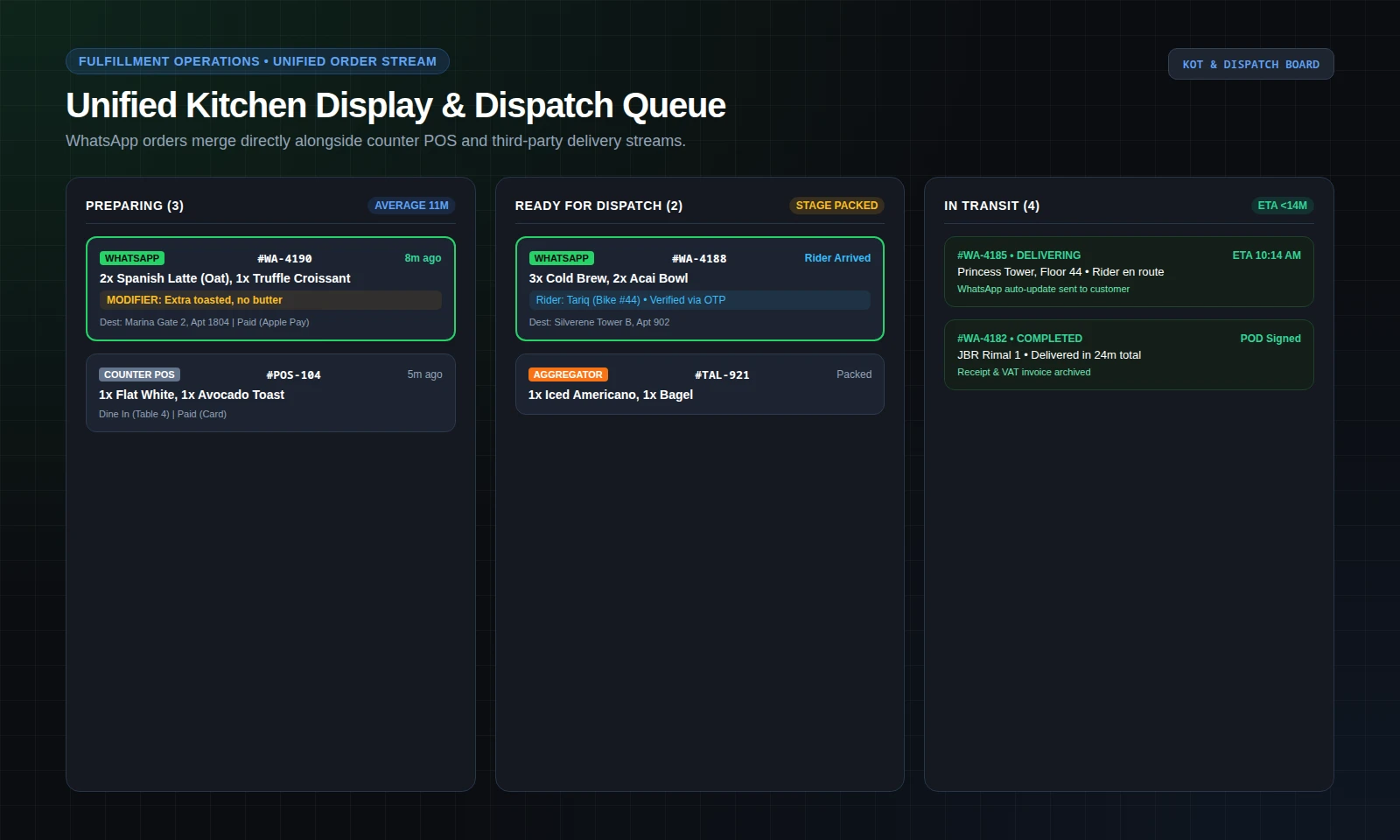 Orders from WhatsApp land directly alongside counter POS and delivery aggregator tickets on one kitchen display board without manual retyping.
Common integration mistakes to avoid
- Equating a WhatsApp chat widget with live integration: A floating chat button merely opens a conversation; it does not check inventory balances, issue VAT invoices, or prevent double-selling.
- Letting chat text dictate pricing: Never allow chat text to act as the pricing authority. Pricing logic must reside exclusively in your POS or central commerce database.
- Omitting cart reservation rules: Unreserved carts allow multiple users to attempt purchasing the same final inventory unit. Implement automated 15-minute temporary reservation expirations.
- Conflating transactional and promotional messaging: Customers who opt in for delivery updates have not consented to daily marketing promotions. Violating this boundary triggers spam reports and risks Meta account suspension.
- Failing to assign failure queues: Webhook retries, expired payment links, and out-of-stock conflicts require clear operational escalation paths so floor managers can intervene before customers complain.
Limitations and when to involve a specialist
Live integration requires that your existing POS or ERP provides accessible, documented APIs. If your legacy cash register lacks an API export capability, direct real-time synchronization is impossible without intermediate middleware or hardware bridges.
Engage an enterprise integration consultancy when:
- Your order workflows interact with complex multi-location ERPs or customized SAP/Odoo instances.
- You sell pharmaceutical, regulated, or restricted goods requiring identity verification.
- You operate cross-border entities across UAE mainland and free-zone jurisdictions with distinct tax reporting frameworks.
- Your high-throughput transaction volume requires dedicated webhook load balancing and microservice architecture.
FAQ
What is WhatsApp live-order integration?
WhatsApp live-order integration connects your WhatsApp business chat directly with your POS, ERP, inventory database, and payment gateway. It transforms incoming chat messages into verified, paid order records without human retyping.
How does this differ from a standard WhatsApp catalogue?
A standard WhatsApp catalogue displays product photos and descriptions inside the app, but orders still arrive as unstructured text messages requiring manual verification. Live integration automates stock verification, payment capture, POS ticket generation, and fulfillment tracking.
Is the free WhatsApp Business app sufficient for live ordering?
No. The standard free app is limited to manual conversations and small static catalogues. Live automated ordering, webhooks, interactive Flows, and automated status notifications require the WhatsApp Business Platform (API).
Can WhatsApp ordering integrate with my existing POS?
Yes, provided your POS offers an API or webhooks (e.g., Foodics, Revel, Lightspeed, Odoo). If your POS is closed, custom middleware can synchronize orders via cloud connectors or automated kitchen print bridges.
What payment gateways work with WhatsApp ordering in Dubai?
Leading UAE gateways including Tap Payments, PayTabs, Telr, Network International, and Stripe UAE integrate smoothly, providing native Apple Pay, credit cards, and local debit card checkout links.
How are bilingual Arabic and English orders handled?
The WhatsApp Business Platform supports dual-language templates and Flows. Customers select their preferred language at the prompt, rendering localized product names and RTL layouts while passing uniform SKU identifiers to your kitchen.
Where this fits
This guide belongs to JUHENZA's technical library under Custom Software and Integrations > WhatsApp and Ordering Integrations.
To understand the core architectural mechanics of automated messaging pipelines, review our guide on the WhatsApp order automation workflow. If you are evaluating channel strategy for retail commerce, read our comparative analysis on website, marketplace or WhatsApp catalogue.
Next step
If your Dubai retail or F&B business is managing peak order volume through manual WhatsApp chat, the solution is not hiring more phone staff—it is engineering a synchronized order core.
Send your project brief to JUHENZA detailing your current POS or ERP stack, daily order volume, and fulfillment workflows. Our engineering team will review your architecture and provide an objective recommendation on whether an off-the-shelf product or custom live integration is the right commercial path.