
Direct answer: Gate-to-slab material reconciliation is a three-way match between what entered the site gate (Goods Receipt Note, or GRN), what was issued to a specific structural work front (Material Issue Slip), and what the contractor billed (Running Account, or RA bill). When those three records are cross-checked against theoretical consumption from structural drawings and bar bending schedules, both site pilferage and contractor double billing become visible before payments are disbursed.
If you run two to five active residential or commercial sites in Mohali, Zirakpur, or New Chandigarh, you do not need an enterprise ERP suite to stop material leakage. You need a repeatable reconciliation protocol that systematically closes the control gap between the gate delivery and the concrete pour. This blueprint provides a 7-step operating protocol, the three-way match workflow, a minimum paperwork checklist, and a worked example of how contractor double billing is identified and stopped before payment.
What Gate-to-Slab Reconciliation Actually Means (and Why Mohali Builders Lose Money Without It)
Gate-to-slab reconciliation is the operational discipline of accounting for every high-value material—cement, structural steel, ready-mix concrete (RMC), masonry blocks, and aggregates—from the instant it arrives at the site gate until it is permanently cast into a specific structural element.
It answers two fundamental commercial questions for every material:
- Did the building consume what the engineering design specified?
- Did our company pay for that material once, and only once?
In Mohali's competitive residential and commercial building sectors—from IT City and Sector 82 to Airport Road expansions—operating margins are thin. A contractor’s invoice is rarely the only place capital leaks. Uncontrolled loss occurs through short delivery weights at the weighbridge, unrecorded manual issues to sub-contractors, undocumented inter-site truck diversions, and billing for raw materials that the builder already supplied free-of-cost (FOC).
A recent commercial dispute in Mohali’s IT City district demonstrates how quickly unverified delivery challans and missing store ledgers escalate into costly legal disputes. Material reconciliation is not an administrative accounting formality; it is an active operational defense that keeps site disputes from threatening project timelines.
Most small and mid-sized builders already maintain a security gate register and receive contractor RA bills. What they lack is an auditable three-way link between the two—and that link is the gate-to-slab protocol.
The 3-Way Match: The Core Control Against Pilferage and Double Billing
The three-way match is the primary control framework that exposes inventory pilferage and billing duplication simultaneously. Each operational leg produces an objective document against which the other two are validated.
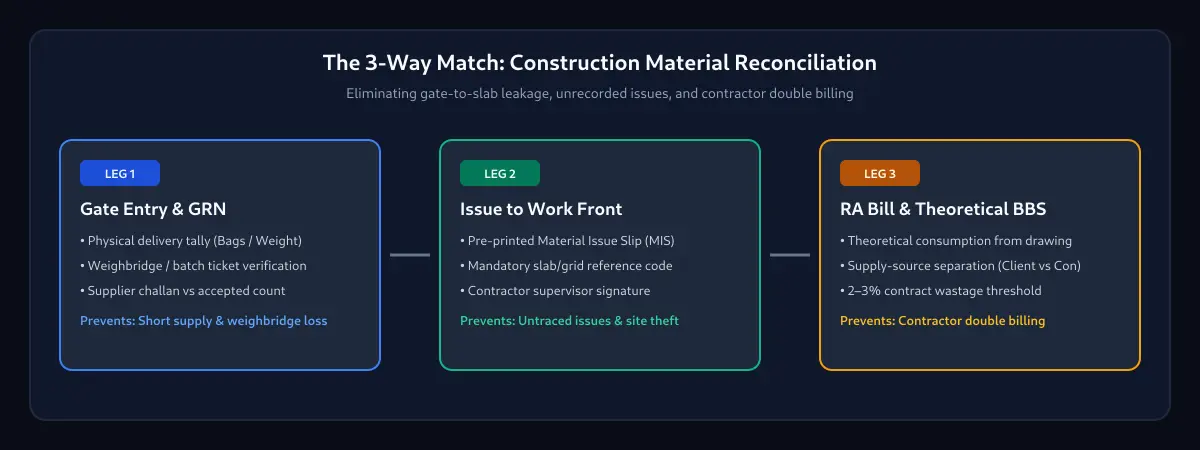
Leg 1 — Gate Entry and Goods Receipt Note (GRN)
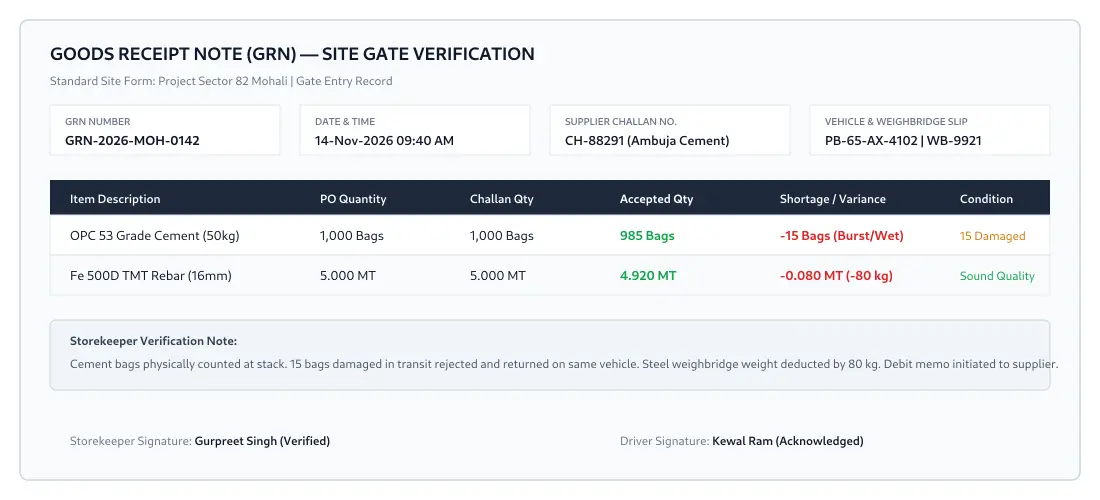
Every vehicle entering the site must be verified against the official purchase order and the supplier’s physical challan before the Goods Receipt Note (GRN) is signed.
- For steel rebar: Count bundles and individual bars by diameter. Calculate theoretical linear weight (for example, standard 12 mm TMT bar weighs 0.888 kg per metre) and compare that figure against the weighbridge gross-tare slip.
- For bagged cement: Physically tally bags offloaded, verify manufacturer batch codes, and check manufacturing dates to reject moisture-damaged stock.
- The rule: The GRN records accepted physical quantity, never the supplier's printed invoice figure.
Leg 2 — Issue to Work Front (Material Issue Slip)
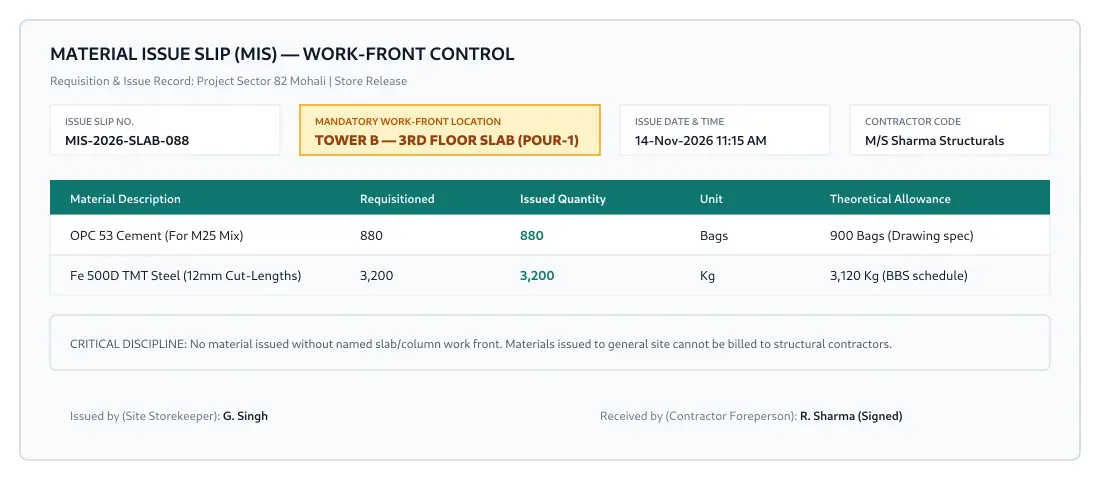
When material leaves the central site store, it must be issued exclusively against a named work front—such as Tower B, 3rd Floor Slab (Pour-1) or Grid C4–C8 Retaining Wall—never issued generically to a contractor's firm name.
The pre-printed Material Issue Slip (MIS) must capture:
- Issue date and time
- Exact structural location / work-front code
- Material grade and quantity
- Site storekeeper signature and contractor foreperson counter-signature
Without a mandatory work-front reference, contractors can claim material was never received on the slab, leaving the builder unable to prove where bulk bags or steel bundles were consumed.
Leg 3 — Contractor RA Bill and Theoretical Consumption
The contractor's monthly or slab-wise Running Account (RA) bill must include a material reconciliation annexure comparing theoretical consumption from structural drawings or the bar bending schedule (BBS) against the actual quantity issued by the site store.
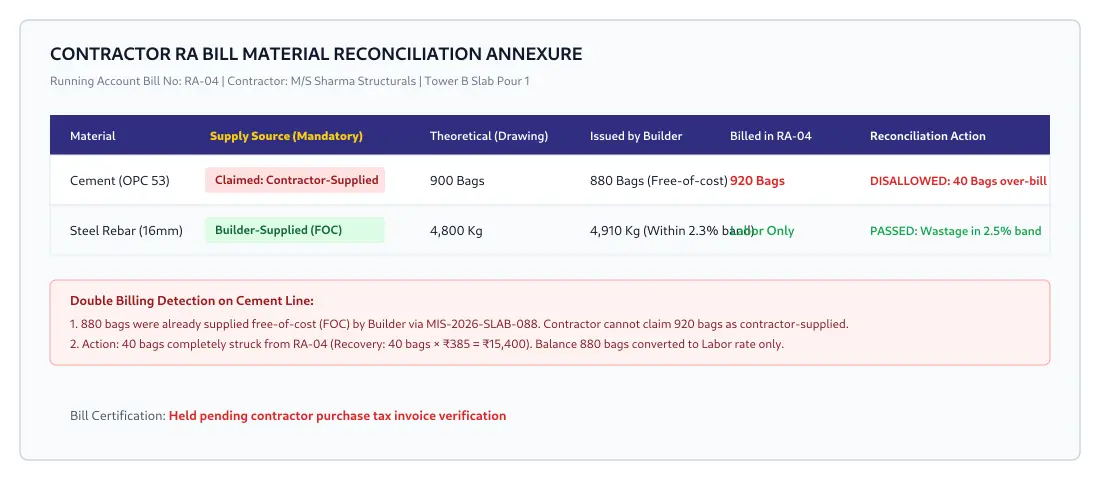
Where a hybrid procurement model is used—the builder supplies primary cement and steel, while the contractor provides supplementary materials—the billing annexure must feature a dedicated Supply Source column (Builder-Supplied FOC vs. Contractor-Supplied). The common contractor double-billing pattern is straightforward: billing for materials that the builder already purchased, or resubmitting the same delivery challan across consecutive RA bills.
When these three operational legs are compared, discrepancies highlight clear failure modes:
| Observed Discrepancy Pattern | Operational Root Cause | Prescribed Control Response |
|---|---|---|
| GRN Quantity > Issued Quantity (with zero store balance) | Material was diverted at the gate, leaked, or stolen from unsecured yards | Perform emergency physical count; audit inter-site truck movements and night gate logs |
| Issued Quantity > Theoretical Consumption (exceeding permissible wastage) | Severe site wastage, oversized concrete forms, over-excavation, or unrecorded issues | Audit shuttering alignment; inspect bar cutting practices; check offcuts scrap pile |
| Contractor Billed Quantity > Store Issued Quantity | Subcontractor double billing or billing for client-supplied materials | Reject invoice line item immediately; demand verified supplier GST invoices and delivery challans |
A 7-Step Reconciliation Protocol for Builders with 2–5 Sites
This protocol is structured to execute per RA bill or per slab pour, not postponed until annual financial year-ends. It requires one competent site storekeeper per project and a central project engineer or director reviewing submissions across sites.
Step 1 — Lock the Gate Record Before the Pour
No delivery enters the project boundary without an authenticated GRN tied to an approved Purchase Order. The GRN must record accepted count, supplier delivery challan number, truck registration number, and gross/tare weighbridge printout. If rebar is short or bags are damaged, record the shortage on the face of the challan and issue a debit memo to the vendor the same day.
Step 2 — Issue Exclusively Against a Named Work Front
Enforce pre-printed Material Issue Slips. The site engineer must specify the structural grid or pour stage before the storekeeper releases stock. This single discipline prevents subcontractors from borrowing materials between work fronts and makes element-wise reconciliation possible.
Step 3 — Calculate Theoretical Consumption for the Billing Window
For each raw material, determine the exact engineering requirement for work executed during the specific billing window:
- Cement: Mix design grade (e.g., M25 at 7.5 bags/m³) × verified cast concrete volume.
- Steel Rebar: Bar bending schedule (BBS) detailing cut lengths, hooks, and mandatory structural laps.
- Ready-Mix Concrete (RMC): Theoretical formwork volume compared against computer batching tickets.
Step 4 — Derive Actual Physical Consumption
Calculate actual consumption using the standard store balance formula:
$$\text{Actual Consumption} = \text{Opening Physical Stock} + \text{GRN Receipts} - \text{Closing Physical Stock}$$
The closing stock figure must be a physical hands-on count, never a clerical balance copied from an Excel sheet. Physically count cement stacks, tally rebar bundles, and survey sand/aggregate stockpiles.
Step 5 — Apply Contractual Permissible Wastage Bands
Contractual wastage thresholds must be negotiated and executed in writing before work begins. In North Indian private residential and commercial contracting, standard bands include:
- Cement: 2.0% – 2.5%
- Reinforcing TMT Steel: 2.5% – 3.0% (accounting for cut pieces and rolling margin variances)
- Ready-Mix Concrete: 1.5% – 2.0% (pump residue and transit hold)
Variances exceeding these bands must be explained in writing or debited directly from the contractor’s billing certification.
Step 6 — Run the 3-Way Variance Table
Consolidate the quantities into a single variance matrix:
- Reconcile GRN receipts against store issues.
- Reconcile store issues against contractor-billed quantities.
- Compare store issues against theoretical structural consumption plus allowable wastage.
Flag any invoice line where billed volumes exceed site store release records.
Step 7 — Recover Debits Before Releasing the RA Payment
Unsubstantiated variances must generate a formal Debit Note appended to the payment certificate. Do not release running account payments, milestone disbursements, or statutory retention balances until the reconciliation statement is signed off by both the project engineer and the contractor’s authorized representative.
Worked Example: Catching a Double Bill on an M25 Slab Pour
The following scenario illustrates typical field calculations encountered on a 120 m³ structural pour in Punjab.
A builder in Mohali Sector 82 is casting an M25 suspended floor slab measuring 120 cubic metres. The laboratory-approved mix design specifies cement consumption of 7.5 bags per cubic metre, establishing a theoretical consumption of 900 bags ($120 \times 7.5$).
The site store ledger records:
- Opening stock: 200 bags
- GRN delivery receipts during the pour cycle: 1,000 bags
- Physical closing stock counted in the shed: 250 bags
Using the balance formula, actual site consumption equals $200 + 1,000 - 250 = \mathbf{950\text{ bags}}$. This reflects an apparent variance of 50 bags (5.56%), substantially exceeding the contractual 2.5% permissible wastage threshold (22.5 bags).

When the project engineer audits the Material Issue Slips:
- Exactly 880 bags were issued under slip reference MIS-2026-SLAB-088 marked specifically for the 3rd Floor Slab.
- An additional 70 bags were issued under a vague "General Site Masonry" code without a work-front identifier.
However, when the structural subcontractor submits Running Account Bill RA-04, their billing schedule claims 920 bags of cement as contractor-supplied emergency stock at ₹385 per bag.
The three-way match exposes the discrepancy immediately:
- Builder GRN Receipts: 1,000 bags
- Store Issued to Slab: 880 bags (Supplied by Builder FOC)
- Claimed on Contractor Bill: 920 bags (Claimed as Contractor-Supplied)
The bill exceeds actual slab store issues by 40 bags. Furthermore, the contractor claims reimbursement for 920 bags when 880 bags were already supplied directly by the builder's store.
Resolution:
- The builder demands commercial tax purchase invoices and delivery challans for the claimed 920 bags. The contractor cannot produce them.
- The 40 unissued bags are disallowed entirely (saving ₹15,400).
- The 880 builder-supplied bags are converted from a full material-inclusive rate to a labor-only fixing rate, eliminating a ₹338,800 duplicate claim.
- The remaining 70 bags are traced to a site boundary wall foundation, properly categorized in the general ledger, and eliminated from the slab calculation.

The Minimum Paperwork Checklist (No Complex ERP Required)
Builders managing 2 to 5 sites can operate an airtight reconciliation workflow using pre-printed carbon registers or a shared Google Sheet. Maintain these nine mandatory records:
- Purchase Order (PO): Clear specifications of material grades, ISI certifications, agreed unit rates, and delivery schedules.
- Goods Receipt Note (GRN): Physical verification capturing accepted bags or weighed tonnage, vendor challan reference, and truck numbers.
- Weighbridge & Batch Slips: Mandatory computerized tare/gross weight receipts for rebar; automated batching tickets for RMC.
- Material Issue Slip (MIS): Requisition slip requiring specific structural work-front codes and contractor supervisory signatures.
- Daily Store Balance Register: Running daily ledger recording opening counts, daily receipts, issues, damaged returns, and physical closing tallies.
- Theoretical Consumption Sheet: Calculation template derived from approved architectural drawings, BBS schedules, and structural pour sheets.
- Contractor RA Bill Annexure: Billing schedule featuring a mandatory Supply Source Column separating FOC client materials from contractor claims.
- Monthly Variance Log: Formal register documenting every material discrepancy exceeding the allowable wastage band, attached to debit notes.
- Inter-Site Transfer Challan: Gate pass signed by both dispatching and receiving storekeepers for materials moved between sister projects.
5 Common Mistakes That Allow Leakage to Continue
- Accepting delivery invoices without independent physical verification: Signing delivery challans based on vendor paper counts rather than manual bag counts or computerized weighbridge tickets invites systematic short supply.
- Releasing materials without a work-front code: Issuing bags or rebar bundles generically to a contractor's firm name destroys slab-wise traceability and makes post-pour reconciliation impossible.
- Substituting ledger book balances for physical site counts: Relying on spreadsheet balances rather than counting physical bags and surveying steel racks hides yard pilferage and moisture damage.
- Applying a single blanket wastage rate across all materials: Cement handling loss (2.0%), structural steel cutting laps (2.5%), and RMC pump residue (1.5%) behave differently. A blended single rate masks structural steel leakage behind loose aggregate buffers.
- Postponing reconciliation until project completion: Attempting reconciliation at the final handover stage guarantees contractor disputes, cold document trails, and unrecoverable overpayments. Enforce reconciliation at every intermediate RA bill.
When to Bring in a Specialist (and When Software Helps)
For builders running a single active site with a trusted storekeeper, standard manual registers provide adequate control. Engage an external quantity surveyor, technical auditor, or workflow specialist when:
- Material consumption variances on cement or steel exceed allowable thresholds across two consecutive RA bills.
- Subcontractors dispute theoretical BBS figures, and existing contracts lack clear rolling-margin or wastage clauses.
- Your business expands from two to five simultaneous sites, and site storekeepers are overwhelmed by manual cross-site transfers.
- You identify recurring weighbridge discrepancies across bulk steel deliveries.
Practical field note: Rolling margin and supply-source checks on a 3-site project
On a multi-site residential project in Sector 82, Mohali, a builder running three active towers implemented this gate-to-slab protocol after noticing an unexplained 7.4% variance in structural steel over two billing cycles.
During the first month of enforcement:
- Contractor pushback: Subcontractors initially resisted signing the work-front field on issue slips, claiming it created delays during peak morning slab preparations. The builder resolved this by stationing pre-printed pads directly at the site gate and making signed work-front slips mandatory before releasing crane hoists.
- Caught variance 1 (weighbridge & rolling margin): Verifying bundle weights against the bar bending schedule (BBS) revealed that delivered 16 mm rebar carried a +4.2% rolling margin discrepancy from the mill, resulting in fewer effective linear metres than invoiced. Recording accepted linear weight on the GRN enabled immediate credit adjustments from the rebar vendor.
- Caught variance 2 (contractor double billing): When the third RA bill arrived, the structural contractor billed 120 bags of cement as "contractor-supplied emergency backup." Cross-checking the material issue slips revealed that the builder’s store had already issued 115 bags free-of-cost to that exact third-floor slab pour via Slip MIS-2026-SLAB-088. The contractor was unable to produce purchase invoices for the claimed cement, preventing an unauthorized ₹46,000 double billing.
Within 60 days, total unexplained steel and cement variance fell from 7.4% to 2.1%, comfortably within the contractual 2.5% allowable wastage band.
For builders looking to replace error-prone spreadsheets, custom software can automate gate entry, issue slips, and billing checks into a single verified chain. At JUHENZA, we engineer custom software around operating workflows and AI-assisted anomaly checks that flag inventory discrepancies and duplicate invoices automatically across multi-site operations.
Frequently Asked Questions
What is gate-to-slab material reconciliation?
Gate-to-slab material reconciliation is an operational control protocol that links delivery gate receipts (GRNs), store issues tied to specific structural work fronts (MIS), and contractor invoices (RA bills) against theoretical engineering consumption. It verifies that materials entering the site gate match the structural drawings and prevents paying for the same materials twice.
How frequently should a small builder reconcile cement, steel, and RMC?
Reconcile high-value materials at every intermediate RA bill or immediately following each major slab pour. Perform weekly physical counts of bagged cement and steel rebar yards, and run comprehensive three-way matching before certifying payments.
What is the exact formula for actual material consumption?
The standard construction inventory formula is:
$$\text{Actual Consumption} = \text{Opening Physical Stock} + \text{Receipts during Period} - \text{Closing Physical Stock}$$
Closing inventory must always represent a verified physical count, not a balance copied from accounting ledgers.
How do builders prevent contractor double billing on material?
Require a mandatory Supply Source Column in the RA bill reconciliation annexure categorizing every line item as Builder-Supplied (Free of Cost) or Contractor-Supplied. Validate billed volumes against site store issue slips; if a contractor bills for materials without corresponding site requisitions and verified purchase tax invoices, disallow the line item.
What are standard permissible wastage percentages in private Indian construction?
Private building agreements across North India typically define allowable wastage thresholds between 2.0% and 2.5% for cement, 2.5% and 3.0% for TMT reinforcing steel, and 1.5% to 2.0% for RMC. Wastage terms must be agreed upon in the primary contract.
Can gate-to-slab reconciliation operate without expensive ERP software?
Yes. A disciplined paper-based system using pre-printed Goods Receipt Notes, Material Issue Slips with mandatory work-front references, and a basic spreadsheet reconciliation annexure is entirely sufficient for builders operating 2 to 5 active sites.
What is the primary source of material leakage on Punjab construction sites?
Unrecorded gate deliveries, short weighbridge supplies, and unallocated store releases represent far greater financial losses than nocturnal site theft. Accepting delivery challans on paper without verifying actual counts or weighing trucks creates invisible margins that compounding contractors and vendors exploit.
When should a builder engage an external quantity surveyor or technical auditor?
Engage a specialist when material consumption variances exceed contractual wastage thresholds across two consecutive billing cycles, when structural contractors dispute theoretical BBS calculations, or when expanding across multiple locations without centralized store controls.
Conclusion: Turn Site Reconciliation into an Operating Condition
The margin leakage that impacts small and mid-sized builders does not stem from bad intentions; it happens because the three documents that should align—gate delivery challans, store issue slips, and contractor billing schedules—are maintained in isolation by different people and rarely reconciled before money leaves the bank.
Implementing this 7-step protocol changes contractor and vendor dynamics immediately: verify GRN weights at the gate, issue materials strictly against named work fronts, calculate theoretical consumption from engineering drawings, verify physical closing balances, and enforce debit adjustments before certifying running bills.
Begin by applying the protocol to cement on your next upcoming slab pour. Once the three-way match is operating smoothly, expand the discipline across structural steel, masonry blocks, and finishes. If your organization is ready to digitize this protocol across multiple active projects with automated anomaly alerts, connect with JUHENZA to evaluate a custom, streamlined workflow system built around your existing field operations.
References
- Civaropulse — Steel Reconciliation: The Complete Technical Guide (GRN discipline, rolling margin tolerances, and diameter-wise bar scheduling).
- True Site Sync — Preventing Material Theft on Construction Sites in India (Analysis of Indian material leak points and gate-level verification).
- Indian Express — Commercial Fraud and Material Dispute Case in Mohali Project (Reporting on site record disputes and commercial contracting risks).