
Hiring the wrong web agency in Dubai rarely fails at the design mockup stage—it fails six months after launch when mobile pages lag on UAE cellular networks, Arabic layouts break your checkout flow, or you discover you do not actually own your hosting and source code.
The best web development company in Dubai is not whichever agency pays to sit at the top of a directory list. It is an engineering partner that scopes your actual business workflow before quoting, builds native Arabic and English interfaces that pass Google Core Web Vitals, integrates cleanly with your payment or enterprise systems, and hands over full source code and cloud ownership in writing.
When business owners search for the best web development company in Dubai, they usually encounter two types of pages: pay-to-play agency directories and self-published "Top 10" blog posts where the author conveniently ranks their own firm number one. Neither format tells you how to evaluate technical competence, compare two vastly different commercial quotes, or prevent vendor lock-in. This blueprint gives Dubai founders, operations leads, and procurement teams a practical engineering framework to shortlist vendors, audit proposals, and select the right delivery model for their business.

Why Most "Top 10" Dubai Agency Lists Mislead Business Buyers
Headcount, founding year and directory badges do not establish project fit. Inspect the proposed team’s work, delivery process and understanding of your data flows before comparing credentials.
To identify the best web development company in Dubai for your specific project, you must shift your evaluation from agency vanity metrics to system capabilities:
- Workflow alignment: Does the vendor start by asking what color palette you want, or do they map how leads, orders, and inventory records move between your staff and your software?
- Architectural honesty: Do they push the same Content Management System (CMS) for every brief, or do they explain when WordPress or Shopify is sufficient versus when a custom React or Next.js application is required?
- Explicit ownership: Does the written proposal guarantee that your company owns the Git repository, domain registrar, cloud infrastructure accounts, and database backups from day one?
Step 1: Match the Website Architecture to Your Business Workflow
Before requesting quotes, define the job your website must perform. A corporate profile, a high-SKU industrial catalog, a multi-currency e-commerce store, and a role-based customer portal require fundamentally different engineering stacks.
Review the comparison table below to identify which architecture fits your operational goal before speaking to vendors.
| Website Category | Best-Fit Business Use Case in Dubai | Recommended Tech Stack | Key Engineering Focus | When NOT to Use This Approach |
|---|---|---|---|---|
| Marketing & Corporate Site | Professional services, consultancies, clinics, or real estate brokers needing fast lead generation. | Next.js, Astro, Webflow, or clean WordPress | Mobile speed, local schema, bilingual URL structure, CRM lead routing. | You need complex multi-role user dashboards or custom ERP rules. |
| B2B Product Catalog & RFQ Portal | Trading firms, industrial suppliers, and wholesale distributors in JAFZA, DMCC, or Al Quoz. | React, Next.js, or Vite + Headless API & PostgreSQL | Fast SKU/code search, specification filtering, bulk Request for Quote (RFQ) workflows. | You only sell 5–10 simple retail products with standard parcel checkout. |
| Direct-to-Consumer (D2C) E-Commerce | Retail brands, fashion, electronics, and specialty food merchants selling across the GCC. | Shopify, WooCommerce, or Headless Commerce | AED/multi-currency checkout, UAE payment gateways, BNPL, inventory sync. | Your sales process requires negotiated B2B credit limits and custom contracts. |
| Custom Web App / SaaS / Operations Portal | Logistics tracking, tenant portals, booking engines, or internal workflow automation. | Next.js, React, TypeScript, Node.js, Python, PostgreSQL | Role-based access control, audit logs, API integrations, automated background jobs. | A standard off-the-shelf SaaS subscription already solves 95% of the workflow. |
If your team is unsure whether your project requires a standard CMS build or a tailored web application, review our software and AI development services to see how different capabilities map to specific operational problems.
Step 2: Verify the 5 Non-Negotiable Dubai & UAE Engineering Standards
A web development agency that builds exclusively for single-language Western or domestic markets often misses critical technical requirements specific to the United Arab Emirates. Vet every vendor against these five engineering standards.
1. True Bilingual Right-to-Left (RTL) and Left-to-Right (LTR) Engineering
In Dubai, supporting Arabic and English is not as simple as installing an automated translation plugin. Translation overlays alone may leave layout, directional icons and crawlable language URLs unresolved.
- Requirement: The developer must use CSS Logical Properties (such as
margin-inline-startandpadding-inline-endinstead of hardcodedleftandrightvalues) so layout spacing adapts when switching between English (dir="ltr") and Arabic (dir="rtl"). - Recommendation: Follow W3C guidance on HTML text direction, and test mixed Arabic/Latin product codes and form inputs. Use dedicated, crawlable language subdirectories (
/en/and/ar/) paired with validhreflangannotations (en-aeandar-ae) and Arabic-optimized web fonts (such as Cairo, Tajawal, or IBM Plex Sans Arabic) with adjusted line heights for legibility.
2. Core Web Vitals on Mobile Networks
Test mobile discovery and purchasing workflows explicitly. Heavy unoptimized video backgrounds, bloated third-party tracking scripts, and render-blocking JavaScript destroy mobile conversion rates.
- Requirement: According to Google Search Central's Core Web Vitals documentation, production pages should achieve a Largest Contentful Paint (LCP) within 2.5 seconds, an Interaction to Next Paint (INP) of less than 200 milliseconds, and a Cumulative Layout Shift (CLS) score of less than 0.1.
- Recommendation: Require your developer to benchmark these metrics at the 75th percentile of field loads as defined in the official Web Vitals engineering specification, and deploy edge caching or hosting nodes close to the Gulf region (such as AWS Middle East
me-central-1in the UAE or Cloudflare's GCC edge network).
3. UAE Payment Gateways and Regional Checkout Flows
If your website processes transactions in UAE Dirhams (AED) or across Gulf Cooperation Council (GCC) currencies, your checkout architecture must align with local banking expectations and regulatory rules.
- Scope check: Evaluate integration with regional gateways such as Network International, PayTabs, Telr, Checkout.com, or Stripe UAE, alongside Apple Pay and local Buy Now, Pay Later (BNPL) providers like Tabby and Tamara.
- Regulatory boundary: Marketplaces that hold or route third-party funds need a payment and legal review before architecture is agreed. Have a qualified adviser and the payment provider confirm licensing, settlement and onboarding requirements.
4. UAE Personal Data Protection Law (PDPL) Readiness
Websites collecting customer inquiries, account profiles, resumes, or behavioral analytics from residents in the UAE must respect national data privacy legislation.
- Requirement: The UAE government’s data-protection overview describes the federal PDPL, consent requirements and exceptions, data-subject rights, and cross-border transfer controls. Ask counsel to establish the applicable regime and lawful basis before implementation.
- Engineering Implementation: Your web developer should implement granular cookie and tracking consent controls, encrypt personal records in transit and at rest, provide a clear mechanism for users to request data erasure or stop direct-marketing processing, and verify where third-party APIs or AI models store customer data.
- Disclaimer: This technical summary is for informational architecture planning as of November 2026 and does not constitute legal advice; consult a qualified UAE legal practitioner regarding binding statutory compliance under UAE PDPL, DIFC, or ADGM data regimes.
5. ERP, CRM, and Inventory System Handoffs
For established Dubai businesses, a website that dumps form submissions into an unmonitored email inbox creates manual data-entry bottlenecks.
- Requirement: Define which system owns each record before building API connections. Whether connecting to SAP, Odoo, Tally, HubSpot, Zoho, or a custom PostgreSQL database, the web application must validate inputs, handle API timeouts gracefully, and prevent duplicate records.
- Optional Best Practice: Keep high-stakes financial or inventory approvals behind a human review step rather than allowing public web forms to write directly to your core accounting ledger.
Step 3: Choose Your Delivery Model (Onshore Dubai vs. Remote Engineering Studio)
When hiring a web development partner for a Dubai business, you generally choose between three operating models. None is universally "best"—the right choice depends on your governance requirements, budget, and need for direct engineering access.
- Onshore Dubai Mainland / Free Zone Enterprise Agency:
- How it works: Account managers and project directors sit in Dubai (such as Dubai Media City or Business Bay), while engineering is either performed locally or subcontracted to offshore partner teams.
- Best for: Government tenders, semi-government entities, or large enterprises that mandate daily in-person workshops at their Dubai premises.
- Trade-off: Confirm which staff are local, which work remotely, who owns technical decisions and whether you can speak directly with the implementation team.
- Freelance Developer or Solo Designer:
- How it works: An individual developer builds the site independently.
- Best for: Simple, low-risk landing pages with zero backend integrations.
- Trade-off: Single point of failure for deployment, security patches, and post-launch recovery.
- Founder-Led Remote Engineering Studio (With Agreed UAE Review Windows):
- How it works: You work directly with the lead software architect and engineering team operating from a dedicated technology hub (for example, JUHENZA delivers remotely from Anand, Gujarat, India—just 1.5 hours ahead of UAE Gulf Standard Time) with scheduled review windows, working staging releases, and documented handover.
- Best for: Founders, SMEs, and enterprise operations teams who want senior full-stack engineering (React, Next.js, Node.js, Python, custom integrations) and direct technical communication without paying for a middleman agency layer.
- Trade-off: Meetings happen over video calls rather than in a physical Dubai boardroom, requiring clear written briefs and milestone acceptance criteria up front.
Explore how we structure cross-border review cadences, hosting ownership, and technical delivery on our Dubai software and web development page.
Step 4: Score Shortlisted Vendors Using the 100-Point Technical Matrix
Do not rely on sales pitch decks to pick the best web development company in Dubai. Give this 100-point scorecard to your procurement or leadership team and grade your top three shortlisted vendors objectively.
| Evaluation Category | Weight | Specific Verification Question to Ask the Vendor | Poor Response (0–3 pts) | Strong Engineering Response (8–10 pts) |
|---|---|---|---|---|
| 1. Workflow & Discovery Depth | 20 pts | "How do you scope our project before giving a final implementation price?" | Sends a fixed lump-sum price after a 15-minute sales call with no written exclusions. | Maps user roles, existing tools, data flows, acceptance criteria, and explicit exclusions first. |
| 2. Live Technical Proof | 20 pts | "Can you share 2 live production URLs we can inspect right now for speed and code quality?" | Shows only static Dribbble/Figma screenshots or password-locked demos. | Shares live URLs with inspectable search, filtering, clean DOM structure, and responsive mobile performance. |
| 3. Bilingual & Mobile Architecture | 15 pts | "How do you architect Arabic/English layouts and measure and improve Core Web Vitals?" | "We install a translation plugin and optimize images at the end". | Explains CSS logical properties, /ar/ and /en/ routing, hreflang, and LCP/INP/CLS budgets from day one. |
| 4. System Integration & Data Integrity | 15 pts | "How will the website connect to our CRM, ERP, or inventory records?" | Suggests manual CSV exports or fragile unmonitored webhooks. | Defines the system of record, validation rules, error handling, and role-based permissions before coding. |
| 5. Code, Cloud & IP Ownership | 15 pts | "Who owns the Git repo, cloud hosting account, and domain during and after the build?" | Hosts everything on the agency's proprietary server; charges a release fee to leave. | Client owns the domain, cloud accounts, and source code upon milestone payment, with full handover documentation. |
| 6. Post-Launch Support & Security | 15 pts | "What happens if an API breaks or we need security updates three months after launch?" | Vague "1-year free support" promise with no defined SLA or boundary. | Defines exact post-launch warranty window, backup/recovery steps, and optional ongoing maintenance boundaries. |
Score each category from 0 to 10, then multiply by its weight divided by 10. Add the weighted scores for a total out of 100. This is a proposed procurement rubric, not an independently validated agency ranking.
Step 5: Audit Commercial Quotes for Hidden Exclusions and Lock-In
Two quotes for the same brief can differ substantially. A lower headline number frequently omits essential engineering work that your business will still have to pay for before launch.
When comparing proposals side by side, follow the verification steps detailed in our scoped software project pricing guide:
- Compare identical workflows and integrations: Verify that both vendors are quoting for the exact same user roles, language versions, and ERP/CRM connections—not just the same number of pages.
- Audit the exclusions list: Check whether copywriting, product photography, Arabic human translation, third-party API licenses, cloud hosting fees, and specialist legal/regulatory audits are included or excluded by default.
- Verify acceptance criteria: Confirm how each milestone is tested, who signs off on working releases, and how mid-project scope changes are estimated and approved.
- Separate discovery from full build when uncertainty is high: If your project involves undocumented legacy APIs or complex operational rules, commission a bounded discovery or prototype phase first rather than signing an inflated fixed-price guess.
- Confirm AI and search visibility readiness: Ensure technical SEO fundamentals—clean crawlable HTML, structured schema markup, canonical tags, and clear entity descriptions—are built into the template architecture rather than bolted on later. If organic discovery is a primary growth channel, align your developer early with a structured technical and local SEO strategy for Dubai.
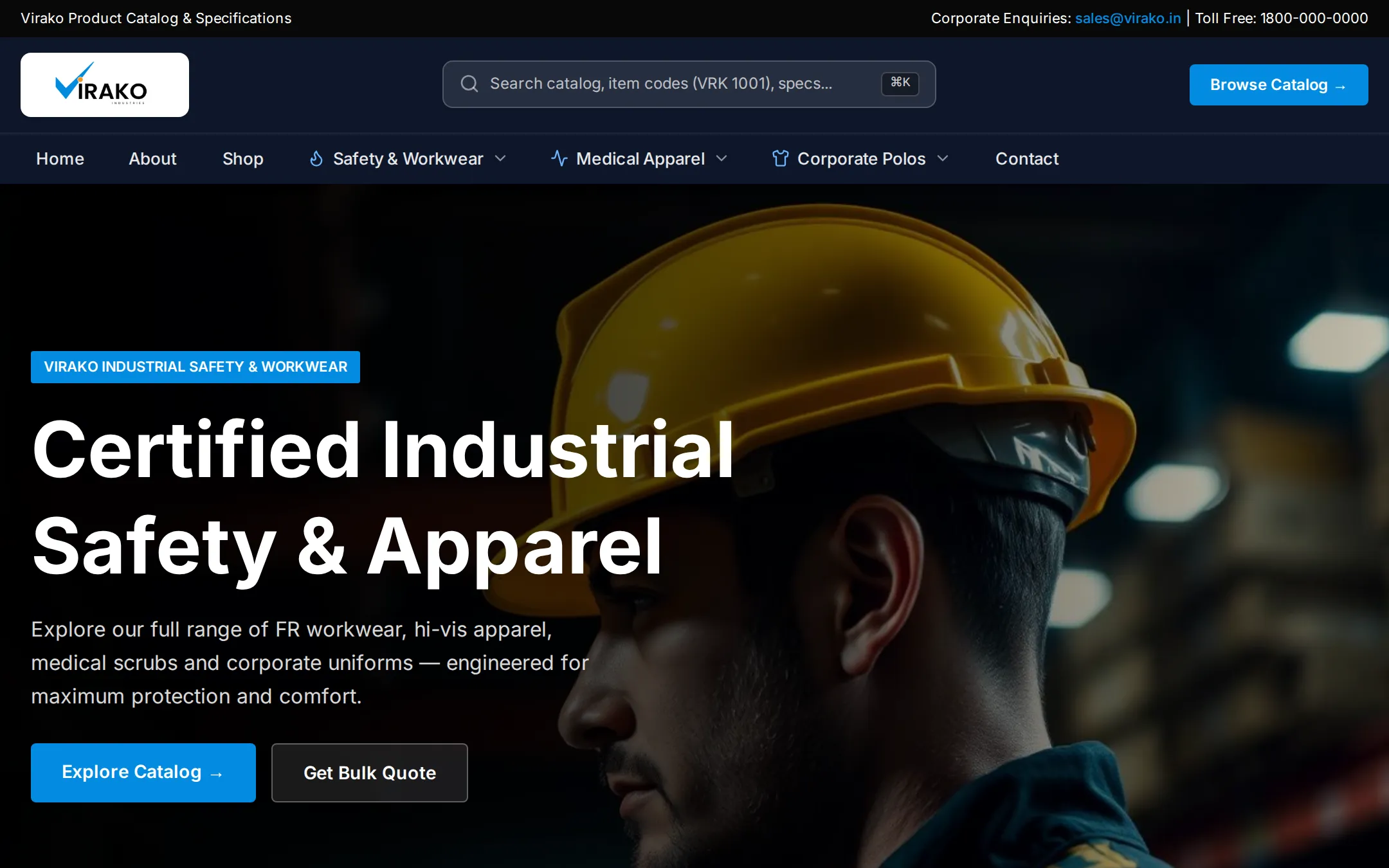
Engineering examples from JUHENZA’s published work
JUHENZA is based in Anand, India and delivers remotely. These published portfolio examples illustrate relevant workflows; they are not Dubai client results or performance benchmarks.
A useful discovery exercise is to trace how buyers find a product and how staff turn the resulting inquiry into a quotation. The portfolio examples below show workflows worth discussing with shortlisted vendors.
In our published engineering work, we focus on connecting product discovery directly to commercial action:
- Structuring high-SKU B2B catalogs (
Virako): When building the digital catalog for Virako Industrial Safety & Workwear (constructed with React, Vite, TanStack Router, and Tailwind CSS), the primary engineering challenge was not visual styling—it was enabling industrial procurement buyers to filter certified protective clothing by range, inspect item-coded SKUs (VRK 1001onward), trigger instant keyboard search (⌘K), and transition directly into a bulk quotation flow with custom embroidery specifications. That exact catalog-to-RFQ architecture applies directly to Dubai industrial supply, building materials, and wholesale trading firms. - Building explainable B2B discovery graphs (
AGNITY): For the AGNITY agriculture intelligence platform (built on Next.js and React), we connected company profiles, products, markets, and commercial opportunities into a single interactive graph with ask-first search and transparent matching rules, while keeping source and verification labels visible on every record. - Protecting operational boundaries: Across our custom application development projects, we enforce a strict rule: public-facing web interfaces and AI assistants should accelerate discovery and draft preparation, but critical financial approvals, inventory write-backs, and contract commitments must remain under explicit role-based human authorization.
Illustrative Decision Scenario: Comparing 3 Quotes for a Dubai Distributor
Note: The following scenario is illustrative to demonstrate how a Dubai business owner should apply the 100-Point Matrix and Quote Audit rules in practice.
The Business Brief: An industrial electrical equipment distributor operating out of Jebel Ali Free Zone (JAFZA) needs a bilingual (English/Arabic) B2B web platform. They have 1,800 SKUs managed in Odoo ERP, need instant specification search for contractors, and want a bulk Request for Quote (RFQ) cart that routes inquiries to sales reps by territory.
How Three Typical Vendors Respond:
- Vendor A (Low-Cost Template Reseller):
- Proposal: Quotes a flat low fee using a pre-bought WordPress WooCommerce theme, promising delivery in 3 weeks.
- Audit Finding: No native Odoo sync (staff must upload CSVs manually), relies on an auto-translate widget that breaks Arabic technical spec tables, and excludes data migration. Score: 34/100.
- Vendor B (Large Retainer Marketing Agency):
- Proposal: Pitches a massive branding and custom design retainer with 6 weeks of mood boards, quoting a high six-figure AED budget.
- Audit Finding: Heavy emphasis on cinematic motion graphics that degrade mobile INP/LCP scores; treats the Odoo API handoff and SKU specification search as an unpriced "Phase 2" add-on. Score: 58/100.
- Vendor C (Workflow-First Engineering Partner):
- Proposal: Begins by mapping the 1,800-SKU Odoo data structure, user roles, and territorial RFQ routing rules. Proposes a fast React/Next.js frontend with clean
/en/and/ar/RTL layouts, a read-only product sync from Odoo, and a validated RFQ payload that creates draft quotations in Odoo for sales rep approval. - Audit Finding: Clear deliverables, explicit exclusions, client owns cloud and Git repositories, and staging releases are reviewed weekly. Score: 91/100.
If your project also involves automating repetitive back-office tasks—such as extracting data from supplier PDFs or purchase orders—you can evaluate the financial payback of adding automation using our AI automation ROI calculation framework before committing to the build.
Common Mistakes, Limitations, and When to Involve a Specialist
Even experienced founders fall into predictable traps when commissioning a website in the UAE. Avoid these five mistakes:
- Mistake 1: Treating Arabic as a post-launch translation task. Retrofitting RTL support onto a website built exclusively with hardcoded left-to-right CSS can require substantial frontend rework. Scope bilingual requirements before UI design begins.
- Mistake 2: Buying custom code when an off-the-shelf tool works (or vice versa). Not every business needs a custom-engineered platform. If you run a standard 50-item retail boutique, Shopify with a clean theme and UAE payment gateway is faster and more economical than a custom build. Conversely, forcing a complex multi-role B2B workflow into a fragile stack of 35 WordPress plugins creates permanent security and maintenance debt.
- Mistake 3: Ignoring who owns the cloud and domain accounts. Never let an agency register your primary
.aeor.comdomain or production database under their own corporate billing account without transfer rights. - Mistake 4: Automating ERP writes without failure recovery. When connecting a website to an accounting or inventory system, network drops and malformed payloads happen. Always build retry queues, validation logs, and human review gates.
- Mistake 5: Expecting a website build to substitute for legal or regulatory sign-off. A software engineering team can build cookie consent banners, audit logs, and secure encryption, but they cannot provide formal legal counsel.
When to Involve a Specialist:
- UAE Legal & Data Protection Counsel: Engage a licensed UAE lawyer if your platform processes sensitive personal health data, financial credit scoring, children's data, or cross-border data transfers regulated under UAE Federal Decree-Law No. 45 of 2021, DIFC Data Protection Law, or ADGM regulations.
- Regulated Fintech / Payment Compliance Advisors: Involve a CBUAE regulatory specialist if your platform acts as an escrow agent, payment aggregator, or stored-value facility.
- Dedicated Penetration Testing Firm: Commission an independent third-party security audit if your web application handles high-value financial transactions or regulated government workflows.
Frequently Asked Questions
How much does a web development company in Dubai charge?
Website development costs in Dubai depend entirely on workflow complexity, bilingual requirements, and system integrations rather than a flat per-page rate. Basic CMS marketing sites sit at the entry tier, whereas bilingual B2B catalogs, custom e-commerce builds, and ERP-connected web applications require scoped discovery quotes based on user roles, API handoffs, and acceptance criteria.
Should I hire an onshore Dubai agency or a remote software engineering studio?
Hire an onshore Dubai agency if your organization mandates frequent in-person boardroom meetings or holds local government contracts requiring a mainland trade license. Choose a founder-led remote engineering studio if you want direct access to senior software architects, transparent milestone releases, and an agreed remote delivery process.
What is the best tech stack for a business website in Dubai in 2026?
For high-speed corporate sites, B2B catalogs, and custom portals, React, Next.js, and TypeScript paired with a Node.js or Python backend can support strong mobile performance and security when implemented and maintained well. For straightforward retail stores, Shopify or WooCommerce remain practical choices when configured with regional AED payment gateways and lightweight themes.
How do I make sure my Dubai website supports both Arabic and English properly?
Require your developer to build with CSS Logical Properties so the interface supports both Left-to-Right (English) and Right-to-Left (Arabic) modes. Use separate indexable URL paths (/en/ and /ar/), implement hreflang="en-ae" and hreflang="ar-ae" tags, and have a native speaker review business terminology rather than relying on automated machine translation.
Who should own the source code and hosting after our website launches?
Your business should retain full legal and administrative ownership of the domain name, cloud hosting accounts (such as AWS, Vercel, or Cloudflare), database instances, and the Git source code repository upon milestone payment. Verify that handover documentation and access credentials are listed as mandatory deliverables in your contract.
Does my Dubai business website need to comply with the UAE Personal Data Protection Law (PDPL)?
Applicability depends on the entity, processing and statutory exceptions. The federal PDPL and separate regimes such as DIFC and ADGM require a project-specific assessment. Ask qualified counsel to define the applicable obligations, then translate them into data flows, access controls, notices and rights-request procedures.
How long does it take to build and launch a custom website or web portal?
Timeline depends on scope clarity, content readiness, and integration depth. A clearly scoped corporate website or B2B catalog typically moves from discovery to working staging release in a few weeks, while complex multi-role web applications or ERP-integrated platforms are best delivered in phased working increments rather than a single delayed launch.
Conclusion: Start With Your Workflow Brief
Choosing the best web development company in Dubai comes down to engineering clarity, not sales polish. Before signing any proposal, write down the single primary workflow your website needs to improve, the users who will interact with it, the internal systems it must connect to, and the evidence that will prove the first release succeeded.
At JUHENZA, J. Prajapati leads a software and AI engineering studio based in Anand, Gujarat, India, working remotely with founders and operations teams across Dubai and the wider UAE. Whether you need a high-speed Next.js web platform, a searchable B2B product catalog, an ERP/CRM integration, or a scoped custom web application, we agree on clear review windows, acceptance criteria, and full handover responsibilities before writing code.
Ready to turn your requirements into a structured scope you can compare objectively? Prepare your project brief on our contact page to receive a documented technical approach and scoped quote.
References
- UAE Government: Data protection laws (Accessed November 2026).
- Google Search Central Documentation: Understanding Core Web Vitals and Google Search Results (Accessed November 2026).
- web.dev by Google Chrome Developers: Web Vitals: Essential Metrics for a Healthy Site (LCP, INP, CLS Thresholds) (Accessed November 2026).
Image credits
Dubai skyline: Sergei Gussev, via Wikimedia Commons, CC BY 2.0. Cropped, resized and converted to WebP. The photograph dates from 2017 and is illustrative. Virako catalog image: JUHENZA’s existing portfolio asset; it illustrates the published project, not a Dubai deployment.
