
Direct answer: the best web development company in Dubai for your business is the one that matches your project type, can prove relevant engineering depth, and will put ownership, compliance and post-launch support in writing. A low quote from a template shop is not the same product as a scoped custom build, and the two should not be compared on price alone.
Search for the best web development company in Dubai and you will find no shortage of agencies claiming the title. What most of those pages do not give you is a way to compare them. This guide does: the four types of provider, the questions that separate a reliable partner from an expensive lesson, and the point at which a custom web application becomes cheaper than a broken template.

What "best web development company in Dubai" should mean
"Best" is not a universal ranking. It is a fit between your problem and a provider's actual capability. A company that builds beautiful brochure sites may be the wrong choice for a customer portal with role-based access and payment integration. A custom software firm may be overkill for a five-page marketing site.
So the first decision is not which company. It is which category of company. Once you know the category, the shortlist gets much smaller, and the quotes start becoming comparable.
The four types of web development companies in Dubai
| Provider type | What they usually build | Best for | Watch-outs |
|---|---|---|---|
| Template / CMS agency | WordPress, Shopify and Webflow sites from pre-built themes | Fast launches, small marketing sites, tight budgets | Customisation limits; plugin dependency; performance and security degrade as the site grows |
| Custom website agency | Bespoke marketing sites, editorial CMS, multilingual builds | Brands that need unique design, content workflows, or Arabic and English structure | Still not a software team; complex integrations may be subcontracted |
| Web application / custom software company | Portals, dashboards, SaaS products, API integrations, AI features | Businesses replacing manual operations, building a product, or connecting several systems | More discovery effort; requires a written scope and acceptance criteria |
| Offshore / remote product team | Any of the above, delivered remotely | Cost-effective access to senior engineering; flexible capacity | Time-zone overlap, communication discipline and IP ownership must be explicit |
The fourth row deserves emphasis, because it is where most Dubai buyers get confused. "Offshore" is not a category of quality; it is a delivery model. A remote team can be excellent or terrible, and the difference is rarely visible on a website. It shows up in how they scope, how they document, and whether they hand over the repository at the end.
JUHENZA's web development services sit between the second and third categories: marketing sites, customer portals and web applications, with a published engineering approach. For projects that need logged-in users, integrations or AI, the better starting point is application development.
How much should you budget for web development in Dubai?
Published Dubai market guides quote ranges from a few thousand dirhams for a basic brochure site to well over AED 150,000 for complex platforms. Those numbers are real but not useful on their own, because "website" can mean a five-page brochure or a multi-tenant portal with payments. Treat any single figure — including one from an agency — with suspicion until you know what it covers.
A more reliable approach is to budget by cost driver:
| Cost driver | What raises the price | What keeps it lower |
|---|---|---|
| Scope | Logged-in users, dashboards, payments, integrations, AI | Static pages, simple forms, no integrations |
| Design | Custom design system, motion, accessibility work | Template-based layouts |
| Content and languages | Arabic and RTL, several locales, structured CMS | English only, small page count |
| Compliance | PDPL-driven consent, data mapping, retention rules | No personal data collected |
| Delivery model | Senior in-house team, discovery phase, testing | Junior-heavy team, discovery skipped |
| Post-launch | SLA-backed support, monitoring, security patching | Ad-hoc support, no handover documentation |
Before comparing quotes, ask each provider to break the price down along these lines. A quote that cannot be broken down is a quote you cannot compare with anything.
There is also a second way to justify spend, and it is not a price comparison at all. JUHENZA publishes a simple planning example on its site: a task repeated 200 times a month at 15 minutes each consumes 50 staff hours; cutting it to 5 minutes releases roughly 33 hours a month, a 67% reduction in task time. That is an illustrative arithmetic example, not a Dubai client result and not a price. But it is the right shape of argument for a custom build: measure the operational cost the system removes, then compare that with the build cost.
Nine questions to ask before hiring
- Are you licensed to provide IT services in the UAE? IT and software activity in Dubai requires a valid licence, from a free zone or a mainland authority. Meydan Free Zone, for example, issues software and IT consultancy licences under activity codes 6200.00, 6201.00, 6202.00 and 6209.00, and its own guide describes these as core activities that need no third-party approvals. Ask for the trade licence and check that the activity actually matches the work you are commissioning.
- Who owns the code and design files when the project ends? The contract should state that you own the repository, the design files and the deployment credentials on final payment. If the agency hosts everything and will not hand over source code, you are renting your website, not owning it.
- How will you handle UAE PDPL obligations? If your site collects names, emails, phone numbers or analytics data, the UAE Personal Data Protection Law (Federal Decree-Law No. 45 of 2021) is likely relevant. Ask how the provider structures consent, privacy notices, data-subject requests and data storage. This is not legal advice; confirm your own obligations with a qualified UAE lawyer.
- Do you engineer Arabic and RTL, or translate afterwards? Arabic is the UAE's official language, and right-to-left layout affects navigation, forms, typography and CMS structure. A provider that treats Arabic as a translation plugin will produce a fragile site. Ask for a live Arabic project and test its forms.
- What happens after launch? Ask for the support model: response times, security patching, backup policy, and the cost of ongoing maintenance. A cheap build with no support tends to become expensive within six months.
- Can you show a live project of similar complexity? A portfolio of brochure sites does not prove a team can build a portal or an integration. Ask for a live project that matches your complexity, and ask what engineering trade-offs it required.
- How do you scope AI features? AI should be tied to a workflow, not added as a demo. Ask where the data comes from, who can access it, and how outputs are reviewed. JUHENZA's AI and intelligent automation work frames AI around document intelligence, bounded agents and workflow automation with review steps.
- What is the total cost of ownership over three years? Include hosting, licences, maintenance, content updates and internal staff time. The lowest build quote is frequently not the lowest three-year cost.
- What are the acceptance criteria and payment milestones? A written scope with testable acceptance criteria protects both sides. Payment tied to milestones beats payment tied to a calendar.
Template vs custom website vs web application
Use this as a starting point, not a rigid rule.
| Your situation | Likely right choice | Why |
|---|---|---|
| A credible online presence is needed quickly, on a small budget | Template or CMS site | Fastest path; custom engineering adds cost without adding value |
| You need a distinct brand experience, editorial workflows or bilingual content | Custom website | Template limits show up in design, CMS structure and performance |
| You need logged-in users, dashboards, payments or integrations | Web application | The complexity is in the application logic, not the pages |
| You are replacing a manual process (bookings, approvals, reporting) | Custom software with a web interface | The deliverable is a working system, not a website |
| You want AI features but cannot describe the workflow | Discovery first | AI without a defined workflow is a demo, not a product |
Illustrative example. A Dubai logistics company has a brochure site and a booking process run through email and spreadsheets. A new marketing site would look better but would not fix the booking process. The higher-value project is a customer portal with booking, status tracking and document upload — a web application. That is a different category of provider and a different budget.

Where Dubai web projects fail
- Choosing on price alone. The cheapest quote often excludes discovery, testing or handover.
- No written scope. "We will build a modern website" is not a scope. If it is not written, it cannot be accepted or rejected.
- Leaving data protection until after launch. PDPL questions are much cheaper to answer before the database schema exists.
- Treating Arabic as a translation task. RTL is an engineering requirement, not a content swap.
- No IP ownership or handover. If you cannot move the site to another host or developer, you do not control it.
- Buying AI features without a workflow. A chatbot answering generic questions is not the same as an assistant grounded in your approved documents.
- No support plan. Security patches and dependency updates are not optional.
When to involve a specialist: if the project involves regulated data, multiple systems that must stay in sync, role-based access, or AI outputs that affect customers or operations. A template agency should not be asked to build those; a custom software team should not be asked to deliver a five-page site on a template budget.
A transparent view from JUHENZA
JUHENZA is a founder-led custom software development company. It publishes its engineering approach and its case studies, including work built with React, Next.js, TanStack and Tailwind, and describes its delivery as remote-first from Anand, Gujarat, India, serving clients internationally. It is not a Dubai-based agency, and this section makes no claim about Dubai-specific client results.
What the public record does show is a consistent starting point: define the operating problem before choosing technology. In the case studies, the work is described through the workflow, the users and the engineering decisions, not just the visual output. That is the level of specificity a Dubai buyer should ask for, whether the provider is local or remote.
For a Dubai project, the relevant fit is usually one of three situations:
- A marketing site that needs to become a customer portal or self-service area.
- A manual workflow that needs a web application with defined permissions and integrations.
- A web product that needs AI-assisted document handling or workflow automation with review steps.
The trade-off of a remote-first team is time-zone and communication discipline. Dubai is UTC+4 and India is UTC+5:30, so there is overlap, but it has to be planned rather than assumed. Ask any remote provider how they run discovery, reviews and handover before you sign.
Frequently Asked Questions
How much does a website cost in Dubai?
Published ranges vary from a few thousand dirhams for a basic site to well over AED 150,000 for complex platforms. The number that matters is total cost of ownership over three years, including maintenance, hosting and internal time. Ask for a scope-based quote broken down by cost driver.
How long does web development take in Dubai?
A template site can launch in two to six weeks. A custom marketing site typically takes six to twelve weeks. A web application or custom software project usually takes three to six months or more, depending on integrations, compliance and feedback cycles. Discovery and content readiness are the most common causes of delay.
Do I need a Dubai-based company, or can I hire remotely?
You do not need a Dubai address to get good engineering. You do need a provider that can communicate in your time zone, understands UAE compliance expectations, and will put ownership and support in writing. Remote teams work well when those conditions are met.
What is the difference between web development and web design?
Web design covers layout, visual hierarchy and user experience. Web development covers the engineering that makes the site work: front-end code, back-end logic, CMS, integrations, performance, security and deployment. A design studio may not have the engineering depth for a web application.
Is Arabic required for a Dubai website?
There is no single rule requiring every business website to be bilingual, but Arabic is the official language and consumer-facing information is often expected in Arabic. For a UAE-licensed online store, Arabic product information can be a legal requirement. Treat Arabic and RTL as a scope decision, not an afterthought.
What is UAE PDPL, and does my website need to comply?
The UAE Personal Data Protection Law (Federal Decree-Law No. 45 of 2021) governs the processing of personal data in the UAE. If your website collects personal data, you likely have obligations around consent, transparency, security and individual rights. This is not legal advice; confirm your position with a qualified lawyer.
Can a web development company also build AI features?
Some can, but the skill set is different. Ask for the workflow the AI supports, the data sources it uses, who can access it, and how outputs are reviewed. A company that cannot explain those boundaries is not ready to build production AI.
What should be in a web development contract?
Scope with acceptance criteria, payment milestones, IP ownership, handover requirements, support terms, data-processing responsibilities and a change-request process. If the contract does not mention ownership and handover, ask for an amendment before signing.
The best next step: score the shortlist, then test the brief
The best web development company in Dubai is the one that can answer your hardest questions in writing. Use the nine questions above as a scorecard: score each provider from 1 to 3, and drop any provider that cannot answer the ownership, PDPL and support questions.
If the project is a marketing site with standard requirements, a reputable local CMS agency may be the right fit. If it involves a portal, an integration or AI-assisted operations, the provider needs custom software depth. JUHENZA publishes its engineering work and its service scope so you can judge fit before a call. When you are ready, send a project brief and ask for a scoped response, not a ballpark. More buying guides sit on the JUHENZA blog.
References
- UAE Government portal — Data protection laws, including the Personal Data Protection Law.
- Meydan Free Zone — Software house and IT consultancy licensing guide.
- TDRA — Telecommunications and Digital Government Regulatory Authority.
Image credits
Photographs are used under their original open licences, cropped and converted to WebP.
- Dubai skyline unsplash — Robert Bock, CC0.
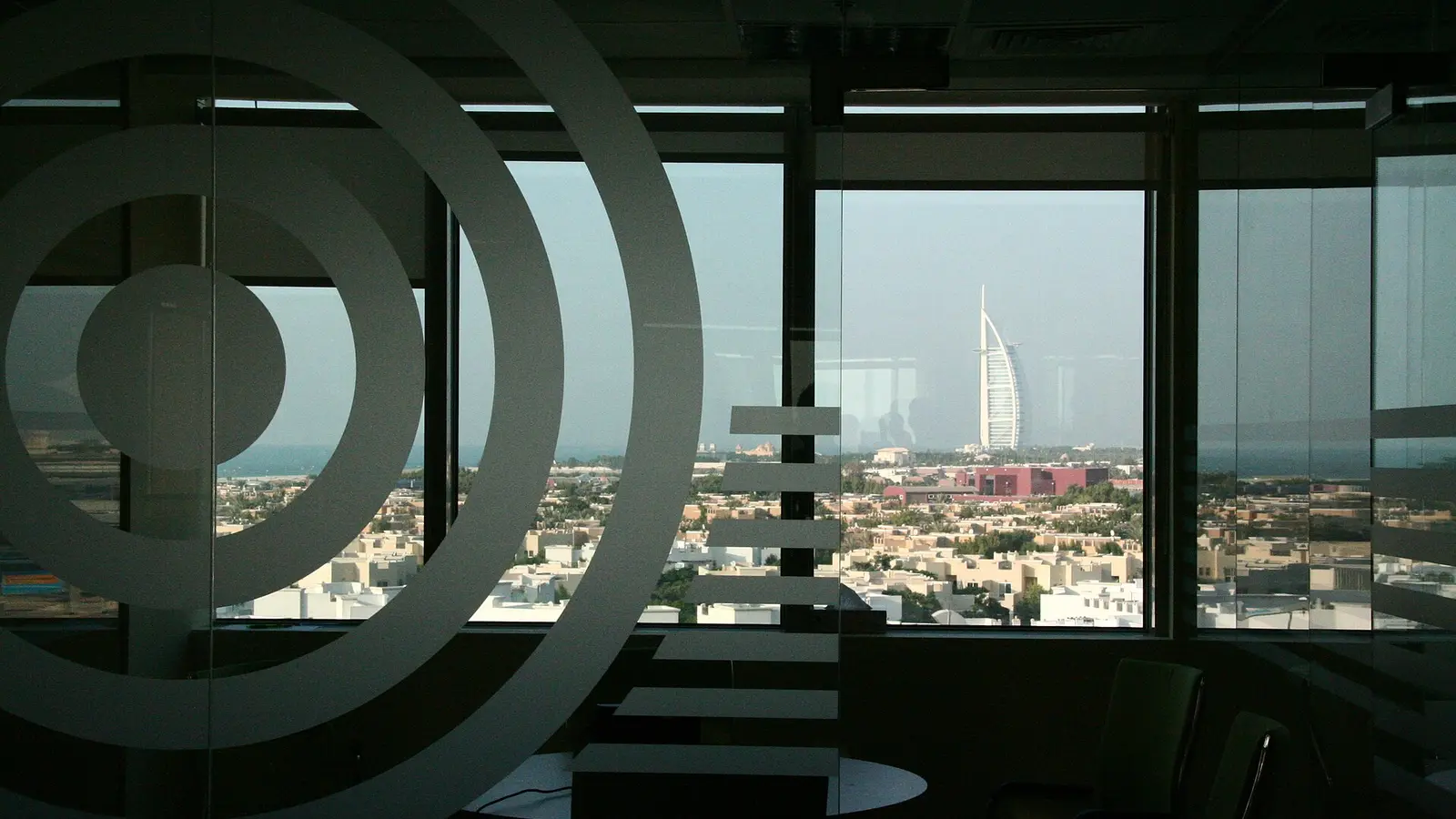
- Tecnomen dubai office — Titoni Thomas, CC BY-SA 3.0.
- Dubai Internet City Sign — Nowitscorrect, CC BY-SA 4.0.
- Business professional engages in note-taking during a meeting at a modern office desk — Shixart1985, CC BY 2.0.


Cost ranges, delivery timelines and the planning arithmetic are indicative, not quotes. Licensing and data-protection points are summaries for planning; confirm current requirements with the relevant authority or a qualified adviser.